
Fasting Rules
 Meat
Allowed
 Fish
Allowed
 Dairy
Allowed
 Oil
Allowed
 Wine
Allowed
Saints & Commemorations
St Innocent, Metr. of Moscow / Holy Apostle Thomas
One of the Twelve Apostles, he was a Galilean by birth. His name means “twin.” The twentieth chapter of St John’s Gospel describes how, when he doubted the appearance of the Risen Lord, Christ appeared to him again, saying “Reach hither thy hand, and thrust it into my side; and be not faithless, but believing,” at which Thomas cried out “My Lord and my God!” Through this one event the Holy Scriptures attest that Christ is risen bodily, not merely as a spirit, as some heresies claim; and that He is in fact God. After Penteco
One of the Twelve Apostles, he was a Galilean by birth. His name means “twin.” The twentieth chapter of St John’s Gospel describes how, when he doubted the appearance of the Risen Lord, Christ appeared to him again, saying “Reach hither thy hand, and thrust it into my side; and be not faithless, but believing,” at which Thomas cried out “My Lord and my God!” Through this one event the Holy Scriptures attest that Christ is risen bodily, not merely as a spirit, as some heresies claim; and that He is in fact God. After Pentecost, St Thomas proclaimed the Gospel in the East, and established the Christian faith as far as India, where the small remnant of the ancient Church still traces its foundation to him. According to some accounts he met a martyr’s end; according to others, he reposed in peace. St John Chrysostom mentions that his tomb was in Edessa in Syria; his relics may have been translated there from India in the fourth century.
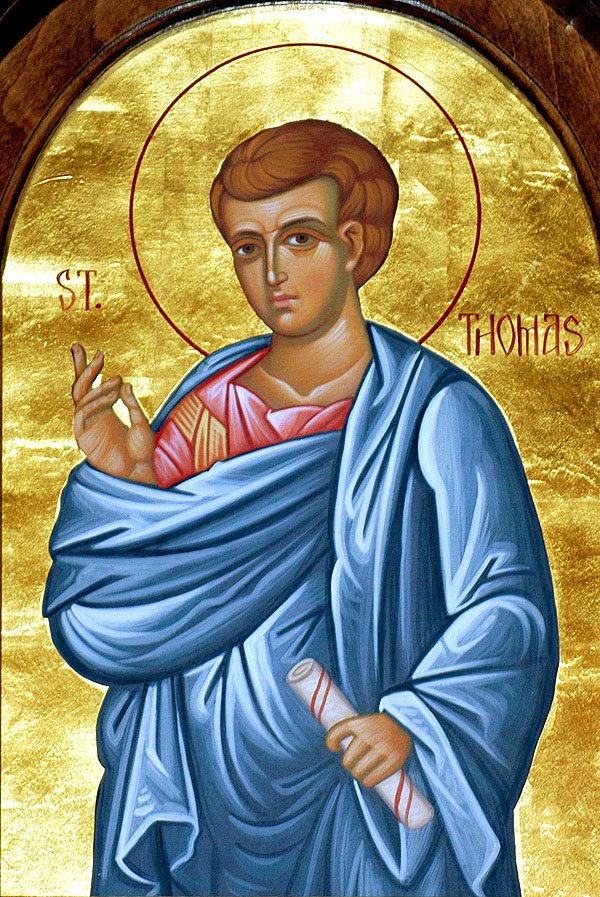
Holy Apostle Thomas
The Holy and Glorious Apostle Thomas was born in the Galilean city of Pansada and was a fisherman. Hearing the good tidings of Jesus Christ, he left all and followed after Him. The Apostle Thomas is included in the number of the holy Twelve Apostles of the Savior.
According to Holy Scripture, the holy Apostle Thomas did not believe the reports of the other disciples about the Resurrection of Jesus Christ: “Unless I see in His hands the print of the nails, and put my finger into the print of the nails, and thrust my hand into His side, I will not believe” (John 20:25).
On
The Holy and Glorious Apostle Thomas was born in the Galilean city of Pansada and was a fisherman. Hearing the good tidings of Jesus Christ, he left all and followed after Him. The Apostle Thomas is included in the number of the holy Twelve Apostles of the Savior.
According to Holy Scripture, the holy Apostle Thomas did not believe the reports of the other disciples about the Resurrection of Jesus Christ: “Unless I see in His hands the print of the nails, and put my finger into the print of the nails, and thrust my hand into His side, I will not believe” (John 20:25).
On the eighth day after the Resurrection, the Lord appeared to the Apostle Thomas and showed him His wounds. “My Lord and my God,” the Apostle cried out (John 20:28). “Thomas, being once weaker in faith than the other apostles,” says Saint John Chrysostom, “toiled through the grace of God more bravely, more zealously and tirelessly than them all, so that he went preaching over nearly all the earth, not fearing to proclaim the Word of God to savage nations.”
Some icons depicting this event are inscribed “The Doubting Thomas.” This is incorrect. In Greek, the inscription reads, “The Touching of Thomas.” In Slavonic, it says, “The Belief of Thomas.” When Saint Thomas touched the Life-giving side of the Lord, he no longer had any doubts.
According to Church Tradition, the holy Apostle Thomas founded Christian churches in Palestine, Mesopotamia, Parthia, Ethiopia and India. Preaching the Gospel earned him a martyr’s death. For having converted the wife and son of the prefect of the Indian city of Meliapur [Melipur], the holy apostle was locked up in prison, suffered torture, and finally, pierced with five spears, he departed to the Lord. Part of the relics of the holy Apostle Thomas are in India, in Hungary and on Mt. Athos. The name of the Apostle Thomas is associated with the Arabian (or Arapet) Icon of the Mother of God (September 6).
Troparion - Tone 2
You were a disciple of Christ, / and a member of the divine college of Apostles. / Having been weak in faith you doubted the Resurrection of Christ, / but by feeling the wounds you believed in His all-pure Passion: / pray now to Him, O all-praised Thomas, to grant us peace and great mercy.
Kontakion - Tone 4
Thomas, the faithful servant and disciple of Christ, / filled with divine grace, cried out from the depth of his love: / “You are my Lord and my God!”
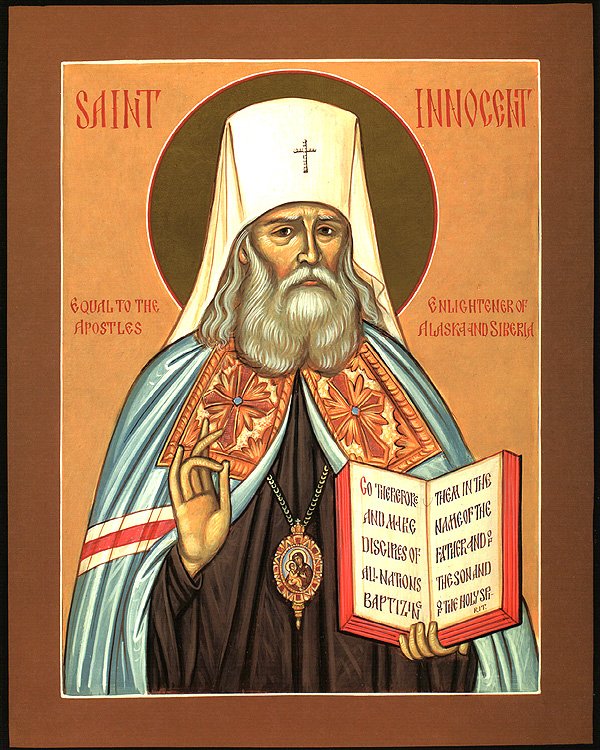
Repose of St Innocent, Enlightener of Alaska and Siberia, Metropolitan of Moscow (1879)
Saint Innocent, Metropolitan of Moscow, Enlightener of the Aleuts and Apostle to America (in the world John Popov-Veniaminov), was born on August 26, 1797 in the village of Anginsk in the Irkutsk diocese, into the family of a sacristan. The boy mastered his studies at an early age and by age seven, he was reading the Epistle in church.
Saint Innocent, Metropolitan of Moscow, Enlightener of the Aleuts and Apostle to America (in the world John Popov-Veniaminov), was born on August 26, 1797 in the village of Anginsk in the Irkutsk diocese, into the family of a sacristan. The boy mastered his studies at an early age and by age seven, he was reading the Epistle in church. In 1806 they sent him to the Irkutsk seminary. In 1814, the new rector thought it proper to change the surnames of some of the students. John Popov received the surname Veniaminov in honor of the deceased Archbishop Benjamin of Irkutsk (+ July 8, 1814). On May 13, 1817 he was ordained deacon for the Irkutsk Annunciation church, and on May 18, 1821, he was ordained priest.
The missionary service of the future Apostle of America and Siberia began with the year 1823. Father John spent 45 years laboring for the enlightenment of the peoples of Kamchatka, the Aleutian Islands, North America, Yakutsk, the Khabarov frontier, performing his apostolic exploit in severe conditions and at great risks to life. Saint Innocent baptized ten thousand people, and built churches, beside which he founded schools and he himself taught the fundamentals of the Christian life. His knowledge of various crafts and arts aided him in his work.
Father John was a remarkable preacher. During the celebration of the Liturgy, memorial services and the all-night Vigil, he incessantly guided his flock. During his time of endless travels, Father John studied the languages, customs and habits of the peoples, among whom he preached. His work in geography, ethnography and linguistics received worldwide acclaim. He composed an alphabet and grammar for the Aleut language and translated the Catechism, the Gospel and many prayers into that language. One of the finest of his works was the Indication of the Way into the Kingdom of Heaven (1833), translated into the various languages of the peoples of Siberia and appearing in more than 40 editions. Thanks to the toil of Father John, the Yakut people in 1859 first heard the Word of God and divine services in their own native language.
On November 29, 1840, after the death of his wife, Father John was tonsured a monk with the name Innocent by Saint Philaret, the Metropolitan of Moscow, in honor of Saint Innocent of Irkutsk. On December 15, Archimandrite Innocent was consecrated Bishop of Kamchatka, the Kurile and Aleutian Islands. On April 21, 1850 Bishop Innocent was elevated to the rank of archbishop.
By the Providence of God on January 5, 1868, Saint Innocent succeeded Metropolitan Philaret on the Moscow cathedra. Through the Holy Synod, Metropolitan Innocent consolidated the secular missionary efforts of the Russian Church (already in 1839 he had proposed a project for improving the organization of missionary service).
Under the care of Metropolitan Innocent a Missionary Society was created, and the Protection monastery was reorganized for missionary work. In 1870 the Japanese Orthodox Spiritual Mission headed by Archimandrite Nicholas Kasatkin [afterwards Saint Nicholas of Japan, (February 3)] was set up, with whom Saint Innocent had shared much of his own spiritual experience. The guidance by Saint Innocent of the Moscow diocese was also fruitful, by his efforts, the church of the Protection of the Most Holy Theotokos was built up into the Moscow Spiritual Academy.
Saint Innocent fell asleep in the Lord on March 31, 1879, on Holy Saturday, and was buried at the Holy Spirit Church of the Trinity-Saint Sergius Lavra. On October 6, 1977, Saint Innocent was glorified by the Russian Orthodox Church. His memory is celebrated three times during the year: on March 31, the day of his blessed repose, on October 5 (Synaxis of the Moscow Hierarchs), and on October 6, the day of his glorification.
Troparion - Tone 4
O Holy Father Innocent / in obedience to the will of God / you accepted dangers and tribulations / bringing many peoples to the knowledge of truth. / You showed us the way, / now by your prayers help lead us into the Kingdom of Heaven.
Kontakion - Tone 2
You evangelized the northern people of America and Asia, / proclaiming the Gospel of Christ to the natives in their own tongues. / Holy Hierarch Father Innocent, / enlightener of Alaska and all America, / your ways were ordered by the Lord! / Pray to Him for the salvation of our souls in His heavenly Kingdom!
Scripture Readings
☩Epistle
Philippians 1:8-14
8
For God is my record, how greatly I long after you all in the bowels of Jesus Christ.
9
And this I pray, that your love may abound yet more and more in knowledge and in all judgment;
10
That ye may approve things that are excellent; that ye may be sincere and without offence till the day of Christ;
11
Being filled with the fruits of righteousness, which are by Jesus Christ, unto the glory and praise of God.
12
But I would ye should understand, brethren, that the things which happened unto me have fallen out rather unto the furtherance of the gospel;
13
So that my bonds in Christ are manifest in all the palace, and in all other places;
14
And many of the brethren in the Lord, waxing confident by my bonds, are much more bold to speak the word without fear.
☩Gospel
Luke 6:37-45
37
Judge not, and ye shall not be judged: condemn not, and ye shall not be condemned: forgive, and ye shall be forgiven:
38
Give, and it shall be given unto you; good measure, pressed down, and shaken together, and running over, shall men give into your bosom. For with the same measure that ye mete withal it shall be measured to you again.
39
And he spake a parable unto them, Can the blind lead the blind? shall they not both fall into the ditch?
40
The disciple is not above his master: but every one that is perfect shall be as his master.
41
And why beholdest thou the mote that is in thy brother’s eye, but perceivest not the beam that is in thine own eye?
42
Either how canst thou say to thy brother, Brother, let me pull out the mote that is in thine eye, when thou thyself beholdest not the beam that is in thine own eye? Thou hypocrite, cast out first the beam out of thine own eye, and then shalt thou see clearly to pull out the mote that is in thy brother’s eye.
43
For a good tree bringeth not forth corrupt fruit; neither doth a corrupt tree bring forth good fruit.
44
For every tree is known by his own fruit. For of thorns men do not gather figs, nor of a bramble bush gather they grapes.
45
A good man out of the good treasure of his heart bringeth forth that which is good; and an evil man out of the evil treasure of his heart bringeth forth that which is evil: for of the abundance of the heart his mouth speaketh.
Liturgical data sourced from OCA.org and orthocal.info