
Fasting Rules
 Meat
Abstain
 Fish
Abstain
 Dairy
Abstain
 Oil
Abstain
 Wine
Abstain
Saints & Commemorations
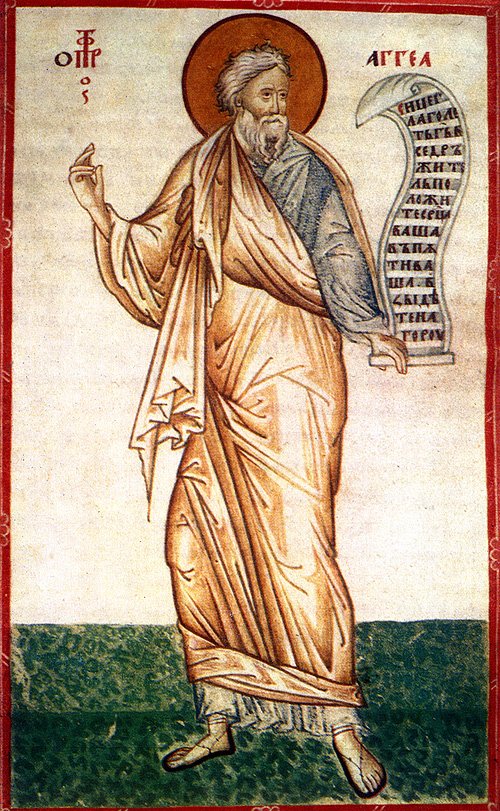
Prophet Haggai
The Holy Prophet Haggai was the tenth of the Twelve Minor Prophets. He was of the Tribe of Levi and he prophesied during the times of the Persian emperor Darius Hystaspis (prior to 500 B.C.). Upon the return of the Jews from the Babylonian Captivity, he persuaded the people to build the Second Temple at Jerusalem, and he proclaimed that the Messiah would appear in this Temple in the last times.
The Holy Prophet Haggai was the tenth of the Twelve Minor Prophets. He was of the Tribe of Levi and he prophesied during the times of the Persian emperor Darius Hystaspis (prior to 500 B.C.). Upon the return of the Jews from the Babylonian Captivity, he persuaded the people to build the Second Temple at Jerusalem, and he proclaimed that the Messiah would appear in this Temple in the last times.
It is believed that Haggai was buried with the priests at Jerusalem, since he was descended from Aaron.
Troparion - Tone 2
We celebrate the memory / of Your prophet Haggai, O Lord; / through him we entreat You, / save our souls.
Kontakion - Tone 4
Enlightened by the Spirit, your pure heart became the dwelling place of most splendid prophecy; / for you saw things far off as if they were near. / Therefore, we honor you, blessed and glorious Prophet Haggai.
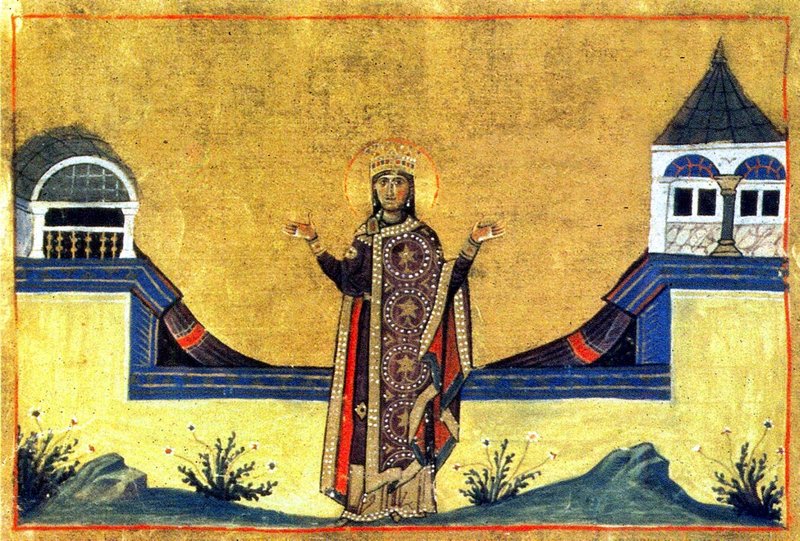
Holy Empress and Wonderworker Theophano (893)
Saint Theophanó was a pious and virtuous Empress, who was greatly praised by the chroniclers of her time because of her evangelical life, her almsgiving, and her exceptional piety. She born in Constantinople, the daughter of Constantine Martinakios and his wife Anna, who raised their daughter with diligence.
Saint Theophanó was a pious and virtuous Empress, who was greatly praised by the chroniclers of her time because of her evangelical life, her almsgiving, and her exceptional piety. She born in Constantinople, the daughter of Constantine Martinakios and his wife Anna, who raised their daughter with diligence. When she was of a marriageable age, Emperor Basil the Macedonian chose her to be the wife of his son Leo the Wise (886 - 912), with whom she dwelt in marital fidelity for twelve years.
The Holy Empress Theophanó and her husband Leo were imprisoned for three years, because Leo was falsely accused of plotting to assassinate his father, Emperor Basil. After obtaining her freedom,Theophanó spent her life in prayer and fasting, earnestly struggling for her salvation. She was recognized as a Saint and a wonderworker, even during her lifetime, because of the many good works which she performed out of love for her neighbor.
Though she lived in the world, she renounced everything worldly, and became a benefactor of the poor. She also built churches and monasteries, or restored those in need of repair. She was a true mother to her subjects, caring for widows and orphans, and consoling the sorrowful.
Despite all the grandeur and wealth surrounding her, she preserved her customary humility and modesty. She preferred to dress in simple clothing so that she would not recognized. Accompanied by two trusted servants, she would visit the homes of the poor and the persecuted, offering her assistance. Her faith was such that she was found worthy of the gift of performing miracles. When medical science gave up on a patient because it could not heal him, Saint Theophanó restored him to health. In spite of all the bitterness she had experienced in her life, Saint Theophanó could still sing praises to the Lord, according to the words of the Prophet King David: "Sing praises to the Lord, sing praises; sing praises to our King, sing praises" (Psalm 46/47:6).
Saint Theophanó reposed circa 893-894. Even before her death, her husband started to build a church, intending to dedicate it to Theophanó, but she forbade him to do so. It was Emperor Leo who decreed that the Sunday after Pentecost be dedicated to All Saints. Believing his wife to be one of the righteous, he knew that she would also be honored whenever the Feast of All Saints was celebrated.
The incorrupt relics of Saint Theophanó are preserved in the Patriarchal Church of Saint George, at the Phanar in Constantinople. A particle from her relics is in Dionysiou Monastery on Mount Athos.
Troparion - Tone 4
Preferring heavenly things to the earthly, O Theophanó, / while on earth you lived an angelic life; / therefore, you were found worthy of heavenly gifts. / As you stand before the King of all with the Angelic hosts, / and the choirs of the Saints, entreat Him to grant us mercy.
Kontakion - Tone 4
Celebrating your most radiant Feast today, O Theophanó, / we cry aloud to you most devoutly: / “Preserve your servants, who sing to you, from all dangers.”
Scripture Readings
☩Epistle
Hebrews 5:11-6:8
11
Of whom we have many things to say, and hard to be uttered, seeing ye are dull of hearing.
12
For when for the time ye ought to be teachers, ye have need that one teach you again which be the first principles of the oracles of God; and are become such as have need of milk, and not of strong meat.
13
For every one that useth milk is unskilful in the word of righteousness: for he is a babe.
14
But strong meat belongeth to them that are of full age, even those who by reason of use have their senses exercised to discern both good and evil.
1
Therefore leaving the principles of the doctrine of Christ, let us go on unto perfection; not laying again the foundation of repentance from dead works, and of faith toward God,
2
Of the doctrine of baptisms, and of laying on of hands, and of resurrection of the dead, and of eternal judgment.
3
And this will we do, if God permit.
4
For it is impossible for those who were once enlightened, and have tasted of the heavenly gift, and were made partakers of the Holy Ghost,
5
And have tasted the good word of God, and the powers of the world to come,
6
If they shall fall away, to renew them again unto repentance; seeing they crucify to themselves the Son of God afresh, and put him to an open shame.
7
For the earth which drinketh in the rain that cometh oft upon it, and bringeth forth herbs meet for them by whom it is dressed, receiveth blessing from God:
8
But that which beareth thorns and briers is rejected, and is nigh unto cursing; whose end is to be burned.
☩Gospel
Mark 8:30-34
30
And he charged them that they should tell no man of him.
31
And he began to teach them, that the Son of man must suffer many things, and be rejected of the elders, and of the chief priests, and scribes, and be killed, and after three days rise again.
32
And he spake that saying openly. And Peter took him, and began to rebuke him.
33
But when he had turned about and looked on his disciples, he rebuked Peter, saying, Get thee behind me, Satan: for thou savourest not the things that be of God, but the things that be of men.
34
And when he had called the people unto him with his disciples also, he said unto them, Whosoever will come after me, let him deny himself, and take up his cross, and follow me.
Liturgical data sourced from OCA.org and orthocal.info