
Fasting Rules
 Meat
Abstain
 Fish
Abstain
 Dairy
Abstain
 Oil
Allowed
 Wine
Allowed
Saints & Commemorations
Forefeast of Nativity
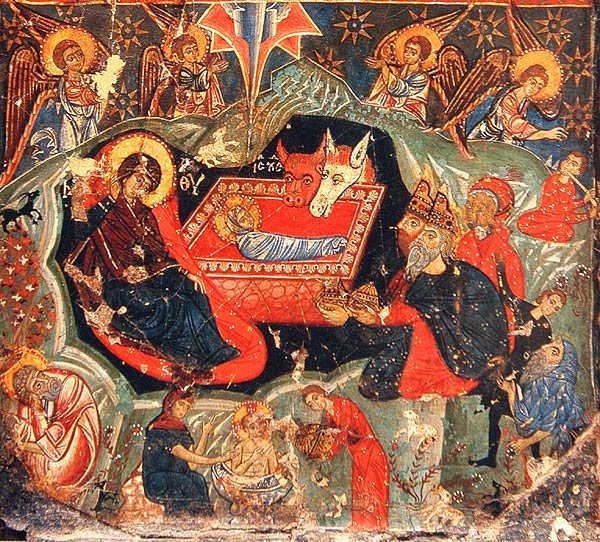
The Forefeast of the Nativity of the Lord begins on December 20. From now on, most of the liturgical hymns will be concerned with the birth of the Savior. Many of the Church’s hymns of this period are slightly modified versions of the hymns of Holy Week.
From December 20-23 we sing the Troparion (Tone 4) “Prepare, O Bethlehem, for Eden has been opened to all. Ado
The Forefeast of the Nativity of the Lord begins on December 20. From now on, most of the liturgical hymns will be concerned with the birth of the Savior. Many of the Church’s hymns of this period are slightly modified versions of the hymns of Holy Week.
From December 20-23 we sing the Troparion (Tone 4) “Prepare, O Bethlehem, for Eden has been opened to all. Adorn yourself, O Ephratha, for the Tree of Life blossoms forth from the Virgin in the cave. Her womb is a spiritual paradise planted with the Divine Fruit; if we eat of it we shall live forever and not die like Adam. Christ comes to restore the image which He made in the beginning.”
We also sing the Kontakion (Tone 3) “Today the Virgin comes to the cave to give birth ineffably to the pre-eternal Word. Hearing this, rejoice, O inhabited earth! With the angels and the shepherds glorify the pre-eternal God, Whose will it was to appear as a young child!
Troparion - Tone 4
Prepare, O Bethlehem, for Eden has been opened to all! / Adorn yourself, O Ephratha, for the Tree of Life blossoms forth from the Virgin in the cave! / Her womb is a spiritual paradise planted with the Divine Fruit; / if we eat of it, we shall live forever and not die like Adam. / Christ is born to raise up again what fell in former times, His image.
Kontakion - Tone 3
Today the Virgin comes to the cave / to give birth ineffably to the pre-eternal Word. / Hearing this, rejoice, O inhabited earth! / With the angels and the shepherds glorify / the pre-eternal God, Whose will it was to appear as a young child!
Hieromartyr Ignatius the Godbearer
There is a tradition that it was the young boy Ignatius whom Christ took upon his knee to explain to His followers that they must become as children to enter the Kingdom. He knew the holy Apostles personally and, with St Polycarp (February 25) was a disciple of St John the Evangelist. He succeeded Evodus as second Bishop of Antioch, the capital of Syria and at that time one of the largest cities in the world.
There is a tradition that it was the young boy Ignatius whom Christ took upon his knee to explain to His followers that they must become as children to enter the Kingdom. He knew the holy Apostles personally and, with St Polycarp (February 25) was a disciple of St John the Evangelist. He succeeded Evodus as second Bishop of Antioch, the capital of Syria and at that time one of the largest cities in the world. Here, during the persecutions of Domitian, he strengthened the faithful, brought many pagans to Christ, and prayed that he himself would be granted the crown of martyrdom. His flock called him the Godbearer, a title that he did not refuse, for he said that all Christians after their Baptism are truly Bearers of Christ, clothed in the Holy Spirit.
When peace was restored to the Church for awhile, the holy Bishop devoted himself to organizing the young Church on strong foundations at a time when the last of the Apostles had only recently passed away. He established the principle that the Grace imparted to the Apostles at Pentecost was handed down to the bishops appointed by them, and so on through the generations: the Apostolic Succession.
The Emperor Trajan, passing through Syria to make war in Armenia, spent some time in Antioch and initiated a persecution of Christians. Rejoicing that the time of martyrdom had at last arrived, Ignatius presented himself before the Emperor and eloquently declared his faith in Christ.
“So you are a disciple of the one crucified under Pontius Pilate?” asked the Emperor.
“I am the disciple of Him who has nailed my sin to the Cross, and has trodden the Devil and his devices underfoot.”
“Why do you call yourself the Godbearer?”
“Because I carry the living Christ within me!”
“Therefore, let the bearer of the Crucified One be taken in chains to Rome, there to be fed to the lions for the amusement of the people.”
And so it was. During the long and difficult journey to Rome, cruelly mistreated by his guards, the Saint wrote a series of letters to the young churches which remain one of the treasures of the Church. In Smyrna, he was able to meet with his fellow-disciple Polycarp and entrust to him the care of the churches whose shepherd he had been. As Trajan had ordered, in Rome he was taken to the amphitheater and, as the Synaxarion says, “entered the arena as though approaching the holy altar to serve his last Liturgy in the presence of the faithful, who were crowded among pagans on the steps of the amphitheatre.” In a few moments he was completely devoured by the lions, save for a few bones. These were gathered by the faithful and returned to Antioch.
In his Letter to the Romans, the holy Bishop wrote to some who wished to rescue him from his martyrdom: “I am the wheat of God, and am ground by the teeth of the wild beasts, that I may be found to be the pure bread of God.”
Repose of Our Holy Father John of Kronstadt (1908)
His main commemoration is on October 19.
Sunday before Nativity
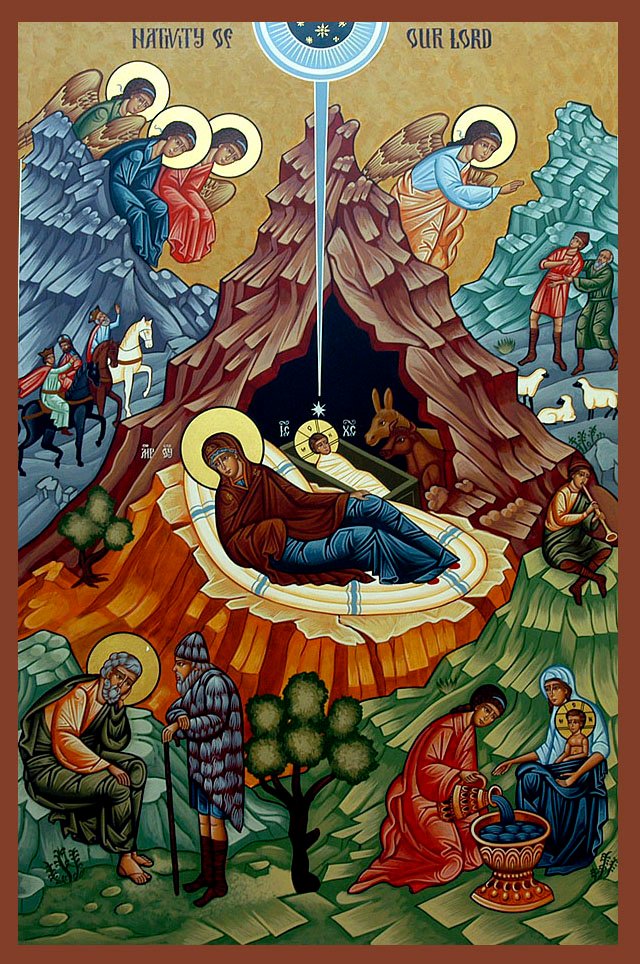
The Sunday before the Nativity of Christ we commemorate Adam and Eve (the first-created), the righteous Abel, son of Adam, the righteous Seth, son of Adam, the righteous Enos, son of Seth, the righteous Kenan, son of Enos, the righteous Mehaliel (Maleleim), son of Kenan, the righteous Jared, son of Mehaliel, the righteous Enoch, son of Jared, the righteous Methuselah, son of Enoch, the righteous Lamech, son of Methuselah, the righteous Noah, son of Lamech, the righteous Shem, son of Noah, the righteous Japheth, son of Noah, the righteous Arphachshad, son of Shem, the righteous Canaan, son of Arphachshad (in some versions of the OT, Canaan is called the son of Ham), the righteous Shelah, son of Canaan (some versions of the OT call Shelah the son of Arphachshad), the righteous Eber (from whom the Hebrews take their name), son of Shelah, the righteous Peleg, son of Eber, the righteous Ragab (Reu), son of Peleg, the righteous Serug, son of Ragab, the righteous Nahor, son of Serug, the righteous Terah, son of Serug.
The Sunday before the Nativity of Christ we commemorate Adam and Eve (the first-created), the righteous Abel, son of Adam, the righteous Seth, son of Adam, the righteous Enos, son of Seth, the righteous Kenan, son of Enos, the righteous Mehaliel (Maleleim), son of Kenan, the righteous Jared, son of Mehaliel, the righteous Enoch, son of Jared, the righteous Methuselah, son of Enoch, the righteous Lamech, son of Methuselah, the righteous Noah, son of Lamech, the righteous Shem, son of Noah, the righteous Japheth, son of Noah, the righteous Arphachshad, son of Shem, the righteous Canaan, son of Arphachshad (in some versions of the OT, Canaan is called the son of Ham), the righteous Shelah, son of Canaan (some versions of the OT call Shelah the son of Arphachshad), the righteous Eber (from whom the Hebrews take their name), son of Shelah, the righteous Peleg, son of Eber, the righteous Ragab (Reu), son of Peleg, the righteous Serug, son of Ragab, the righteous Nahor, son of Serug, the righteous Terah, son of Serug.
The holy Patriarchs: the righteous Patriarch Abraham, son of Terah, the righteous Patriarch Isaac, son of Abraham, the righteous Patriarch Jacob, son of Isaac, the righteous Patriarch Reuben, son of Jacob and Leah, the righteous Patriarch Simeon, son of Jacob and Leah, the righteous Patriarch Levi, son of Jacob and Leah, the righteous Patriarch Judah (Christ was of this tribe), the righteous Patriarch Zebulon, son of Jacob and Leah, the righteous Patriarch Issachar, son of Jacob and Leah, the righteous Patriarch Dan, son of Jacob and Bilhah (Rachel's maid), the righteous Patriarch Gad, son of Jacob and Zilpah (Leah's maid), the righteous Patriarch Asher, son of Jacob and Zilpah, the righteous Patriarch Naphthali, son of Jacob and Bilhah, the righteous Patriarch Joseph, son of Jacob and Rachel, the righteous Patriarch Benjamin, son of Jacob and Rachel.
The righteous Pharez and Zerah, twin sons of Judah, the righteous Hezron, son of Pharez, the righteous Aram, son of Hezron, the righteous Aminadab, son of Aram, the righteous Nahshon, son of Aminadab, the righteous Salmon, son of Nahshon, the righteous Boaz, son of Salmon, the righteous Obed, son of Boaz and Ruth, the righteous Jesse, son of Obed.
The holy Prophet-King David, son of Jesse, King Solomon, son of David, King Rehoboam, son of Solomon, King Abijah, son of Rehoboam, King Asa, son of Abijah, King Jehosaphat, son of Asa, King Joram (Jehoram, an evil king), son of Jehosaphat, King Ochoziah (Ahaziah), son of Joram, King Jotham, son of Uzziah (Oziah), King Ahaz (a faithless king), son of Jotham, King Hezekiah, son of Ahaz, King Manesseh, son of Hezekiah, King Amos (Ammon), son of Manesseh, King Josiah, son of Amos, King Jechoniah, son of Josiah.
Shealtiel, son of Jechoniah, Zerubbabel (who led captives back to Jerusalem, and laid the foundations of the new Temple), son of Shealtiel, Abiud, son of Zerubbabel, Eliachem, son of Abiud, Azor, son of Eliachem, Zadok, son of Azor, Achim, son of Zadok, Eliud, son of Achim, Eleazar, son of Eliud, Matthan, son of Eleazar, Jacob, son of Matthan, St Joseph the Betrothed, son of Jacob.
The righteous Melchizedek, King of Salem, the righteous Job, the holy Prophet Moses, the priests Hur and Aaron, Joshua, son of Nun.
The holy prophet Samuel, the holy prophet Nathan, the holy prophet Daniel, the three holy youths Hananiah, Mishael and Azariah.
The righteous Sarah, wife of Abraham, the righteous Rebecca, wife of Isaac, the righteous Leah, first wife of Jacob, the righteous Rachel, second wife of Jacob, the righteous Asineth, wife of Patriarch Joseph the all-comely, the righteous Miriam, sister of Moses, the righteous Deborah, Judge of Israel and prophetess, the righteous Ruth, wife of Boaz, the righteous woman of Zarephath, to whom Elias was sent (3 Kings 17), the righteous woman of Shunem, who was hospitable to Elisha (4 Kings 4), the righteous Judith, slayer of Holofernes, the righteous Esther, who delivered Israel from death, the righteous Hannah, mother of the prophet Samuel, the righteous Susanna.
Righteous Ezra was a scribe and priest who lived in Babylon (during the Captivity), and returned to Jerusalem circa 458 B. C. He collected and revised the previous Old Testament writings, and established the Old Testament Canon. His book I Esdras 1 (in the Greek Septuagint) tells the story of the return to Jerusalem.
Troparion - Tone 2
Great are the accomplishments of faith, / for the Three Holy Youths rejoiced in the source of the flame, as if by restful waters,1 / and the Prophet Daniel appeared / as a shepherd of lions as of sheep. / By their prayers, O Christ God, save our souls.
Kontakion - Tone 6
(For when the Sunday before the Nativity falls on December 18-19)
You would not worship an image made by hands, O thrice-blessed youths; / but shielded by the ineffable Essence, you were glorified through your ordeal by fire. / In the midst of the unbearable fire you called upon God, crying: / "Hasten, O compassionate One, / and in Your mercy come to our aid, / for if You will, You can do so."2
Our Righteous Father Philogonius, Bishop of Antioch
Before becoming a bishop, Saint Philogonius was a laywer who defended the poor, the widowed and the orphaned. When his wife died, he was chosen as Bishop of Antioch.
Distinguished by profound theological knowledge, Saint Philogonius successfully defended Orthodoxy against the Arian heresy and by this prevented unrest in the Church.
During the persecution against Christians under the emperors Maximian (284-305)and Licinius (311-324), Saint Philogonius proved himself a confessor of the Orthodox Faith. He died peacefully in about the year 323. Saint John Chrysostom wrote a eulogy for Saint Philogonius in 386.
Troparion - Tone 4
In truth you were revealed to your flock as a rule of faith, / an image of humility and a teacher of abstinence; / your humility exalted you; / your poverty enriched you. / Hierarch Father Philogonius, / entreat Christ our God / that our souls may be saved.
Repose of St. John of Kronstadt
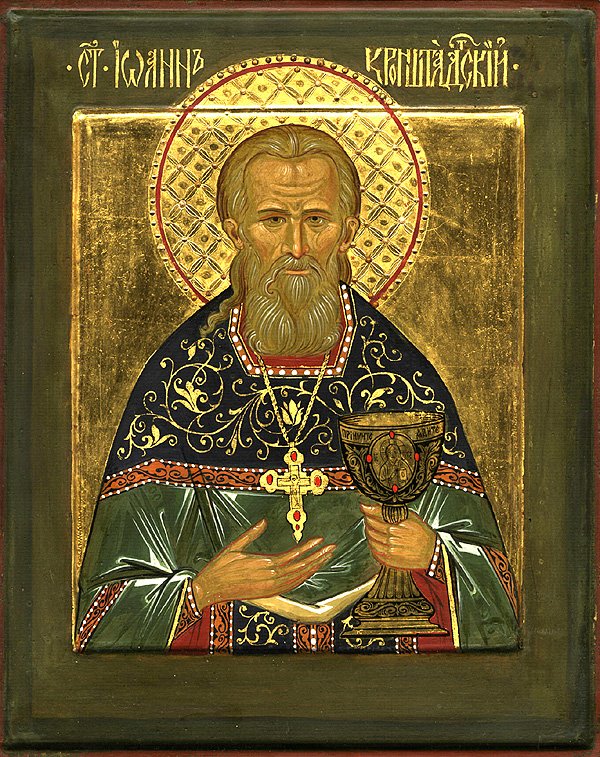
Saint John of Kronstadt was born in the village of Sura in Archangel province on October 19, 1829, and was called John in honor of Saint John of Rila (August 18). His parents were very poor but were very devoted to the Church. Even though he was poor, as a young boy John learned to feel compassion for others in their misfortune.
Saint John of Kronstadt was born in the village of Sura in Archangel province on October 19, 1829, and was called John in honor of Saint John of Rila (August 18). His parents were very poor but were very devoted to the Church. Even though he was poor, as a young boy John learned to feel compassion for others in their misfortune. His neighbors frequently asked him to pray for them, as they noticed this special grace-endowed gift in him. When John was ten, his parents were able to raise some money and send him to the local school which was attached to the church. At first, the boy had an extremely difficult time with his studies. He worked for days on end, but still failed to keep up.
Writing about his life he once recalled an evening when everyone had already gone to bed. “I could not sleep, and I still failed to understand anything I was taught. I still read poorly and could not remember anything I was told. I became so depressed I fell to my knees and began to pray. I don’t know whether I had spent a long time in that position or not, but suddenly something shook my whole being. It was as if a veil had fallen from my eyes, and my mind had been opened, and I remembered clearly my teacher of that day and his lesson. I also recalled the topic and the examples he had given. I felt so light and joyous inside.” After this experience he did so well he became one of the first in his class to be chosen to go to seminary, and after seminary to the Theological Academy in Saint Petersburg (a great honor at that time).
Throughout his studies, John thought about the importance of forgiveness, meekness, and love, and came to believe that these were the very center and power of Christianity, and that only one path—the path of humble love—leads to God and the triumph of His righteousness. He also thought a great deal about the Savior’s death on the Cross at Golgotha, and pitied those who did not know Jesus Christ. He wished to preach to them about His death and Resurrection. He dreamed about becoming a missionary to distant China, but saw that there was a great deal of work for a genuine pastor of Christ’s flock both in his own city and the surrounding towns.
When John graduated from the Academy he met Elizabeth Nesvitsky who lived in the town of Kronstadt. They dated, he proposed, and they were married. After his studies, John still desired to learn more about his faith and his Church.
It was in this frame of mind that he prepared to be a priest and to enter public ministry. He was ordained a deacon on December 10, 1855, and then priest on December 12. He was assigned to Saint Andrew’s Cathedral in the city of Kronstadt. He said, “I made myself a rule to be as sincere as possible in my work, and of strictly watching myself and my inner life.”
Father John wanted most of all to earn the love of the people in his care, because only a loving attitude could provide the firm support and help he needed as he faced the difficult work of the priesthood. His constant thought was how he would come before the Last Judgment and have to give an account, not only for his own deeds, but also the deeds of his flock, for whose education and salvation he was responsible. To him no one was a stranger; everyone who came to him for help became a friend and relative. He would tell people “The Church is the best heavenly friend of every sincere Christian.” He conducted divine services daily and offered the prayers of the faithful. He called all who rarely receive Holy Communion to prepare themselves and live their lives in a Christian way so that they could receive more often. Listening to Father John, many people changed their lifestyle, repented sincerely, and joyfully received Holy Communion on a regular basis.
At that time the government exiled murderers, thieves and other criminals to Kronstadt. Life was horrible for the exiles. Even children of exiles would become thieves and criminals. He would go to their dugouts, hovels and shacks to visit with them. Not satisfied with staying for five or ten minutes to administer some rite and then leave, Father John believed he was coming to visit a priceless soul, his brothers and sisters. He would stay for hours, talking, encouraging, comforting, crying, and rejoicing together with them.
From the beginning he also concerned himself with the material needs of the poor. He would shop for food, go to the pharmacy for prescriptions, to the doctor for help, many times giving the poor his last few coins. The inhabitants of Kronstadt would see him returning home barefoot and without his cassock. Often parishioners would bring shoes to his wife, saying to her, “Your husband has given away his shoes to someone, and will come home barefoot.” He would also write articles for the newspaper exhorting the people of Kronstadt to “support the poor morally and materially.” These appeals touched the hearts of many and Father John organized many charitable efforts. Realizing that his individual charity was insufficient for aiding the needy, he founded the Orthodox Christian House Parish Trusteeship of Saint Andrew the First-Called. This brotherhood coordinated many charitable efforts throughout the city and helped many needy people.
In 1857, he began teaching in the local city schools. He would tell people, “If children cannot listen to the Gospel, it is only because it is taught like any other subject, with boredom and indifference. Such teaching defeats the purpose of the Gospel. It fails because it forces students only to read words and memorize them instead of making them live in their lives.” To Father John there were no incapable students. He taught in such a way that poor pupils as well as good ones were able to understand. His attention was aimed not so much at forcing students to memorize as to fill their souls with the joy of living according to Christian values, sharing with them the holy thoughts which filled his soul.
When speaking to other priests about their vocation he would say, “You are a representative of the faith of the Church, O priest; you are a representative of Christ the Lord Himself. You should be a model of meekness, purity, courage, perseverance, patience, and lofty spirit. You are doing the work of God and must not let anything discourage you.”
Saint John has performed more miracles than almost any other saint, with the possible exception of Saint Nicholas. Through his prayers he healed the sick, gave hope to the hopeless, and brought sinners to repentance.
Father John labored endlessly in his work for the Lord preaching, teaching, and helping those in need. Having spent his entire life serving God and His people, Father John fell ill and died on December 20, 1908. Almost immediately, people from near and far began to make pilgrimages to the monastery where he was buried. Even today millions of Orthodox Christians in Russia and around the world pray to him to intercede for them as he had always done from his childhood.
Saint John was glorified by the Russian Orthodox Church on June 8, 1990.
Troparion - Tone 1
As a zealous advocate of the Orthodox faith, / as a caring Solicitor for the land of Russia, / faithful to the rules and image of a pastor, / preaching repentance and life in Christ, / an awesome servant and administer of God’s sacraments, / a daring intercessor for people’s sake, / O Good and righteous Father John, / healer and wonderful miracle-worker, / the praise of the town of Kronstadt / and decoration of our Church, / beseech the All-Merciful God / to reconcile the world and to save our souls!
Kontakion - Tone 3
With the apostles your message has gone out to the ends of the world, / and with the confessors you suffered for Christ! / You are like the hierarchs through your preaching of the word; / with the righteous you are radiant with the grace of God. / The Lord has exalted your humility above the heavens / and given us your name as a source of miracles. / O wonder-worker, living in Christ for ever, / have mercy on those beset by troubles; / and hear us when we cry out in faith, O our beloved shepherd John!
Scripture Readings
☩Epistle
Hebrews 11:9-10, 17-23, 32-40
9
By faith he sojourned in the land of promise, as in a strange country, dwelling in tabernacles with Isaac and Jacob, the heirs with him of the same promise:
10
For he looked for a city which hath foundations, whose builder and maker is God.
17
By faith Abraham, when he was tried, offered up Isaac: and he that had received the promises offered up his only begotten son,
18
Of whom it was said, That in Isaac shall thy seed be called:
19
Accounting that God was able to raise him up, even from the dead; from whence also he received him in a figure.
20
By faith Isaac blessed Jacob and Esau concerning things to come.
21
By faith Jacob, when he was a dying, blessed both the sons of Joseph; and worshipped, leaning upon the top of his staff.
22
By faith Joseph, when he died, made mention of the departing of the children of Israel; and gave commandment concerning his bones.
23
By faith Moses, when he was born, was hid three months of his parents, because they saw he was a proper child; and they were not afraid of the king’s commandment.
32
And what shall I more say? for the time would fail me to tell of Gedeon, and of Barak, and of Samson, and of Jephthae; of David also, and Samuel, and of the prophets:
33
Who through faith subdued kingdoms, wrought righteousness, obtained promises, stopped the mouths of lions,
34
Quenched the violence of fire, escaped the edge of the sword, out of weakness were made strong, waxed valiant in fight, turned to flight the armies of the aliens.
35
Women received their dead raised to life again: and others were tortured, not accepting deliverance; that they might obtain a better resurrection:
36
And others had trial of cruel mockings and scourgings, yea, moreover of bonds and imprisonment:
37
They were stoned, they were sawn asunder, were tempted, were slain with the sword: they wandered about in sheepskins and goatskins; being destitute, afflicted, tormented;
38
(Of whom the world was not worthy:) they wandered in deserts, and in mountains, and in dens and caves of the earth.
39
And these all, having obtained a good report through faith, received not the promise:
40
God having provided some better thing for us, that they without us should not be made perfect.
☩Gospel
Matthew 1:1-25
1
The book of the generation of Jesus Christ, the son of David, the son of Abraham.
2
Abraham begat Isaac; and Isaac begat Jacob; and Jacob begat Judas and his brethren;
3
And Judas begat Phares and Zara of Thamar; and Phares begat Esrom; and Esrom begat Aram;
4
And Aram begat Aminadab; and Aminadab begat Naasson; and Naasson begat Salmon;
5
And Salmon begat Booz of Rachab; and Booz begat Obed of Ruth; and Obed begat Jesse;
6
And Jesse begat David the king; and David the king begat Solomon of her that had been the wife of Urias;
7
And Solomon begat Roboam; and Roboam begat Abia; and Abia begat Asa;
8
And Asa begat Josaphat; and Josaphat begat Joram; and Joram begat Ozias;
9
And Ozias begat Joatham; and Joatham begat Achaz; and Achaz begat Ezekias;
10
And Ezekias begat Manasses; and Manasses begat Amon; and Amon begat Josias;
11
And Josias begat Jechonias and his brethren, about the time they were carried away to Babylon:
12
And after they were brought to Babylon, Jechonias begat Salathiel; and Salathiel begat Zorobabel;
13
And Zorobabel begat Abiud; and Abiud begat Eliakim; and Eliakim begat Azor;
14
And Azor begat Sadoc; and Sadoc begat Achim; and Achim begat Eliud;
15
And Eliud begat Eleazar; and Eleazar begat Matthan; and Matthan begat Jacob;
16
And Jacob begat Joseph the husband of Mary, of whom was born Jesus, who is called Christ.
17
So all the generations from Abraham to David are fourteen generations; and from David until the carrying away into Babylon are fourteen generations; and from the carrying away into Babylon unto Christ are fourteen generations.
18
Now the birth of Jesus Christ was on this wise: When as his mother Mary was espoused to Joseph, before they came together, she was found with child of the Holy Ghost.
19
Then Joseph her husband, being a just man, and not willing to make her a publick example, was minded to put her away privily.
20
But while he thought on these things, behold, the angel of the Lord appeared unto him in a dream, saying, Joseph, thou son of David, fear not to take unto thee Mary thy wife: for that which is conceived in her is of the Holy Ghost.
21
And she shall bring forth a son, and thou shalt call his name JESUS: for he shall save his people from their sins.
22
Now all this was done, that it might be fulfilled which was spoken of the Lord by the prophet, saying,
23
Behold, a virgin shall be with child, and shall bring forth a son, and they shall call his name Emmanuel, which being interpreted is, God with us.
24
Then Joseph being raised from sleep did as the angel of the Lord had bidden him, and took unto him his wife:
25
And knew her not till she had brought forth her firstborn son: and he called his name JESUS.
Liturgical data sourced from OCA.org and orthocal.info