
Fasting Rules
 Meat
Allowed
 Fish
Allowed
 Dairy
Allowed
 Oil
Allowed
 Wine
Allowed
Saints & Commemorations
The Shepherds who saw the Lord
“And there were in the same country shepherds abiding in the field, keeping watch over their flock by night. And lo, the angel of the Lord came upon them, and the glory of the Lord shone round about them. And they were sore afraid. And the angel said unto them, Fear not: for, behold, I bring you good tidings of great joy, which shall be to all people. F
“And there were in the same country shepherds abiding in the field, keeping watch over their flock by night. And lo, the angel of the Lord came upon them, and the glory of the Lord shone round about them. And they were sore afraid. And the angel said unto them, Fear not: for, behold, I bring you good tidings of great joy, which shall be to all people. For unto you is born this day in the city of David a Saviour, which is Christ the Lord. And this shall be a sign unto you; Ye shall find the babe wrapped in swaddling clothes, lying in a manger. And suddenly there was with the angel a multitude of the heavenly host praising God, and saying, Glory to God in the highest, and on earth peace, good will toward men.” (Luke 2:8- 14)
The Veneration of the Magi
See Matthew ch. 2. According to the verses of the Feast and most of the Holy Fathers, the Magi were astrologers from Persia or Babylonia (The Scripture says only that they came “from the east.”) The star which they followed was no inanimate object, but one of the Angelic Powers of heaven, appointed to lead them to the Savior. Fro
See Matthew ch. 2. According to the verses of the Feast and most of the Holy Fathers, the Magi were astrologers from Persia or Babylonia (The Scripture says only that they came “from the east.”) The star which they followed was no inanimate object, but one of the Angelic Powers of heaven, appointed to lead them to the Savior. From the very beginning, the Good News of Christ was proclaimed to the nations.
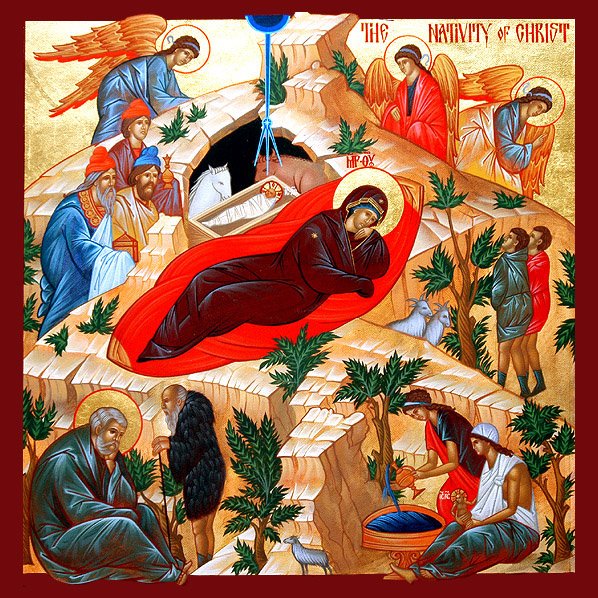
Nativity of Christ
Our Lord Jesus Christ, the Savior of the world, was born of the Most Holy Virgin Mary in the city of Bethlehem during the reign of the emperor Augustus (Octavian). Caesar Augustus decreed that a universal census be made throughout his Empire, which then also included Palestinian Israel. The Jews were accustomed to be counted in the city from where their family came.
Our Lord Jesus Christ, the Savior of the world, was born of the Most Holy Virgin Mary in the city of Bethlehem during the reign of the emperor Augustus (Octavian). Caesar Augustus decreed that a universal census be made throughout his Empire, which then also included Palestinian Israel. The Jews were accustomed to be counted in the city from where their family came. The Most Holy Virgin and the Righteous Joseph, since they were descended from the house and lineage of King David, had to go to Bethlehem to be counted and taxed.
In Bethlehem they found no room at any of the city’s inns. Thus, the God-Man, the Savior of the world, was born in a cave that was used as a stable.
“I behold a strange and most glorious mystery,” the Church sings with awe, “Heaven, a Cave; the Virgin the Throne of the Cherubim; the Manger a room, in which Christ, the God Whom nothing can contain is laid.” (Irmos of the 9th Ode of the Nativity Canon).
Having given birth to the divine Infant without travail, the Most Holy Virgin “wrapped Him in swaddling clothes, and laid Him in a manger” (Luke 2:7). In the stillness of midnight (Wisdom of Solomon 18:14-15), the proclamation of the birth of the Savior of the world was heard by three shepherds watching their flocks by night.
An angel of the Lord (Saint Cyprian says this was Gabriel) came before them and said: “Fear not: for behold, I bring you good tidings of great joy, which shall be to all people. For unto you is born this day in the city of David a Savior, Who is Christ the Lord” (Luke 2:10-11). The humble shepherds were the first to offer worship to Him Who condescended to assume the form of a humble servant for the salvation of mankind. Besides the glad tidings to the Bethlehem shepherds, the Nativity of Christ was revealed to the Magi by a wondrous star. Saint John Chrysostom and Saint Theophylactus, commenting on Saint Matthew’s Gospel, say that this was no ordinary star. Rather, it was “a divine and angelic power that appeared in the form of a star.” Saint Demetrius of Rostov says it was a “manifestation of divine energy” (Narrative of the Adoration of the Magi). Entering the house where the Infant lay, the Magi “fell down, and worshipped Him: and when they had opened their treasures, they presented Him gifts: gold, and frankincense, and myrrh” (Mt. 2:11).
The present Feast, commemorating the Nativity in the flesh of our Lord Jesus Christ, was established by the Church. Its origin goes back to the time of the Apostles. In the Apostolic Constitutions (Section 3, 13) it says, “Brethren, observe the feastdays; and first of all the Birth of Christ, which you are to celebrate on the twenty-fifth day of the ninth month.” In another place it also says, “Celebrate the day of the Nativity of Christ, on which unseen grace is given man by the birth of the Word of God from the Virgin Mary for the salvation of the world.”
In the second century Saint Clement of Alexandria also indicates that the day of the Nativity of Christ is December 25. In the third century Saint Hippolytus of Rome mentions the Feast of the Nativity of Christ, and appoints the Gospel readings for this day from the opening chapters of Saint Matthew.
In 302, during the persecution of Christians by Maximian, 20,000 Christians of Nicomedia (December 28) were burned in church on the very Feast of the Nativity of Christ. In that same century, after the persecution when the Church had received freedom of religion and had become the official religion in the Roman Empire, we find the Feast of the Nativity of Christ observed throughout the entire Church. There is evidence of this in the works of Saint Ephraim the Syrian, Saint Basil the Great, Saint Gregory the Theologian, Saint Gregory of Nyssa, Saint Ambrose of Milan, Saint John Chrysostom and other Fathers of the Church of the fourth century.
Saint John Chrysostom, in a sermon which he gave in the year 385, points out that the Feast of the Nativity of Christ is ancient, and indeed very ancient. In this same century, at the Cave of Bethlehem, made famous by the Birth of Jesus Christ, the empress Saint Helen built a church, which her mighty son Constantine adorned after her death. In the Codex of the emperor Theodosius from 438, and of the emperor Justinian in 535, the universal celebration of the day of the Nativity of Christ was decreed by law. Thus, Nikēphóros Callistus, a writer of the fourteenth century, says in his History that in the sixth century, the emperor Justinian established the celebration of the Nativity of Christ throughout all the world.
Patriarch Anatolius of Constantinople in the fifth century, Sophronius and Andrew of Jerusalem in the seventh, Saints John of Damascus, Cosmas of Maium and Patriarch Germanus of Constantinople in the eighth, the Nun Cassiane in the ninth, and others whose names are unknown, wrote many sacred hymns for the Feast of the Nativity of Christ, which are still sung by the Church on this radiant festival.
During the first three centuries, in the Churches of Jerusalem, Antioch, Alexandria and Cyprus, the Nativity of Christ was combined together with the Feast of His Baptism on January 6, and called “Theophany” (“Manifestation of God”). This was because of a belief that Christ was baptized on anniversary of His birth, which may be inferred from Saint John Chrysostom’s sermon on the Nativity of Christ: “it is not the day on which Christ was born which is called Theophany, but rather that day on which He was baptized.”
In support of such a view, it is possible to cite the words of the Evangelist Luke who says that “Jesus began to be about thirty years of age” (Luke 3:23) when He was baptized. The joint celebration of the Nativity of Christ and His Theophany continued to the end of the fourth century in certain Eastern Churches, and until the fifth or sixth century in others.
The present order of services preserves the memory of the ancient joint celebration of the Feasts of the Nativity of Christ and Theophany. On the eve of both Feasts, there is a similar tradition that one should fast until the stars appear. The order of divine services on the eve of both feastdays and the feastdays themselves is the same.
The Nativity of Christ has long been counted as one of the Twelve Great Feasts. It is one of the greatest, most joyful and wondrous events in the history of the world. “The angel said to the shepherds, ‘Behold, I bring you good tidings of great joy, which shall be to all people. For unto you is born this day in the city of David a Savior, Who is Christ the Lord. And this shall be a sign unto you: you shall find the babe wrapped in swaddling clothes, lying in a manger.’ Then suddenly there was with the angel a multitude of the heavenly hosts, glorifying God and saying: ‘Glory to God in the Highest, and on earth peace, good will toward men.’ Those who heard these things were astonished at what the shepherds told them concerning the Child. And the shepherds returned, glorifying and praising God for all the things that they had heard and seen” (Luke 2:10-20).
Thus the Nativity of Christ, a most profound and extraordinary event, was accompanied by the wondrous tidings proclaimed to the shepherds and to the Magi. This is a cause of universal rejoicing for all mankind, “for the Savior is Born!”
Concurring with the witness of the Gospel, the Fathers of the Church, in their God-inspired writings, describe the Feast of the Nativity of Christ as most profound, and joyous, serving as the basis and foundation for all the other Feasts.
See also: Discourse on the Nativity of Christ by Saint Gregory Thaumatourgos, Bishop of Neocaesarea.
Troparion - Tone 4
Your Nativity, O Christ our God, / has shone to the world the Light of knowledge; / for by it, those who worshipped the stars / were taught by a star to adore You, / the Sun of Righteousness,1 / and to know You, the Dayspring2 from on High. / O Lord, glory to You!
Kontakion - Tone 3
(Original Melody)
Today the Virgin gives birth to the Transcendent One, / and the earth offers a cave to the Unapproachable One! / Angels with shepherds glorify Him. / The wise men journey with a star, / since for our sake the Pre-Eternal God was born as a young Child.31 Malachi 4:2.
2 The beginning of day, dawn.
3 Literally: Since for our sake, God before the ages was born as a young Child.
Scripture Readings
☩Epistle
Galatians 4:4-7
4
But when the fulness of the time was come, God sent forth his Son, made of a woman, made under the law,
5
To redeem them that were under the law, that we might receive the adoption of sons.
6
And because ye are sons, God hath sent forth the Spirit of his Son into your hearts, crying, Abba, Father.
7
Wherefore thou art no more a servant, but a son; and if a son, then an heir of God through Christ.
☩Gospel
Matthew 2:1-12
1
Now when Jesus was born in Bethlehem of Judea in the days of Herod the king, behold, there came wise men from the east to Jerusalem,
2
Saying, Where is he that is born King of the Jews? for we have seen his star in the east, and are come to worship him.
3
When Herod the king had heard these things, he was troubled, and all Jerusalem with him.
4
And when he had gathered all the chief priests and scribes of the people together, he demanded of them where Christ should be born.
5
And they said unto him, In Bethlehem of Judea: for thus it is written by the prophet,
6
And thou Bethlehem, in the land of Juda, art not the least among the princes of Juda: for out of thee shall come a Governor, that shall rule my people Israel.
7
Then Herod, when he had privily called the wise men, enquired of them diligently what time the star appeared.
8
And he sent them to Bethlehem, and said, Go and search diligently for the young child; and when ye have found him, bring me word again, that I may come and worship him also.
9
When they had heard the king, they departed; and, lo, the star, which they saw in the east, went before them, till it came and stood over where the young child was.
10
When they saw the star, they rejoiced with exceeding great joy.
11
And when they were come into the house, they saw the young child with Mary his mother, and fell down, and worshipped him: and when they had opened their treasures, they presented unto him gifts; gold, and frankincense, and myrrh.
12
And being warned of God in a dream that they should not return to Herod, they departed into their own country another way.
Liturgical data sourced from OCA.org and orthocal.info