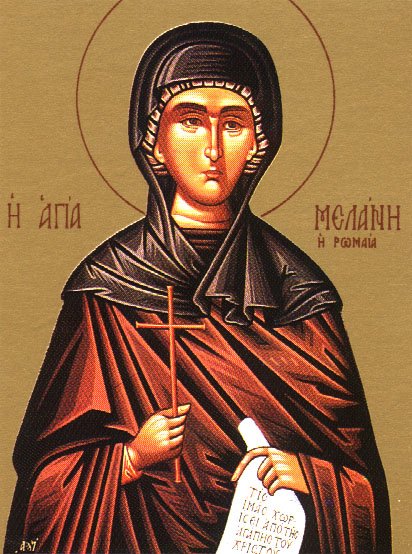
Saint Melania was born in Rome into a devout Christian family. Her parents, people of property and wealth, hoped that their daughter would marry and have children who would inherit their wealth.
At fourteen years of age Melania was married to the illustrious youth Apinianus. From the very beginning of their married life, Saint Melania asked her husband to live with her in chastity or else release her from the marriage.
Saint Melania was born in Rome into a devout Christian family. Her parents, people of property and wealth, hoped that their daughter would marry and have children who would inherit their wealth.
At fourteen years of age Melania was married to the illustrious youth Apinianus. From the very beginning of their married life, Saint Melania asked her husband to live with her in chastity or else release her from the marriage. Apinianus answered, “I cannot agree to this right now. When we have two children to inherit the property, then we shall both renounce the world.”
Soon Melania gave birth to a daughter, whom the young parents dedicated to God. Continuing to live together in marriage, Melania secretly wore a hair shirt and spent her nights in prayer. The second child, a boy, was premature and had severe complications. They baptized him, and he departed to the Lord.
Seeing the suffering of his wife, Apinianus asked the Lord to preserve Saint Melania’s life, and he vowed to spend the rest of their life together in chastity. Recovering, Saint Melania stopped wearing her beautiful clothing and jewelry. Soon their daughter also died. The parents of Saint Melania did not support the young couple’s desire to devote themselves to God. It was only when Saint Melania’s father became deathly ill, that he asked their forgiveness and permitted them to follow their chosen path, asking them to pray for him.
The saints then left the city of Rome, and began a new life completely dedicated to the service of God. Apinianus at this time was twenty-four years of age, and Melania twenty. They began to visit the sick, to take in wanderers, and to help the indigent. They visited those who were exiled, and mine-convicts, and the destitute, there in debtor’s prison. After selling their estates in Italy and Spain, they generously helped monasteries, hospitals, widows and orphans in Mesopotamia, Syria, Egypt, Phoenicia, and Palestine.
Many churches and hospitals were built with their assistance. Churches of both West and East benefited from them. Leaving their native land, they set sail for Africa, and a strong storm arose while they were at sea. The sailors said that this was because of the wrath of God, but Saint Melania said that it was not God’s will that they should go directly to their destination.
The waves carried the ship to an island on which barbarians had landed. The besiegers demanded a ransom from the inhabitants, or else they threatened to lay waste the city. The saints supplied the necessary ransom, and thus saved the city and its people from destruction.
Resuming their voyage, they landed in Africa and helped all the needy there. With the blessing of the local bishops, they made offerings to churches and monasteries. During this time Saint Melania continued to humble her flesh by strict fasting, and she fortified her soul by constantly reading the Word of God, making copies of the sacred books and distributing them to those who lacked them. She sewed a hairshirt for herself, put it on, and continued to wear it.
The saints spent seven years in Carthage, and then decided to visit Jerusalem. At Alexandria, they were welcomed by the bishop, Saint Cyril, and they met in church with the holy Elder Nestorius, who was possessed of the gift of prophecy and healing. The Elder turned to them and told them to have courage and patience in expectation of the Glory of Heaven.
At Jerusalem, the saints distributed their remaining gold to the destitute and then spent their days in poverty and prayer. After a short visit to Egypt, where the saints visited many of the desert Fathers, Saint Melania secluded herself in a cell on the Mount of Olives. Only occasionally did she see Saint Apinianus.
Later, she founded a monastery, where eventually ninety virgins lived in obedience to Saint Melania. Out of humility, she would not consent to be abbess, and lived and prayed in solitude as before. In her instructions, Saint Melania urged the sisters to be vigilant and to pray, to disdain their own opinions and cultivate first of all love for God and for one another, to keep the holy Orthodox Faith, and to guard their purity of soul and of body.
In particular, she exhorted them to be obedient to the will of God. Calling to mind the words of the Apostle Paul, she counselled them to keep the fasts “not with wailing, nor from compulsion, but in virtuous disposition with love for God”. By her efforts an oratory and altar were built in the monastery, where they enshrined the relics of saints: the Prophet Zachariah, the holy Protomartyr Stephen, and the Forty Martyrs of Sebaste. About this time Saint Apinianus fell asleep in the Lord. Saint Melania buried his relics and there spent another four years in fasting and unceasing prayer.
Saint Melania wanted to build a men’s monastery on the Mount of the Ascension of the Lord. The Lord blessed her intent by sending a benefactor who provided the means for the monastery. Joyfully accepting it, Saint Melania finished the great work in a single year. In this monastery, saintly men began to lift up unceasing prayer in the church of the Ascension of Christ.
Having completed her tasks, the saint left Jerusalem for Constantinople, hoping to save the soul of her pagan uncle Volusianus who had traveled there from Rome. Along the way she prayed at the relics of Saint Laurence (August 10), at the place of his martyrdom, and received auspicious signs. Arriving in Constantinople, the saint found her uncle had fallen ill. Her demeanor and her inspired discourses had a profound influence on the sick man. He gave up pagan impiety and died a Christian.
During this time many inhabitants of the capital were deceived by the heretical teaching of Nestorius. Saint Melania accepted anyone who turned to her for proper explanation, converting many of them to Orthodoxy. Many miracles were worked through the prayers of the saint.
Returning to her own monastery, the saint sensed the approach of death, and told this to the priest and the sisters. They listened to her final instructions with deep sorrow and with tears. Having asked their prayers and commanding them to preserve themselves in purity, she received the Holy Mysteries with joy. Saint Melania peacefully gave up her soul to the Lord in the year 439.
Troparion - Tone 8
The image of God was truly preserved in you, O Mother, / for you took up the Cross and followed Christ. / By so doing, you taught us to disregard the flesh, for it passes away; / but to care instead for the soul, since it is immortal. / Therefore your spirit, O holy Mother Melania, rejoices with the angels.
Kontakion - Tone 3
As a two-fold lamp you illumine the Church of Christ / with truly mystical radiance. / You brought forth a hundred-fold fruit through your contest, O Anysia; / and you shone forth in asceticism, O Melania. / You were both found worthy of the incorruptible life of the righteous.
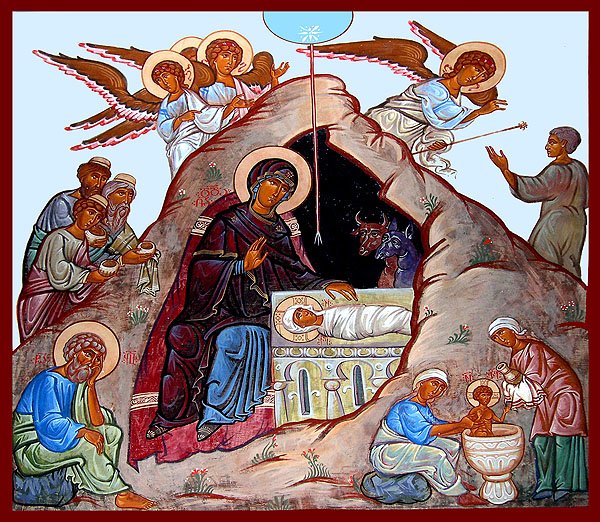
Leavetaking of the Nativity
Materials for the Leavetaking of the Nativity are taken from the service of the Feast day itself in the Menaion. The Scripture readings at Liturgy, however, are of the day, not of the Feast. The Prokeimenon, Alleluia verses, and Communion hymn are all of the Feast.
Troparion - Tone 4
Your Nativity, O Christ our God, / has shone to the world the Light of knowledge; / for by it, those who worshipped the stars / were taught by a star to adore You, / the Sun of Righteousness,1 / and to know You, the Dayspring2 from on High. / O Lord, glory to You!
Kontakion - Tone 3
(Original Melody)
Today the Virgin gives birth to the Transcendent One, / and the earth offers a cave to the Unapproachable One! / Angels with shepherds glorify Him. / The wise men journey with a star, / since for our sake the Pre-Eternal God was born as a young Child.31 Malachi 4:2.
2 The beginning of day, dawn.
3 Literally: Since for our sake, God before the ages was born as a young Child.
Our Holy Mother Melania the Younger of Rome (439)
She was born in 383 in Rome, to a very wealthy family with large estates in Italy, Africa, Spain and even Britain. She was the grand- daughter of St Melania the Elder (June 8) and a pious disciple of Christ from a young age. She was married against her will at the age of fourteen, to a relative named Apinianus.
She was born in 383 in Rome, to a very wealthy family with large estates in Italy, Africa, Spain and even Britain. She was the grand- daughter of St Melania the Elder (June 8) and a pious disciple of Christ from a young age. She was married against her will at the age of fourteen, to a relative named Apinianus. They had two children, both of whom died in early childhood. Henceforth Melania and her husband dedicated themselves entirely to God. They had both dreamed of a high wall that they would have to climb before they could pass through the narrow gate that leads to life, and soon began to take measures to dispose of their wealth. This aroused opposition from some of the Senate, who were concerned that the selling off of such huge holdings would disrupt the economy of the State itself.
With the support of the Empress, though, Melania was able to free 8000 of her slaves and give each a gift of three gold pieces to begin life as freedmen. She employed agents to help fund the establishment of churches and monasteries throughout the Empire, donated many estates to the Church, and sold many more, giving the proceeds as alms. When Rome fell to the Goths under Alaric in 410, Melania and Apinianus moved to Sicily, then to Africa, where they completed the sale of their propery, donating the proceeds to monasteries and to aiding victims of the barbarians.
In Africa Melania, now aged about thirty, took up a life of the strictest asceticism: she kept a total fast on weekdays, only eating on Saturday and Sunday; she slept two hours a night, giving the rest of the night to vigil and prayer. Her days were spent in charitable works, using the remainder of her wealth to relieve the poor and benefit the Church. After seven years in Africa, Melania, her mother and her husband left on pilgrimage to the Holy Land. There they founded a monastery on the Mount of Olives, which grew to a community of ninety nuns. Melania’s mother died in 431, then her husband and spiritual brother Apinianus ; she buried them side by side.
Save for one visit to Constantinople, Melania continued to live in reclusion in a small cave on the Mount of Olives; she became an advisor to the Empress Eudocia, who sought her expert counsel on her gifts to churches and monasteries.
Melania fell ill keeping the Vigil of Nativity in 439, and fell asleep in the Lord six days later; her last words were ‘As it has pleased the Lord, so it has come to pass.’ Her monastery was destroyed in 614 by the Persians, but her cave hermitage on the Mount of Olives is still a place of pilgrimage and veneration.
Saint Zoticus, Cherisher of the Poor and Servant of Lepers (4th c)
He was born in Rome, and as a young man was chosen by the Emperor Constantine to assist in the foundation of his new capital at Byzantium. An outbreak of leprosy in the new City became so severe that the Emperor ordered that all lepers, whatever their rank, be driven from the city or drowned in the sea.
He was born in Rome, and as a young man was chosen by the Emperor Constantine to assist in the foundation of his new capital at Byzantium. An outbreak of leprosy in the new City became so severe that the Emperor ordered that all lepers, whatever their rank, be driven from the city or drowned in the sea. Zoticus, moved by compassion for these people, went to the Emperor and asked him for a large amount of gold to buy gems and pearls to enhance the glory of the city, ‘For, as Your Majesty knows, I am well-qualified in this field.’ The Saint then used the gold to ransom all those being led into exile or to drowning, and to establish for them a camp on the hill of Olivet on the opposite shore of the Bosphorus. There he brought the sick and provided for their care.
In 337 Constantius, an Arian heretic, took the throne upon the death of his father. Some of Zoticus’ enemies at court, seeing an opportunity, denounced Zoticus to the new Emperor, saying that he not only held subversive views, but had misappropriated public money. When he learned of these charges, Zoticus presented himself to the Emperor, finely dressed, and offered to take Constantius to see the gems and pearls that he had bought on his behalf. When they reached the hill of Olivet, Constantius was astonished to see a company of lepers coming to greet him with lighted candles, honoring and praising him and their patron Zoticus. Then the holy Zoticus said to the Emperor, ‘These are the precious stones and brilliant pearls that give luster to the crown of the heavenly Kingdom that you will inherit by their prayers. I bought them for the salvation of your soul.’
Instead of being grateful, the heartless Emperor ordered that Zoticus be tied behind wild mules and dragged until dead. The mules ran down the hill, breaking the Saint’s body upon the rocks and brush. Then, of their own accord, they returned to the top of the hill, still dragging the body, and, like Balaam’s ass (Numbers ch. 22), spoke and proclaimed that the Martyr must be buried on that hill. The astonished and repentant Emperor ordered the Martyr buried with honor, and commanded that a hospital for lepers be built there, staffed by the best physicians and caretakers.
Saint Zoticus is also called Orphanotrophos, ‘Cherisher of Orphans,’ because in later years a large orphanage was added to the leprosarium. The orphanage included a general hospital and a home for the aged. The Saint was honored throughout Byzantine history as the patron of the orphanage.
St Theophylact, Archbishop of Ochrid (ca. 1126)
He was born on the island of Euripos and, after being educated in Constantinople, became one of the clergy of the Great Church there. He was consecrated a bishop and sent, against his will, to Ochrid, where he shepherded the Church in Bulgaria for twenty-five years. An inspired theologian and orator, he has left many homilies and, most important, a commentary on the whole New Testament, which has been has been treasured by Orthodox Christians ever since.
He was born on the island of Euripos and, after being educated in Constantinople, became one of the clergy of the Great Church there. He was consecrated a bishop and sent, against his will, to Ochrid, where he shepherded the Church in Bulgaria for twenty-five years. An inspired theologian and orator, he has left many homilies and, most important, a commentary on the whole New Testament, which has been has been treasured by Orthodox Christians ever since. In his last years he moved to Thessalonica, where he reposed in peace.
Scripture Readings
☩Epistle
James 1:19-27
19
Wherefore, my beloved brethren, let every man be swift to hear, slow to speak, slow to wrath:
20
For the wrath of man worketh not the righteousness of God.
21
Wherefore lay apart all filthiness and superfluity of naughtiness, and receive with meekness the engrafted word, which is able to save your souls.
22
But be ye doers of the word, and not hearers only, deceiving your own selves.
23
For if any be a hearer of the word, and not a doer, he is like unto a man beholding his natural face in a glass:
24
For he beholdeth himself, and goeth his way, and straightway forgetteth what manner of man he was.
25
But whoso looketh into the perfect law of liberty, and continueth therein, he being not a forgetful hearer, but a doer of the work, this man shall be blessed in his deed.
26
If any man among you seem to be religious, and bridleth not his tongue, but deceiveth his own heart, this man’s religion is vain.
27
Pure religion and undefiled before God and the Father is this, To visit the fatherless and widows in their affliction, and to keep himself unspotted from the world.
☩Gospel
Mark 11:27-33
27
And they come again to Jerusalem: and as he was walking in the temple, there come to him the chief priests, and the scribes, and the elders,
28
And say unto him, By what authority doest thou these things? and who gave thee this authority to do these things?
29
And Jesus answered and said unto them, I will also ask of you one question, and answer me, and I will tell you by what authority I do these things.
30
The baptism of John, was it from heaven, or of men? answer me.
31
And they reasoned with themselves, saying, If we shall say, From heaven; he will say, Why then did ye not believe him?
32
But if we shall say, Of men; they feared the people: for all men counted John, that he was a prophet indeed.
33
And they answered and said unto Jesus, We cannot tell. And Jesus answering saith unto them, Neither do I tell you by what authority I do these things.

 Meat
Allowed
 Fish
Allowed
 Dairy
Allowed
 Oil
Allowed
 Wine
Allowed