
Fasting Rules
 Meat
Abstain
 Fish
Abstain
 Dairy
Abstain
 Oil
Abstain
 Wine
Abstain
Saints & Commemorations
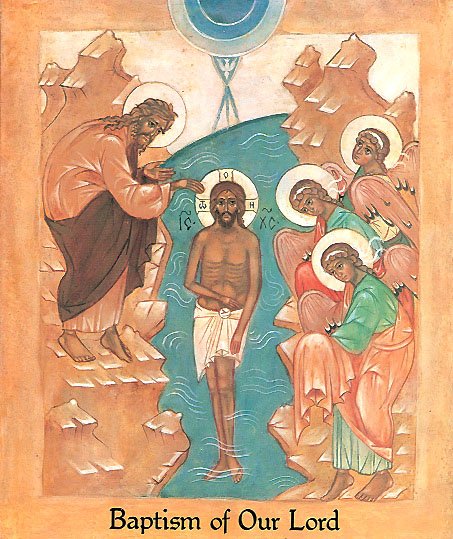
Eve of Theophany
The fourth day of the Forefeast of Theophany falls on January 5. If January 5th falls on a weekday, the following order is observed:
Vespers on the evening of the 4th, then Matins. The First Hour is not read after Matins.
On the 5th we read the Royal Hours, followed by Vespers and the Liturgy of Saint Basil the Great.
If the Eve of Theophany falls on Saturday:
The Royal Hours are read on Friday, but there is no Liturgy. Vespers on the evening of the 4th, followed by Matins. The Liturgy of Saint John Chrysostom is celebrated on Saturday morning.
If the Eve of Theophany falls on a Sunday:
The Royal Hours are read on Friday, but there is no Liturgy. Vigil is served on Saturday evening, and the Liturgy of Saint John Chrysostom is celebrated on Sunday.
There are thirteen readings at Vespers on the Eve of Theophany, and the entrance is made with the Gospel. There is fasting today, whatever day of the week it may be.
Troparion - Tone 4
Of old, the river Jordan / turned back before Elisha’s mantle at Elijah’s ascension. / The waters were parted in two / and the waterway became a dry path. / This is truly a symbol of baptism / by which we pass through this mortal life. / Christ has appeared in the Jordan to sanctify the waters!
Kontakion - Tone 2
O Christ, in Thy compassion and infinite mercy, / Thou art coming as a man to be baptized in the Jordan, / in order to take away the many transgressions of us all, / clothing me in the garment of ancient glory / of which I was cruelly stripped bare.
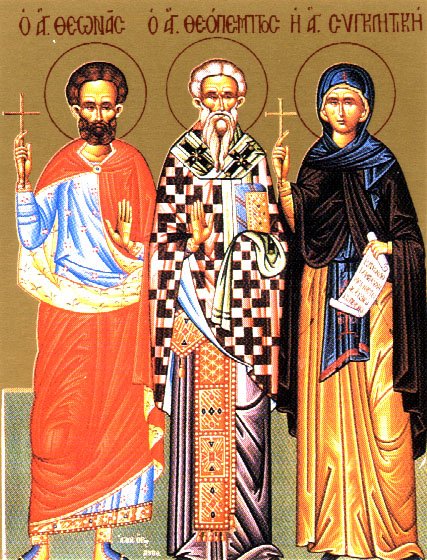
Holy Martyrs Theopemptus and Theonas (ca. 290)
The Holy Martyrs Theopemptus and Theonas suffered in Nicomedia in the year 303. Saint Theopemptus was bishop in Nicomedia in the time of Diocletian. Speaking out against idolatry, he defended the faith in Christ. Because of this, he became one of the first victims of the Diocletian persecution.
The saint refused to obey the emperor’s order to worship an idol of Apollo. S
The Holy Martyrs Theopemptus and Theonas suffered in Nicomedia in the year 303. Saint Theopemptus was bishop in Nicomedia in the time of Diocletian. Speaking out against idolatry, he defended the faith in Christ. Because of this, he became one of the first victims of the Diocletian persecution.
The saint refused to obey the emperor’s order to worship an idol of Apollo. Saint Theopemptus was thrown into a red-hot furnace, but by the power of God he remained alive. The emperor came to the furnace by night with a detachment of soldiers, and there he saw the saint alive and praying to God. Ascribing the miracle to magic, Diocletian thought to exhaust Saint Theopemptus by depriving him of food and drink for twenty-two days, but the martyr was preserved by the will of God.
The emperor brought the famous sorcerer Theonas to overcome Bishop Theopemptus’ supposed magical power. Theonas prepared a poison for Saint Theopemptus, put it into a little cake, and offered it to him to eat. The poison did no harm at all to Saint Theopemptus. Then Theonas tried an even stronger poison on the martyr. Seeing that Saint Theopemptus remained unharmed, he came to believe in Christ. They threw him into prison together with the holy bishop, who taught and baptized him, giving him the name Synesios (which means “full of understanding”).
At dawn Diocletian summoned Saint Theopemptus, and again tried to turn him to pagan impiety. Seeing that the bishop remained firm in his faith, he subjected him to many grievous tortures, after which the saint was beheaded. The holy martyr Theonas refused to offer sacrifice to idols, so he was buried alive in a deep ditch. This occurred at Nicomedia in the year 303.
Troparion - Tone 4
Your holy martyrs Theopemptus and Theonas, O Lord, / through their sufferings have received incorruptible crowns from You, our God. / For having Your strength, they laid low their adversaries, / and shattered the powerless boldness of demons. / Through their intercessions, save our souls!
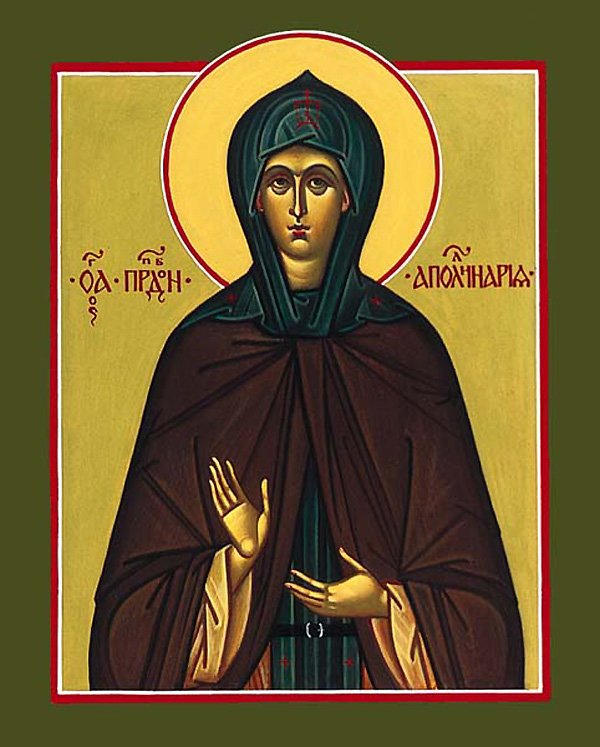
Apollinaria of Egypt
The renowned Apollinaria (Απολλιναρία) lived during the reign of Leo the Great (457–474), and was the daughter of Anthemius, a former proconsul of Rome during the minority of Theodosius the Younger (408-450). Saint Apollinaria was renowned for her beauty and wisdom, as well as for her fervent faith and whole-hearted devotion to Christ. From a young a
The renowned Apollinaria (Απολλιναρία) lived during the reign of Leo the Great (457–474), and was the daughter of Anthemius, a former proconsul of Rome during the minority of Theodosius the Younger (408-450). Saint Apollinaria was renowned for her beauty and wisdom, as well as for her fervent faith and whole-hearted devotion to Christ. From a young age she was inclined to live a life of virginity, and she prayed to God night and day that she might achieve her desire, which was to remain a virgin until death. For this reason she entreated her parents to let her go to Jerusalem. When they granted her permission, the blessed one took some male and female servants with her, as well as gold, silver and expensive clothes, and left for Jerusalem. There she distributed everything to the poor. After she venerated the Holy Places, she freed her servants, keeping just one old servant and a eunuch with her. With them, she went to Alexandria. Arriving there at a level and even place, she decided to rest a little from her weary journey. Slipping away from her servants, she changed into monastic garb and hid in a marsh, where she lived a life of asceticism for several years in strict fasting and prayer. One day, an angel appeared to her in a dream and instructed her to go to the monastery of Sketis, which was under the spiritual direction of Saint Macarius of Egypt (January 19), and to call herself Dorotheus. Saint Macarius accepted her as one of the brethren, and she quickly distinguished herself by her ascetical life.
Saint Apollinaria’s parents had another daughter who was possessed by an unclean spirit. They sent her to Saint Macarius at Sketis, who brought the afflicted girl to "Father Dorotheus." Through her prayers, and by divine grace, her sister was healed. Everyone wanted her to remain with them, but she bade all of them farewell and returned to her monastic cell. Soon, her sister was attacked by a violent demon, who made her appear to be pregnant. The demon spoke through the girl’s lips, saying that Dorotheus had forced himself on her. Her outraged parents sent soldiers to the monastery to find the monk who had defiled their daughter. Saint Apollinaria took the blame and accompanied the envoys to the home of her parents in Rome. There she revealed her secret to them, healed her sister, and returned to Sketis. She reposed in the year 470, and was found worthy to dwell in the heavenly abodes (John 14:2). Only after her death, as the monks were preparing her body for burial, was it discovered that “he” was actually a woman. The Saint was buried in a cave in the monastery church of Saint Macarius of Egypt.
Saint Apollinaria is commemorated on January 4 in Greek usage, while the Slavic churches honor her on January 5.
Troparion - Tone 8
The image of God was truly preserved in you, O Mother, / for you took up your cross and followed Christ. / By so doing, you taught us to disregard the flesh, for it passes away; / but to care instead for the soul, since it is immortal. / Therefore,
O holy Mother Apollinaria, your spirit rejoices with the Angels.
Kontakion - Tone 2
Out of love for God, you despised the desire for rest, O Mother Apollarina / and illuminating your soul with fasting, / you completely vanquished your enemies; / and by your intercession you destroyed the evil schemes of our adversaries.
Our Venerable Mother Syncletike (4th c.)
She was the daughter of wealthy and devout parents in Alexandria. Though much desired as a bride for her great beauty, intelligence and wealth, she showed no interest in any worldly attraction and, when her parents died, gave away all of her large fortune. She then fled with her blind sister to the desert, where she became the foundress of monastic life for women in the Egyptian desert, just as St Anthony had for men.
She was the daughter of wealthy and devout parents in Alexandria. Though much desired as a bride for her great beauty, intelligence and wealth, she showed no interest in any worldly attraction and, when her parents died, gave away all of her large fortune. She then fled with her blind sister to the desert, where she became the foundress of monastic life for women in the Egyptian desert, just as St Anthony had for men. At first she attempted to struggle in solitude, hiding her ascetic labors from all and keeping strict silence before all people. But in time her holiness became known, and a company of young women formed around her, seeking to emulate and share in her way of life. At first she kept her silence even with them, but at last was forced out of love to give way to their pleas and reveal to them the wisdom that had been implanted in her. A settled monastic community grew around her, and she became known to all as Amma, the feminine form of the title Abba.
At the age of eighty-five, she was stricken with an agonizing cancer that slowly destroyed and putrefied her body. She bore these heavy trials with patience and thanksgiving, and told her disciples: “If illness strikes us, let us not be distressed as though physical exhaustion could prevent us from singing God’s praises; for all these things are for our good and for the purification of our desires. Fasting and ascesis are enjoined on us only because of our appetites; so if illness has blunted their edge, there is no longer any need for ascetic labors. To endure illness patiently and to send up thanksgiving to God is the greatest ascesis of all.”
Eventually her illness deprived her even of the power of speech, but it was said that the sight of her joyful and serene countenance amid her sufferings was better than any other teaching, and the faithful continued to flock to her to receive a blessing. After a three-month martyrdom, she departed this life, having predicted the day of her death.
It is said that St Syncletike was the virgin who sheltered St Athanasius the Great when he was driven into hiding for more than a year by the Arians. Her biography, which the Synaxarion calls “one of the basic texts of Orthodox spirituality,” is attributed to St Athanasius.
Scripture Readings
☩Epistle
Acts 13:25-33
25
And as John fulfilled his course, he said, Whom think ye that I am? I am not he. But, behold, there cometh one after me, whose shoes of his feet I am not worthy to loose.
26
Men and brethren, children of the stock of Abraham, and whosoever among you feareth God, to you is the word of this salvation sent.
27
For they that dwell at Jerusalem, and their rulers, because they knew him not, nor yet the voices of the prophets which are read every sabbath day, they have fulfilled them in condemning him.
28
And though they found no cause of death in him, yet desired they Pilate that he should be slain.
29
And when they had fulfilled all that was written of him, they took him down from the tree, and laid him in a sepulchre.
30
But God raised him from the dead:
31
And he was seen many days of them which came up with him from Galilee to Jerusalem, who are his witnesses unto the people.
32
And we declare unto you glad tidings, how that the promise which was made unto the fathers,
33
God hath fulfilled the same unto us their children, in that he hath raised up Jesus again; as it is also written in the second psalm, Thou art my Son, this day have I begotten thee.
☩Gospel
Matthew 3:1-11
1
In those days came John the Baptist, preaching in the wilderness of Judea,
2
And saying, Repent ye: for the kingdom of heaven is at hand.
3
For this is he that was spoken of by the prophet Esaias, saying, The voice of one crying in the wilderness, Prepare ye the way of the Lord, make his paths straight.
4
And the same John had his raiment of camel’s hair, and a leathern girdle about his loins; and his meat was locusts and wild honey.
5
Then went out to him Jerusalem, and all Judea, and all the region round about Jordan,
6
And were baptized of him in Jordan, confessing their sins.
7
But when he saw many of the Pharisees and Sadducees come to his baptism, he said unto them, O generation of vipers, who hath warned you to flee from the wrath to come?
8
Bring forth therefore fruits meet for repentance:
9
And think not to say within yourselves, We have Abraham to our father: for I say unto you, that God is able of these stones to raise up children unto Abraham.
10
And now also the axe is laid unto the root of the trees: therefore every tree which bringeth not forth good fruit is hewn down, and cast into the fire.
11
I indeed baptize you with water unto repentance: but he that cometh after me is mightier than I, whose shoes I am not worthy to bear: he shall baptize you with the Holy Ghost, and with fire:
Liturgical data sourced from OCA.org and orthocal.info