
Fasting Rules
 Meat
Allowed
 Fish
Allowed
 Dairy
Allowed
 Oil
Allowed
 Wine
Allowed
Saints & Commemorations
Sunday after Theophany
St Gregory of Nyssa
“Saint Gregory, the younger brother of Basil the Great, illustrious in speech and a zealot for the Orthodox faith, was born in 331. His brother Basil was encouraged by their elder sister Macrina to prefer the service of God to a secular career (see July 19); Saint Gregory was moved in a similar way by his godly mother Emily, who, when Gregory was still a young man, implored him to attend a service in honour of the holy Forty Martyrs at her retreat at Annesi on the River Iris. S
“Saint Gregory, the younger brother of Basil the Great, illustrious in speech and a zealot for the Orthodox faith, was born in 331. His brother Basil was encouraged by their elder sister Macrina to prefer the service of God to a secular career (see July 19); Saint Gregory was moved in a similar way by his godly mother Emily, who, when Gregory was still a young man, implored him to attend a service in honour of the holy Forty Martyrs at her retreat at Annesi on the River Iris. Saint Gregory came at his mother’s bidding, but being wearied with the journey, and feeling little zeal, he fell asleep during the service. The Forty Martyrs then appeared to him in a dream, threatening him and reproaching him for his slothfulness. After this he repented and became very diligent in the service of God. He became bishop in 372, and because of his Orthodoxy he was exiled in 374 by Valens, who was on one mind with the Arians. After Valens’ death in 378 he was recalled to his throne by the Emperor Gratian. He attended the Local Council of Antioch, which sent him to visit the churches of Arabia and Palestine, which had been defiled and ravaged by Arianism. He attended the Second Ecumenical Council, which was assembled in Constantinople in 381. Having lived some sixty years and left behind many remarkable writings, he reposed about the year 395. The acts of the Seventh Ecumenical Council call him “Father of Fathers.” (Great Horologion)
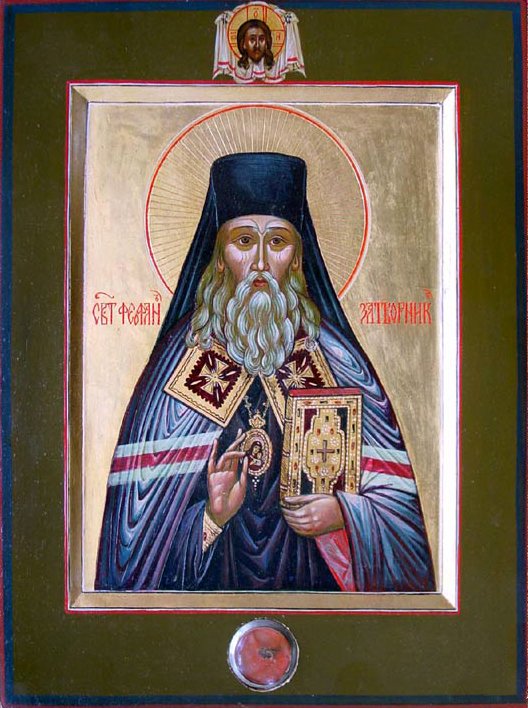
St Theophan the Recluse
George Govorov, the future Saint Theophan, was born on January 10, 1815 in the village of Chernavsk in the Orlov province where his father was a priest.
At first, George attended a primary school at Liven, then a military school. From 1837-1841 he studied at the Kiev Theological Academy, and probably visited the Monastery of the Caves several times.
George Govorov, the future Saint Theophan, was born on January 10, 1815 in the village of Chernavsk in the Orlov province where his father was a priest.
At first, George attended a primary school at Liven, then a military school. From 1837-1841 he studied at the Kiev Theological Academy, and probably visited the Monastery of the Caves several times. In these surroundings, it was not surprising that he received the monastic tonsure while he was still a student. After graduation Hieromonk Theophan was appointed rector of Kiev’s church schools, and later became rector of the seminary in Novgorod. Before he retired from teaching, Father Theophan served as a professor and Assistant Inspector at the Petersburg Academy.
Saint Theophan was not completely happy with academic work, so he asked to be relieved of his duties. He was assigned to be a member of the Russian Mission in Jerusalem. After being raised to the rank of Archimandrite, he became Rector of Olnets Seminary. Soon he was assigned as the chief priest of the embassy church in Constantinople. Saint Theophan was eventually recalled to Russia to become rector of the Petersburg Academy, and supervisor of religious education in the capital’s secular schools.
On May 9, 1859 Saint Theophan was consecrated as Bishop of Tambov, where he established a diocesan school for girls. During his time in Tambov he came to love the secluded Vysha Monastery in his diocese. In 1863 he was transferred to Vladimir and remained there for three years. He also established a diocesan school for girls at Vladimir.
The holy bishop visited parishes throughout his diocese serving, preaching, restoring churches, and sharing the joys and sorrows of his flock. It was very difficult for Bishop Theophan to live in the world and become involved with vain worldly disputes. Many abused his trust, but he could not bring himself to chastise anyone. Instead, he left such unpleasant tasks to the Archpriest of his cathedral.
He was present at the uncovering of the relics of Saint Tikhon of in 1861, and this made a tremendous impression on him, for he had much in common with that saint. He had loved Saint Tikhon from early childhood, and always spoke about him with great enthusiasm. When Saint Tikhon was glorified as a saint on August 13, Bishop Theophan’s joy knew no bounds.
In 1866 his request to be relieved of his duties as Bishop of Vladimir was granted. He was appointed as Superior of the Vysha Monastery, but soon resigned from that position. He was permitted to live there and to celebrate services whenever he wished. He also received a pension of 1000 rubles.
As he prepared to leave his diocese, he wished to focus on his own salvation, and to concentrate on undisturbed communion with God. On July 24, 1866 he bade his diocese farewell, leaving the world for a life of reclusion, and to devote himself to writing spiritual books. Through these books, Saint Theophan has become the spiritual benefector of all Orthodox Christians. Although he sought the Kingdom of God and His righteousness (Mt. 6:33), a reputation as a writer of great significance for the whole world was also added to him.
Bishop Theophan wrote many books, but received no profits from their sale. He tried to keep them as inexpensive as possible, and they quickly sold out. He wrote about topics which others before him had not fully treated, such as how to live a Christian life, how to overcome sinful habits, and how to avoid despair. He tried to explain the steps of spiritual perfection systematically, as one who had himself gone through these various steps. Some of his books include The Spiritual Life and How to be Attuned to It , The Path to Salvation , and Letters on the Spiritual Life . He also translated the Philokalia in five volumes, and The Sermons of Saint Simeon the New Theologian .
For the first six years in the monastery, Bishop Theophan attended all the services, including the early Liturgy. He stood still in church with his eyes closed so that he would not be distracted. He often celebrated Liturgy on Sundays and Feast Days.
Beginning in 1872, he cut off all relationships with people (except for his confessor) and no longer left his cell to attend church. He built a small chapel in his quarters and dedicated it to the Lord’s Baptism. For ten years he served there on Sundays and Feast Days. For the last eleven years of his life he served every day by himself. Sometimes he would sing, and sometimes he kept completely silent.
Whenever anyone visited him on business, Bishop Theophan would reply with as few words as possible, then immerse himself in prayer. If anyone sent him money, he would distribute it to the poor, keeping only a small portion to purchase books.
Whenever he was not occupied with writing or praying, the reclusive bishop worked at carpentry or painting icons. He received from twenty to forty letters each day, and he answered all of them. He was able to discern each writer’s spiritual condition, then give detailed answers to the questions of those who were struggling for the salvation of their souls.
His eyesight deteriorated in his latter years, but he did not curtail his work because of it. In the evening, his cell attendant would prepare everything for the bishop to serve Liturgy the next morning. After finishing the Liturgy, Bishop Theophan would knock on the wall to signal the cell attendant to serve him tea. On days when there was no fasting, he would eat lunch at 1:00 P.M. This consisted of one egg and a glass of milk. At four o’clock he would have some tea, and then no more food that day.
Bishop Theophan began to get weaker at the beginning of 1894. He was still writing on the afternoon of January 6, but when the cell attendant came to check on him at 4:30 he found that the bishop had departed to the Lord.
Saint Theophan’s body lay in the small church in his cell for three days, then three more days in the cathedral. There was no trace of corruption, however. He was laid to rest in the Kazan church of the Vysha Monastery.
Several of Saint Theophan’s books have been translated into English, and are reliable spiritual guides for Orthodox Christians of today. Saint Theophan’s gift was the ability to present the wisdom of the Fathers in terms which modern people can understand. Since he lived close to our own time, many readers find his books “more approachable” than the earlier patristic literature. He treats the life of the soul and the life of the body as a unified whole, not as two separate elements, and reveals to people the path of salvation.
Troparion - Tone 8
O guide of Orthodoxy, teacher of piety and purity, / ascetic of Vysha, divinely wise and holy hierarch Theophan: / By your writings you explained the Word of God, / and showed the way of salvation unto all the faithful. / Entreat Christ God that our souls may be saved.
Kontakion - Tone 4
Holy hierarch Theophan, namesake of Theophany, / you enlightened many people by your teachings. / Now that you stand before the throne of the Holy Trinity / together with the angels, / pray without ceasing for us all.
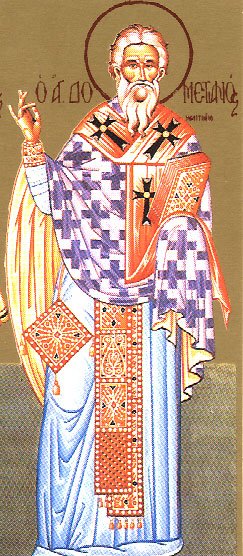
Dometian, Bishop of Melitene
Saint Dometian, Bishop of Melitene, was born and lived during the sixth century, in the time of the emperor Justin the Younger. He was married but was widowed, and thereafter he became a monk and lived a strict and holy life.
At thirty years of age he was chosen bishop of the city of Melitene (in Armenia).
Saint Dometian, Bishop of Melitene, was born and lived during the sixth century, in the time of the emperor Justin the Younger. He was married but was widowed, and thereafter he became a monk and lived a strict and holy life.
At thirty years of age he was chosen bishop of the city of Melitene (in Armenia). Wise and zealous in questions of faith, strong in word and deed, Saint Dometian quickly gained fame as a good and dedicated pastor. More than once he carried out government commissions in Persia to avoid conflict with the Greeks. Beloved by all, Saint Dometian often received rich gifts, which he distributed to the poor. Both during his life and after his death in 601, Saint Dometian was glorified by God with miracles.
Troparion - Tone 4
O God of our Fathers, / always act with kindness towards us; / take not Your mercy from us, / but guide our lives in peace / through the prayers of the hierarchs Gregory and Dometian.
Kontakion - Tone 2
O Hierarch Dometian, divine thunder, spiritual trumpet, / planter of faith and pruner of heresies, great favorite of the Trinity, / while standing with the Angels before God, / pray unceasingly for us all.
Our Holy Father Theophan the Recluse (1894)
This modern-day Church Father was born in Chernavsk in central Russia. The son of a priest, he entered seminary at a young age, then completed the four-year course in theology at the Academy of Kiev. Though he distinguished himself as a student, his heart turned increasingly toward the monastic life, and he was tonsured a monk and ordained a priest upon completion of his studies.
This modern-day Church Father was born in Chernavsk in central Russia. The son of a priest, he entered seminary at a young age, then completed the four-year course in theology at the Academy of Kiev. Though he distinguished himself as a student, his heart turned increasingly toward the monastic life, and he was tonsured a monk and ordained a priest upon completion of his studies. During his time at the Academy he often visited the Lavra of the Caves, and there became a spiritual child of Father Parthenius (March 25).
His desire for monastic life was not fulfilled immediately, for the Church felt need of his intellectual gifts. He served as a professor at the Theological Academy in St Petersburg, then worked for seven years in the Russian Mission to the Near East, mostly in Palestine. During this time he gained a perfect mastery of Greek and studied the works of the Church Fathers in the original languages. Returning to Russia, he was soon consecrated a bishop; but after seven years of episcopal service, he at last achieved his heart’s desire, resigning as bishop and retiring to a small monastery at Yvschen, where he spent the rest of his days.
After taking full part in the liturgical and communal life of the monastery for several years, he took up the life of a recluse in 1872. He lived in two small rooms, subsisting almost entirely on bread and tea, visited only by his confessor and the abbot of the monastery. He celebrated the Divine Liturgy every day in his cell. All of his time not taken up by inner prayer was devoted to translating the works of the Fathers into Russian and, increasingly, to writings of his own. Most importantly, he prepared a Russian-language edition of the Philokalia which had a deep impact upon Russian spiritual life.
Though he received no visitors, St Theophan entered into correspondence with many earnest Christians who sought his counsel, and so in time became the spiritual father of many believers throughout Russia. He reposed in peace in 1894.
In addition to the Philokalia, St Theophan produced (among other works): a Spiritual Psalter of selections from St Ephraim the Syrian; The Path to Salvation, an exposition of Orthodox Spirituality written in clear, plain language for those living in the world; collections of his letters to spiritual children; and Unseen Warfare, a treatise on prayer and the ascetical life. This last has an unusual history. In its original form it was written by Lorenzo Scupoli, an Italian Roman Catholic priest. St Nikodemos of the Holy Mountain, recognizing the book’s merit, produced a Greek edition in which he corrected various deviations from Orthodoxy in the original. St Theophan in turn revised the Greek edition extensively, removing some material and adding passages of his own; so that the Italian, Greek and Russian versions are in fact three substantially different books. Many of St Theophan’s works (including Unseen Warfare) are available in good English translations. They are almost unique in presenting the undiluted hesychastic spirituality of the Orthodox Church in plain, straightforward language accessible to most people.
Scripture Readings
☩Epistle
Ephesians 4:7-13
7
But unto every one of us is given grace according to the measure of the gift of Christ.
8
Wherefore he saith, When he ascended up on high, he led captivity captive, and gave gifts unto men.
9
(Now that he ascended, what is it but that he also descended first into the lower parts of the earth?
10
He that descended is the same also that ascended up far above all heavens, that he might fill all things.)
11
And he gave some, apostles; and some, prophets; and some, evangelists; and some, pastors and teachers;
12
For the perfecting of the saints, for the work of the ministry, for the edifying of the body of Christ:
13
Till we all come in the unity of the faith, and of the knowledge of the Son of God, unto a perfect man, unto the measure of the stature of the fulness of Christ:
☩Gospel
Matthew 4:12-17
12
Now when Jesus had heard that John was cast into prison, he departed into Galilee;
13
And leaving Nazareth, he came and dwelt in Capernaum, which is upon the sea coast, in the borders of Zabulon and Nephthalim:
14
That it might be fulfilled which was spoken by Esaias the prophet, saying,
15
The land of Zabulon, and the land of Nephthalim, by the way of the sea, beyond Jordan, Galilee of the Gentiles;
16
The people which sat in darkness saw great light; and to them which sat in the region and shadow of death light is sprung up.
17
From that time Jesus began to preach, and to say, Repent: for the kingdom of heaven is at hand.
Liturgical data sourced from OCA.org and orthocal.info