
Fasting Rules
 Meat
Allowed
 Fish
Allowed
 Dairy
Allowed
 Oil
Allowed
 Wine
Allowed
Saints & Commemorations
New Martyrs and Confessors of Russia
On the Sunday closest to January 25, the Church commemorates the Synaxis of the Holy New Martyrs and Confessors of Russia, remembering all those Orthodox Christians who suffered for Christ at the hands of the godless Soviets during the years of persecution. These include the royal Passion Bearers Tsar Nicholas II and his family, and the Grand Duchess Elizabeth.
On the Sunday closest to January 25, the Church commemorates the Synaxis of the Holy New Martyrs and Confessors of Russia, remembering all those Orthodox Christians who suffered for Christ at the hands of the godless Soviets during the years of persecution. These include the royal Passion Bearers Tsar Nicholas II and his family, and the Grand Duchess Elizabeth. Countless thousands of martyrs, both clergy and laity also suffered, some of whose names are known, as well as millions of simple believers whose names have been lost to history.
It is estimated that the number of the New Martyrs of Russia, who were glorified by the Russian Orthodox Church at the Jubilee Council of 2000, far exceeds that of all the martyrs who died for Christ during the first three centuries of Christianity. The Russian Church lost millions of its sons and daughters, not only at the hands of external enemies, but also those of their own country. Among those who were murdered and tortured in the years of persecution were countless Orthodox: laity, monks, priests, and bishops, whose only “crime” was their unshakable faith in God.
In the long history of the world, never have so many new heavenly intercessors been glorified by the Church in such a way (more than one thousand New Martyrs were numbered among the saints). Among those who suffered for their faith were some who labored in America before the Russian Revolution: St. Tikhon, Patriarch of Moscow and All Russia (April 7); St. Alexander Hotovitzky (Dec. 4); St. John Kochurov (Oct. 31).
Troparion - Tone 4
Today the Church of Russia joyfully forms a chorus, / praising her New Martyrs and Confessors; / hierarchs and priests, royal passion-bearers, right-believing princes and princesses, / venerable men and women, and all Orthodox Christians. / Having laid down their life for faith in Christ during the days of godless persecution, / they preserved the truth by the shedding of blood. / By their protection, O long-suffering Lord, / preserve our land in Orthodoxy until the end of the age.
Kontakion - Tone 3
Today the New Martyrs of Russia stand in white robes before the Lamb of God, / and with the angels they sing to God the hymn of victory: / "Blessing, and glory, and wisdom, and praise, and honor, / and power, and strength be to our God / unto the ages of ages. Amen."
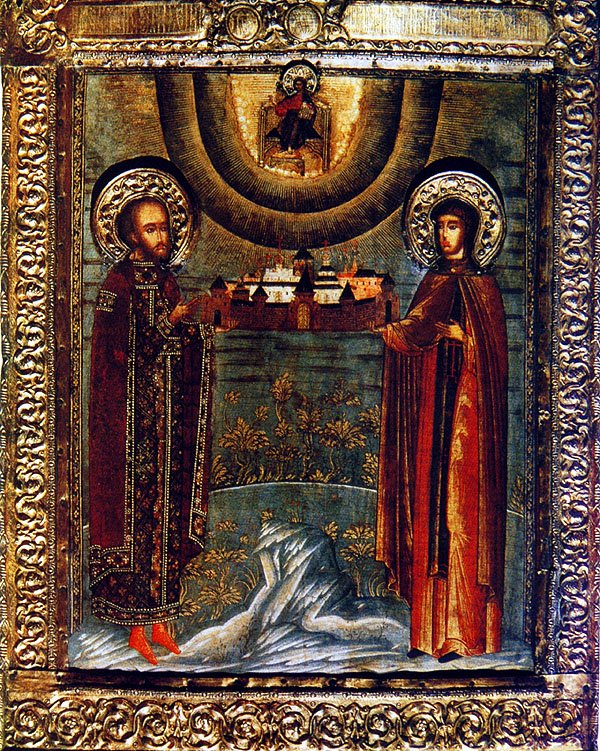
Ven. Xenia of Rome
Saint Xenia of Rome, in the world Eusebia, was the only daughter of an eminent Roman senator. From her youth she loved God, and wished to avoid the marriage arranged for her. She secretly left her parental home with two servants devoted to her, and set sail upon a ship. Through the Providence of God she met the head of the monastery of the holy Apostle Andrew in Milassa, a town of Caria (Asia Minor).
Saint Xenia of Rome, in the world Eusebia, was the only daughter of an eminent Roman senator. From her youth she loved God, and wished to avoid the marriage arranged for her. She secretly left her parental home with two servants devoted to her, and set sail upon a ship. Through the Providence of God she met the head of the monastery of the holy Apostle Andrew in Milassa, a town of Caria (Asia Minor). She besought him to take her and her companions to Milassa. She also changed her name, calling herself Xenia [which means “stranger” or “foreigner” in Greek].
At Milassa she bought land, built a church dedicated to Saint Stephen, and founded a woman’s monastery. Soon after this, Bishop Paul of Milassa made Xenia a deaconess, because of her virtuous life. The saint helped everyone: for the destitute, she was a benefactress; for the grief-stricken, a comforter; for sinners, a guide to repentance. She possessed a deep humility, accounting herself the worst and most sinful of all.
In her ascetic deeds she was guided by the counsels of the Palestinian ascetic, Saint Euthymius. The sublime life of Saint Xenia drew many souls to Christ. The holy virgin died in 450 while she was praying. During her funeral, a luminous wreath of stars surrounding a radiant cross appeared over the monastery in the heavens. This sign accompanied the body of the saint when it was carried into the city, and remained until the saint’s burial. Many of the sick received healing after touching the relics of the saint.
Following the death of Saint Xenia, first one of her former servants died, then the other. They were buried at the saint’s feet.
Troparion - Tone 3
Living the life of a stranger in the world, / you estranged yourself from every sin; / you abandoned comforts and fleeting honors / and betrothed yourself to your Immortal Bridegroom. / Glorious Xenia, entreat Christ our God to grant us His great mercy.
Kontakion - Tone 2
We celebrate the memory of the life you lived as a stranger in the world, / and as we honor you with love, O Xenia, / we praise Christ, who gave you power to grant healing to all; / ever pray to Him on our behalf.
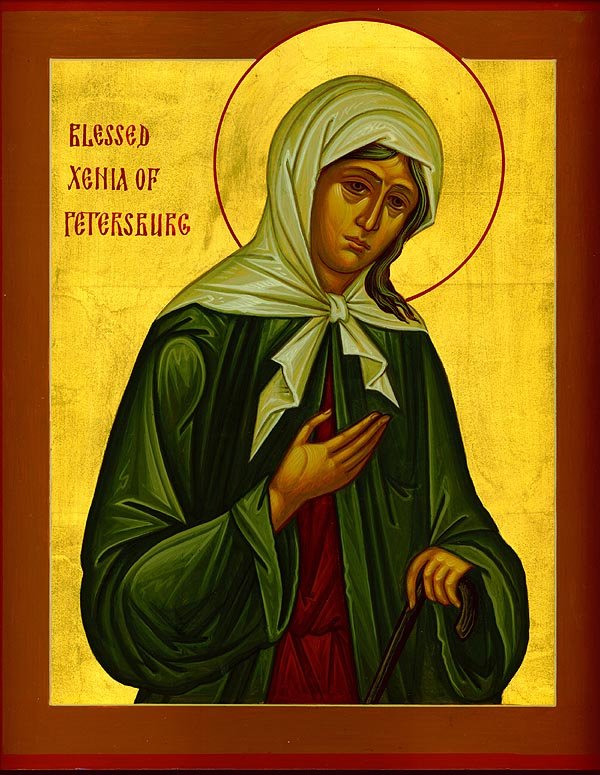
Bl. Xenia of St Petersburg
Saint Xenia lived during the eighteenth century, but little is known of her life or of her family. She passed most of her life in Petersburg during the reigns of the empresses Elizabeth and Catherine II.
Xenia Grigorievna Petrova was the wife of an army officer, Major Andrew Petrov. After the wedding, the couple lived in Saint Petersburg.
Saint Xenia lived during the eighteenth century, but little is known of her life or of her family. She passed most of her life in Petersburg during the reigns of the empresses Elizabeth and Catherine II.
Xenia Grigorievna Petrova was the wife of an army officer, Major Andrew Petrov. After the wedding, the couple lived in Saint Petersburg. Saint Xenia became a widow at the age of twenty-six when her husband suddenly died at a party. She grieved for the loss of her husband, and especially because he died without Confession or Holy Communion.
Once her earthly happiness ended, she did not look for it again. From that time forward, Xenia lost interest in the things of this world, and followed the difficult path of foolishness for the sake of Christ. The basis for this strange way of life is to be found in the first Epistle to the Corinthians (1 Cor. 1:18-24, 1 Cor. 2:14, 1 Cor. 3:18-19). The Lord strengthened her and helped her to bear sorrow and misfortune patiently for the next forty-five years.
She started wearing her husband’s clothing, and insisted that she be addressed as “Andrew Feodorovich.” She told people that it was she, and not her husband, who had died. In a certain sense, this was perfectly true. She abandoned her former way of life and experienced a spiritual rebirth. When she gave away her house and possessions to the poor, her relatives complained to the authorities. After speaking to Xenia, the officials were convinced that she was in her right mind and was entitled to dispose of her property as she saw fit. Soon she had nothing left for herself, so she wandered through the poor section of Petersburg with no place to lay her head. She refused all assistance from her relatives, happy to be free of worldly attachments.
When her late husband’s red and green uniform wore out, she clothed herself in rags of those colors. After a while, Xenia left Petersburg for eight years. It is believed that she visited holy Elders and ascetics throughout Russia seeking instruction in the spiritual life. She may have visited Saint Theodore of Sanaxar (February 19), who had been a military man himself. His life changed dramatically when a young officer died at a drinking party. Perhaps this officer was Saint Xenia’s husband. In any case, she knew Saint Theodore and profited from his instructions.
Saint Xenia eventually returned to the poor section of Petersburg, where she was mocked and insulted because of her strange behavior. When she did accept money from people it was only small amounts, which she used to help the poor. She spent her nights praying without sleep in a field outside the city. Prayer strengthened her, and in her heart’s conversation with the Lord she found the support she needed on her difficult path.
When a new church was being built in the Smolensk cemetery, Saint Xenia brought bricks to the site. She did this in secret, during the night, so that no one would know.
Soon her great virtue and spiritual gifts began to be noticed. She prophesied future events affecting the citizens of Petersburg, and even the royal family. Against her will, she became known as someone pleasing to God, and nearly everyone loved her. They said, “Xenia does not belong to this world, she belongs to God.” People regarded her visits to their homes or shops as a great blessing. Saint Xenia loved children, and mothers rejoiced when the childless widow would stand and pray over a baby’s crib, or kiss a child. They believed that the blessed one’s kiss would bring that child good fortune.
Saint Xenia lived about forty-five years after the death of her husband, and departed to the Lord at the age of seventy-one. The exact date and circumstances of her death are not known, but it probably took place at the end of the eighteenth century. She was buried in the Smolensk cemetery.
By the 1820s, people flocked to her grave to pray for her soul, and to ask her to intercede with God for them. So many visitors took earth from her grave that it had to be replaced every year. Later, a chapel was built over her grave.
Those who turn to Saint Xenia in prayer receive healing from illness, and deliverance from their afflictions. She is also known for helping people who seek jobs.
Troparion - Tone 5
Having lived as a stranger in the world, / you outwitted the deviser of evil / by your pretended foolishness, O Xenia. / You received the grace from God / to foresee and foretell things to come. / Now, as you have been translated from earth to heaven, / you are numbered with the choirs of the angels.
Kontakion - Tone 4
You gave your wealth to the poor, O Xenia, / and accepted poverty out of love for Christ; / having lived a life rivaling the angels, you were accounted worthy of glory on high.
Our Holy Mother Xenia of Petersburg, fool for Christ (ca. 1800)
She was born about 1730, and as a young woman married an army colonel named Andrei, a handsome and dashing man fond of worldly living. When she was twenty-six years old, her husband died suddenly after drinking with his friends, leaving Xenia a childless widow. Soon afterward, she gave away all her possessions and disappeared from St Petersburg for eight years; it is believed that she spent the time in a hermitage, or even a monastery, learning the ways of the spiritual life.
She was born about 1730, and as a young woman married an army colonel named Andrei, a handsome and dashing man fond of worldly living. When she was twenty-six years old, her husband died suddenly after drinking with his friends, leaving Xenia a childless widow. Soon afterward, she gave away all her possessions and disappeared from St Petersburg for eight years; it is believed that she spent the time in a hermitage, or even a monastery, learning the ways of the spiritual life. When she returned to St Petersburg, she appeared to have lost her reason: she dressed in her husband’s army overcoat, and would only answer to his name. She lived without a home, wandering the streets of the city, mocked and abused by many. She accepted alms from charitable people, but immediately gave them away to the poor: her only food came from meals that she sometimes accepted from those she knew. At night she withdrew to a field outside the city where she knelt in prayer until morning.
Slowly, the people of the city noticed signs of a holiness that underlay her seemingly deranged life: she showed a gift of prophecy, and her very presence almost always proved to be a blessing. The Synaxarion says “The blessing of God seemed to accompany her wherever she went: when she entered a shop the day’s takings would be noticeably greater; when a cabman gave her a lift he would get plenty of custom; when she embraced a sick child it would soon get better. So compassion, before long, gave way to veneration, and people generally came to regard her as the true guardian angel of the city.”
Forty-five years after her husband’s death, St Xenia reposed in peace at the age of seventy-one, sometime around 1800. Her tomb immediately became a place of pilgrimage: so many people took soil from the gravesite as a blessing that new soil had to be supplied regularly; finally a stone slab was placed over the grave, but this too was gradually chipped away by the faithful. Miracles, healings and appearances of St Xenia occur to this day, to those who visit her tomb or who simply ask her intercessions. Her prayers are invoked especially for help in finding employment, a home, or a spouse (all of which she renounced in her own life). A pious custom is to offer a Panachida / Trisagion Service for the repose of her husband Andrei, for whom she prayed fervently throughout her life.
Saint Xenia was first officially glorified by the Russian Orthodox Church outside Russia in 1978; then by the Moscow Patriarchate in 1988.
Vavylas the Holy Martyr
Our Holy Father Macedonian (ca. 430)
He lived in asceticism in the wild hills outside Antioch. For forty-five years he had no tent or house of any kind, but wandered from place to place, living in caves or in clefts. In his old age, his disciples finally prevailed on him to build a small hut. Altogether he spent seventy years living in solitary ascesis.
He lived in asceticism in the wild hills outside Antioch. For forty-five years he had no tent or house of any kind, but wandered from place to place, living in caves or in clefts. In his old age, his disciples finally prevailed on him to build a small hut. Altogether he spent seventy years living in solitary ascesis.
Once a hunter met the recluse and asked him what he did in the mountains. The Saint answered ‘Like you, I have come to the mountain to hunt. I am hunting for God, whom I long to see. I ardently desire to catch Him and will never tire of so excellent a chase!’
Once the people of Antioch rioted and tore down a pair of statues of the Emperor Theodosius and his wife. Two generals came from Constantinople, planning to inflict a bloody punishment on the people. Saint Macedonian, learning of this, came to the city and sought out the generals, asking them to take a message to the Emperor: that he, being human and subject to weakness like all men, should not be immoderately angry with other men; and that he should not, in return for the destruction of lifeless images, destroy those who are the very image of God.
During his lifetime Saint Macedonian was granted the gifts of spiritual insight and wonderworking, by which he worked many miracles of healing for the people of Antioch and its surroundings. He reposed in peace around 430, and was buried with honor in Antioch.
Scripture Readings
☩Epistle
Colossians 3:4-11
4
When Christ, who is our life, shall appear, then shall ye also appear with him in glory.
5
Mortify therefore your members which are upon the earth; fornication, uncleanness, inordinate affection, evil concupiscence, and covetousness, which is idolatry:
6
For which things’ sake the wrath of God cometh on the children of disobedience:
7
In the which ye also walked some time, when ye lived in them.
8
But now ye also put off all these; anger, wrath, malice, blasphemy, filthy communication out of your mouth.
9
Lie not one to another, seeing that ye have put off the old man with his deeds;
10
And have put on the new man, which is renewed in knowledge after the image of him that created him:
11
Where there is neither Greek nor Jew, circumcision nor uncircumcision, Barbarian, Scythian, bond nor free: but Christ is all, and in all.
☩Gospel
Luke 18:35-43
35
And it came to pass, that as he was come nigh unto Jericho, a certain blind man sat by the way side begging:
36
And hearing the multitude pass by, he asked what it meant.
37
And they told him, that Jesus of Nazareth passeth by.
38
And he cried, saying, Jesus, thou Son of David, have mercy on me.
39
And they which went before rebuked him, that he should hold his peace: but he cried so much the more, Thou Son of David, have mercy on me.
40
And Jesus stood, and commanded him to be brought unto him: and when he was come near, he asked him,
41
Saying, What wilt thou that I shall do unto thee? And he said, Lord, that I may receive my sight.
42
And Jesus said unto him, Receive thy sight: thy faith hath saved thee.
43
And immediately he received his sight, and followed him, glorifying God: and all the people, when they saw it, gave praise unto God.
Liturgical data sourced from OCA.org and orthocal.info