
Fasting Rules
 Meat
Allowed
 Fish
Allowed
 Dairy
Allowed
 Oil
Allowed
 Wine
Allowed
Saints & Commemorations
Ven. Ephrem the Syrian
He is often called “The Harp of the Holy Spirit” for the sublimity of his writings. He was born in Nisibis of Mesopotamia about the year 306. He embraced the Christian faith while young and for this was driven from his home by his father, a pagan priest. He came under the care of St James of Nisibis (January 13), who was one of the bishops at the Council of Nicaea. He
He is often called “The Harp of the Holy Spirit” for the sublimity of his writings. He was born in Nisibis of Mesopotamia about the year 306. He embraced the Christian faith while young and for this was driven from his home by his father, a pagan priest. He came under the care of St James of Nisibis (January 13), who was one of the bishops at the Council of Nicaea. He took up a strictly ascetical life, renouncing all possessions and denying himself all comforts. It is said that his eyes constantly flowed with tears: tears of compunction for his own sins, or tears of joy as he contemplated the wonders of God’s grace.
He was baptized at the age of twenty and withdrew to the desert, then settled in Edessa. Once, as he was walking to the city, a harlot approached him. Pretending to accept her proposition, he took her to the city’s public square and suggested that they lie together there, in plain view. Horrified, the woman rebuked him, saying ‘Have you no shame?’ The Saint answered, ‘Poor woman, you are afraid of being watched by other people; but why are you not afraid of being seen by God, who sees everything and, on the last day, will judge all our actions and most secret thoughts?’ The woman repented and, with the Saint’s help, embarked upon a new life.
The Saint returned to the desert for a time, then to Nisibis to aid the Persian Christians, persecuted because they were seen as allies of the Romans. When Nisibis finally fell under Persian rule, St Ephraim and his spiritual father St James both settled in Edessa. At that time Edessa was troubled by the gnostic heretic Bardaisan, one of whose devices was to compose attractive hymns, which became popular and enticed many away from the truth. Taking up Bardaisan’s own weapons, St Ephraim composed a number of hymns, beautiful in word and melody, which poetically set forth the true Faith.
Hearing of the sanctity of St Basil the Great, St Ephraim traveled to Cappadocia to meet him. It is recorded that at their first meeting, St Basil greeted him: ‘Art thou the Ephraim who hath beautifully bended his neck and taken upon himself the yoke of the saving Word?’; to which St Ephraim replied, ‘I am Ephraim who hinder myself from traveling the way to heaven.’ After discoursing with the Syrian Saint for some time, St Basil cried out ‘O, if only I had thy sins!’ Basil then ordained St Ephraim to the diaconate. He would have ordained him a priest but St Ephraim, feeling unworthy, refused to be ordained, then and for the rest of his life.
The Saint returned to a life of solitude; but when a famine broke out in Edessa in 372, he came forth to rebuke the wealthy for failing to share their wealth with the poor. Some replied that they knew no one whom they could trust with their goods, so St Ephraim persuaded them to give their alms to him for distribution to the poor. A true deacon, he cared for the sick with his own hands. The following year, he reposed in peace.
St Ephraim was the first to use hymnody and song to express the teaching of the Church, and so might be called the Church’s first hymnographer. His works were probably an inspiration to St Romanos the Melodist, also a Syrian. He is said to have written more than three million lines of verse in Syriac, in addition to many homilies and treatises. Only a fraction of his work has been translated.
A beautiful selection of St Ephraim’s writings can be found in A Spiritual Psalter, a collection edited by St Theophan the Recluse, available in English.
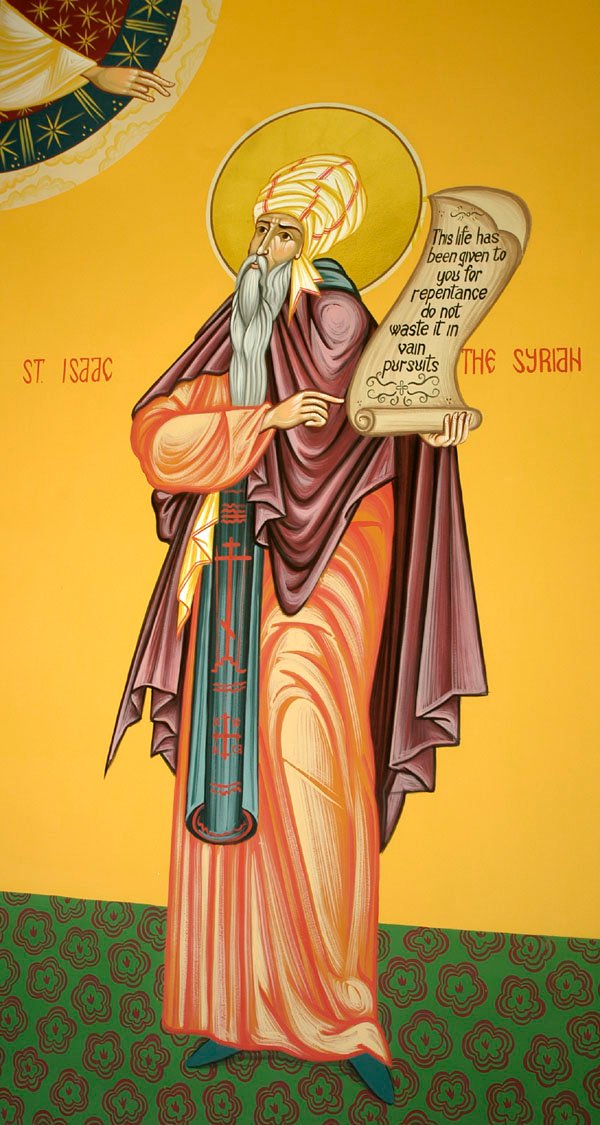
Our Holy Father Isaac the Syrian, bishop of Nineveh (7th c.)
Saint Isaac the Syrian, Bishop of Ninevah, lived during the sixth century. He and his brother entered the monastery of Mar Matthew near Ninevah and received the monastic tonsure. His learning, virtue, and ascetic manner of life attracted the notice of the brethren, and they proposed that he head the monastery.
Saint Isaac the Syrian, Bishop of Ninevah, lived during the sixth century. He and his brother entered the monastery of Mar Matthew near Ninevah and received the monastic tonsure. His learning, virtue, and ascetic manner of life attracted the notice of the brethren, and they proposed that he head the monastery. Saint Issac did not want this burden, preferring a life of silence, so he left the monastery to live alone in the desert.
His brother urged him more than once to return to the monastery, but he would not agree. However, when the fame of Saint Isaac’s holy life had spread, he was made Bishop of Ninevah. Seeing the crude manners and disobedience of the inhabitants of the city, the saint felt that it was beyond his ability to guide them, and moreover, he yearned for solitude.
Once, two Christians came to him, asking him to settle a dispute. One man acknowledged that he owed money to the other, but asked for a short extension. The lender threatened to bring his debtor to court to force him to pay. Saint Isaac, citing the Gospel, asked him to be merciful and give the debtor more time to pay. The man said, “Leave your Gospel out of this!” Saint Isaac replied, “If you will not submit to Lord’s commandments in the Gospel, then what remains for me to do here?” After only five months as bishop, Saint Isaac resigned his office and went into the mountains to live with the hermits. Later, he went to the monastery of Rabban Shabur, where he lived until his death, attaining a high degree of spiritual perfection.
From the early eighth century until the beginning of the eighteenth century, nothing was known about Saint Isaac of Syria in Europe except for his name and works. Only in 1719 was a biography of the saint published at Rome, compiled by an anonymous Arab author. In 1896, more information on Saint Isaac came to light. The learned French soteriologist Abbot Chabot published some eighth century works on Syrian history by Iezudena, bishop of Barsa, where the account of Saint Isaac the Syrian was found.
Troparion - Tone 4
In truth you were revealed to your flock as a rule of faith, / an image of humility and a teacher of abstinence; / your humility exalted you; / your poverty enriched you. / Hierarch Father Isaac, / entreat Christ our God / that our souls may be saved.
Kontakion - Tone 2
O Hierarch Isaac, divine thunder, spiritual trumpet, / planter of faith and pruner of heresies, great favorite of the Trinity, / while standing with the Angels before God, / pray unceasingly for us all.
Palladios the Hermit of Antioch
Saint Palladius the Desert Dweller led an ascetical life in a certain mountain cave near Syrian Antioch. Because of his struggles, he received from the Lord a gift of wonderworking. Once, a merchant was found murdered by robbers near his cave. People accused Saint Palladius of the murder, but through the prayer of the saint, the dead man rose up and named his murderers.
Saint Palladius the Desert Dweller led an ascetical life in a certain mountain cave near Syrian Antioch. Because of his struggles, he received from the Lord a gift of wonderworking. Once, a merchant was found murdered by robbers near his cave. People accused Saint Palladius of the murder, but through the prayer of the saint, the dead man rose up and named his murderers. The saint died at the end of the fourth century, leaving behind several edifying works.
Troparion - Tone 8
By a flood of tears you made the desert fertile, / and your longing for God brought forth fruits in abundance. / By the radiance of miracles you illumined the whole universe! / O our holy father Palladius, pray to Christ our God to save our souls!
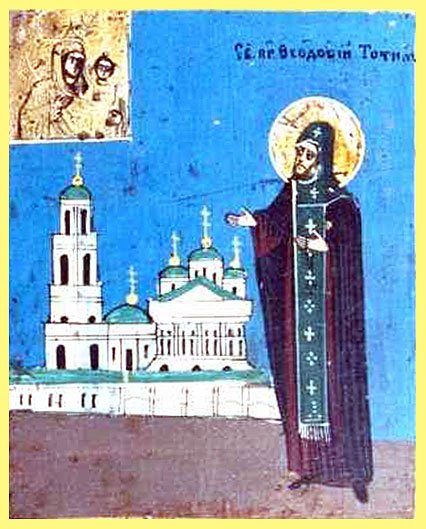
Theodosius of Totma
Saint Theodosius of Totma was born at Vologda about the year 1530. In his youth he was raised in a spirit of Christian piety and the fear of God. At the insistence of his parents he married, but family life did not turn him away from God. He went fervently to church and prayed at home, particularly at night.
Saint Theodosius of Totma was born at Vologda about the year 1530. In his youth he was raised in a spirit of Christian piety and the fear of God. At the insistence of his parents he married, but family life did not turn him away from God. He went fervently to church and prayed at home, particularly at night. After the death of his parents and his wife, he withdrew to the Priluki monastery not far from Vologda.
At the monastery Theodosius passed through the various obediences: he carried water, chopped fire-wood, milled flour and baked bread. He went to Totma on the igumen’s orders to search for a salt-works for the monastery. He sought the permission of Tsar Ivan Vasilevich and the blessing of Archbishop Nicander to found a monastery at Totma. Theodosius was appointed head of this newly-formed Totma monastery, which in a grant of 1554 was declared free of taxation.
The saint founded the Totma Ephraimov wilderness monastery and brought brethren into it. Eventually becoming the head of two monasteries, Theodosius continued to lead an ascetic life. He wore down his body by wearing chains and a hairshirt, and beneath his monastic cowl he wore an iron cap. Fond of spiritual reading, he acquired many books for the monastery. Saint Theodosius reposed in the year 1568 and was buried in the monastery he founded, and miracles occurred at his grave.
On September 2, 1796 during the reconstruction of the Ascension church, his relics were found incorrupt, and their glorification took place on January 28, 1798, on the day of his repose.
Troparion - Tone 8
By a flood of tears you made the desert fertile, / and your longing for God brought forth fruits in abundance. / By the radiance of miracles you illumined the whole universe! / O our holy father Theodosius, pray to Christ our God to save our souls!
Scripture Readings
☩Epistle
Hebrews 10:35-11:7
35
Cast not away therefore your confidence, which hath great recompence of reward.
36
For ye have need of patience, that, after ye have done the will of God, ye might receive the promise.
37
For yet a little while, and he that shall come will come, and will not tarry.
38
Now the just shall live by faith: but if any man draw back, my soul shall have no pleasure in him.
39
But we are not of them who draw back unto perdition; but of them that believe to the saving of the soul.
1
Now faith is the substance of things hoped for, the evidence of things not seen.
2
For by it the elders obtained a good report.
3
Through faith we understand that the worlds were framed by the word of God, so that things which are seen were not made of things which do appear.
4
By faith Abel offered unto God a more excellent sacrifice than Cain, by which he obtained witness that he was righteous, God testifying of his gifts: and by it he being dead yet speaketh.
5
By faith Enoch was translated that he should not see death; and was not found, because God had translated him: for before his translation he had this testimony, that he pleased God.
6
But without faith it is impossible to please him: for he that cometh to God must believe that he is, and that he is a rewarder of them that diligently seek him.
7
By faith Noah, being warned of God of things not seen as yet, moved with fear, prepared an ark to the saving of his house; by the which he condemned the world, and became heir of the righteousness which is by faith.
☩Gospel
Mark 9:10-16
10
And they kept that saying with themselves, questioning one with another what the rising from the dead should mean.
11
And they asked him, saying, Why say the scribes that Elias must first come?
12
And he answered and told them, Elias verily cometh first, and restoreth all things; and how it is written of the Son of man, that he must suffer many things, and be set at nought.
13
But I say unto you, That Elias is indeed come, and they have done unto him whatsoever they listed, as it is written of him.
14
And when he came to his disciples, he saw a great multitude about them, and the scribes questioning with them.
15
And straightway all the people, when they beheld him, were greatly amazed, and running to him saluted him.
16
And he asked the scribes, What question ye with them?
Liturgical data sourced from OCA.org and orthocal.info