
Fasting Rules
 Meat
Allowed
 Fish
Allowed
 Dairy
Allowed
 Oil
Allowed
 Wine
Allowed
Saints & Commemorations
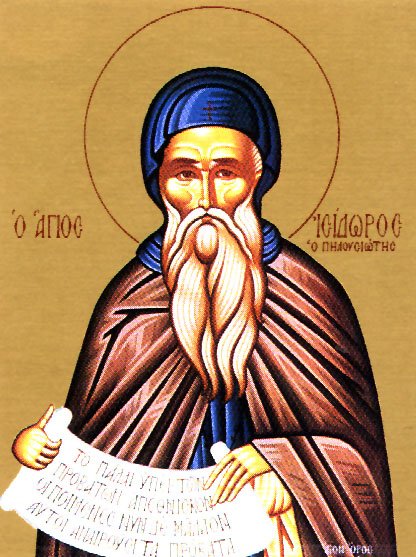
Ven. Isidore of Pelusium
Saint Isidore of Pelusium lived during the fourth-fifth centuries. He was a native of Alexandria, and was raised among pious Christians. He was a relative of Theophilus, Archbishop of Alexandria, and of his successor, Saint Cyril (January 18). While still a youth he quit the world and withdrew to Egypt to Mount Pelusium, which became the site of his monastic efforts.
Saint Isidore of Pelusium lived during the fourth-fifth centuries. He was a native of Alexandria, and was raised among pious Christians. He was a relative of Theophilus, Archbishop of Alexandria, and of his successor, Saint Cyril (January 18). While still a youth he quit the world and withdrew to Egypt to Mount Pelusium, which became the site of his monastic efforts.
Saint Isidore’s spiritual wisdom and strict asceticism, combined with his broad learning and innate knowledge of the human soul, enabled him to win the respect and love of his fellow monks in a short time. They chose him as their head and had him ordained a priest (the earliest sources for his life, however, say nothing of him being an igumen).
Following the example of Saint John Chrysostom, whom he had managed to see and hear during a trip to Constantinople, Saint Isidore devoted himself primarily to Christian preaching, that “practical wisdom” which, in his own words, is both “the foundation of the edifice and the edifice itself”, while logic is “its embellishment, and contemplation its crown”.
He was a teacher and a willingly provided counsel for anyone who turned to him for spiritual encouragement, whether it was a simple man, a dignitary, a bishop, the Patriarch of Alexandria, or even the emperor. He left behind about 10,000 letters, of which 2,090 have survived. A large portion of these letters reveal profound theological thought and contain morally edifying interpretations of Holy Scripture. Saint Photius (February 6) calls Isidore a model of priestly and ascetical life, and also a master of style.
Saint Isidore’s love for Saint John Chrysostom resulted in his support of Saint John when he was persecuted by the empress Eudoxia and Archbishop Theophilus. After the death of Saint John, Saint Isidore persuaded Theophilus’ successor Saint Cyril to inscribe the name of Saint John Chrysostom into the Church diptychs as a confessor. Through the initiative of Saint Isidore the Third Ecumenical Council was convened at Ephesus (431), at which the false teaching of Nestorius concerning the person of Jesus Christ was condemned.
Saint Isidore lived into old age and died around the year 436. The Church historian Evagrius (sixth century) writes of Saint Isidore, “his life seemed to everyone the life of an angel upon the earth.” Another historian, Nikēphóros Callistus (ninth century), praises Saint Isidore thus: “He was a vital and inspired pillar of monastic rules and divine vision, and as such he presented a very lofty image of most fervent example and spiritual teaching.”
Troparion - Tone 4
In your wisdom you adorned the Church of Christ gloriously with your many homilies, / O Venerable Isidore, / you were purified by abstinence, great deeds, and divine vision, / and you shone forth in the world. / By your words, O Father, we are guided and initiated into a more excellent life.
Kontakion - Tone 4
Finding you to be another morning star, O glorious one, / the Church is illumined by the brilliance of your words, / and she cries out to you: “Rejoice, most blessed and godly-minded Isidore.”
Venerable Cyril of New Lake (Novoezezrsk) (1532)
When he was only fifteen, St Cyril left home in secret to join the Monastery of St Cornelius of Komel (May 19). Seven years later his father visited the monastery and recognized his son. Instead of persuading Cyril to return to the world, the father was persuaded by his son to enter monastic life; his mother soon joined them, entering a convent nearby.
When he was only fifteen, St Cyril left home in secret to join the Monastery of St Cornelius of Komel (May 19). Seven years later his father visited the monastery and recognized his son. Instead of persuading Cyril to return to the world, the father was persuaded by his son to enter monastic life; his mother soon joined them, entering a convent nearby. Within the next few years, St Cyril’s mother and father both died, prompting him to exclaim ‘I too am mortal!’ He redoubled his ascetical labors and before long was granted the gift of tears in prayer. Ten years after entering the monastery, St Cyril obtained his abbot’s blessing to live the life of a hermit. He lived in complete reclusion, subsisting on wild greens and mushrooms. After seven years of solitude, he built a hermitage at New Lake and established two churches there. Soon he was ordained to the priesthood. His sanctity attracted a large company of disciples, and he founded a large monastery. There he continued to live in the strictest asceticism and shared in all the common labor of the monks. Once some thieves tried to steal the church bells, but by divine intervention became disoriented and circled the monastery in the dark until morning. When they were apprehended and brought to the Saint, he told them, ‘My children, no one has ever been enriched by stealing, but many have lost even what belonged to them.’ He then ordered that they be given food and released.
During his lifetime the Saint wrought many healings, and was especially known for restoring the sight of the blind. Once his disciple Athanasius saw an unknown deacon serving with St Cyril at the Liturgy. The mysterious deacon disappeared at the end of the service, and St Cyril forbade his disciple to speak of the incident until after his death. In 1532 the Saint reposed in peace: his last words were ‘Glory to God for all things!’
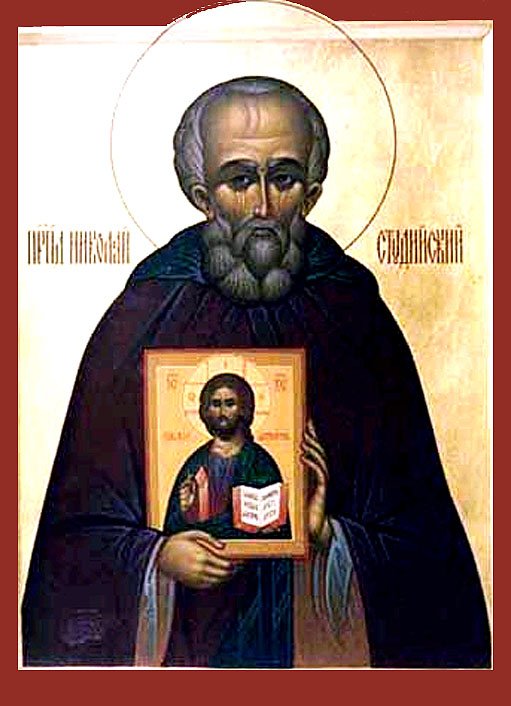
Nicholas the Confessor
Saint Nicholas the Confessor, Igumen of the Studion Monastery, lived during the ninth century. He was born on the island of Crete in the village of Kedonia into a Christian family. When he was ten, his parents sent him to Constantinople to his uncle, Saint Theophanes (October 11), who was a monk at the Studion monastery.
Saint Nicholas the Confessor, Igumen of the Studion Monastery, lived during the ninth century. He was born on the island of Crete in the village of Kedonia into a Christian family. When he was ten, his parents sent him to Constantinople to his uncle, Saint Theophanes (October 11), who was a monk at the Studion monastery. With the approval of Saint Theodore (November 11), the head of the Studion monastery, the boy was enrolled in the monastery school. When he finished school at sixteen years of age, he was tonsured a monk. After several years, he was ordained a priest.
During this time there was a fierce persecution, initiated by the Byzantine emperor Leo the Armenian (813-820), against those who venerated the holy icons. Saint Nicholas and Saint Theodore the Studite were repeatedly locked up in prison, tortured in various ways, and humiliated. However, they zealously continued to defend Orthodoxy.
Under the holy Empress Theodora (February 11), who ruled the realm while her son Michael was still a minor, icon veneration was restored, and a time of relative peace followed. Saint Nicholas returned to the Studite monastery and was chosen its head. But this calm did not last very long.
The Empress Theodora was removed from the throne, and the emperor’s uncle, Bardas, a man who defiled himself by open cohabitation with his son’s wife, came to power. The attempts of Patriarch Ignatius (October 23) to restrain the impiety of Bardas proved unsuccessful. On the contrary, he was deposed from the patriarchal throne and sent into exile.
Unwilling to witness the triumph of iniquity, Saint Nicholas left Constantinople. He spent seven years at various monasteries. Later on, he returned as a prisoner to the Studite monastery, where he spent two years imprisoned, until the death of the emperor Michael (855-867) and Bardas. When the emperor Basil I the Macedonian (867-886) ascended the throne, Saint Nicholas was set free, and again became igumen on the orders of the emperor. Because of his life as a confessor and ascetic he received from God the gift of healing, which continued even after his repose in the year 868.
Troparion - Tone 3
O Studite Nicholas, you were shown as the divine offspring of Kydonίa and a model of the monastic life; / and you revered the Icon of Christ, / excelling in the struggles of your confession. / O Venerable Father, / intercede with Christ God, that He may grant us great mercy.
Kontakion - Tone 8
You arose from Kydonίa as a brilliant luminary, / and illuminated the fullness of the Church by your steadfast confession O God-bearer. / You clarified the veneration of the Icon of Christ by your struggles and pains. / Therefore we cry out: “Rejoice, Father Nicholas.”
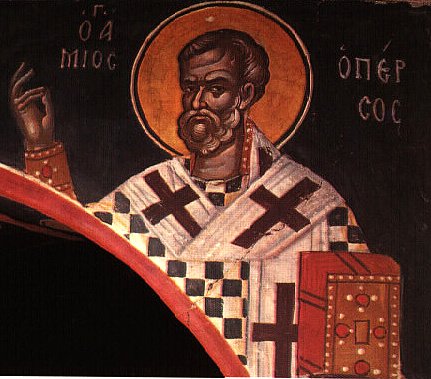
Hieromartyr Abramius
The Hieromartyr Abramius, Bishop of Arbela, suffered during a persecution against Christians in Persia under the emperor Sapor II. When they demanded that the saint renounce Christ and worship the sun, he answered, “How foolish to forsake the Creator and instead worship creatures! Isn’t the sun just a creation of my God?”
After this, they fiercely beat and tortured him. Saint
The Hieromartyr Abramius, Bishop of Arbela, suffered during a persecution against Christians in Persia under the emperor Sapor II. When they demanded that the saint renounce Christ and worship the sun, he answered, “How foolish to forsake the Creator and instead worship creatures! Isn’t the sun just a creation of my God?”
After this, they fiercely beat and tortured him. Saint Abramius prayed during torture, echoing the words of the Savior: “Lord, do not count this sin against them, for they know not what they do!” The hieromartyr was beheaded by the sword in the village of Felman.
Troparion - Tone 4
By sharing in the ways of the Apostles, / you became a successor to their throne. / Through the practice of virtue, you found the way to divine contemplation, O inspired one of God; / by teaching the word of truth without error, you defended the Faith, / even to the shedding of your blood. / Hieromartyr Abramius, entreat Christ God to save our souls.
Scripture Readings
☩Epistle
James 1:19-27
19
Wherefore, my beloved brethren, let every man be swift to hear, slow to speak, slow to wrath:
20
For the wrath of man worketh not the righteousness of God.
21
Wherefore lay apart all filthiness and superfluity of naughtiness, and receive with meekness the engrafted word, which is able to save your souls.
22
But be ye doers of the word, and not hearers only, deceiving your own selves.
23
For if any be a hearer of the word, and not a doer, he is like unto a man beholding his natural face in a glass:
24
For he beholdeth himself, and goeth his way, and straightway forgetteth what manner of man he was.
25
But whoso looketh into the perfect law of liberty, and continueth therein, he being not a forgetful hearer, but a doer of the work, this man shall be blessed in his deed.
26
If any man among you seem to be religious, and bridleth not his tongue, but deceiveth his own heart, this man’s religion is vain.
27
Pure religion and undefiled before God and the Father is this, To visit the fatherless and widows in their affliction, and to keep himself unspotted from the world.
☩Gospel
Mark 10:17-27
17
And when he was gone forth into the way, there came one running, and kneeled to him, and asked him, Good Master, what shall I do that I may inherit eternal life?
18
And Jesus said unto him, Why callest thou me good? there is none good but one, that is, God.
19
Thou knowest the commandments, Do not commit adultery, Do not kill, Do not steal, Do not bear false witness, Defraud not, Honour thy father and mother.
20
And he answered and said unto him, Master, all these have I observed from my youth.
21
Then Jesus beholding him loved him, and said unto him, One thing thou lackest: go thy way, sell whatsoever thou hast, and give to the poor, and thou shalt have treasure in heaven: and come, take up the cross, and follow me.
22
And he was sad at that saying, and went away grieved: for he had great possessions.
23
And Jesus looked round about, and saith unto his disciples, How hardly shall they that have riches enter into the kingdom of God!
24
And the disciples were astonished at his words. But Jesus answereth again, and saith unto them, Children, how hard is it for them that trust in riches to enter into the kingdom of God!
25
It is easier for a camel to go through the eye of a needle, than for a rich man to enter into the kingdom of God.
26
And they were astonished out of measure, saying among themselves, Who then can be saved?
27
And Jesus looking upon them saith, With men it is impossible, but not with God: for with God all things are possible.
Liturgical data sourced from OCA.org and orthocal.info