
Fasting Rules
 Meat
Abstain
 Fish
Abstain
 Dairy
Abstain
 Oil
Abstain
 Wine
Abstain
Saints & Commemorations
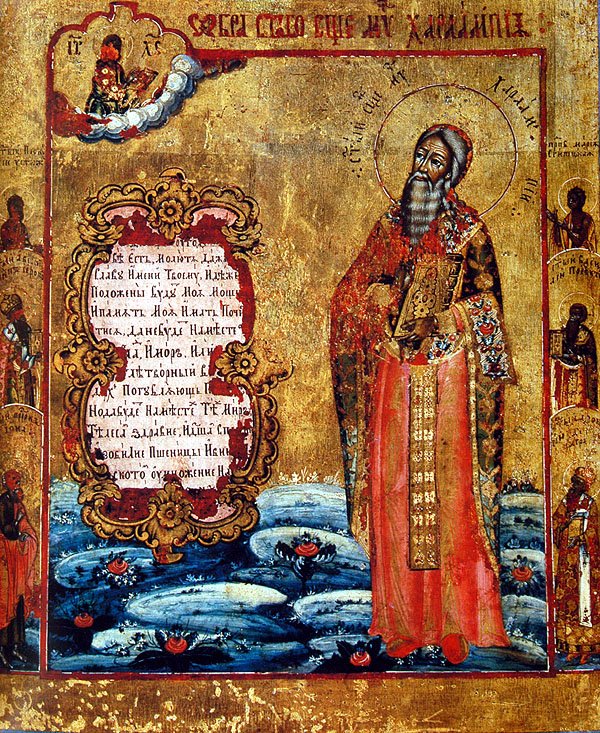
Hieromartyr Haralambos
The Hieromartyr Haralampus, Bishop of Magnesia, the martyrs Porphyrius and Baptus and three women martyrs suffered in the year 202.
Saint Haralampus, Bishop of Magnesia (Asia Minor), successfully spread faith in Christ the Savior, guiding people on the way to salvation. News of his preaching reached Lucian, the governor of the district, and the military commander Lucius.
The Hieromartyr Haralampus, Bishop of Magnesia, the martyrs Porphyrius and Baptus and three women martyrs suffered in the year 202.
Saint Haralampus, Bishop of Magnesia (Asia Minor), successfully spread faith in Christ the Savior, guiding people on the way to salvation. News of his preaching reached Lucian, the governor of the district, and the military commander Lucius. The saint was arrested and brought to trial, where he confessed his faith in Christ and refused to offer sacrifice to idols.
Despite the bishop’s advanced age (he was 113 years old), he was subjected to monstrous tortures. They lacerated his body with iron hooks, and scraped all the skin from his body. During this the saint turned to his tormentors, “I thank you, brethren, that you have restored my spirit, which longs to pass over to a new and everlasting life!”
Seeing the Elder’s endurance and his complete lack of malice, two soldiers (Porphyrius and Baptus) openly confessed Christ, for which they were immediately beheaded with a sword. Three women who were watching the sufferings of Saint Haralampus also began to glorify Christ, and were quickly martyred.
The enraged Lucius seized the instruments of torture and began to torture the holy martyr, but suddenly his forearms were cut off as if by a sword. The governor then spat in the face of the saint, and immediately his head was turned around so that he faced backwards.
Then Lucius entreated the saint to show mercy on him, and both torturers were healed through the prayers of Saint Haralampus. During this a multitude of witnesses came to believe in Christ. Among them also was Lucius, who fell at the feet of the holy bishop, asking to be baptized.
Lucian reported these events to the emperor Septimus Severus (193-211), who was then at Pisidian Antioch (western Asia Minor). The emperor ordered Saint Haralampus to be brought to him in Antioch. Soldiers twisted the saint’s beard into a rope, wound it around his neck, and used it to drag him along. They also drove an iron nail into his body. The emperor then ordered them to torture the bishop more intensely, and they began to burn him with fire, a little at a time. But God protected the saint, and he remained unharmed.
Many miracles were worked through his prayer: he raised a dead youth, and healed a man tormented by devils for thirty-five years, so that many people began to believe in Christ the Savior. Even Galina, the daughter of the emperor, began to believe in Christ, and twice smashed the idols in a pagan temple. On the orders of the emperor they beat the saint about the mouth with stones. They also wanted to set his beard on fire, but the flames burned the torturer.
Full of wickedness, Septimus Severus and an official named Crispus hurled blasphemy at the Lord, mockingly summoning Him to come down to the earth, and boasting of their own power and might. The Lord sent an earthquake, and great fear fell upon all, the impious ones were both suspended in mid-air held by invisible bonds, and only by the prayer of the saint were they put down. The dazed emperor was shaken in his former impiety, but again quickly fell into error and gave orders to torture the saint.
And finally, the emperor sentenced Saint Haralampus to beheading with a sword. During Saint Haralampus' final prayer, the heavens opened and the saint saw the Savior and a multitude of angels. The holy martyr asked Him to grant that the place where his relics would repose would never suffer famine or disease. He also begged that there would be peace, prosperity, and an abundance of fruit, grain, and wine in that place, and that the souls of these people would be saved. The Lord promised to fulfill his request and ascended to heaven, and the soul of the hieromartyr Haralampus followed after Him. By the mercy of God, the saint died before he could be executed. Galina buried the martyr’s body with great honor.
In Greek hagiography and iconography Saint Haralampus is regarded as a priest, while Russian sources seem to regard him as a bishop.
Troparion - Tone 4
You became a firm column in the Church of Christ, wise Haralampus; / a lamp of everlasting light to the world: / Well known to the world through your martyrdom, / you dispelled the dark night of idolatry. / Boldly intercede with Christ God that He may save our souls.
Kontakion - Tone 4
Your holy martyrs O Lord, / through their sufferings have received incorruptible crowns from You, our God. / For having Your strength, they laid low their adversaries, / and shattered the powerless boldness of demons. / Through their intercessions, save our souls!
Hieromartyr Haralambos (Charalampus), bishop of Magnesia (202)
“This great saint was bishop in Magnesia, and suffered for Christ at the age of 113. When a violent persecution broke out under the Emperor Septimus Severus, the aged Charalampus did not hide from his persecutors, but freely and openly preached the Christian faith. He endured all tortures as though not in the body, and when they flayed the living flesh from him, the godly saint said to the Emperor’s soldiers: ‘Thank you, my brethren, for scraping off the old body and renewing my soul for new and eternal life.’ He performed many wonders and brought many to the Faith. Even th
“This great saint was bishop in Magnesia, and suffered for Christ at the age of 113. When a violent persecution broke out under the Emperor Septimus Severus, the aged Charalampus did not hide from his persecutors, but freely and openly preached the Christian faith. He endured all tortures as though not in the body, and when they flayed the living flesh from him, the godly saint said to the Emperor’s soldiers: ‘Thank you, my brethren, for scraping off the old body and renewing my soul for new and eternal life.’ He performed many wonders and brought many to the Faith. Even the Emperor’s daughter, Gallina, repudiated the paganism of her father and became a Christian. Condemned to death and led to the place of execution, St Charalampus raised his arms to heaven and prayed for all men, that God would give them bodily health and salvation of soul, and that He would grant them the fruits of the earth in abundance: ‘Lord, Thou knowest that men are flesh and blood; forgive them their sins and pour out Thy blessing on all.’ After praying thus, the saintly elder gave his soul to God before the executioner had laid his sword to his neck. He suffered in 202. Gallina took his body and buried it.” (Prologue)
The Great Horologion puts his age at 103.
Martyrs Porphyrius and Baptus
St Scholastica of Italy, sister of St Benedict (543)
She was the twin sister of St Benedict, patriarch of monasticism in the West (March 14), and his constant fellow-laborer in the vineyard of Christ. They lived in neighboring monasteries; though they loved one another dearly, they met only once a year, spending the day in prayer and spiritual conversation, then parting after sharing a simple meal.
She was the twin sister of St Benedict, patriarch of monasticism in the West (March 14), and his constant fellow-laborer in the vineyard of Christ. They lived in neighboring monasteries; though they loved one another dearly, they met only once a year, spending the day in prayer and spiritual conversation, then parting after sharing a simple meal. At their meeting in 543, she prevailed on her brother (and the monk who accompanied him) to break his own monastic rule and stay with her in vigil through the night. Three days later, as Benedict looked out his cell window, he saw his sister’s soul in the form of a dove ascending to heaven.
Recommended: The Holy Twins: Benedict and Scholastica, a beautifully illustrated children’s book about the two Saints; by Kathleen Norris, illustrated by Tomie dePaola.
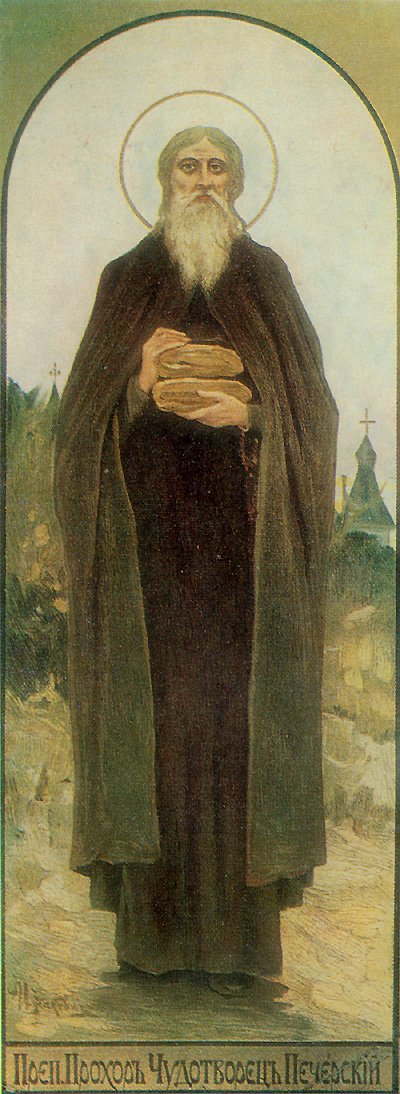
Our Venerable Father Prochorus of the Kiev Caves (1107)
Saint Prochorus of the Caves was a native of Smolensk, and entered the Kiev Caves monastery under the igumen John (1089-1103). He was a great ascetic of strict temperance. In place of bread he ate pigweed (or orach), and so he was called “pigweed-eater.” Every summer, he gathered pigweed and made enough bread from it to last him for a whole year. He
Saint Prochorus of the Caves was a native of Smolensk, and entered the Kiev Caves monastery under the igumen John (1089-1103). He was a great ascetic of strict temperance. In place of bread he ate pigweed (or orach), and so he was called “pigweed-eater.” Every summer, he gathered pigweed and made enough bread from it to last him for a whole year. He also ate prosphora from church now and then, and his only drink was water. Seeing the patience of Saint Prochorus, God transformed the usual bitterness of the pigweed into sweetness.
During the saint’s lifetime, a famine threatened Russia. Prochorus began to gather the pigweed even more zealously and to prepare his “bread”. Certain people followed his example, but they were not able to eat this weed because of its bitterness. Prochorus distributed his pigweed bread to the needy, and it tasted like it was made from fine wheat. Only the bread given with the blessing of Saint Prochorus was edible, and even pure and light in appearance. If anyone tried to prepare this bread himself, or take it without the saint’s blessing, it was not fit for consumption. This became known to the igumen and the brethren, and the fame of Prochorus spread far and wide.
After a certain while there was no salt at Kiev, and the people suffered because of this. Then the saint gathered ashes from all the cells, and began to distribute it to the needy. Through his prayers, the ashes became pure salt. The merchants, who hoped to take advantage of this shortage of salt for their own profit, became angry with Saint Prochorus for distributing free salt to the people.
Prince Svyatopolk confiscated the salt from Prochorus. When they transported it to the prince’s court, everyone saw that it was just ordinary ashes. After three days, Svyatopolk gave orders to discard it. Saint Prochorus blessed the people to take the discarded ashes, and they were again changed into salt.
This miracle reformed the fierce prince. He began to pray zealously, made peace with the igumen of the monastery of the Caves, and highly esteemed Saint Prochorus. When the last hour of the saint approached, the prince left his army and hastened to him, even though he was at war.
He received his blessing and with his own hands, carried the body of the saint to the cave and buried him. Returning to his army, Svyatopolk easily gained victory over the Polvetsians, turning them to flight and capturing their supply carts. Such was the great power of the prayer of Saint Prochorus.
The righteous one died in the year 1107, and was buried in the Near Caves. He is also commemorated on September 28 and on the second Sunday of Great Lent.
Troparion - Tone 8
By a flood of tears you made the desert fertile, / and your longing for God brought forth fruits in abundance. / By the radiance of miracles you illumined the whole universe! / O our holy father Prochorus, pray to Christ our God to save our souls!
Scripture Readings
☩Epistle
James 3:11-4:6
11
Doth a fountain send forth at the same place sweet water and bitter?
12
Can the fig tree, my brethren, bear olive berries? either a vine, figs? so can no fountain both yield salt water and fresh.
13
Who is a wise man and endued with knowledge among you? let him shew out of a good conversation his works with meekness of wisdom.
14
But if ye have bitter envying and strife in your hearts, glory not, and lie not against the truth.
15
This wisdom descendeth not from above, but is earthly, sensual, devilish.
16
For where envying and strife is, there is confusion and every evil work.
17
But the wisdom that is from above is first pure, then peaceable, gentle, and easy to be intreated, full of mercy and good fruits, without partiality, and without hypocrisy.
18
And the fruit of righteousness is sown in peace of them that make peace.
1
From whence come wars and fightings among you? come they not hence, even of your lusts that war in your members?
2
Ye lust, and have not: ye kill, and desire to have, and cannot obtain: ye fight and war, yet ye have not, because ye ask not.
3
Ye ask, and receive not, because ye ask amiss, that ye may consume it upon your lusts.
4
Ye adulterers and adulteresses, know ye not that the friendship of the world is enmity with God? whosoever therefore will be a friend of the world is the enemy of God.
5
Do ye think that the scripture saith in vain, The spirit that dwelleth in us lusteth to envy?
6
But he giveth more grace. Wherefore he saith, God resisteth the proud, but giveth grace unto the humble.
☩Gospel
Mark 11:22-26
22
And Jesus answering saith unto them, Have faith in God.
23
For verily I say unto you, That whosoever shall say unto this mountain, Be thou removed, and be thou cast into the sea; and shall not doubt in his heart, but shall believe that those things which he saith shall come to pass; he shall have whatsoever he saith.
24
Therefore I say unto you, What things soever ye desire, when ye pray, believe that ye receive them, and ye shall have them.
25
And when ye stand praying, forgive, if ye have ought against any: that your Father also which is in heaven may forgive you your trespasses.
26
But if ye do not forgive, neither will your Father which is in heaven forgive your trespasses.
Liturgical data sourced from OCA.org and orthocal.info