
Fasting Rules
 Meat
Abstain
 Fish
Abstain
 Dairy
Abstain
 Oil
Abstain
 Wine
Abstain
Saints & Commemorations
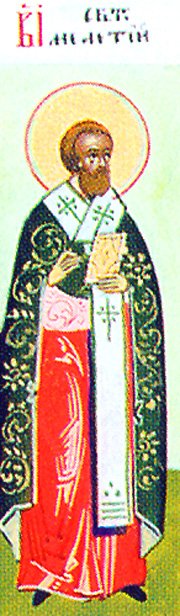
St Meletius, Archbishop of Antioch
Saint Meletius, Archbishop of Antioch, was Bishop of Sebaste in Armenia (ca. 357), and afterwards he was summoned to Antioch by the emperor Constantius to help combat the Arian heresy, and was appointed to that See.
Saint Meletius struggled zealously against the Arian error, but through the intrigues of the heretics he was thrice deposed from his cathedra by the Emperor Constantius who had become surrounded by the Arians and had accepted their position.
Saint Meletius, Archbishop of Antioch, was Bishop of Sebaste in Armenia (ca. 357), and afterwards he was summoned to Antioch by the emperor Constantius to help combat the Arian heresy, and was appointed to that See.
Saint Meletius struggled zealously against the Arian error, but through the intrigues of the heretics he was thrice deposed from his cathedra by the Emperor Constantius who had become surrounded by the Arians and had accepted their position. In all this Saint Meletius was distinguished by an extraordinary gentleness, and he constantly led his flock by the example of his own virtue and kindly disposition, supposing that the seeds of the true teaching sprout more readily on such soil.
Saint Meletius was the one who ordained the future hierarch Saint Basil the Great as deacon. Saint Meletius also baptized and encouraged another of the greatest luminaries of Orthodoxy, Saint John Chrysostom, who later eulogized his former archpastor.
After Constantius, the throne was occupied by Julian the Apostate, and the saint again was expelled, having to hide himself in secret places for his safety. Returning under the emperor Jovian in the year 363, Saint Meletius wrote his theological treatise, “Exposition of the Faith,” which facilitated the conversion of many of the Arians to Orthodoxy.
In the year 381, under the emperor Theodosius the Great (379-395), the Second Ecumenical Council was convened. In the year 380 the saint had set off on his way to the Second Ecumenical Council at Constantinople, and came to preside over it.
Before the start of the Council, Saint Meletius raised his hand displaying three fingers, and then withdrawing two fingers and leaving one extended he blessed the people, proclaiming: “We understand three hypostases, and we speak about a single nature.” With this declaration, a fire surrounded the saint like lightning. During the Council Saint Meletius fell asleep in the Lord. Saint Gregory of Nyssa honored the memory of the deceased with a eulogy.
Saint Meletius has left treatises on the consubstantiality of the Son of God with the Father, and a letter to the emperor Jovian concerning the Holy Trinity. The relics of Saint Meletius were transferred from Constantinople to Antioch.
Troparion - Tone 4
You appeared to your flock as a rule of faith, / an image of humility and a teacher of abstinence. / Because of your lowliness, Heaven was opened to you. / Because of your poverty, riches were granted to you. / O holy Bishop Meletios, pray to Christ our God to save our souls.
Kontakion - Tone 6
Fearing your spiritual boldness, the apostate Makedonios fled, / and we your servants, celebrating your service with love, flee to you as an intercessor, O Meletios, / converser with Angels, and fiery sword of Christ our God, smiting all the godless; / and we sing to you, as a lamp which enlightens all.
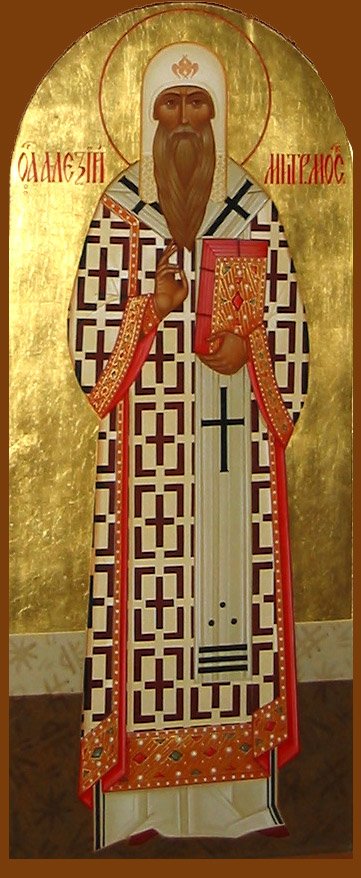
St Aleksy, Metr. of All Russia
Saint Alexei, Metropolitan of Moscow and All Russia the Wonderworker (in the world Eleutherios), was born in the year 1292 (or according to another source, 1304) at Moscow into the family of the noble Theodore Byakont, a descendant of the Chernigov princely line.
The Lord revealed to the future Saint his lofty destiny from early childhood.
Saint Alexei, Metropolitan of Moscow and All Russia the Wonderworker (in the world Eleutherios), was born in the year 1292 (or according to another source, 1304) at Moscow into the family of the noble Theodore Byakont, a descendant of the Chernigov princely line.
The Lord revealed to the future Saint his lofty destiny from early childhood. At twelve years of age Eleutherios went to a field and set nets to ensnare birds. He dozed off and suddenly he heard a voice: “Alexei! Why do you labor in vain? You are to be a catcher of men."
From this day on the boy abandoned childish games and spent much time in solitude. He often attended church, and when he was fifteen he decided to become a monk.
In 1320, he entered Moscow’s Theophany Monastery, where he spent more than twelve years in strict monastic struggles. The renowned ascetics of that monastery, the Elders Gerontios and Saint Stephen (July 14), the brother of Saint Sergius of Radonezh , were guides for him and his companions.
Metropolitan Theognostos, who noticed the virtuous life and spiritual gifts of Saint Alexei, bade the future Saint to leave the monastery and manage the ecclesiastical courts. The Saint fulfilled this office for twelve years. Toward the end of 1350, Metropolitan Theognostos had Alexei consecrated as Bishop of Vladimir. Following the Metropolitan's repose in the year 1354, Saint Alexei succeeded him.
During this period the Russian Church was torn by great rifts and quarrels, in part because of the pretensions of Metropolitan Romanos of Lithuania and Volhynia. In 1356, in order to put an end to the troubles and disturbances, the Saint went to Constantinople to see the Ecumenical Patriarch. Patriarch Kallistos gave Saint Alexei the right to be called, and to consider himself, as both Archbishop of Kiev and Great Russia with the title, “Most Venerable Metropolitan and Exarch.”
On his return journey, during a storm at sea, the ship was in danger of sinking. Saint Alexei prayed and vowed to build a temple to the Saint of that day on which the ship should come to shore. The storm subsided, and the ship arrived on August 16.
In spite of problems on every side, Saint Alexei devoted himself to his flock: he appointed bishops, and established cenobitic monasteries (on the model of the Trinity Lavra, founded by Saint Sergius), and he brought order to Russian relations with the Khans of the Horde. Saint Alexei journeyed more than once to the Golden Horde. In 1357 the Khan told the Great Prince that Saint Alexei should come to him and heal the blindness of his wife Taidulla.
“That is beyond my power,” Metropolitan Alexei replied, “but I believe that God, Who gave sight to the blind, will also help me.” By his prayers, and after sprinkling the Khan's wife with holy water, she was healed.
When Great Prince John died, his young son Demetrios (the future saint), then still a minor, was taken under the Saint Alexei's guardianship. The holy Hierarch had much difficulty in reconciling and appeasing the Princes, who obstinately refused to accept Moscow's authority. Nor did Vladyka Metropolitan neglect the work of establishing new monasteries.
In 1361 he founded a Monastery dedicated to the Icon of the Savior Not Made by Hands at the Yauza in Moscow. Andronikos, the disciple of Saint Sergius, was the first Igoumen of the Monastery, thus fulfilling the vow he had made on his return journey from Constantinople, when the ship was in danger.
Metropolitan Alexei also founded the Chudov Monastery 1 in the Moscow Kremlin. Ancient monasteries were restored: the Annunciation Monastery at Nizhni-Novgorod, and Saints Constantine and Helen at Vladimir. In 1361 a women’s cenobitic monastery was named for him (Alekse'ev).
Saint Alexei reached the advanced age of seventy-eight, having spent twenty-four years upon the metropolitan cathedra. He reposed on February 12, 1378 and was buried at the Chudov Monastery in accordance with his last wishes. His relics were uncovered in a miraculous manner fifty years later, after which the memory of the great holy Hierarch and intercessor began to be commemorated.
Saint Alexei is also commemorated on May 20 ( Recovery of his relics ) and on October 5 ( Synaxis of the Moscow Hierarchs ).
1 The Monastery is dedicated to the Miracle of the Archangel Michael (September 6).
Troparion - Tone 4
The fervent preserver of Apostolic dogmas, / the shepherd and teacher of the Russian Church: / By celebrating the memory of the blessed Hierarch Alexei / we glorify Christ our God in songs. / He has given us a faithful worker / and a fountain of healing grace, / the praise and confirmation of Orthodox Christians.
Kontakion - Tone 3
The luminous memorial of the Hierarch dispelled the sorrows of all, / and shone with the light of heavenly gifts, calling everyone to the Feast; / for the Hierarch Alexei has received from God the grace to drive away sickness and to heal all the people, / and for the monks he was revealed as the way (of ascent to God).
St Meletios, archbishop of Antioch (381)
Our holy father Meletios, an Armenian by birth, became archbishop of Antioch at the height of the Arian controversy. Though he was appointed by influential Arians who thought that he shared their views, as soon as he was raised to the throne he began to preach the consubstantiality of the Son with the Father.
Our holy father Meletios, an Armenian by birth, became archbishop of Antioch at the height of the Arian controversy. Though he was appointed by influential Arians who thought that he shared their views, as soon as he was raised to the throne he began to preach the consubstantiality of the Son with the Father. “At this, the archdeacon, an Arian, put his hand over the bishop’s mouth; Meletios then extended three fingers towards the people, closed them, and extended one only, showing by signs the equality and unity of the Trinity. The embarrassed archdeacon then seized his hand, but released his mouth, and Meletios spoke out even more forcibly in defense of the Council of Nicea” (Great Horologion). It was St Meletios who ordained St John Chrysostom reader and deacon in Antioch. He presided at the Second Ecumenical Council in 381. At his repose, St Gregory of Nyssa gave his funeral oration, lamenting: “Our Elijah has been caught up, and no Elisha is left behind in his place.”
Christos the New Martyr
Scripture Readings
☩Epistle
1 Peter 1:1-2, 10-12, 2:6-10
1
Peter, an apostle of Jesus Christ, to the strangers scattered throughout Pontus, Galatia, Cappadocia, Asia, and Bithynia,
2
Elect according to the foreknowledge of God the Father, through sanctification of the Spirit, unto obedience and sprinkling of the blood of Jesus Christ: Grace unto you, and peace, be multiplied.
10
Of which salvation the prophets have enquired and searched diligently, who prophesied of the grace that should come unto you:
11
Searching what, or what manner of time the Spirit of Christ which was in them did signify, when it testified beforehand the sufferings of Christ, and the glory that should follow.
12
Unto whom it was revealed, that not unto themselves, but unto us they did minister the things, which are now reported unto you by them that have preached the gospel unto you with the Holy Ghost sent down from heaven; which things the angels desire to look into.
6
Wherefore also it is contained in the scripture, Behold, I lay in Sion a chief corner stone, elect, precious: and he that believeth on him shall not be confounded.
7
Unto you therefore which believe he is precious: but unto them which be disobedient, the stone which the builders disallowed, the same is made the head of the corner,
8
And a stone of stumbling, and a rock of offence, even to them which stumble at the word, being disobedient: whereunto also they were appointed.
9
But ye are a chosen generation, a royal priesthood, an holy nation, a peculiar people; that ye should shew forth the praises of him who hath called you out of darkness into his marvellous light:
10
Which in time past were not a people, but are now the people of God: which had not obtained mercy, but now have obtained mercy.
☩Gospel
Mark 12:1-12
1
And he began to speak unto them by parables. A certain man planted a vineyard, and set an hedge about it, and digged a place for the winefat, and built a tower, and let it out to husbandmen, and went into a far country.
2
And at the season he sent to the husbandmen a servant, that he might receive from the husbandmen of the fruit of the vineyard.
3
And they caught him, and beat him, and sent him away empty.
4
And again he sent unto them another servant; and at him they cast stones, and wounded him in the head, and sent him away shamefully handled.
5
And again he sent another; and him they killed, and many others; beating some, and killing some.
6
Having yet therefore one son, his wellbeloved, he sent him also last unto them, saying, They will reverence my son.
7
But those husbandmen said among themselves, This is the heir; come, let us kill him, and the inheritance shall be ours.
8
And they took him, and killed him, and cast him out of the vineyard.
9
What shall therefore the lord of the vineyard do? he will come and destroy the husbandmen, and will give the vineyard unto others.
10
And have ye not read this scripture; The stone which the builders rejected is become the head of the corner:
11
This was the Lord’s doing, and it is marvellous in our eyes?
12
And they sought to lay hold on him, but feared the people: for they knew that he had spoken the parable against them: and they left him, and went their way.
Liturgical data sourced from OCA.org and orthocal.info