
Fasting Rules
 Meat
Allowed
 Fish
Allowed
 Dairy
Allowed
 Oil
Allowed
 Wine
Allowed
Saints & Commemorations
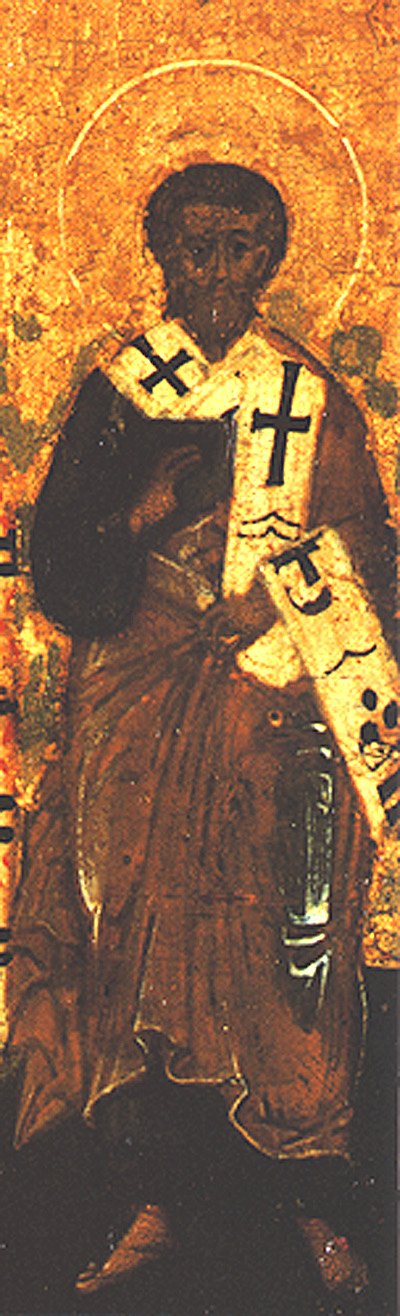
Apostle Onesimus of the Seventy
Saint Onesimus, Apostle of the Seventy in his youth was a servant of Philemon, a Christian of distinguished lineage, living in the city of Colossae, Phrygia. Guilty of an offense against his master and fearing punishment, Saint Onesimus fled to Rome, but as a runaway slave he wound up in prison. In prison he encountered the Apostle Paul, was enlightened by him, and was baptized.
Saint Onesimus, Apostle of the Seventy in his youth was a servant of Philemon, a Christian of distinguished lineage, living in the city of Colossae, Phrygia. Guilty of an offense against his master and fearing punishment, Saint Onesimus fled to Rome, but as a runaway slave he wound up in prison. In prison he encountered the Apostle Paul, was enlightened by him, and was baptized.
In prison Saint Onesimus served the Apostle Paul like a son. Saint Paul was personally acquainted with Philemon, and wrote him a letter filled with love, asking him to forgive the runaway slave and to accept him like a brother. He sent Saint Onesimus with this letter to his master, depriving himself of help, of which he was very much in need.
After he received the letter, Saint Philemon not only forgave Onesimus, but also sent him back to Rome to the apostle. Saint Philemon (January 4, February 19, and November 22) was afterwards consecrated bishop of the city of Gaza.
After the death of the Apostle Paul, Saint Onesimus served the apostles until their end, and he was made a bishop. After the death of the holy apostles he preached the Gospel in many lands and cities: in Spain, Carpetania, Colossae, Patras. In his old age, Saint Onesimus occupied the bishop’s throne at Ephesus, after the Apostle Timothy. When they took Saint Ignatius the God-Bearer (December 20) to Rome for execution, Bishop Onesimus came to meet with him with other Christians, as Saint Ignatius mentions in his Epistle to the Ephesians.
During the reign of the emperor Trajan (89-117), Saint Onesimus was arrested and brought to trial before the eparch Tertillus. He held the saint in prison for eighteen days, and then sent him to prison in the city of Puteoli. After a certain while, the eparch sent for the prisoner and, convincing himself that Saint Onesimus maintained his faith in Christ, had him stoned, after which they beheaded the saint with a sword. A certain illustrious woman took the body of the martyr and placed it in a silver coffin. This took place in the year 109.
Troparion - Tone 3
Holy Apostle Onesimus, / entreat the merciful God, / to grant our souls forgiveness of transgressions.
Kontakion - Tone 4
Like a beam of light you shone on the world, / illumined by Paul, the all-radiant sun, whose rays enlighten the world. / Therefore we honor you, glorious Onesimus.
Our Venerable Father Dalmatius of Siberia (1697)
Saint Dalmatius is venerated as a pioneer of the movement that took many ascetics to dwell in the wilderness of Siberia, establishing a new company of Desert Fathers and causing the Russian Far North to be called the ‘Northern Thebaid.’ He was born in Tobolsk and reared in piety by his family, recently-converted Tatars. Whe
Saint Dalmatius is venerated as a pioneer of the movement that took many ascetics to dwell in the wilderness of Siberia, establishing a new company of Desert Fathers and causing the Russian Far North to be called the ‘Northern Thebaid.’ He was born in Tobolsk and reared in piety by his family, recently-converted Tatars. When grown, he entered the imperial army as a Cossack and served with such distinction that the Tsar awarded him a noble title. He married and lived in Tobolsk in comfort and prosperity. One day — after the destruction of Tobolsk in a great fire in 1643 — struck by a realization of the vanity of worldly things, he left family, wealth and property and went to a monastery in the Ural Mountains, taking with him only an icon of the Dormition of the Theotokos.
He was tonsured a monk with the name of Dalmatius, and devoted himself to prayer and ascesis with such fervor that, a short time later, the brethren elected him Abbot. Fearing pride and fleeing honor, Dalmatius fled with his icon of the Theotokos to a remote cave, where he lived a life of silence and continual prayer. His presence did not long remain secret in that sparsely-settled region, and soon Christians were coming from far and wide to ask his prayer and counsel; many pagans came to him for holy Baptism. Soon his habitation became too small for those who had chosen to stay as his disciples, and the Saint received a blessing from the Bishop of Tobolsk to build a wooden chapel and some cells. This was the beginning of the great Monastery of the Dormition (also called the Monastery of St Dalmatius).
Over the years the brethren endured many tribulations. Once the Tatar Prince of the region, provoked by false rumors, planned to destroy the monastery and kill all the monks. The night before the attack, the holy Mother of God appeared to the prince in resplendent clothes, holding a flaming sword in one hand and a scourge in the other. She forbade the Prince to harm the monastery or the brethren, and commanded him to give them a permanent concession over the region. Convinced by this vision, the Prince made peace with the monks and became the Monastery’s protector, though he was a Muslim.
In the succeeding years the Monastery was repeatedly burned down by the fierce pagan tribes which inhabited the area; once all the monks except St Dalmatius himself were butchered, but always the monastery was rebuilt. The Saint reposed in peace in 1697, and was succeeded as abbot by his own son Isaac, who built a stone shrine at the Monastery to house the relics of the Saint and the icon of the Mother of God which he had kept with him throughout his monastic life.
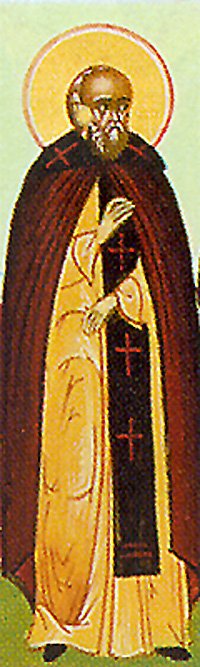
Eusebius the Righteous of Syria
Saint Eusebius the Hermit lived in the fourth century and lived in asceticism on a mountain near the village of Asicha in Syria. He led a very strict life under the open sky, patiently enduring the summer heat and winter cold. He wore skins for clothing, and nourished himself on the pods of peas and beans.
Saint Eusebius the Hermit lived in the fourth century and lived in asceticism on a mountain near the village of Asicha in Syria. He led a very strict life under the open sky, patiently enduring the summer heat and winter cold. He wore skins for clothing, and nourished himself on the pods of peas and beans.
Though he was elderly and infirm, he ate only fifteen figs during the Great Forty day Fast. When many people began to flock to Saint Eusebius, he went to a nearby monastery, built a small enclosure at the monastery walls and lived in it until his death.
Saint Eusebius died at the age of ninety, sometime after the year 400.
Troparion - Tone 8
By a flood of tears you made the desert fertile, / and your longing for God brought forth fruits in abundance. / By the radiance of miracles you illumined the whole universe! / O our holy father Eusebius, pray to Christ our God to save our souls!
Our Venerable Father Anthimos of Chios (1960)
He was born in 1869 to devout peasants on Chios; he left elementary school early to become a shoemender. At the age of nineteen he visited a monastery (founded by the monk Pachomios, who had been the spiritual counsellor of St Nektarios); he was so moved by the monks’ ‘angelic life’ that on returning home he built himself a small hut and dwelt in it. His o
He was born in 1869 to devout peasants on Chios; he left elementary school early to become a shoemender. At the age of nineteen he visited a monastery (founded by the monk Pachomios, who had been the spiritual counsellor of St Nektarios); he was so moved by the monks’ ‘angelic life’ that on returning home he built himself a small hut and dwelt in it. His only ‘help’ in his spiritual contests was an icon of the Mother of God, which soon began to work miracles, drawing many to his hermitage. After a time he retired to a monastery where he was tonsured under the name Anthimos. He fell ill there, and his abbot sent him home to his parents for the sake of his health. At home, despite the fact that he was caring for his aged parents and practicing his shoemender’s trade, he continued to live as a monk, spending nights on end in prayer and sometimes living only on bread and water for extended periods.
Increasing numbers of visitors came to his hermitage and wonder-working icon of the Theotokos, and in 1910 he received the Great Schema. The people of Chios wanted him to be ordained to the priesthood, but his bishop refused due to the Saint’s lack of education. At the prompting of Anthimos’ godfather, the Bishop of Smyrna ordained him instead. After a pilgrimage to Mt Athos, he returned to Chios, where he became chaplain to a leper hospital. Soon the hospital, which had fallen into corruption, became a spiritual center, as much like a monastery as a hospital. Saint Anthimos tended many of the sickest with his own hands, working many miracles of healing; some of his recovered patients became monks or nuns.
With the notorious ‘Exchange of Populations’ of 1922-1924, refugees poured into Chios, many of them destitute nuns and girls. In response to a vision of the Mother of God, St Anthimos built a monastery, which opened with thirty nuns and grew rapidly, despite the opposition of many who said that setting up such a community was out of date (in 1924!). The monastery soon housed eighty nuns and was known througout Greece as a model of monastic life. Father Anthimos served as priest to the nuns, and continued to receive the many faithful — often sixty or seventy per day — who came to him for prayer or counsel. He carried on this ministry for more than thirty years, working many miracles of healing. When he was too old to work with his hands, he retired to his cell and prayed that he be enabled to serve his neighbor until his last breath. He reposed in peace at the age of ninety-one, mourned and revered by the whole island of Chios.
Scripture Readings
☩Epistle
1 Peter 2:21-3:9
21
For even hereunto were ye called: because Christ also suffered for us, leaving us an example, that ye should follow his steps:
22
Who did no sin, neither was guile found in his mouth:
23
Who, when he was reviled, reviled not again; when he suffered, he threatened not; but committed himself to him that judgeth righteously:
24
Who his own self bare our sins in his own body on the tree, that we, being dead to sins, should live unto righteousness: by whose stripes ye were healed.
25
For ye were as sheep going astray; but are now returned unto the Shepherd and Bishop of your souls.
1
Likewise, ye wives, be in subjection to your own husbands; that, if any obey not the word, they also may without the word be won by the conversation of the wives;
2
While they behold your chaste conversation coupled with fear.
3
Whose adorning let it not be that outward adorning of plaiting the hair, and of wearing of gold, or of putting on of apparel;
4
But let it be the hidden man of the heart, in that which is not corruptible, even the ornament of a meek and quiet spirit, which is in the sight of God of great price.
5
For after this manner in the old time the holy women also, who trusted in God, adorned themselves, being in subjection unto their own husbands:
6
Even as Sara obeyed Abraham, calling him lord: whose daughters ye are, as long as ye do well, and are not afraid with any amazement.
7
Likewise, ye husbands, dwell with them according to knowledge, giving honour unto the wife, as unto the weaker vessel, and as being heirs together of the grace of life; that your prayers be not hindered.
8
Finally, be ye all of one mind, having compassion one of another, love as brethren, be pitiful, be courteous:
9
Not rendering evil for evil, or railing for railing: but contrariwise blessing; knowing that ye are thereunto called, that ye should inherit a blessing.
☩Gospel
Mark 12:13-17
13
And they send unto him certain of the Pharisees and of the Herodians, to catch him in his words.
14
And when they were come, they say unto him, Master, we know that thou art true, and carest for no man: for thou regardest not the person of men, but teachest the way of God in truth: Is it lawful to give tribute to Cesar, or not?
15
Shall we give, or shall we not give? But he, knowing their hypocrisy, said unto them, Why tempt ye me? bring me a penny, that I may see it.
16
And they brought it. And he saith unto them, Whose is this image and superscription? And they said unto him, Cesar’s.
17
And Jesus answering said unto them, Render to Cesar the things that are Cesar’s, and to God the things that are God’s. And they marvelled at him.
Liturgical data sourced from OCA.org and orthocal.info