
Fasting Rules
 Meat
Abstain
 Fish
Abstain
 Dairy
Abstain
 Oil
Abstain
 Wine
Abstain
Saints & Commemorations
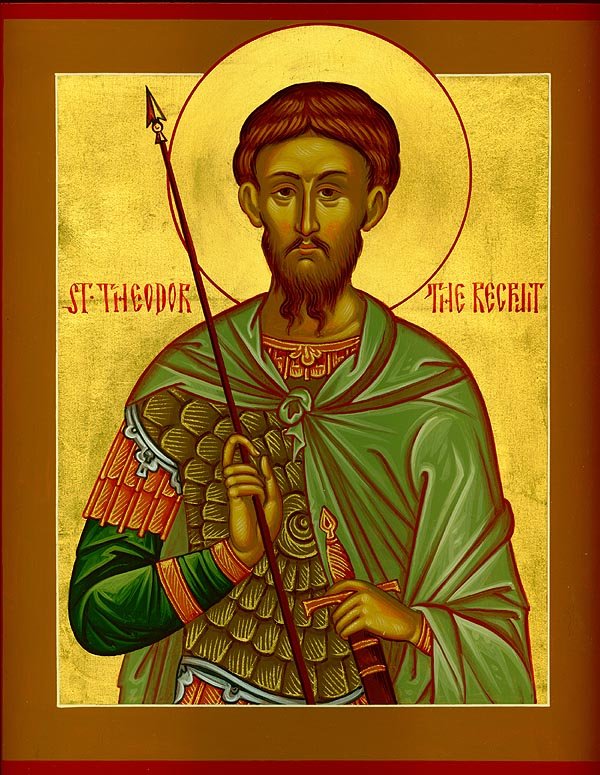
Great Martyr Theodore Tyro
The Holy Great Martyr Theodore the Recruit 1 was a soldier in the city of Amáseia in Pontus (Asia Minor) on the coast of the Euxine (Black) Sea, under the command of the Praepositus (regimental commander) Brincus. Saint Theodore was ordered to offer sacrifice to idols, but he proclaimed his faith in Christ the Savior in a loud voice.
The Holy Great Martyr Theodore the Recruit 1 was a soldier in the city of Amáseia in Pontus (Asia Minor) on the coast of the Euxine (Black) Sea, under the command of the Praepositus (regimental commander) Brincus. Saint Theodore was ordered to offer sacrifice to idols, but he proclaimed his faith in Christ the Savior in a loud voice. Brincus gave him a few days to think it over, during which time the Saint prayed.
Theodore was accused of setting a pagan temple on fire and destroying the idol of Rhea, and so he was thrown into prison to be starved to death. The Lord Jesus Christ appeared to him there, comforting and encouraging him. When he was brought before the Governor Publius, Theodore boldly confessed his faith, for which he was subjected to new torments and condemned to be burnt alive. The Great Martyr Theodore mounted an enormous pyre, and after he made the Sign of the Cross, the wood was lit, but the Holy Spirit cooled the flames. Saint Theodore stood in the flames, praising and glorifying God. Then he gave his holy soul into God's hands, and the onlookers saw his soul ascending to Heaven, according to the author of his Life, who was also an eyewitness.
This occurred in about the year 306 under the Roman Emperor Galerius (305-311). Unharmed by the fire, Saint Theodore's body was buried under a widow's house in the city of Eukháϊta, not far from Amáseia. Later, his relics were transferred to Constantinople, to the church which bears his name. His head is in the city of Gaeto, Italy.
Fifty years after the Saint Theodore's martyrdom, Emperor Julian the Apostate (reigned 361-363), planned to commit an outrage upon the Christians during the first week of Great Lent. He ordered the city magistrate of Constantinople to sprinkle all the food in the marketplaces with blood which had been offered to idols. Saint Theodore appeared to Archbishop Eudoxios in a dream, and told him to inform all the Christians that no one should buy anything in the marketplaces, but to eat boiled wheat with honey (kolyva) instead.
In remembrance of this occurrence, the Orthodox Church commemorates the holy Great Martyr Theodore the Recruit each year on the first Saturday of Great Lent. On Friday evening, at the Divine Liturgy of the Presanctified Gifts, after the prayer at the Ambo, the Canon to the Holy Great Martyr Theodore, composed by Saint John of Damascus, is sung. After this, kolyva is blessed and distributed to the faithful. The celebration of the Great Martyr Theodore on the first Saturday of Great Lent was established by Patriarch Nektarios of Constantinople (381-397).
The Troparion to Saint Theodore is very similar to the Troparion for the Prophet Daniel and the Three Holy Youths (on the Sunday Before the Nativity of the Lord). The Kontakion to Saint Theodore, who suffered martyrdom by fire, reminds us that he also had faith as his breastplate (see I Thessalonians 5:8).
In iconography, Saint Theodore the Recruit is depicted in four different ways: either alone in military garb, battling a large snake, or together with Saint Theodore the Commander, standing upright or riding horses. He always wears his military uniform.
We pray to Saint Theodore the Recruit for the recovery of stolen articles.
1 His title comes from the Latin word tiro, because he was a newly-enlisted recruit, not because he came from the city of Tyre, as some misinformed persons imagine.
Troparion - Tone 2
Great are the accomplishments of faith, / for the Holy Martyr Theodore rejoiced in the fount of flames as though at the waters of rest;1 / for having been made a whole burnt offering in the fire, / he was offered as a sweet bread to the Trinity. / By his entreaties, O Christ God, save our souls!
Kontakion - Tone 8
(Original melody)
Having received the faith of Christ in your heart as a breastplate, / you trampled upon inimical forces, O much-suffering champion, / and you have been crowned eternally with a heavenly crown, as one invincible.1 Psalm 22/23:2
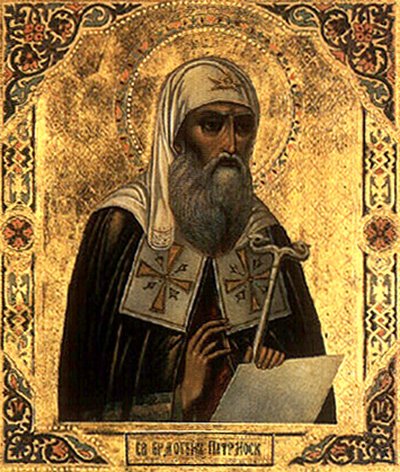
Hieromartyr Germogen, Patriarch of Moscow
The Hieromartyr Hermogenes, Patriarch of Moscow and all Rus, was born in Kazan around 1530, and was descended from the Don Cossacks. According to the Patriarch’s own testimony, he served as priest in Kazan in a church dedicated to Saint Nicholas (December 6 and May 9), near the Kazan bazaar. Soon he became a monk, and from 1582 was archimandrite of the Savior-Transfiguration monastery at Kazan. O
The Hieromartyr Hermogenes, Patriarch of Moscow and all Rus, was born in Kazan around 1530, and was descended from the Don Cossacks. According to the Patriarch’s own testimony, he served as priest in Kazan in a church dedicated to Saint Nicholas (December 6 and May 9), near the Kazan bazaar. Soon he became a monk, and from 1582 was archimandrite of the Savior-Transfiguration monastery at Kazan. On May 13, 1589 he was consecrated bishop and became the first Metropolitan of Kazan.
While he was the priest at Saint Nicholas, the wonderworking Kazan Icon of the Mother of God (July 8) was discovered in Kazan in 1579. With the blessing of Archbishop Jeremiah of Kazan, he carried the newly-appeared icon from the place of its discovery to the Church of Saint Nicholas. Having remarkable literary talent, the saint in 1594 compiled an account describing the appearance of the wonderworking icon and the miracles accomplished through it. In 1591 the saint gathered newly-baptized Tatars into the cathedral church and for several days he instructed them in the Faith.
The relics of Saint Germanus, the second archbishop of Kazan (September 25, November 6, and June 23), who died at Moscow on November 6, 1567 during a plague, were transfered and buried in Saint Nicholas Church in 1592. With the blessing of Patriarch Job (1589-1605), Saint Hermogenes reburied the relics at the Sviyazhsk Dormition monastery.
On January 9, 1592 Saint Hermogenes addressed a letter to Patriarch Job, in which he asked for permission to commemorate in his See of Kazan those Orthodox soldiers who gave their lives for the Faith and the nation in a battle against the Tatars. In the past, it was customary to enter into the diptychs the names of all Orthodox warriors who had fallen in battle, and to commemorate them.
At the same time he mentioned three martyrs who had suffered at Kazan for their faith in Christ, one of whom was a Russian named John (January 24) born at Nizhny Novgorod and captured by the Tatars. The other two, Stephen and Peter (March 24), were newly-converted Tatars.
The saint expressed regret that these martyrs were not inserted into the diptychs read on the Sunday of Orthodoxy, and that “Memory Eternal” was not sung for them. In answer to Saint Hermogenes, the Patriarch issued a decree on February 25, which said: “to celebrate at Kazan and throughout all the Kazan metropolitanate a panikhida for all the Orthodox soldiers killed at Kazan and the environs of Kazan, on the Saturday following the Feast of the Protection of the Most Holy Theotokos (October 1), and to inscribe them in the great Synodikon read on the Sunday of Orthodoxy,” and also ordered that the three Kazan martyrs be inscribed in the Synodikon, leaving it to Saint Hermogenes to set the day of their memory. Saint Hermogenes circulated the Patriarchal decree throughout his diocese, and required all the churches and monasteries to serve Liturgies, Panikhidas and Lityas for the three Kazan martyrs on January 24.
Saint Hermogenes displayed zeal in the faith and firmness in the observance of Church traditions, and he devoted himself to the enlightenment of Kazan Tatars with the faith of Christ.
In 1595, with the active participation of the Saint Hermogenes, the relics of the Kazan Wonderworkers Saint Gurias, the first archbishop of Kazan (October 4, December 5, June 20), and Saint Barsanuphius bishop of Tver (October 4, April 11) were discovered and uncovered. Tsar Theodore Ioannovich (1584-1598) had given orders to erect at the Kazan Savior-Transfiguration monastery a new stone church on the site of the first one, where the saints were buried.
When the graves of the saints were discovered, Saint Hermogenes came with a gathering of clergy. He commanded the graves to be opened and, when he saw the incorrupt relics and clothing of the saints, he notified the Patriarch and the Tsar. With the blessing of Patriarch Job and by order of the Tsar, the relics of the newly-appeared wonderworkers were placed in the new church. Saint Hermogenes himself compiled the lives of hierarchs Gurias and Barsanuphius.
Having been found worthy of the patriarchal throne, Metropolitan Hermogenes was elected to the primatial See, and on July 3, 1606 he was installed as Patriarch by the assembly of the holy hierarchs at Moscow’s Dormition cathedral. Metropolitan Isidore handed the Patriarch the staff of the holy hierarch Peter, Moscow Wonderworker (October 5, December 21, August 24), and the Tsar gave as a gift to the new Patriarch a panagia, embellished with precious stones, a white klobuk and staff. In the ancient manner, Patriarch Hermogenes made his entrance riding upon a donkey.
The activity of Patriarch Hermogenes coincided with a difficult period for the Russian state: the appearance of the false Tsarevich Demetrius and the Polish king Sigismund III. The first hierarch devoted all his powers to the service of the Church and the nation.
Patriarch Hermogenes was not alone in this exploit: his self-sacrificing fellow-countrymen followed his example and assisted him. With special inspiration His Holiness the Patriarch stood up against the traitors and enemies of the nation, who wanted to spread Uniatism and Western Catholicism throughout Russia and to wipe out Orthodoxy, while enslaving the Russian nation.
When the imposter arrived at Moscow and settled himself at Tushino, Patriarch Hermogenes sent two letters to the Russian traitors. In one of them he wrote: “...You have forgotten the vows of our Orthodox Faith, in which we are born, baptized, nourished and raised. You have violated your oath and the kissing of the Cross to stand to the death for the house of the Most Holy Theotokos and for the Moscow realm, but have fallen for your false would-be Tsarevich ... My soul aches, my heart is sickened, all within me agonizes, and all my frame shudders; I weep and with sobbing I lament: Have mercy, have mercy, brethren and children, on your own souls and your parents departed and living ... Consider, how our nation is devastated and plundered by foreigners, who offer insult to the holy icons and churches, and how innocent blood is spilled, crying out to God. Think! Against whom do you take up arms: is it not against God, Who has created you? Is it not against your own brothers? Do you not devastate your own country?... I adjure you in the name of God, give up your undertaking, there is yet time, so that you do not perish in the end.” In the second document the saint appeals: “For the sake of God, come to your senses and turn around, gladden your parents, your wives and children; and we stand to pray God for you...”
Soon the righteous judgment of God fell upon the Brigand of Tushino: he was killed by his own close associates on December 11, 1610. But Moscow continued to remain in peril, since the Poles and traitors, loyal to Sigismund III, remained in the city. The documents sent by Patriarch Hermogenes throughout the cities and villages, exhorted the Russian nation to liberate Moscow from the enemies and to choose a lawful Russian Tsar.
The Muscovites rose up in rebellion, and the Poles burned the city, shutting themselves up in the Kremlin. Together with Russian traitors they forcefully seized Patriarch Hermogenes from the patriarchal throne and imprisoned him in the Chudov monastery.
On Bright Monday in 1611, the Russian militia approached Moscow and began the seige of the Kremlin, which continued for several months. Besieged within the Kremlin, the Poles often sent messengers to the Patriarch with the demand that he order the Russian militia to leave the city, threatening him with execution if he refused.
The saint firmly replied, “What are your threats to me? I fear only God. If all our enemies leave Moscow, I shall bless the Russian militia to withdraw from Moscow; but if you remain here, I shall bless all to stand against you and to die for the Orthodox Faith.”
While still in prison, the hieromartyr Hermogenes sent a final epistle to the Russian nation, blessing the liberating army to fight the invaders. The Russian commanders could not come to an agreement over a way to take the Kremlin and free the Patriarch. He languished more than nine months in dreadful confinement, and on February 17, 1612 he died a martyr’s death from starvation.
The liberation of Russia, for which Saint Hermogenes stood with such indestructible valor, was successfully achieved. The body of the hieromartyr Hermogenes was buried in the Chudov monastery, but in 1654 was transferred to the Moscow Dormition cathedral. The glorification of Patriarch Hermogenes as a saint occurred on May 12, 1913.
Troparion - Tone 4
You were the First Hierarch of the Russian land and a tireless intercessor before God. / By laying down your life for the faith of Christ and for your flock, you delivered your land from lawlessness. / Therefore we cry out to you: “Preserve us by your prayers, O Hieromartyr Ermogénes, our Father.”
Kontakion - Tone 6
Exhausted by imprisonment and starvation, you remained faithful until death, O Blessed Ermogénes, / dispelling cowardice from the hearts of your people and calling all of them to a common struggle. / In this way, you suppressed the rebellion of the wicked, and you strengthened your land as well, / so that all of us may cry out to you: “Rejoice, intercessor for the Russian land.”
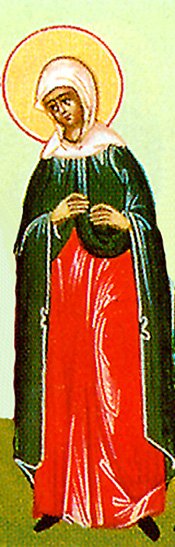
Mariamne, Sister of Apostle Philip, and Equal to the Apostles
Righteous Mariamne “The Apostolic Virgin” and sister of the holy Apostle Philip (November 14), made a vow of virginity and became the companion of her brother Philip and the holy Apostle Bartholomew (June 11), actively assisting them in their apostolic work.
The Church historian Nikēphóros Callistus describes their successful preaching in the Phrygian city of Hieropolis, where they were arrested and locked up in prison. They
Righteous Mariamne “The Apostolic Virgin” and sister of the holy Apostle Philip (November 14), made a vow of virginity and became the companion of her brother Philip and the holy Apostle Bartholomew (June 11), actively assisting them in their apostolic work.
The Church historian Nikēphóros Callistus describes their successful preaching in the Phrygian city of Hieropolis, where they were arrested and locked up in prison. They put the Apostle Philip to death on a cross, but Saint Mariamne and Saint Bartholomew were set free. Saint Bartholomew went to preach the Gospel in India. Saint Mariamne, after burying the body of Saint Philip, preached the Gospel at Lykaonia (Asia Minor). She died there in peace.
Troparion - Tone 8
In you the image was preserved with exactness, O Mothers, / for taking up your cross, you followed after Christ. / By so doing, you taught us to disregard the flesh, for it passes away, / but to care instead for the soul, since it is immortal. / Therefore, most venerable Mothers Mariamne and Perozhavra your spirits rejoice with the Angels.
Kontakion - Tone 2
Because of your love of God you forsook a bed for rest, O Mothers Mariamne and Perozhavra, / you illumined your souls with fasting, thoroughly vanquishing your enemies; / but by your intercessions destroy the evil designs of our adversaries.
Scripture Readings
☩Epistle
1 Peter 4:1-11
1
Forasmuch then as Christ hath suffered for us in the flesh, arm yourselves likewise with the same mind: for he that hath suffered in the flesh hath ceased from sin;
2
That he no longer should live the rest of his time in the flesh to the lusts of men, but to the will of God.
3
For the time past of our life may suffice us to have wrought the will of the Gentiles, when we walked in lasciviousness, lusts, excess of wine, revellings, banquetings, and abominable idolatries:
4
Wherein they think it strange that ye run not with them to the same excess of riot, speaking evil of you:
5
Who shall give account to him that is ready to judge the quick and the dead.
6
For for this cause was the gospel preached also to them that are dead, that they might be judged according to men in the flesh, but live according to God in the spirit.
7
But the end of all things is at hand: be ye therefore sober, and watch unto prayer.
8
And above all things have fervent charity among yourselves: for charity shall cover the multitude of sins.
9
Use hospitality one to another without grudging.
10
As every man hath received the gift, even so minister the same one to another, as good stewards of the manifold grace of God.
11
If any man speak, let him speak as the oracles of God; if any man minister, let him do it as of the ability which God giveth: that God in all things may be glorified through Jesus Christ, to whom be praise and dominion for ever and ever. Amen.
☩Gospel
Mark 12:28-37
28
And one of the scribes came, and having heard them reasoning together, and perceiving that he had answered them well, asked him, Which is the first commandment of all?
29
And Jesus answered him, The first of all the commandments is, Hear, O Israel; The Lord our God is one Lord:
30
And thou shalt love the Lord thy God with all thy heart, and with all thy soul, and with all thy mind, and with all thy strength: this is the first commandment.
31
And the second is like, namely this, Thou shalt love thy neighbour as thyself. There is none other commandment greater than these.
32
And the scribe said unto him, Well, Master, thou hast said the truth: for there is one God; and there is none other but he:
33
And to love him with all the heart, and with all the understanding, and with all the soul, and with all the strength, and to love his neighbour as himself, is more than all whole burnt offerings and sacrifices.
34
And when Jesus saw that he answered discreetly, he said unto him, Thou art not far from the kingdom of God. And no man after that durst ask him any question.
35
And Jesus answered and said, while he taught in the temple, How say the scribes that Christ is the Son of David?
36
For David himself said by the Holy Ghost, The Lord said to my Lord, Sit thou on my right hand, till I make thine enemies thy footstool.
37
David therefore himself calleth him Lord; and whence is he then his son? And the common people heard him gladly.
Liturgical data sourced from OCA.org and orthocal.info