
Fasting Rules
 Meat
Allowed
 Fish
Allowed
 Dairy
Allowed
 Oil
Allowed
 Wine
Allowed
Saints & Commemorations
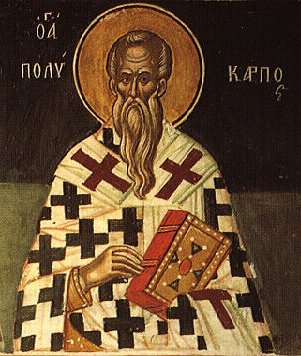
Hieromartyr Polycarp, Bishop of Smyrna
Saint Polycarp, Bishop of Smyrna, who was “fruitful in every good work” (Col. 1:10), was born in the first century, and lived in Smyrna in Asia Minor. He was orphaned at an early age, but at the direction of an angel, he was raised by the pious widow Kallista. After the death of his adoptive mother, Polycarp gave away his possessions and began to lead a chaste life, caring for the sick and the infirm. He
Saint Polycarp, Bishop of Smyrna, who was “fruitful in every good work” (Col. 1:10), was born in the first century, and lived in Smyrna in Asia Minor. He was orphaned at an early age, but at the direction of an angel, he was raised by the pious widow Kallista. After the death of his adoptive mother, Polycarp gave away his possessions and began to lead a chaste life, caring for the sick and the infirm. He was very fond of and close to Saint Bucolus, Bishop of Smyrna (February 6). He ordained Polycarp as deacon, entrusting to him to preach the Word of God in church. He also ordained him to the holy priesthood.
The holy Apostle John the Theologian was still alive at this time. Saint Polycarp was especially close to Saint John, and sometimes accompanied him on his apostolic journeys.
Shortly before his death, Saint Bucolus expressed his wish that Polycarp be made Bishop of Smyrna. When Saint Polycarp was consecrated as a bishop, the Lord Jesus Christ appeared to him. Saint Polycarp guided his flock with apostolic zeal, and he was also greatly loved by the clergy. Saint Ignatius the God-Bearer of Antioch (December 20) also had a high regard for him. Setting out for Rome where execution awaited him, he wrote to Saint Polycarp, “This age is in need of you if it is to reach God, just as pilots need winds, and as a storm-tossed sailor needs a port.”
The emperor Marcus Aurelius (161-180) came to the Roman throne and started up a most fierce persecution against Christians. The pagans demanded that the judge search for Saint Polycarp, “the father of all the Christians” and “the seducer of all Asia.”
During this time Saint Polycarp, at the persistent urging of his flock, stayed in a small village not far from Smyrna. When the soldiers came for him, he went out to them and invited them in to eat. He asked for time to pray, in order to prepare himself for martyrdom. His suffering and death are recorded in the “Epistle of the Christians of the Church of Smyrna to the Other Churches,” one of the most ancient memorials of Christian literature.
Having been brought to trial, Saint Polycarp firmly confessed his faith in Christ, and was condemned to be burned alive. The executioners wanted to nail him to a post, but he declared that God would give him the strength to endure the flames, so they could merely tie him with ropes. The flames encircled the saint but did not touch him, coming together over his head in the shape of a vault. Seeing that the fire did him no harm, the pagans stabbed him with a dagger. So much blood flowed from this wound that it extinguished the flames. The body of the hieromartyr Polycarp was then cremated. The Christians of Smyrna reverently gathered up what remained of his holy relics, and each year they celebrated the day of his martyrdom.
A story has been preserved about Saint Polycarp by his disciple, Saint Irenaeus of Lyons, which Eusebius cites in his ECCLESIASTICAL HISTORY (V, 20):
“I was still very young when I saw you in Asia Minor at Polycarp’s,” writes Saint Irenaeus to his friend Florinus, “but I would still be able to point out the place where Blessed Polycarp sat and conversed, and be able to depict his walk, his mannerisms in life, his outward appearance, his speaking to people, his companionable wandering with John, and how he himself related, together with other eyewitnesses of the Lord, those things that he remembered from the words of others. He also told what he heard from them about the Lord, His teachings and miracles....
“Through the mercy of God to me, I then already listened attentively to Polycarp and wrote down his words, not on tablets, but in the depths of my heart. Therefore, I am able to bear witness before God, that if this blessed and apostolic Elder heard something similar to your fallacy, he would immediately stop up his ears and express his indignation with his usual phrase: ‘Good God! That Thou hast permitted me to be alive at such a time!’”
During his life the holy bishop wrote several Epistles to the flock and letters to various individuals. The only one that has survived to the present day is his Epistle to the Philippians which, Saint Jerome testifies, was read in the churches of Asia Minor at divine services. It was written by the saint in response to the request of the Philippians to send them some letters of the hieromartyr Ignatius (December 20) which Saint Polycarp had in his possession.
The composer H.I.F. Bibier (1644-1704) has written a Sonata “Scti Polycarpi” for eight trumpets in honor of the holy martyr.
Troparion - Tone 4
By sharing in the ways of the Apostles, / you became a successor to their throne. / Through the practice of virtue, you found the way to divine contemplation, O inspired one of God; / by teaching the word of truth without error, you defended the Faith, even to the shedding of your blood. / Hieromartyr Polycarp, entreat Christ God to save our souls.
Kontakion - Tone 1
Through virtues, you offered spiritual fruit to the Lord, / therefore, you were glorified as a worthy hierarch, wise Polycarp. / Today, we who have been enlightened by your words / extol in song your praise-worthy memory, / thereby giving glory to the Lord.
Saint Gorgonia (372)
Most of the information about Saint Gorgonia (Γοργονία) comes from her brother, Saint Gregory the Theologion (January 25) in his Oration VIII, "On his Sister Gorgonia," which was delivered sometime after their brother Saint Caesarius (March 9) went to the Lord in 369, and before the repose of their father, the elder Saint Gregory Nazianzus, in 374.
She wa
Most of the information about Saint Gorgonia (Γοργονία) comes from her brother, Saint Gregory the Theologion (January 25) in his Oration VIII, "On his Sister Gorgonia," which was delivered sometime after their brother Saint Caesarius (March 9) went to the Lord in 369, and before the repose of their father, the elder Saint Gregory Nazianzus, in 374.
She was the daughter of Saint Gregory Nazianzus (January 1) and Saint Nonna (August 5), and was named for her maternal grandmother Gorgonia. Saint Gregory the Theologian tells us that she derived her existence and her reputation from their parents, because they sowed in her the seeds of piety.
In praising her virtues, Saint Gregory states that her modesty surpassed those of her own time, and those who lived before her. She blended the excellence of the married state with that of the unmarried state, avoiding the disadvantages of each, while combining all that is best in both. Thus, Saint Gorgonia proved that "neither of them absolutely binds us to, or separates us from, God or the world." It is the mind which nobly presides over marriage and virginity, arranging and working on them as "the raw material of virtue."
Saint Gorgonia had consecrated herself to God, and also won her husband Alypios to her side. He was from the city of Iconium, where Faustinus was the bishop. She made Alypios "a good fellow servant, instead of an unreasonable master." This pious couple had five children; two sons who became bishops, and three daughters: Alypianḗ, Eugenia, and Nonna. Moreover, she made her children and their children's children the fruit of her spirit, dedicating to God not only her soul, but also her entire family and household. As long as she lived, she showed herself as an example of all that is good. Her devoted brother even compared her to King Solomon's virtuous woman (Proverbs 31:10-31).
This daughter of a saintly family took both her natural and spiritual parents as her models of virtue, and they were the source of her goodness. She did not wear fine clothes or expensive jewelry, nor did she use pigments to enhance her beauty. The only red coloring dear to her was the blush of modesty; and her only white coloring was the tint of temperance.
She adorned the churches with offerings, and thereby presented herself to God as a living temple. She opened her house to members of her family who were in want, and even to strangers. She was sympathetic to those in trouble, and compassionate toward widows. She "dispersed abroad" and "gave to the poor" (Psalm 111/112:9). The only wealth she left to her children was the excellence of her example.
In her fasting, her chanting of the Psalms, her vigils, her tears, and her prayers, she surpassed not only women, but also the most devout men, thereby demonstrating that the distinction between male and female is one of body, not of soul.
One day, as Saint Gorgonia was riding in her carriage, the mules bolted and the carriage was overturned. She was dragged over the ground and suffered serious injury. Those who were not Christians were scandalized that God would permit such a thing to happen to this righteous woman. Although she was bruised in her bones and limbs, she would not allow a physician to examine her, in order to preserve her modesty. She trusted that God would heal her, and He did. Seeing her unexpected recovery, people concluded that the accident had occurred so that by her patient endurance and her miraculous healing, God would be glorified.
Saint Gorgonia longed for death, preferring to be with Christ rather than remain on earth. She had a vision in which the day of her death was revealed to her so that she might prepare herself. As that time drew near she took to her bed, and spent her last day giving instructions to her husband, her children, and her friends. After discoursing about spiritual matters, she reposed in the year 370 at the age of thirty-eight. Her last words were, “I will both lie down in peace and sleep” (Psalm 4:8).
Damian the New Martyr of Mount Athos
Saint Damian lived in the thirteenth century. He was a hesychast on Mt. Athos, and struggled in the skete of Esphigmenou monastery, on a mountain called Samareia, between the monasteries of Hilandar and Esphigmenou, and also in one of the caves where the Father of Russian Monasticism, Saint Anthony of the Caves (July 10), had lived in asceticism.
Saint Damian lived in the thirteenth century. He was a hesychast on Mt. Athos, and struggled in the skete of Esphigmenou monastery, on a mountain called Samareia, between the monasteries of Hilandar and Esphigmenou, and also in one of the caves where the Father of Russian Monasticism, Saint Anthony of the Caves (July 10), had lived in asceticism.
Known for his ascetic life and for the miracles he performed, he was truly obedient and kept the injunctions of the Fathers.
Saint Damian reposed in his cell in the year 1280, and a miraculous fragrance issued from his grave for forty days. His Life was written by his friend Saint Cosmas of Zographou Monastery (September 22).
Troparion - Tone 8
By a flood of tears you made the desert fertile, / and your longing for God brought forth fruits in abundance. / By the radiance of miracles you illumined the whole universe! / O our holy father Damian, pray to Christ our God to save our souls!
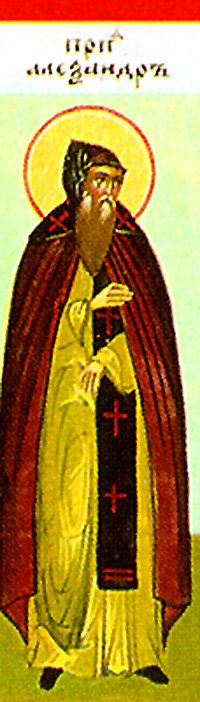
Our Venerable Father Alexander the Unsleeping (430)
Saint Alexander, Founder of the Monastery of the “Unsleeping Ones,” was born in Asia and received his education at Constantinople. He spent some time in military service but, sensing a calling to other service, he left the world and received monastic tonsure in one of the desert monasteries near Antioch under the guidance of Igumen Elias.
Ha
Saint Alexander, Founder of the Monastery of the “Unsleeping Ones,” was born in Asia and received his education at Constantinople. He spent some time in military service but, sensing a calling to other service, he left the world and received monastic tonsure in one of the desert monasteries near Antioch under the guidance of Igumen Elias.
Having advanced through all the degrees of monastic obedience, he received a blessing from the igumen to dwell in the wilderness. The saint lived an ascetical life in the wilderness, taking only the Holy Gospel with him. Afterwards, the Lord summoned him to preach to pagans. He converted to the faith the local city-head Rabbul, who afterwards prospered in the service of the Church, attaining the rank of bishop, and for thirty years, he occupied the bishop’s cathedra in the city of Edessa.
Finally, Saint Alexander settled not far from the Euphrates River. Monks gathered around him, attracted by the loftiness of his prayerful asceticism and spiritual experience. A monastery of 400 monks eventually sprang up there.
Then the holy igumen in his prayerful zeal decided to offer never-ceasing praise to the Lord at the monastery both by day and by night. For three years the holy abba prayed that God might reveal to him whether it was pleasing to Him to establish such a monastic rule. He received an answer by divine revelation. All the monks were divided into twenty-four watches of prayer. Changing shifts each hour, two choirs sang the holy Psalms both day and night, except when divine services were celebrated in church. Hence the name “Monastery of Unsleeping Ones,” since the ascetics offered unceasing praise to God.
Saint Alexander guided the monastery on the Euphrates for twelve years. Thereafter, having left the experienced Elder Trophimus as igumen, he set off with some chosen brethren through the cities bordering on Persia, to preach the Gospel. Having arrived at Constantinople, capital of the Byzantine Empire, he also established a monastery there with his Rule of unceasing praise. The abba died at a great old age after fifty years of monastic struggles. His death occurred in the year 430.
Saint Alexander is also commemorated on July 3.
Troparion - Tone 8
By a flood of tears you made the desert fertile, / and your longing for God brought forth fruits in abundance. / By the radiance of miracles you illumined the whole universe! / O our holy father Alexander, pray to Christ our God to save our souls!
Scripture Readings
☩Epistle
2 Peter 2:9-22
9
The Lord knoweth how to deliver the godly out of temptations, and to reserve the unjust unto the day of judgment to be punished:
10
But chiefly them that walk after the flesh in the lust of uncleanness, and despise government. Presumptuous are they, selfwilled, they are not afraid to speak evil of dignities.
11
Whereas angels, which are greater in power and might, bring not railing accusation against them before the Lord.
12
But these, as natural brute beasts, made to be taken and destroyed, speak evil of the things that they understand not; and shall utterly perish in their own corruption;
13
And shall receive the reward of unrighteousness, as they that count it pleasure to riot in the day time. Spots they are and blemishes, sporting themselves with their own deceivings while they feast with you;
14
Having eyes full of adultery, and that cannot cease from sin; beguiling unstable souls: an heart they have exercised with covetous practices; cursed children:
15
Which have forsaken the right way, and are gone astray, following the way of Balaam the son of Bosor, who loved the wages of unrighteousness;
16
But was rebuked for his iniquity: the dumb ass speaking with man’s voice forbad the madness of the prophet.
17
These are wells without water, clouds that are carried with a tempest; to whom the mist of darkness is reserved for ever.
18
For when they speak great swelling words of vanity, they allure through the lusts of the flesh, through much wantonness, those that were clean escaped from them who live in error.
19
While they promise them liberty, they themselves are the servants of corruption: for of whom a man is overcome, of the same is he brought in bondage.
20
For if after they have escaped the pollutions of the world through the knowledge of the Lord and Saviour Jesus Christ, they are again entangled therein, and overcome, the latter end is worse with them than the beginning.
21
For it had been better for them not to have known the way of righteousness, than, after they have known it, to turn from the holy commandment delivered unto them.
22
But it is happened unto them according to the true proverb, The dog is turned to his own vomit again; and the sow that was washed to her wallowing in the mire.
☩Gospel
Mark 13:14-23
14
But when ye shall see the abomination of desolation, spoken of by Daniel the prophet, standing where it ought not, (let him that readeth understand,) then let them that be in Judea flee to the mountains:
15
And let him that is on the housetop not go down into the house, neither enter therein, to take any thing out of his house:
16
And let him that is in the field not turn back again for to take up his garment.
17
But woe to them that are with child, and to them that give suck in those days!
18
And pray ye that your flight be not in the winter.
19
For in those days shall be affliction, such as was not from the beginning of the creation which God created unto this time, neither shall be.
20
And except that the Lord had shortened those days, no flesh should be saved: but for the elect’s sake, whom he hath chosen, he hath shortened the days.
21
And then if any man shall say to you, Lo, here is Christ; or, lo, he is there; believe him not:
22
For false Christs and false prophets shall rise, and shall shew signs and wonders, to seduce, if it were possible, even the elect.
23
But take ye heed: behold, I have foretold you all things.
Liturgical data sourced from OCA.org and orthocal.info