
Fasting Rules
 Meat
Allowed
 Fish
Allowed
 Dairy
Allowed
 Oil
Allowed
 Wine
Allowed
Saints & Commemorations
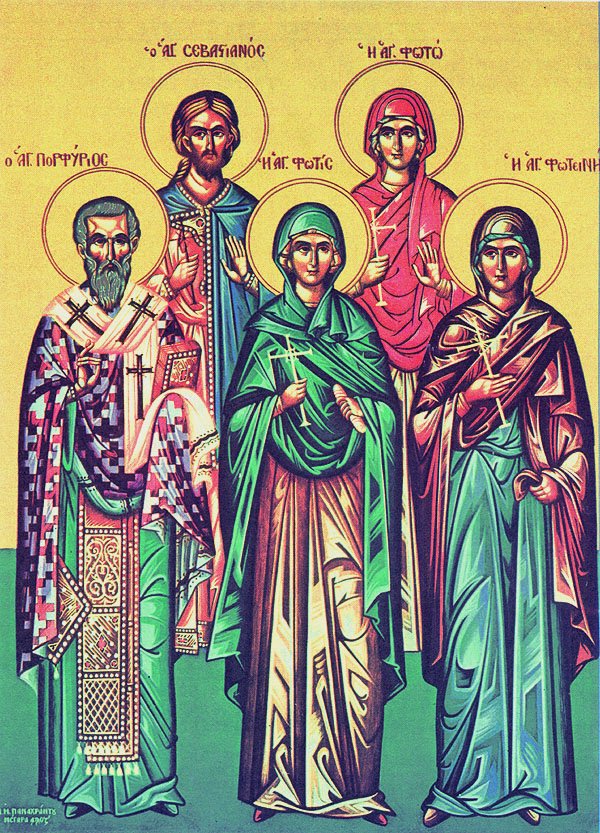
St Porphyrius, Bishop of Gaza
Saint Porphyrius, Archbishop of Gaza, was born about the year 346 at Thessalonica. His parents were people of substance, and this allowed Saint Porphyrius to receive a fine education. Having the inclination for monastic life, he left his native region at twenty-five years of age and set off for Egypt, where he lived in the Nitrian desert under the guidance of Saint Macarius the Great (January 19).
Saint Porphyrius, Archbishop of Gaza, was born about the year 346 at Thessalonica. His parents were people of substance, and this allowed Saint Porphyrius to receive a fine education. Having the inclination for monastic life, he left his native region at twenty-five years of age and set off for Egypt, where he lived in the Nitrian desert under the guidance of Saint Macarius the Great (January 19). There he also met Saint Jerome (June 15), who was then visiting the Egyptian monasteries. He went to Jerusalem on pilgrimage to the holy places, and to venerate the Life-Creating Cross of the Lord (September 14), then he moved into a cave in the Jordanian wilderness for prayer and ascetic deeds.
After five years, Saint Porphyrius was afflicted with a serious malady of the legs. He decided to go to the holy places of Jerusalem to pray for healing. As he lay half-conscious at the foot of Golgotha, Saint Porphyrius fell into a sort of trance. He beheld Jesus Christ descending from the Cross and saying to him, “Take this Wood and preserve it.”
Coming out of his trance, he found himself healthy and free from pain. Then he gave away all his money to the poor and for the adornment of the churches of God. For a time he supported himself by working as a shoemaker. The words of the Savior were fulfilled when the saint was forty-five years old. The Patriarch of Jerusalem ordained Saint Porphyrius to the holy priesthood and appointed him custodian of the Venerable Wood of the Cross of the Lord.
In 395 the bishop of the city of Gaza (in Palestine) died. The local Christians went to Caesarea to ask Metropolitan John to send them a new bishop who would be able to contend against the pagans, which were predominant in their city and were harassing the Christians there. The Lord inspired the Metropolitan to summon the priest Porphyrius. With fear and trembling the ascetic accepted the office of bishop, and with tears he prostrated himself before the Life-Creating Wood and went to fulfill his new obedience.
In Gaza there were only three Christian churches, but there were a great many pagan temples and idols. During this time there had been a long spell without rain, causing a severe drought. The pagan priests brought offerings to their idols, but the woes did not cease. Saint Porphyrius imposed a fast for all the Christians; he then served an all-night Vigil, followed by a church procession around the city. Immediately the sky covered over with storm clouds, thunder boomed, and abundant rains poured down. Seeing this miracle, many pagans cried out, “Christ is indeed the only true God!” As a result of this, 127 men, thirty-five women and fourteen children were united to the Church through Holy Baptism, and another 110 men soon after this.
The pagans continued to harass the Christians. They passed them over for public office, and burdened them with taxes. Saint Porphyrius and Metropolitan John of Caesarea journeyed to Constantinople to seek redress from the emperor. Saint John Chrysostom (September 14, January 27 and 30) received them and assisted them.
Saints John and Porphyrius were presented to the empress Eudoxia who was expecting a child at that time. “Intercede for us,” said the bishops to the empress, “and the Lord will send you a son, who shall reign during your lifetime”. Eudoxia very much wanted a son, since she had given birth only to daughters. Through the prayer of the saints an heir was born to the imperial family. As a result of this, the emperor issued an edict in 401 ordering the destruction of pagan temples in Gaza and the restoration of privileges to Christians. Moreover, the emperor gave the saints money for the construction of a new church, which was to be built in Gaza on the site of the chief pagan temple.
Saint Porphyrius upheld Christianity in Gaza to the very end of his life, and guarded his flock from the vexatious pagans. Through the prayers of the saint numerous miracles and healings occurred. The holy archpastor guided his flock for twenty-five years, and reposed in 420 at an advanced age.
Troparion - Tone 4
Who can tell of your labors and illnesses leading to godly devotion, O Father? / For you labored incessantly day and night, cleansing Gaza of its wickedness, / and planting piety; / therefore, as the protector of your flock, O Porphyrios, / entreat Christ God for the salvation of our souls.
Kontakion - Tone 2
Adorned with the royal purple of your virtues, / you were glorious as a hierarch and shone forth resplendently, O wise Porphyrios. / You were excellent in word and deed / strengthening all with the grace of godliness. / Since you always serve Christ, do not cease to pray for the world.
St Photini the Samaritan Woman, and those with her (66)
She was the Samaritan Woman who met Christ at Jacob’s Well (John ch. 4). She repented, and told her townsmen that she had met the Christ, for which she is sometimes called the first to proclaim the Gospel of Christ. She converted her four sisters (Phota, Photis,Parasceva, and Cyriaca), and her sons (Victor and Joses), and all of them became tireless evangelists for Christ. A
She was the Samaritan Woman who met Christ at Jacob’s Well (John ch. 4). She repented, and told her townsmen that she had met the Christ, for which she is sometimes called the first to proclaim the Gospel of Christ. She converted her four sisters (Phota, Photis,Parasceva, and Cyriaca), and her sons (Victor and Joses), and all of them became tireless evangelists for Christ. After the martyrdom of the holy Apostles Peter and Paul, she traveled to Carthage to proclaim the Gospel there. She, with her Christian sisters and sons, all met martyrdom under the persecutions of Nero. She is also commemorated on the Sunday of the Samaritan Woman during the Paschal season.
Scripture Readings
☩Epistle
1 John 2:7-17
7
Brethren, I write no new commandment unto you, but an old commandment which ye had from the beginning. The old commandment is the word which ye have heard from the beginning.
8
Again, a new commandment I write unto you, which thing is true in him and in you: because the darkness is past, and the true light now shineth.
9
He that saith he is in the light, and hateth his brother, is in darkness even until now.
10
He that loveth his brother abideth in the light, and there is none occasion of stumbling in him.
11
But he that hateth his brother is in darkness, and walketh in darkness, and knoweth not whither he goeth, because that darkness hath blinded his eyes.
12
I write unto you, little children, because your sins are forgiven you for his name’s sake.
13
I write unto you, fathers, because ye have known him that is from the beginning. I write unto you, young men, because ye have overcome the wicked one. I write unto you, little children, because ye have known the Father.
14
I have written unto you, fathers, because ye have known him that is from the beginning. I have written unto you, young men, because ye are strong, and the word of God abideth in you, and ye have overcome the wicked one.
15
Love not the world, neither the things that are in the world. If any man love the world, the love of the Father is not in him.
16
For all that is in the world, the lust of the flesh, and the lust of the eyes, and the pride of life, is not of the Father, but is of the world.
17
And the world passeth away, and the lust thereof: but he that doeth the will of God abideth for ever.
☩Gospel
Mark 14:3-9
3
And being in Bethany in the house of Simon the leper, as he sat at meat, there came a woman having an alabaster box of ointment of spikenard very precious; and she brake the box, and poured it on his head.
4
And there were some that had indignation within themselves, and said, Why was this waste of the ointment made?
5
For it might have been sold for more than three hundred pence, and have been given to the poor. And they murmured against her.
6
And Jesus said, Let her alone; why trouble ye her? she hath wrought a good work on me.
7
For ye have the poor with you always, and whensoever ye will ye may do them good: but me ye have not always.
8
She hath done what she could: she is come aforehand to anoint my body to the burying.
9
Verily I say unto you, Wheresoever this gospel shall be preached throughout the whole world, this also that she hath done shall be spoken of for a memorial of her.
Liturgical data sourced from OCA.org and orthocal.info