
Fasting Rules
 Meat
Allowed
 Fish
Allowed
 Dairy
Allowed
 Oil
Allowed
 Wine
Allowed
Saints & Commemorations
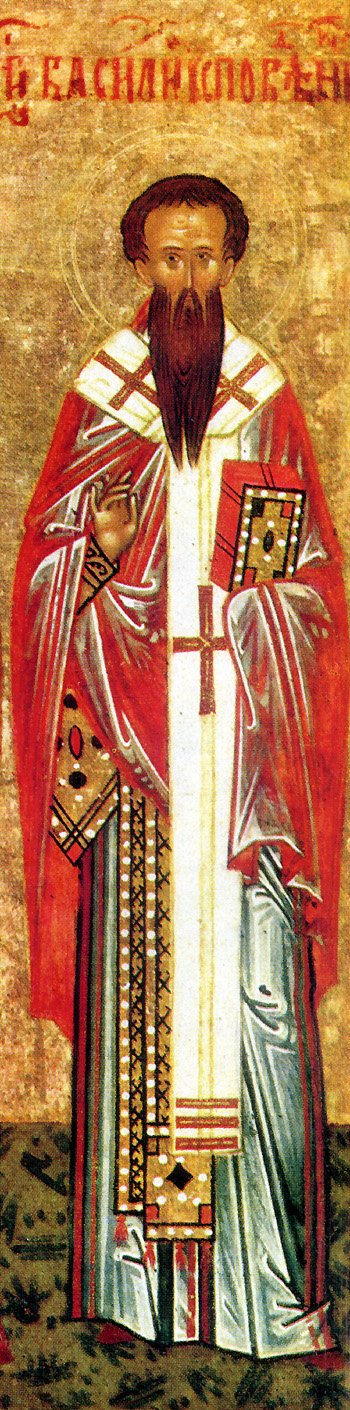
Ven. Basil the Confessor
Saint Basil the Confessor was a monk and suffered during the reign of the iconoclast emperor Leo the Isaurian (717-741). When a persecution started against those who venerated holy icons, Saint Basil and his companion Saint Procopius of Decapolis (February 27) were subjected to much torture and locked up in prison.
Saint Basil the Confessor was a monk and suffered during the reign of the iconoclast emperor Leo the Isaurian (717-741). When a persecution started against those who venerated holy icons, Saint Basil and his companion Saint Procopius of Decapolis (February 27) were subjected to much torture and locked up in prison. Here both martyrs languished for a long while, until the death of the impious emperor.
When the holy Confessors Basil and Procopius were set free along with other venerators of holy icons, they continued in their monastic struggles, instructing many in the Orthodox Faith and the virtuous life. Saint Basil died peacefully in the year 750.
Troparion - Tone 1
Dweller of the desert and angel in the body, / you were shown to be a wonder-worker, our God-bearing Father Basil. / You received heavenly gifts through fasting, vigil, and prayer: / Healing the sick and the souls of those drawn to you by faith. / Glory to Him who gave you strength! / Glory to Him who granted you a crown! / Glory to Him who through you grants healing to all!
Kontakion - Tone 2
You received a revelation of God from on high, O wise one, / and withdrew from the midst of the world’s tumult. / You lived the monastic life with honor, / receiving the power to work miracles and heal diseases by grace, / most blessed and holy Basil.
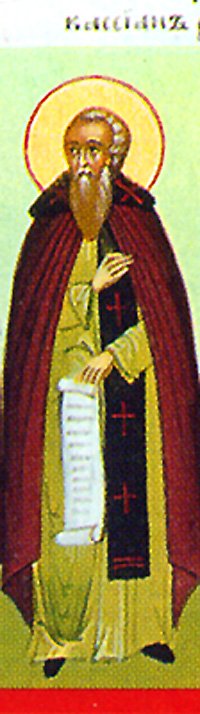
Righteous John Cassian the Confessor
Saint John Cassian the Roman was born around 360, probably in Lesser Scythia (in Dacia Pontica). His pious Christian parents gave him an excellent classical education, and also instructed him in the Holy Scriptures and in the spiritual life.
Saint John entered a monastery in the diocese of Tomis, where his friend and relative Saint Germanus labored as an ascetic.
Saint John Cassian the Roman was born around 360, probably in Lesser Scythia (in Dacia Pontica). His pious Christian parents gave him an excellent classical education, and also instructed him in the Holy Scriptures and in the spiritual life.
Saint John entered a monastery in the diocese of Tomis, where his friend and relative Saint Germanus labored as an ascetic. In 380, desiring to venerate the Holy Places, Saint John went to Jerusalem with his sister and his friend Saint Germanus. The two monks stayed at a Bethlehem monastery, not far from where the Savior was born.
After five years at the monastery, Saints John and Germanus traveled through the Thebaid and the desert monasteries of Sketis for seven years, drawing upon the spiritual experience of countless ascetics. The Egyptian monks taught them many useful things about spiritual struggles, prayer, and humility. Like honeybees they journeyed from place to place, gathering the sweet nectar of spiritual wisdom. The notes Saint John made formed the basis of his book called CONFERENCES WITH THE FATHERS in twenty-four chapters.
Returning to Bethlehem for a brief time, the spiritual brothers lived for three years in complete solitude. Then they went back to Egypt and lived there until 399. Because of the disturbances caused by Archbishop Theophilus of Alexandria to the monasteries along the Nile, they decided to go to Constantinople, after hearing of the virtue and holiness of Saint John Chrysostom. The great hierarch ordained Saint John Cassian as a deacon and accepted him as a disciple. John and Germanus remained with Saint John Chrysostom for five years, learning many profitable things from him.
When Chrysostom was exiled from Constantinople in 404, Saints John Cassian and Germanus went to Rome to plead his case before Innocent I. Cassian was ordained to the holy priesthood in Rome, or perhaps later in Gaul. After Chrysostom’s death in 407, Saint John Cassian went to Massilia [Marseilles] in Gaul (now France). There he established two cenobitic monasteries in 415, one for men and another for women, based on the model of Eastern monasticism.
At the request of Bishop Castor of Aptia Julia (in southern Gaul), Cassian wrote THE INSTITUTES OF CENOBITIC LIFE (De Institutis Coenobiorum) in twelve books, describing the life of the Palestinian and Egyptian monks. Written between 417-419, the volume included four books describing the clothing of the monks of Palestine and Egypt, their schedule of prayer and services, and how new monks were received into the monasteries.The last eight books were devoted to the eight deadly sins and how to overcome them. Through his writings, Saint John Cassian provided Christians of the West with examples of cenobitic monasteries, and acquainted them with the asceticism of the Orthodox East.
Cassian speaks as a spiritual guide about the purpose of life, about attaining discernment, about renunciation of the world, about the passions of the flesh and spirit, about the hardships faced by the righteous, and about prayer.
Saint John Cassian also wrote CONFERENCES WITH THE FATHERS (Collationes Patrum) in twenty-four books in the form of conversations about the perfection of love, about purity, about God’s help, about understanding Scripture, about the gifts of God, about friendship, about the use of language, about the four levels of monasticism, about the solitary life and cenobitic life, about repentance, about fasting, about nightly meditations, and about spiritual mortification. This last has the explanatory title “I do what I do not want to do.”
Books 1-10 of the CONFERENCES describe Saint John’s conversations with the Fathers of Sketis between 393-399. Books 11-17 relate conversations with the Fathers of Panephysis, and the last seven books are devoted to conversations with monks from the region of Diolkos.
In 431 Saint John Cassian wrote his final work, ON THE INCARNATION OF THE LORD, AGAINST NESTORIUS (De Incarnationem Domini Contra Nestorium). In seven books he opposed the heresy, citing many Eastern and Western teachers to support his arguments.
In his works, Saint John Cassian was grounded in the spiritual experience of the ascetics, and criticized the abstract reasoning of Saint Augustine (June 15). Saint John said that “grace is defended less adequately by pompous words and loquacious contention, dialectic syllogisms and the eloquence of Cicero (i.e. Augustine), than by the example of the Egyptian ascetics.” In the words of Saint John of the Ladder (March 30), “great Cassian reasons loftily and excellently.” His writings are also praised in the Rule of Saint Benedict.
Saint John Cassian lived in the West for many years, but his spiritual homeland was the Orthodox East. He fell asleep in the Lord in the year 435. His holy relics rest in an underground chapel in the Monastery of Saint Victor in Marseilles. His head and right hand are in the main church.
Troparion - Tone 8
Having been purified through fasting, / you attained the knowledge of wisdom from the God-bearing Fathers who lived in the desert, / and learned to restrain the passions. / Therefore, by your prayers, grant that our flesh may be obedient to our spirit; / for you, O Venerable Cassian, are the teacher of all those in Christ who glorify your memory.
Kontakion - Tone 4
As a venerable monk, O John Cassian, / you consecrated your life to God, and radiant with virtue, / you shone like the sun with the splendor of your divine teachings, / always enlightening the hearts of all who honor you. / Earnestly entreat Christ on behalf of those who praise you with fervent love.
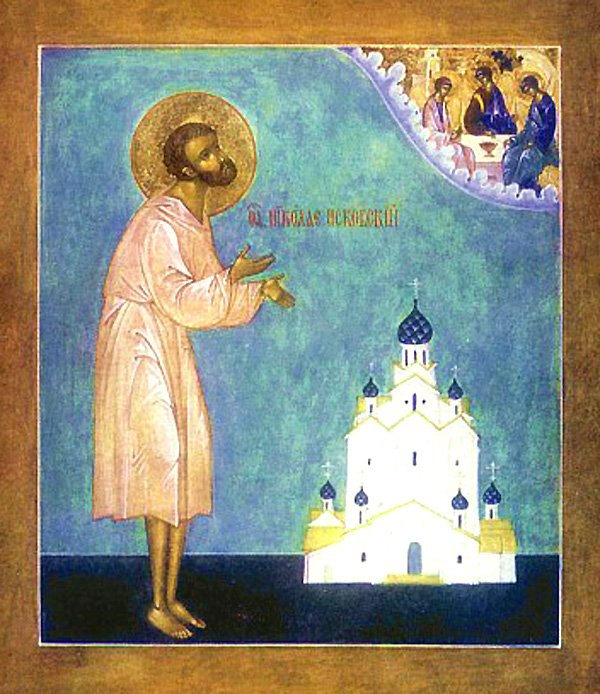
Blessed Nicholas of Pskov, fool for Christ (1576)
Blessed Nicholas of Pskov lived the life of a holy fool for more than three decades. Long before his repose, he acquired the grace of the Holy Spirit and was granted the gifts of wonderworking and of prophecy. During his lifetime, the residents of Pskov called him Mikula [Mikola, Nikola] the Fool, and revered him as a Saint, even calling him Saint Mikula.
Blessed Nicholas of Pskov lived the life of a holy fool for more than three decades. Long before his repose, he acquired the grace of the Holy Spirit and was granted the gifts of wonderworking and of prophecy. During his lifetime, the residents of Pskov called him Mikula [Mikola, Nikola] the Fool, and revered him as a Saint, even calling him Saint Mikula.
In February 1570, after a devastating campaign against Novgorod, Tsar Ivan the Terrible decided to attack Pskov, suspecting the inhabitants of treason. As the Pskov Chronicle relates, “the Tsar came ... with great ferocity, like a roaring lion, 1 wanting to tear innocent people apart, and to shed much blood.”
On the first Saturday of Great Lent, the whole city prayed to be delivered from the Tsar’s wrath. Hearing the bell ring for Matins in Pskov, the Tsar’s heart was softened when he read the inscription on the XV century wonderworking Liubyatov Tenderness Icon of the Mother of God (March 19) in the Monastery of Saint Nicholas (the Tsar’s army was at the time). “Be merciful,” he told his soldiers. “Blunt your swords upon the stones, and let there be an end to killing.”
All the inhabitants of Pskov came out upon the streets, and each family knelt at the doors of their houses, holding bread and salt to meet the Tsar. On one of the streets Blessed Nicholas ran toward the Tsar astride a stick as if he were riding a horse, and cried out: “Ivanushko, Ivanushko, eat our bread and salt, but not the blood of Christians."
The Tsar commanded that the holy fool be apprehended, but he disappeared.
Though he had forbidden his men to kill, Ivan still intended to sack the city. The Tsar attended a Moleben at Holy Trinity Cathedral, where he venerated the relics of the right-believing Prince Vsevolod-Gabriel (February 11). He also expressed his wish to receive the blessing of the holy fool Nicholas. The Saint taught the Tsar “by many terrible sayings,” to stop the killing and not to plunder God's holy churches.
He prophesied that when the Tsar left Pskov he would not have a horse to ride. "Leave us, you passer-by," the blessed one said in a stern voice, "go quickly from us. If you hesitate, there will be nothing here for you to flee on."
Tsar Ivan did not listen to him, and he ordered his men to remove the bell from Holy Trinity Cathedral. Then, just as the Saint had predicted, the Tsar’s favorite horse fell dead.
Blessed Nicholas invited the Tsar to visit his cell under the bell tower. When the Tsar arrived at the Saint's cell Nicholas said, “Come in and accept a drink of water from us, there is no reason why you should shun it.” Then the holy fool offered the Tsar a piece of raw meat.
“I am a Christian and I do not eat meat during Lent," Ivan objected.
"But you drink human blood,” Nicholas replied.
Frightened by the fulfillment of the Saint's prophecy and denounced for his wicked deeds, Ivan ordered a stop to the looting and fled from the city. The Oprichniki, witnessing this, wrote: “The mighty tyrant ... departed beaten and shamed, driven off as though by an enemy. Thus did a worthless beggar terrify and drive off the Tsar with his multitude of a thousand soldiers.”
Blessed Nicholas fell asleep in the Lord on February 28, 1576 and was buried at Holy Trinity Cathedral in the city he had saved. Such honors were granted only to the Pskov Princes, and later on, to Hierarchs.
The local veneration of the Saint began five years after his death. In the year 1581, when Pskov was besieged by the soldiers of the Polish king Stephen Bathory, the Mother of God appeared to the blacksmith Dorotheos, together with a number of Pskov Saints, praying for the city. Among these was Blessed Nicholas, according to an account concerning the Pskov-Protection Icon of the Mother of God (October 1).
At Holy Trinity cathedral the relics of Blessed Nicholas of Pskov are still venerated, for “by feigning foolishness, he was shown as a glorified citizen of the Heavenly Jerusalem" (Troparion). He also “turned the Tsar’s power from wrath to mercy" (Kontakion).
Troparion - Tone 4
According to the flesh, the Holy Fool was a Slav from the land of Pskov; / yet by feigning foolishness, he was shown as a glorified citizen of the Heavenly Jerusalem, 1 / rejoicing with the Angels; / he was named for the myrrh-streaming Hierarch Nicholas, / with whom he always prays to Christ God to grant us great mercy.1 Hebrews 12:22
Kontakion - Tone 8
According to the flesh, the Holy Fool was a Slav from the land of Pskov; / yet by feigning foolishness, he was shown as a glorified citizen of the Heavenly Jerusalem, 1 / rejoicing with the Angels; / he was named for the myrrh-streaming Hierarch Nicholas, / with whom he always prays to Christ God to grant us great mercy.
Scripture Readings
☩Epistle
1 Corinthians 6:12-20
12
All things are lawful unto me, but all things are not expedient: all things are lawful for me, but I will not be brought under the power of any.
13
Meats for the belly, and the belly for meats: but God shall destroy both it and them. Now the body is not for fornication, but for the Lord; and the Lord for the body.
14
And God hath both raised up the Lord, and will also raise up us by his own power.
15
Know ye not that your bodies are the members of Christ? shall I then take the members of Christ, and make them the members of an harlot? God forbid.
16
What? know ye not that he which is joined to an harlot is one body? for two, saith he, shall be one flesh.
17
But he that is joined unto the Lord is one spirit.
18
Flee fornication. Every sin that a man doeth is without the body; but he that committeth fornication sinneth against his own body.
19
What? know ye not that your body is the temple of the Holy Ghost which is in you, which ye have of God, and ye are not your own?
20
For ye are bought with a price: therefore glorify God in your body, and in your spirit, which are God’s.
☩Gospel
Luke 15:11-32
11
And he said, A certain man had two sons:
12
And the younger of them said to his father, Father, give me the portion of goods that falleth to me. And he divided unto them his living.
13
And not many days after the younger son gathered all together, and took his journey into a far country, and there wasted his substance with riotous living.
14
And when he had spent all, there arose a mighty famine in that land; and he began to be in want.
15
And he went and joined himself to a citizen of that country; and he sent him into his fields to feed swine.
16
And he would fain have filled his belly with the husks that the swine did eat: and no man gave unto him.
17
And when he came to himself, he said, How many hired servants of my father’s have bread enough and to spare, and I perish with hunger!
18
I will arise and go to my father, and will say unto him, Father, I have sinned against heaven, and before thee,
19
And am no more worthy to be called thy son: make me as one of thy hired servants.
20
And he arose, and came to his father. But when he was yet a great way off, his father saw him, and had compassion, and ran, and fell on his neck, and kissed him.
21
And the son said unto him, Father, I have sinned against heaven, and in thy sight, and am no more worthy to be called thy son.
22
But the father said to his servants, Bring forth the best robe, and put it on him; and put a ring on his hand, and shoes on his feet:
23
And bring hither the fatted calf, and kill it; and let us eat, and be merry:
24
For this my son was dead, and is alive again; he was lost, and is found. And they began to be merry.
25
Now his elder son was in the field: and as he came and drew nigh to the house, he heard musick and dancing.
26
And he called one of the servants, and asked what these things meant.
27
And he said unto him, Thy brother is come; and thy father hath killed the fatted calf, because he hath received him safe and sound.
28
And he was angry, and would not go in: therefore came his father out, and intreated him.
29
And he answering said to his father, Lo, these many years do I serve thee, neither transgressed I at any time thy commandment: and yet thou never gavest me a kid, that I might make merry with my friends:
30
But as soon as this thy son was come, which hath devoured thy living with harlots, thou hast killed for him the fatted calf.
31
And he said unto him, Son, thou art ever with me, and all that I have is thine.
32
It was meet that we should make merry, and be glad: for this thy brother was dead, and is alive again; and was lost, and is found.
Liturgical data sourced from OCA.org and orthocal.info