
Fasting Rules
 Meat
Allowed
 Fish
Allowed
 Dairy
Allowed
 Oil
Allowed
 Wine
Allowed
Saints & Commemorations
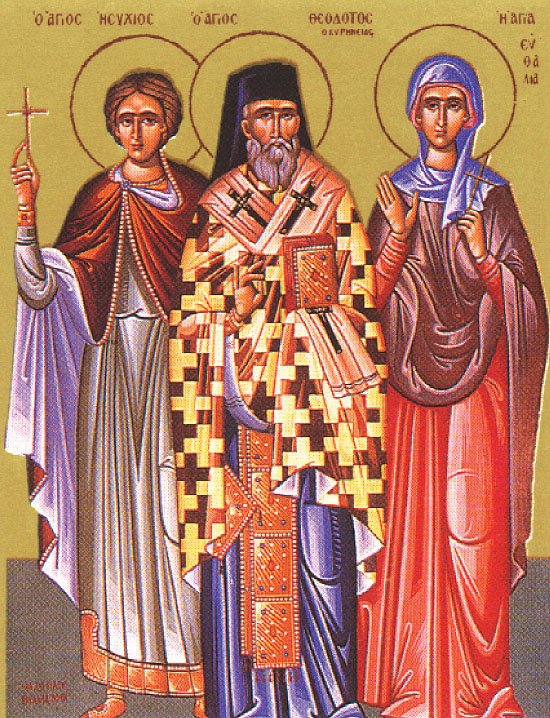
Hieromartyr Theodotus, Bishop of Cyrenia
The Hieromartyr Theodotus, a native of Galatia in Asia Minor, was Bishop of Cyrenia in Cyprus. During a time of persecution against Christians under the impious emperor Licinius (311-324), Saint Theodotus openly preached Christ, calling on the pagans to abandon idolatry and turn to the true God. Sabinus, the governor of Cyprus, ordered that Bishop Theodotus be arrested and brought to trial.
The Hieromartyr Theodotus, a native of Galatia in Asia Minor, was Bishop of Cyrenia in Cyprus. During a time of persecution against Christians under the impious emperor Licinius (311-324), Saint Theodotus openly preached Christ, calling on the pagans to abandon idolatry and turn to the true God. Sabinus, the governor of Cyprus, ordered that Bishop Theodotus be arrested and brought to trial.
When he heard about this order, the saint did not wait for the soldiers to be sent after him, but immediately went to the governor saying, “I, whom you seek, am here. I have shown myself in order to preach Christ my God.”
The governor ordered that the saint be beaten without mercy, suspended from a tree, raked with sharp implements, and then be taken to prison. Five days later Saint Theodotus was brought to the governor, who presumed that after his tortures the bishop would prefer to renounce Christ, rather than endure new sufferings.
However, Saint Theodotus did not cease to preach about Christ. At first they put the saint on an iron grate, under which they lit a fire, and then hammered nails into his feet and let him go. Many witnessed the sufferings of the martyr. Astonished at the saint’s endurance and his divinely-inspired speech, they came to believe in Christ. Learning of this, Sabinus gave orders to stop the torture and throw the saint into prison.
During the reign of Saint Constantine the Great (May 21), the freedom to confess their faith was given to all Christians, and among those set free from prison was Saint Theodotus. The saint returned to Cyrenia and after two years serving as bishop he peacefully fell asleep in the Lord in about the year 326.
Troparion - Tone 4
By sharing in the ways of the Apostles, / you became a successor to their throne. / Through the practice of virtue, you found the way to divine contemplation, O inspired one of God; / by teaching the word of truth without error, you defended the Faith, even to the shedding of your blood. / Hieromartyr Theodotus, entreat Christ God to save our souls.
Kontakion - Tone 3
You denounced the depths of false belief. / With the Orthodox faith you wounded the delusion of idolatry. / As a godly, whole burnt sacrifice, / you refreshed the ends of the earth with your wonders! / O holy hierarch Theodotus, our father, / entreat Christ God to grant us great mercy!
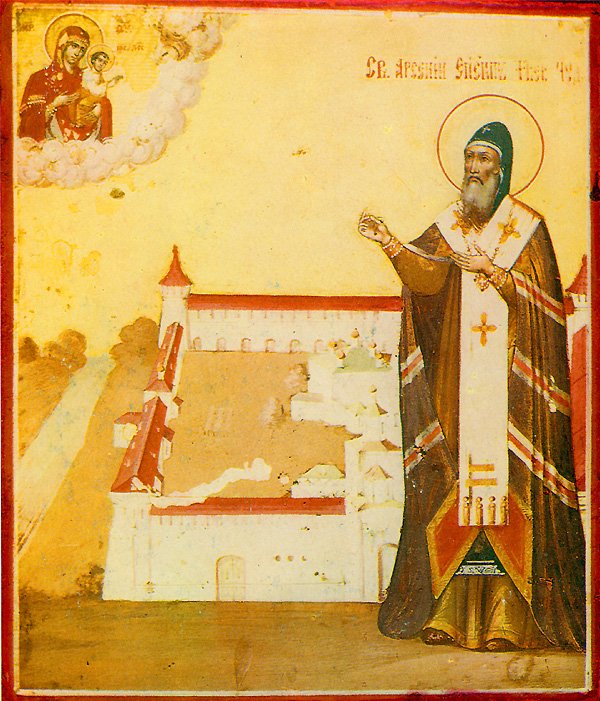
St Arseny, Bishop of Tver
Saint Arsenius, Bishop of Tver, was born at Tver, and in his early years received monastic tonsure in the Kiev Caves monastery. Even among the monks of this ancient monastery, distinguished for their piety, Arsenius was noted for his saintly life as well as for his strictness in keeping his monastic vows, his knowledge of the Church typikon, his study of Holy Scripture, and his love for work.
Saint Arsenius, Bishop of Tver, was born at Tver, and in his early years received monastic tonsure in the Kiev Caves monastery. Even among the monks of this ancient monastery, distinguished for their piety, Arsenius was noted for his saintly life as well as for his strictness in keeping his monastic vows, his knowledge of the Church typikon, his study of Holy Scripture, and his love for work.
Under Metropolitan Cyprian of Kiev (1380-1382) he served as archdeacon, and when the Metropolitan was absent, he governed the administration of the Kiev metropolitanate. On July 3, 1390 he went with Metropolitan Cyprian to Tver, where at the request of Prince Micjae of Tver, a Council of Russian and Greek hierarchs had been convened to pass judgment upon Bishop Euthymius of Tver.
The prince and the bishop were involved in a lengthy dispute, and many of the people of Tver made serious accusations against the bishop. After unsuccessful attempts to restore peace to the Tver church, Metropolitan Cyprian deposed Euthymius as bishop and sent him off to Moscow to the Chudov monastery.
Saint Arsenius was appointed to the Tver cathedra, but he was both troubled and afraid to accept this position, in view of the great enmity and spite in that place. Upon the return of Metropolitan Cyprian and archdeacon Arsenius to Moscow, the Prince sent his nobles to the Metropolitan with a petition to consecrate Arsenius as Bishop of Tver. This time Arsenius also refused. In the words of the chronicle for the year 1390 “even at the Metropolitan’s entreaty, Archdeacon Arsenius would not go to Tver.”
After threatening Arsenius with suspension, the Metropolitan and the Prince finally got him to agree to accept episcopal consecration, which took place on August 15, 1390. Among the bishops taking part in the laying on of hands was Saint Stephen, Bishop of Perm (April 26).
Bishop Arsenius, as a man of great prayer and peacemaker, was able to end much of the discord in the Tver principality. During his episcopacy, from 1390 to 1409, cathedrals were built and consecrated in honor of the Archangel Michael at Staritsa and Mikulina, and the Savior-Transfiguration cathedral was restored with the construction of a cathedral belltower. The saint founded the Zheltikov monastery on the river Tmaka near Tver, where a church was built in honor of Saints Anthony and Theodosius of the Kiev Caves (1394), and a stone Dormition cathedral.
Desiring that the monks of this new monastery would always be edified by the asceticism of the Fathers of the Caves, Saint Arsenius gave orders to compile a list from the Kiev Caves Paterikon, using the most ancient manuscripts of this precious memorial of Russian literature. This compilation was known as the Arseniev Redaction.
The saint died on March 2, 1409, and was buried in the Zheltikov monastery of the Dormition of the Most Holy Theotokos, which he founded. In 1483 his relics were found incorrupt and were placed in the monastery cathedral. In the same year hieromonk Theodosius composed a Life and a Canon in honor of the holy bishop.
At a Council of 1547 Saint Arsenius’ commemoration was established throughout all the Church.
Troparion - Tone 1
You were enlightened by divine grace from above, O Hierarch, / and with much patience in this temporal life you performed your ascetical contests. / Therefore, you pour forth the grace of miracles / for all those who come with faith to the revered shrine of your relics, most blessed Arsenios. / Therefore, we cry out to you: / “Glory to Him Who strengthened you. / Glory to Him Who crowned you. / Glory to Him Who, through you, grants healing to all.”
Kontakion - Tone 8
You appeared today as a Russian star revealed by God, / resplendent with miracles, O Hierarch Arsenios. / Therefore, do not cease praying to Christ God for your flock, / and preserve your homeland, and your city, / and the people who with faith glorify the transfer of your revered relics, / bowing down before them with fear and love. / May we all cry out to you with a loud voice: / “Rejoice, godly-wise Hierarch Arsenios, our Father.”
The Four Hundred and Forty Martyrs of Lombardy (579)
Forty of them were beheaded in one place in Lombardy (in Italy) because they refused to eat food offered to idols. Another four hundred were massacred because they refused to join with the Lombard pagans’ practice of dancing around a goat’s head that had been brought for sacrifice to the idols. Their deaths are recorded by St Gregory the Dialogist (Gregory the Great).
We
Forty of them were beheaded in one place in Lombardy (in Italy) because they refused to eat food offered to idols. Another four hundred were massacred because they refused to join with the Lombard pagans’ practice of dancing around a goat’s head that had been brought for sacrifice to the idols. Their deaths are recorded by St Gregory the Dialogist (Gregory the Great).
We sometimes imagine that the Roman Empire converted almost overnight to Christianity during the reign of St Constantine the Great. This incident, more than two hundred years into Europe’s ‘Christian era’, reminds us that the progress of the Faith among the people was often slow and halting, and that paganism remained a force for many centuries.
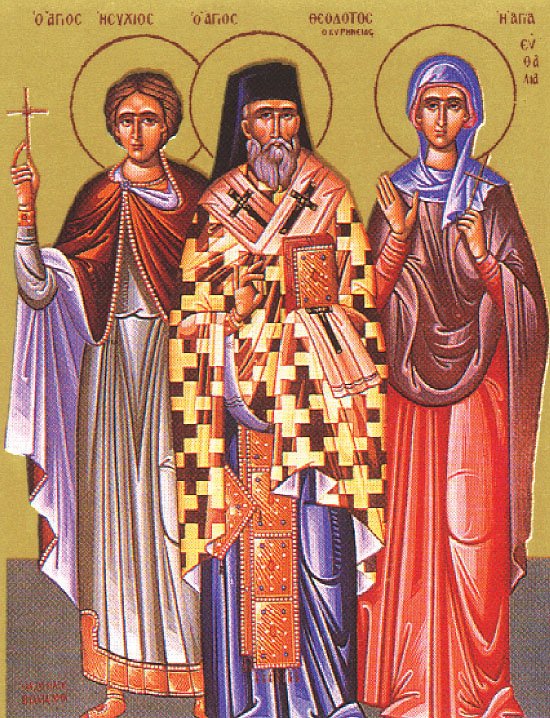
Holy Martyr Euthalia (257)
The Holy Martyr Euthalia lived with her mother and brother in Leontina on the island of Sicily. Euthalia’s mother, a pagan, suffered for a long while with an issue of blood. Once, the Martyrs Alphaeus, Philadelphus and Cyprian (May 10) appeared to her in a dream and told her she would be healed only if she believed in Christ and was baptized.
The Holy Martyr Euthalia lived with her mother and brother in Leontina on the island of Sicily. Euthalia’s mother, a pagan, suffered for a long while with an issue of blood. Once, the Martyrs Alphaeus, Philadelphus and Cyprian (May 10) appeared to her in a dream and told her she would be healed only if she believed in Christ and was baptized.
After being baptized with her daughter, she was healed of her infirmity. When Euthalia’s pagan brother Sirmianus learned of the baptism, went into a violent rage. The mother succeeded in fleeing, but Saint Euthalia confessed herself a Christian and suffered martyrdom. After fierce tortures, the saint was beheaded with a sword.
Troparion - Tone 4
Your lamb Euthalia, / calls out to You, O Jesus, in a loud voice: / “I love You, my Bridegroom, / and in seeking You, I endure suffering. / In baptism I was crucified so that I might reign in You, / and I died so that I might live with You. / Accept me as a pure sacrifice, / for I have offered myself in love.” / Through her prayers save our souls, since You are merciful.
Kontakion - Tone 2
Finding your most revered temple to be a source of healing for our souls, / we the faithful cry out to You with a loud voice: / “O most renowned Virgin Martyr Euthalia, / entreat Christ God unceasingly on behalf of us all.”
Scripture Readings
☩Epistle
1 John 3:10-20
10
In this the children of God are manifest, and the children of the devil: whosoever doeth not righteousness is not of God, neither he that loveth not his brother.
11
For this is the message that ye heard from the beginning, that we should love one another.
12
Not as Cain, who was of that wicked one, and slew his brother. And wherefore slew he him? Because his own works were evil, and his brother’s righteous.
13
Marvel not, my brethren, if the world hate you.
14
We know that we have passed from death unto life, because we love the brethren. He that loveth not his brother abideth in death.
15
Whosoever hateth his brother is a murderer: and ye know that no murderer hath eternal life abiding in him.
16
Hereby perceive we the love of God, because he laid down his life for us: and we ought to lay down our lives for the brethren.
17
But whoso hath this world’s good, and seeth his brother have need, and shutteth up his bowels of compassion from him, how dwelleth the love of God in him?
18
My little children, let us not love in word, neither in tongue; but in deed and in truth.
19
And hereby we know that we are of the truth, and shall assure our hearts before him.
20
For if our heart condemn us, God is greater than our heart, and knoweth all things.
☩Gospel
Mark 14:10-42
10
And Judas Iscariot, one of the twelve, went unto the chief priests, to betray him unto them.
11
And when they heard it, they were glad, and promised to give him money. And he sought how he might conveniently betray him.
12
And the first day of unleavened bread, when they killed the passover, his disciples said unto him, Where wilt thou that we go and prepare that thou mayest eat the passover?
13
And he sendeth forth two of his disciples, and saith unto them, Go ye into the city, and there shall meet you a man bearing a pitcher of water: follow him.
14
And wheresoever he shall go in, say ye to the goodman of the house, The Master saith, Where is the guestchamber, where I shall eat the passover with my disciples?
15
And he will shew you a large upper room furnished and prepared: there make ready for us.
16
And his disciples went forth, and came into the city, and found as he had said unto them: and they made ready the passover.
17
And in the evening he cometh with the twelve.
18
And as they sat and did eat, Jesus said, Verily I say unto you, One of you which eateth with me shall betray me.
19
And they began to be sorrowful, and to say unto him one by one, Is it I? and another said, Is it I?
20
And he answered and said unto them, It is one of the twelve, that dippeth with me in the dish.
21
The Son of man indeed goeth, as it is written of him: but woe to that man by whom the Son of man is betrayed! good were it for that man if he had never been born.
22
And as they did eat, Jesus took bread, and blessed, and brake it, and gave to them, and said, Take, eat: this is my body.
23
And he took the cup, and when he had given thanks, he gave it to them: and they all drank of it.
24
And he said unto them, This is my blood of the new testament, which is shed for many.
25
Verily I say unto you, I will drink no more of the fruit of the vine, until that day that I drink it new in the kingdom of God.
26
And when they had sung an hymn, they went out into the mount of Olives.
27
And Jesus saith unto them, All ye shall be offended because of me this night: for it is written, I will smite the shepherd, and the sheep shall be scattered.
28
But after that I am risen, I will go before you into Galilee.
29
But Peter said unto him, Although all shall be offended, yet will not I.
30
And Jesus saith unto him, Verily I say unto thee, That this day, even in this night, before the cock crow twice, thou shalt deny me thrice.
31
But he spake the more vehemently, If I should die with thee, I will not deny thee in any wise. Likewise also said they all.
32
And they came to a place which was named Gethsemane: and he saith to his disciples, Sit ye here, while I shall pray.
33
And he taketh with him Peter and James and John, and began to be sore amazed, and to be very heavy;
34
And saith unto them, My soul is exceeding sorrowful unto death: tarry ye here, and watch.
35
And he went forward a little, and fell on the ground, and prayed that, if it were possible, the hour might pass from him.
36
And he said, Abba, Father, all things are possible unto thee; take away this cup from me: nevertheless not what I will, but what thou wilt.
37
And he cometh, and findeth them sleeping, and saith unto Peter, Simon, sleepest thou? couldest not thou watch one hour?
38
Watch ye and pray, lest ye enter into temptation. The spirit truly is ready, but the flesh is weak.
39
And again he went away, and prayed, and spake the same words.
40
And when he returned, he found them asleep again, (for their eyes were heavy,) neither wist they what to answer him.
41
And he cometh the third time, and saith unto them, Sleep on now, and take your rest: it is enough, the hour is come; behold, the Son of man is betrayed into the hands of sinners.
42
Rise up, let us go; lo, he that betrayeth me is at hand.
Liturgical data sourced from OCA.org and orthocal.info