
Fasting Rules
 Meat
Abstain
 Fish
Abstain
 Dairy
Abstain
 Oil
Abstain
 Wine
Abstain
Saints & Commemorations
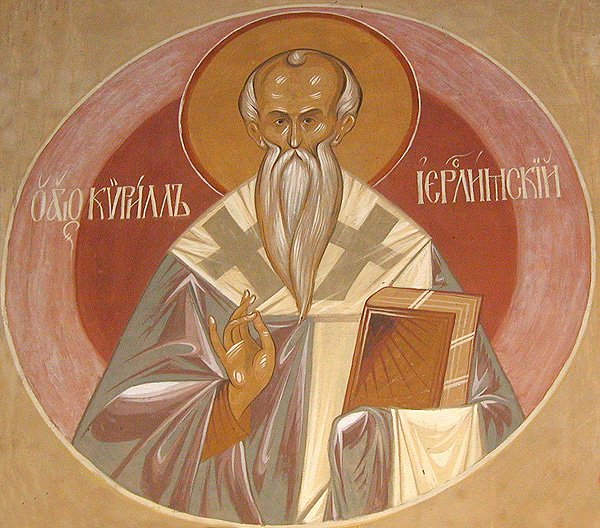
St Cyril, Archbishop of Jerusalem
Saint Cyril, Archbishop of Jerusalem, was born in Jerusalem in the year 315 and was raised in strict Christian piety. Upon reaching the age of maturity, he became a monk, and in the year 346 he became a presbyter. In the year 350, upon the death of Archbishop Maximus, he succeeded him on the episcopal throne of Jerusalem.
Saint Cyril, Archbishop of Jerusalem, was born in Jerusalem in the year 315 and was raised in strict Christian piety. Upon reaching the age of maturity, he became a monk, and in the year 346 he became a presbyter. In the year 350, upon the death of Archbishop Maximus, he succeeded him on the episcopal throne of Jerusalem.
As Patriarch of Jerusalem, Saint Cyril zealously fought against the heresies of Arius and Macedonius. In so doing, he aroused the animosity of the Arian bishops, who sought to have him deposed and banished from Jerusalem.
There was a miraculous portent in 351 at Jerusalem: at the third hour of the day on the Feast of Pentecost, the Holy Cross appeared in the heavens, shining with a radiant light. It stretched from Golgotha above the Mount of Olives. Saint Cyril reported this portent to the Arian emperor Constantius (351-363), hoping to convert him to Orthodoxy.
The heretic Acacius, deposed by the Council of Sardica, was formerly the Metropolitan of Caesarea, and he collaborated with the emperor to have Saint Cyril removed. An intense famine struck Jerusalem, and Saint Cyril expended all his wealth in charity. But since the famine did not abate, the saint pawned church utensils, and used the money to buy wheat for the starving. The saint’s enemies spread a scandalous rumor that they had seen a woman in the city dancing around in clerical garb. Taking advantage of this rumor, the heretics forcibly expelled the saint.
The saint found shelter with Bishop Silvanus in Tarsus. After this, a local Council was held at Seleucia, at which there were about 150 bishops, and among them Saint Cyril. The heretical Metropolitan Acacius did not want to allow him to take a seat, but the Council would not consent to this. Acacius stormed out of the Council, and before the emperor and the Arian patriarch Eudoxius, he denounced both the Council and Saint Cyril. The emperor had the saint imprisoned.
When the emperor Julian the Apostate (361-363) ascended the throne he repealed all the anti-Orthodox decrees of Constantius, seemingly out of piety. Saint Cyril returned to his own flock. But after a certain while, when Julian had become secure upon the throne, he openly apostasized and renounced Christ. He permitted the Jews to start rebuilding the Temple of Jerusalem that had been destroyed by the Romans, and he even provided them part of the funds for the building from the state treasury.
Saint Cyril predicted that the words of the Savior about the destruction of the Temple down to its very stones (Luke. 21:6) would undoubtedly transpire, and the blasphemous intent of Julian would come to naught. Soon there was such a powerful earthquake, that even the solidly set foundation of the ancient Temple of Solomon shifted in its place, and what had been rebuilt fell down and shattered into dust. When the Jews resumed construction, a fire came down from the heavens and destroyed the tools of the workmen. Great terror seized everyone. On the following night, the Sign of the Cross appeared on the clothing of the Jews, which they could not remove by any means.
After this heavenly confirmation of Saint Cyril’s prediction, they banished him again, and the bishop’s throne was occupied by Saint Cyriacus. But Saint Cyriacus soon suffered a martyr’s death (October 28).
After the emperor Julian perished in 363, Saint Cyril returned to his See, but during the reign of the emperor Valens (364-378) he was exiled for a third time. It was only under the holy emperor Saint Theodosius the Great (379-395) that he finally returned to his archpastoral activity. In 381 Saint Cyril participated in the Second Ecumenical Council, which condemned the heresy of Macedonius and affirmed the Nicea-Constantinople Symbol of Faith (Creed).
Saint Cyril’s works include twenty-three Instructions (Eighteen are Catechetical, intended for those preparing for Baptism, and five are for the newly-baptized) and two discourses on Gospel themes: “On the Paralytic,” and “Concerning the Transformation of Water into Wine at Cana.”
At the heart of the Catechetical Instructions is a detailed explanation of the Symbol of Faith. The saint suggests that a Christian should inscribe the Symbol of Faith upon “the tablets of the heart.”
“The articles of the Faith,” Saint Cyril teaches, “were not written through human cleverness, but they contain everything that is most important in all the Scriptures, in a single teaching of faith. Just as the mustard seed contains all its plethora of branches within its small kernel, so also does the Faith in its several declarations combine all the pious teachings of the Old and the New Testaments.”
Saint Cyril, a great ascetic and a champion of Orthodoxy, died in the year 386.
Troparion - Tone 8
You were seen in Zion clothed in a robe of godliness / as an illustrious pillar of the Apostles’ faith. / You became an heir to their grace, / setting forth their pious doctrines / and dispensing their talents of wisdom. / O Cyril, our Father and hierarch, pray for us.
Kontakion - Tone 1
With your lips, O wise Cyril, / and through divine inspiration / you enlightened your people / to the worship of the one Trinity, / undivided in essence, yet divided in Hypostases. / Wherefore rejoicing, we celebrate your all-holy memory, / offering you as our intercessor before God.
Rep. St Nikolaj of Zhicha
St Ananias (Aninus) the Wonderworker (?)
“Born in Chalcedon, he was little of stature, like Zaccheus, but great in spirit and faith. He denied himself to the world at the age of fifteen and settled near the River Euphrates in a little hut, where he atoned for his sins, and prayed to God, at first with his teacher Mayum and then, after Mayum’s death, alone. By
“Born in Chalcedon, he was little of stature, like Zaccheus, but great in spirit and faith. He denied himself to the world at the age of fifteen and settled near the River Euphrates in a little hut, where he atoned for his sins, and prayed to God, at first with his teacher Mayum and then, after Mayum’s death, alone. By the power of his prayers he filled an empty well with water, healed the sick of various pains and tamed wild beasts. There was a tamed lion with him as his servant. He had insight into distant happenings. When robbers attacked a stylite, Pionius, at some distance from him, and beat him up to such an extent that he decided to come down from his pillar and go to complain to the judges, St Aninus saw his intention in his soul and sent him a letter by means of his lion, telling him to set aside his intention, to forgive his assaulters and to continue in his asceticism. He was inexpressibly generous. The bishop of Neo-Caesarea made a gift to him of a donkey, to ease his carrying of water from the river, but he gave this donkey to some poor man who had complained to him of his poverty. The bishop gave him a second donkey, but he gave that away. Then the bishop gave him a third donkey, not for his own but only to serve as a water-carrier, to be kept and returned. At the time of his death, he saw Moses, Aaron and Or coming to him and calling: ‘Aninus, the Lord is calling you. Get up and come with us.’ This he revealed to his disciples, and gave his spirit to the Lord whom he had served so faithfully. He was 110 years old when he finished his earthly course.” (Prologue)
Saint Nikolai (Velimirovic), Bishop of Ochrid and Zica, Serbia (1956)(March 5 OC)
He has been called ‘The New Chrysostom’ for his many grace-filled sermons and writings.
He was born in 1880 in the Serbian village of Lelich. After attending the Seminary of St Sava in Belgrade, he obtained doctoral degrees from both the University of Berne and Oxford University. In 1919, Archimandrite Nikolai was made Bishop of Zica.
In
He has been called ‘The New Chrysostom’ for his many grace-filled sermons and writings.
He was born in 1880 in the Serbian village of Lelich. After attending the Seminary of St Sava in Belgrade, he obtained doctoral degrees from both the University of Berne and Oxford University. In 1919, Archimandrite Nikolai was made Bishop of Zica.
In 1941 Bishop Nikolai was arrested by the Nazis and, after three years’ imprisonment in Ljubostir Vojlovici Monastery, was sent to the infamous Dachau concentration camp along with the Serbian Patriarch Gavrilo. He both witnessed and personally underwent many tortures there until the camp was liberated by the US army in 1945.
After the war he fled Communist-controlled Yugoslavia and emigrated to the United States, where he taught at St Sava’s Seminary, St Vladimir Seminary and St Tikhon seminary. It was at St Tikhon Seminary that he reposed in 1956. His relics rested for awhile at St Sava’s Seminary in Libertyville IL, then were returned to Serbia, where they now reside.
Throughout his adult life, the holy monk and bishop poured forth a steady stream of beautiful homilies and theological and spiritual writings. He is the author of the Prologue from Ochrid, a Slavic Synaxarion. The luminous homilies included therein, one for each day of the year, give a good sample of his inspired writing.
His feast is kept on this day (March 5 OC, March 18 NC) by Orthodox Christians on both the Old and New Calendars.
Note: With the blessing of Bishop Jovan of the Serbian Orthodox Church, Mitrophan Chin is engaged in a project to translate St Nikolai’s Prologue into Chinese. To learn more about this worthy project, see his web site: http://chineseorthodox.n3.net
Scripture Readings
View scripture readings for this date on OCA.org.
View readings on OCA.orgNotes
["Great Canon"]
Liturgical data sourced from OCA.org and orthocal.info