
Fasting Rules
 Meat
Abstain
 Fish
Abstain
 Dairy
Abstain
 Oil
Allowed
 Wine
Allowed
Saints & Commemorations
Memorial Saturday
Saturday is the day which the Church has set aside for the commemoration of Orthodox Christians departed this life in the hope of resurrection and eternal life. Since the Divine Liturgy cannot be served on weekdays during Great Lent, the second, third, and fourth Saturdays of the Fast are appointed as Soul Saturdays when the departed are remembered at Liturgy.
Saturday is the day which the Church has set aside for the commemoration of Orthodox Christians departed this life in the hope of resurrection and eternal life. Since the Divine Liturgy cannot be served on weekdays during Great Lent, the second, third, and fourth Saturdays of the Fast are appointed as Soul Saturdays when the departed are remembered at Liturgy.
In addition to the Liturgy, kollyva (wheat or rice cooked with honey and mixed with raisins, figs, nuts, sesame, etc.) is blessed in church on these Saturdays. The kollyva reminds us of the Lord’s words, “Unless a grain of wheat falls into the earth and dies, it remains alone; but if it dies, it bears much fruit” (John 12:24).The kollyva symbolizes the future resurrection of all the dead. As Saint Simeon of Thessalonica (September 15) says, man is also a seed which is planted in the ground after death, and will be raised up again by God’s power. Saint Paul also speaks of this (I Cor. 15:35-49).
It is also customary to give alms in memory of the dead. The angel who spoke to Cornelius testifies to the efficacy of almsgiving, “Your prayers and your alms have ascended as a memorial before God” (Acts 10:4).
Memorial services for the dead may be traced back to ancient times. Chapter 8 of the Apostolic Constitutions recommends memorial services with Psalms for the dead. It also contains a beautiful prayer for the departed, asking that their voluntary and involuntary sins be pardoned, that they be given rest with the Patriarchs, Prophets, and Apostles in a place where sorrow, suffering, and sighing have fled away (Isaiah 35:10). Saint John Chrysostom mentions the service for the dead in one of his homilies on Philippians, and says that it was established by the Apostles. Saint Cyprian of Carthage (Letter 37) also speaks of our duty to remember the martyrs.
The holy Fathers also testify to the benefit of offering prayers, memorial services, Liturgies, and alms for the dead (Saint John Chrysostom, Saint Cyril of Jerusalem, Saint John of Damascus, etc.). Although both the righteous and those who have not repented and corrected themselves may receive benefit and consolation from the Church’s prayer, it has not been revealed to what extent the unrighteous receive this solace. It is not possible, however, to transfer a soul from a state of evil and condemnation to a state of holiness and blessedness through the Church’s prayer. Saint Basil the Great points out that the time for repentance and forgiveness of sins is during the present life, while the future life is a time for righteous judgment and retribution (Moralia 1). Saint John Chrysostom, Saint Gregory the Theologian, and other patristic writers concur with Saint Basil’s statement.
By praying for others, we bring benefit to them, and also to ourselves, because “God is not so unjust as to forget your work and the love which you showed for His sake in serving the saints...” (Heb. 6:10).
Troparion - Tone 8
Only Creator, with wisdom profound, You mercifully order all things, / and give that which is needed to all men: / Give rest, O Lord, to the souls of Your servants who have fallen asleep, / for they have placed their trust in You, our Maker and Fashioner, and our God.
Kontakion - Tone 8
With the saints give rest, O Christ, to the souls of Your servants, / where there is neither sickness nor sorrow, and no more sighing, / but life everlasting.
Martyrs Terence, Pompeius, Africanus and Companions
These African Christians suffered during the persecution of the Church by the emperor Decius, during which a great many Christians denied the faith rather than suffer. These faithful few boldly upheld the Faith and, after many torments, were condemned to death by beheading. The went to their execution singing psalms and hymns of thanksgiving, and received the crown of martyrdom in 250.
These African Christians suffered during the persecution of the Church by the emperor Decius, during which a great many Christians denied the faith rather than suffer. These faithful few boldly upheld the Faith and, after many torments, were condemned to death by beheading. The went to their execution singing psalms and hymns of thanksgiving, and received the crown of martyrdom in 250.
In the early centuries of the Church, North Africa, especially the region of Carthage, was one of the centers of the Christian Faith, comparable to Asia Minor.
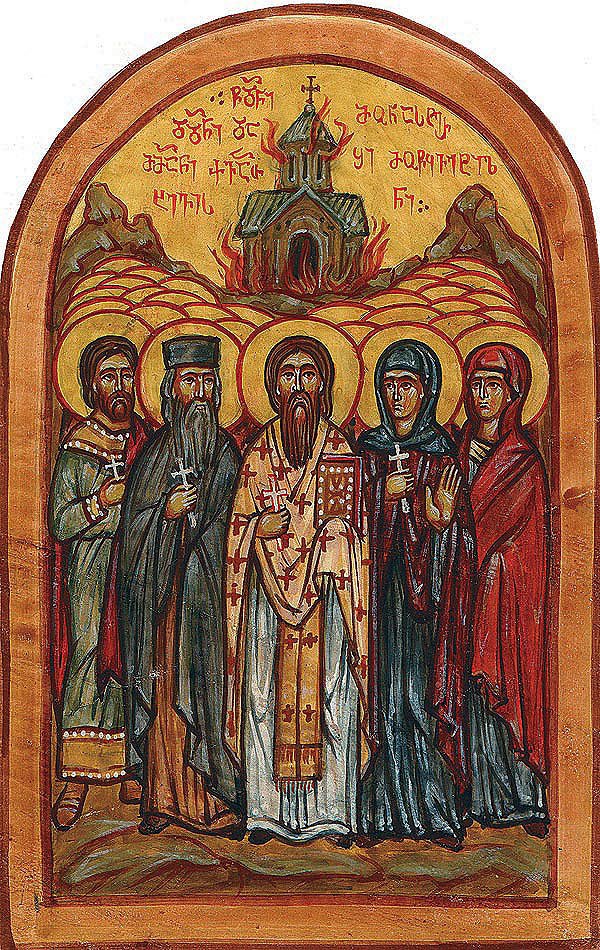
Six Thousand Holy Martyrs in Georgia (1615)
In the 14th century, during the reign of King Bagrat V (1360-1394), Timur (Tamerlane) invaded Georgia seven times. His troops inflicted irreparable damage on the country, seizing centuries-old treasures and razing ancient churches and monasteries.
Timur’s armies ravaged Kartli, then took the king, queen, and the entire royal court captive and sent them to Karabakh (in present-day Azerbaijan). L
In the 14th century, during the reign of King Bagrat V (1360-1394), Timur (Tamerlane) invaded Georgia seven times. His troops inflicted irreparable damage on the country, seizing centuries-old treasures and razing ancient churches and monasteries.
Timur’s armies ravaged Kartli, then took the king, queen, and the entire royal court captive and sent them to Karabakh (in present-day Azerbaijan). Later Timur attempted to entice King Bagrat to renounce the Christian Faith in exchange for permission to return to the throne and for the release of the other Georgian prisoners.
For some time Timur was unable to subjugate King Bagrat, but in the end, being powerless and isolated from his kinsmen, the king began to falter. He devised a sly scheme: to confess Islam before the enemy, but to remain a Christian at heart. Satisfied with King Bagrat’s decision to “convert to Islam,” Timur permitted the king to return to the throne of Kartli. At the request of King Bagrat, Timur sent twelve thousand troops with him to complete Georgia’s forcible conversion to Islam.
When they were approaching the village of Khunani in southeastern Georgia, Bagrat secretly informed his son Giorgi of everything that had happened and called upon him and his army to massacre the invaders.
The news of Bagrat’s betrayal and the ruin of his army infuriated Timur, and he called for immediate revenge. At their leader’s command, his followers destroyed everything in their path, set fire to cities and villages, devastated churches, and thus forced their way through to Kvabtakhevi Monastery.
Monastics and laymen alike were gathered in Kvabtakhevi when the enemy came thundering in. Having forced open the gate, the attackers burst into the monastery, then plundered and seized all its treasures. They captured the young and strong, carrying them away.
The old and infirm were put to the sword. As the greatest humiliation, they mocked the clergy and monastics by strapping them with sleigh bells and jumping and dancing around them.
Already drunk on the blood they had shed, the barbarians posed an ultimatum to those who remained: to renounce Christ and live or to be driven into the church and burned alive.
Faced with these terms, the faithful cried out: “Go ahead and burn our flesh—in the Heavenly Kingdom our souls will burn with a divine flame more radiant than the sun!” And in their exceeding humility, the martyrs requested that their martyrdom not be put on display: “We ask only that you not commit this sin before the eyes of men and angels. The Lord alone knows the sincerity of our will and comforts us in our righteous afflictions!”
Having been driven like beasts into the church, the martyrs raised up a final prayer to God: “ In the multitude of Thy mercy shall I go into Thy house; I shall worship toward Thy holy temple in fear of Thee. O Lord, guide me in the way of Thy righteousness; because of mine enemies, make straight my way before Thee (Ps. 5:6-7) that with a pure mind I may glorify Thee forever....”
The executioners hauled in more and more wood, until the flames enveloping the church blazed as high as the heavens and the echo of crackling timber resounded through the mountains. Ensnared in a ring of fire, the blissful martyrs chanted psalms as they gave up their spirits to the Lord.
The massacre at Kvabtakhevi took place in 1386. The imprints of the martyrs’ charred bodies remain on the floor of the church to this day.
Troparion - Tone 4
Your holy martyrs O Lord, / through their sufferings have received incorruptible crowns from You, our God. / For having Your strength, they laid low their adversaries, / and shattered the powerless boldness of demons. / Through their intercessions, save our souls!
New Hieromartyr Gregory, Patriarch of Constantinople (1821)
The Holy Patriarch Gregory (George Angelopoulos in the world) was born in 1745 at Dēmētsána in the Pelopónnēsos. He began his education in the village schools, since his father could not afford to send him to better schools. In 1765, he went to Athens to study under the renowned teacher Dēmḗtrios Vodas, and in 1767, he went to Smyrna to attend an ecclesiastical school. Later,
The Holy Patriarch Gregory (George Angelopoulos in the world) was born in 1745 at Dēmētsána in the Pelopónnēsos. He began his education in the village schools, since his father could not afford to send him to better schools. In 1765, he went to Athens to study under the renowned teacher Dēmḗtrios Vodas, and in 1767, he went to Smyrna to attend an ecclesiastical school. Later, he went to Patmos for further study, and was ordained as a Deacon in 1775 at Smyrna. Soon after, he was ordained as a Hieromonk.
In 1785 he was consecrated as a Bishop, and was chosen as the Metropolitan of Smyrna. His ministry produced much spiritual fruit, and he edified his flock by his eloquent sermons, by building schools, and by writing books. On May 1,1797 he was elected as Patriarch of Constantinople. From that day forward, he concerned himself with the internal and external order of the Patriarchate. He established rules for his household and staff, called regular meetings, and set agendas for the Synod of Bishops.
In the early XIX century, Greece was suffering under the heavy Turkish yoke, though many Greek patriots hoped to regain their independence. They found support from the Holy Patriarch, whose connections with Greek patriots were revealed only after Alexander Ypsilantis crossed the Prut River with his army against Sultan Mahmud.
The Patriarch was an ascetic who kept the fasts and devoted himself to the unceasing Prayer of the Heart. Such traits did not endear him to everyone, and he had many enemies. The Saint's austerity annoyed some bishops, who slandered him, resulting in his removal and exile to Mount Athos from 1798-1806, where he lived in the Greatest Lavra.
His second tenure as Patriarch began amid political turmoil. Once more he began a program of building churches and schools. Turkey declared war in 1807 as the result of Russian activity in the Balkans. The Sultan ordered Saint Gregory to issue an encyclical against Russia in order to prevent the Greeks from cooperating with them. He bore no malice toward Russia, but he was trying to avoid massacres and insurrections. Three times during his second Patriarchate, Saint Gregory was forced to quell Greek attempts to revolt. Nevertheless, he was deposed and exiled to the Holy Mountain in 1808.
In January 1819, the Holy Hierarch ascended the Patriarchal throne for the final time. He established a fund to help the poor of Constantinople and reorganized the Patriarchal printing press, which published many spiritual books. In March, several bishops were imprisoned or executed because of the failed insurrection of Alexander Ypsilantis in Moldavia. When the Greek Revolution began on March 25, 1821, the Turks ordered the Patriarch and his Synod to issue an anathema against Ypsilantis and those who had cooperated with him. The anathema was ignored, because the Greeks knew that it had been issued under duress.
During that Lent, jailings and executions were common. One of the Patriarch's friends advised him to flee from Constantinople to the Morea. Saint Gregory replied: "I have a premonition that the fish of the Bosphorus will eat my body, but I will die calmly, for the sake of of saving my nation."
On Holy Pascha, April 10, 1821, the Patriarch was seized at 10:00 A.M. and hanged at the gate of the Patriarchate, and then his body was thrown into the sea. That gate has remained shut ever since.
Greek sailors noticed the place where the Hieromartyr's body was abandoned, and placed it on a ship from Kephalonia under the command of Captain Macri Sklavos, and then it was taken to Odessa under the Russian flag. The Hierarch's relics were buried in the Greek church of the Holy Trinity on June 19, 1821. Patriarchal vestments were sent from Moscow for the Saint's relics, as well as a mitre and a cross, which had belonged to His Holiness Patriarch Nikon (1652-1658). The Hieromartyr Gregory V of Constantinople, held the See of Constantinople three times (1797-1799, 1806-1808, 1819-1821).
In 1871, at the request of the Greek government, permission was granted to transfer Patriarch Gregory's relics from Odessa to Athens for the celebration of the fiftieth anniversary of Greek independence. A special Service was composed in Athens in honor of the Hierarch, whose martyrdom heralded the triumph of Christianity in Greece.
The Hieromartyr Gregory was glorified as a Saint in 1921. The scroll on his Icon reads: "For freedom Christ has set us free; stand fast therefore, and do not be entangled again with the yoke of slavery" (Galatians 5:1).
Troparion - Tone 1
Let us the faithful honor the offspring of Dēmētsána and leader of Byzantium, / as an all-glorious Martyr of Christ, / that we may receive forgiveness for our faults, crying aloud to God: / “Glory to Him Who strengthened you. / Glory to Him Who crowned you. / Glory to Him Who glorified you in Heaven, O Saint.”
Kontakion - Tone 4
Gathering together today in the city of Athens, / all you true sons of Greece, / let us celebrate Patriarch Gregory joyously, with divine songs.
Scripture Readings
☩Epistle
Hebrews 6:9-12
9
But, beloved, we are persuaded better things of you, and things that accompany salvation, though we thus speak.
10
For God is not unrighteous to forget your work and labour of love, which ye have shewed toward his name, in that ye have ministered to the saints, and do minister.
11
And we desire that every one of you do shew the same diligence to the full assurance of hope unto the end:
12
That ye be not slothful, but followers of them who through faith and patience inherit the promises.
☩Gospel
Mark 7:31-37
31
And again, departing from the coasts of Tyre and Sidon, he came unto the sea of Galilee, through the midst of the coasts of Decapolis.
32
And they bring unto him one that was deaf, and had an impediment in his speech; and they beseech him to put his hand upon him.
33
And he took him aside from the multitude, and put his fingers into his ears, and he spit, and touched his tongue;
34
And looking up to heaven, he sighed, and saith unto him, Ephphatha, that is, Be opened.
35
And straightway his ears were opened, and the string of his tongue was loosed, and he spake plain.
36
And he charged them that they should tell no man: but the more he charged them, so much the more a great deal they published it;
37
And were beyond measure astonished, saying, He hath done all things well: he maketh both the deaf to hear, and the dumb to speak.
Liturgical data sourced from OCA.org and orthocal.info