
Fasting Rules
 Meat
Abstain
 Fish
Abstain
 Dairy
Abstain
 Oil
Abstain
 Wine
Abstain
Saints & Commemorations
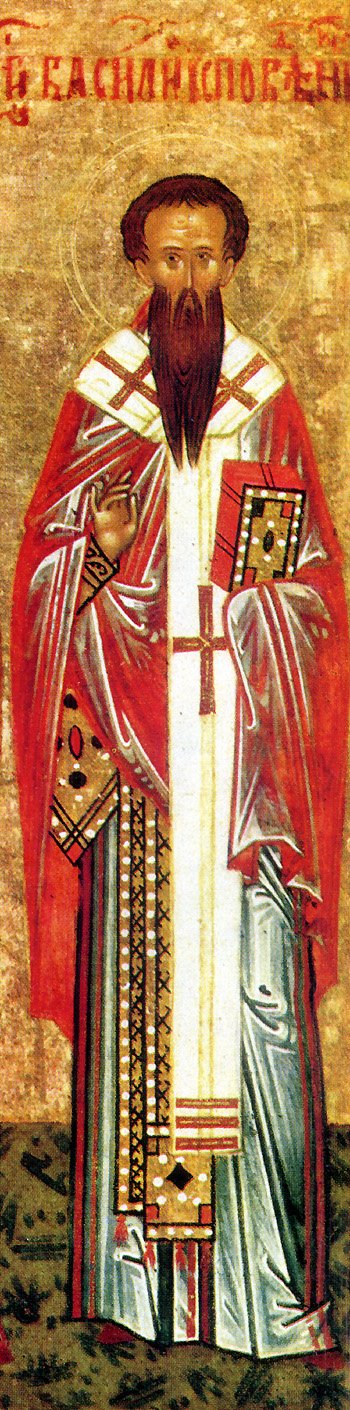
St Basil the Confessor, Bishop of Parium
Saint Basil the Confessor, Bishop of Parium, lived during the eighth century. He was elected as bishop by the inhabitants of Parium, who venerated the saint as a true pastor of the flock of Christ.
When the Iconoclast heresy broke out, Saint Basil resolutely came out on the side of icon veneration and refused to sign the orders for their abolition (the “Iniquitous Scroll”) of the Council of 754 which was convened under the emperor Constantine V Copronymos (741-775). The
Saint Basil the Confessor, Bishop of Parium, lived during the eighth century. He was elected as bishop by the inhabitants of Parium, who venerated the saint as a true pastor of the flock of Christ.
When the Iconoclast heresy broke out, Saint Basil resolutely came out on the side of icon veneration and refused to sign the orders for their abolition (the “Iniquitous Scroll”) of the Council of 754 which was convened under the emperor Constantine V Copronymos (741-775). The saint avoided any contact with the heretics and did not permit them into his diocese. For his zeal he suffered much persecution, hunger and deprivation.
Saint Basil remained faithful to the Orthodox Church until his death.
Troparion - Tone 4
Glorious hierarch Basil, / priest of the King of glory, / you are a radiant confessor of the Faith: / You opposed the iconoclasts and suffered for the Truth. / Standing before God, remember those who honor you.
Kontakion - Tone 6
You royally served the King of all, / holy hierarch Basil. / You revealed divine truths / and became a whole burnt offering. / You cry to those who honor you: / “The honor given to an icon ascends to Christ.”
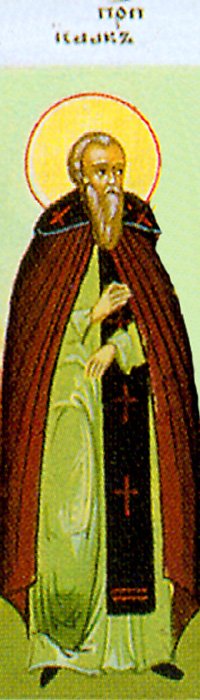
St Isaac the Syrian, abbot of Spoleto, Italy (ca. 550)
Saint Isaac the Syrian lived during the mid-sixth century. He came to the Italian city of Spoleto from Syria. The saint asked permission of the church wardens to remain in the temple, and he prayed in it for two and a half days. One of the church wardens began to reproach him with hypocrisy and struck him on the cheek.
Saint Isaac the Syrian lived during the mid-sixth century. He came to the Italian city of Spoleto from Syria. The saint asked permission of the church wardens to remain in the temple, and he prayed in it for two and a half days. One of the church wardens began to reproach him with hypocrisy and struck him on the cheek. Then the punishment of God came upon the church warden. The devil threw him down at the feet of the saint and cried out, “Isaac, cast me out!” Just as the saint bent over the man, the unclean spirit fled.
News of this quickly spread throughout the city. People began to flock to the saint, offering him help and the means to build a monastery. The humble monk refused all this. He left the city and settled in a desolate place, where he built a small cell. Disciples gathered around the ascetic, and so a monastery was formed. When his disciples asked the Elder why he had declined the gifts, he replied, “A monk who acquires possessions is no longer a monk.”
Saint Isaac was endowed with the gift of clairvoyance. Saint Gregory Dialogus (March 12) speaks of this in his “Dialogues About the Lives and Miracles of the Italian Fathers.” Once, Saint Isaac bade the monks to leave their spades in the garden for the night, and in the morning he asked them to prepare food for the workers. Some robbers, equal to the number of spades, had come to rob the monastery, but the power of God forced them to abandon their evil intent. They took the spades and began to work. When the monks arrived in the garden, all the ground had been dug up. The saint greeted the toilers and invited them to refresh themselves with food. Then he admonished them to stop their thievery, and gave them permission to come openly and pick the fruits of the monastery garden.
Another time, two almost naked men came to the saint and asked him for clothing. He told them to wait a bit, and sent a monk into the forest. In the hollow of a tree he found the fine clothes the travelers had hidden in order to to deceive the holy igumen. The monk brought back the clothes, and Saint Isaac gave them to the wanderers. Seeing that their fraud was exposed, they fell into great distress and shame.
It happened that a certain man sent his servant to the saint with two beehives. The servant hid one of these hives along the way. The saint said to the servant, “I accept the gift, but be careful when you go back for the beehive that you hid. Poisonous snakes have entered into it. If you stretch forth your hand, they will bite you.” Thus the saint unmasked the sins of people wisely and without malice, desiring salvation for all.
Saint Isaac died in 550. This saint should not be confused with the other Saint Isaac the Syrian, Bishop of Ninevah, who lived during the seventh century (January 28).
Troparion - Tone 8
By a flood of tears you made the desert fertile, / and your longing for God brought forth fruits in abundance. / By the radiance of miracles you illumined the whole universe! / O our holy father Isaac, pray to Christ our God to save our souls!
Anthousa the Righteous of Constantinople
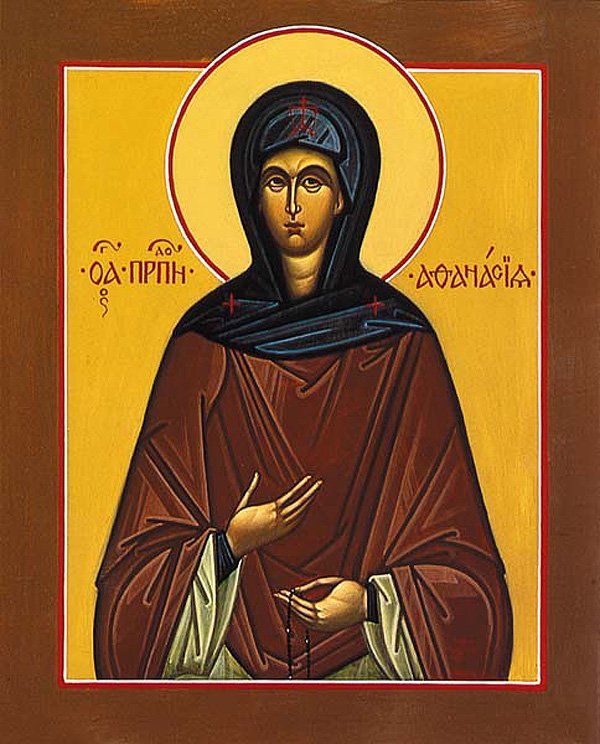
Our Holy Mother Athanasia (860)
Saint Athanasia was abbess of a monastery on the island of Aegina in the ninth century. She was born into a pious Christian family, and her parents were named Nicetas and Marina. Already at seven years of age the girl studied the Psalter , which she read constantly and with feeling. Once, while working at the weaver’s loom, Saint Athanasia saw a shining star coming down to her from above, which touched her bosom and lightened all her being, and then disappeared. F
Saint Athanasia was abbess of a monastery on the island of Aegina in the ninth century. She was born into a pious Christian family, and her parents were named Nicetas and Marina. Already at seven years of age the girl studied the Psalter , which she read constantly and with feeling. Once, while working at the weaver’s loom, Saint Athanasia saw a shining star coming down to her from above, which touched her bosom and lightened all her being, and then disappeared. From that moment, the maiden was illumined in soul and she firmly resolved to enter a monastery.
When Saint Athanasia reached the age of sixteen, her parents entreated her to marry. She consented, but after sixteen days her husband was killed by barbarians who invaded Aegina.
Saint Athanasia decided to take advantage of her unexpected freedom and dedicate herself to God. Then the emperor Michael the Stammerer (820-829) issued a decree ordering all young widows and virgins to take husbands. Therefore, Saint Athanasia was forced to marry again. It is said that her second husband was a Moslem, whom she converted by her holy way of life.
She led a pious and virtuous life. She did housework, helped the sick and those in need, and took in wanderers. On Sundays and feastdays she invited family and acquaintances to her home and read the Holy Scriptures to them. Under her influence, her husband entered a monastery, and progressed in virtue and holiness. Soon, he departed to the Lord.
The saint gave away her property, became a nun, and founded a women’s monastery in a remote place. After four years, the sisters asked Saint Athanasia to become the abbess of the small community. In spite of her position, the saint surpassed all the others in meekness and humility. She asked about the infractions of the sisters with love, not anger.
Although Saint Athanasia had the title of abbess, she regarded herself as the least of the sisters and always had in mind the commandment of the Savior: “Whoever would be first among you, let him be your servant” (Mt. 20:27). The saint never permitted the sisters to wait on her, not even to pour water over her hands.
Saint Athanasia wore a hair-shirt, and over it clothes of coarse sheep’s wool. She slept very little, and prayed most of the night. By day she labored together with the sisters. On most days she ate only bread and water, and that in moderation, and only after the ninth hour of the day. She never ate cheese or fish except on Pascha and on the twelve Great Feasts. During Lent, she did not eat bread or drink water. She would only eat some vegetables every other day.
On the island of Aegina lived a certain monk named Matthew, who had been an igumen. Each night he read the whole PSALTER, and also read prayers. The saint slept sitting up and only for a short time. He could not refrain from tears when the Psalms were chanted, while reading prayers, or offering the Bloodless Sacrifice.
He wore only a coarse hair-shirt, and through his temperance and struggles his body became completely withered. He had a special love for Saint John the Theologian. Once, during the the Divine Liturgy he saw the Apostle standing by the altar table.
The saint healed a paralytic with his mantle; by making the Sign of the Cross he corrected the face of a man distorted by the actions of the devil; he cast out demons and worked many other miracles. Saint Matthew blessed Saint Athanasia to go to a more isolated place with her sisters. She built a monastery on a desolate hill of the island near an ancient church of the Protomartyr Stephen.
Saint Athanasia was granted the gift of healing by God. After she healed a man afflicted with a malady of the eyes, a crowd of people began to flock to her in order to receive healing from their infirmities of soul and body. From the abundant gifts brought to the monastery, she built three churches at the monastery: one dedicated to the Most Holy Theotokos, another to the holy Prophet John the Forerunner, and the third to Saint Nicholas the Wonderworker.
Her increasing celebrity distressed the saint, and she took the two sisters closest to her in spirit (Maria and Eupraxia) and went secretly to Constantinople. There, as a simple nun, she entered one of the women’s monasteries, where she lived for seven years.
Again, her holy life attracted attention. The sisters of the Aegina monastery learned where their abbess had gone, and they went to her imploring her to return. Submitting to the will of God, she returned to the monastery she founded. Soon after this she had a vision of two radiant men, giving her a document which said: “Here is your freedom, take it and rejoice.”
Saint Athanasia spent the twelve days before her death in unceasing prayer. On the eve of the Dormition of the Most Holy Theotokos she summoned the sisters and said that she was able to read the PSALTER only as far as the twelfth Psalm. The saint asked them to continue reading the PSALTER for her in church. The sisters went to church and there fulfilled her request, and then they came to bid the saint farewell. She blessed them and asked them to celebrate the Feast of the Dormition of the Most Holy Theotokos solemnly and joyfully, and also to provide a meal for the poor and destitute. Then, after Divine Liturgy, they could bury her body. With these words, Saint Athanasia fell asleep in the Lord on August 14, 860.
The saint predicted that she would receive glory in Heaven forty days after her death. On the fortieth day, two devout sisters were granted to see Saint Athanasia and two radiant men standing before the royal doors of the iconostasis. They clothed her with a purple robe embroidered with gold, pearls, and precious stones. They set a crown on her head, handed her a gleaming staff, and led her through the royal doors into the altar.
Before her death, Saint Athanasia ordered the nuns to feed the poor for forty days. The sisters, however, did not fulfill her request and set out the memorial meal for only ten days. The saint appeared to some of the sisters and said, “Let everyone know that alms given for a departed soul for forty days after death, and food offered to the hungry, appease God. If the departed souls are sinful, they receive forgiveness from God. If they are righteous, then the good deeds bring God’s mercy on the souls of those who perform them.”
Then she thrust her staff into the ground and became invisible. The staff left behind sprouted the next day and became a live tree. A year after the saint’s death, they led a possessed woman to the grave. When they dug up the ground, they then noticed a fragrance and removed the coffin. After she touched it, the demoniac was immediately healed. Then they opened the lid of the coffin and saw the saint’s incorrupt body, from which myrrh flowed.
Saint Athanasia looked like she was asleep. Her face shone brightly, her body was preserved incorrupt and soft, and even her hands were supple. The priests decided to place her body in church. When they transferred the body into a new coffin, the nuns removed the hair-shirt from her holy relics and wanted to dress her in silken clothes, but the hands of Saint Athanasia were so firmly clasped to her bosom, that the nuns could not dress her in the silken garb. Even in death the saint displayed her love for poverty. Then one of the sisters knelt down and began to pray to the saint, saying, “O lady, hear us as you heard us when you lived with us. Now consent to be dressed in these clothes, our humble gift to you.” Saint Athanasia, as though alive, lifted and extended her hands into the clothing.
The holy relics of Saint Athanasia were put into a crypt and became a source of healings.
The Life of Saint Athanasia is found in Vatican codex 1660, which dates from the year 916.
Saint Athanasia of Aegina is commemorated on April 12 (Slavic usage), and on April 18 (Greek usage).
Troparion - Tone 8
By a flood of tears you made the desert fertile, / and your longing for God brought forth fruits in abundance. / By the radiance of miracles you illumined the whole universe! / O our holy mother Athanasia, pray to Christ our God to save our souls!
Scripture Readings
View scripture readings for this date on OCA.org.
View readings on OCA.orgLiturgical data sourced from OCA.org and orthocal.info