
Fasting Rules
 Meat
Abstain
 Fish
Abstain
 Dairy
Abstain
 Oil
Allowed
 Wine
Allowed
Saints & Commemorations
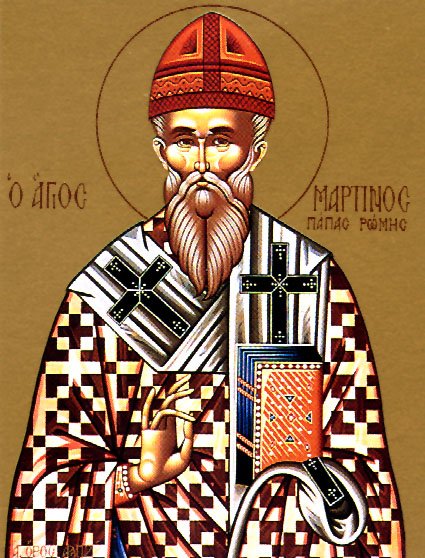
St Martin the Confessor, Pope of Rome
Saint Martin the Confessor, Pope of Rome, was a native of the Tuscany region of Italy. He received a fine education and entered into the clergy of the Roman Church. After the death of Pope Theodore I (642-649), Martin was chosen to succeed him.
At this time the peace of the Church was disturbed by the Monothelite heresy (the false doctrine that in Christ there is only one will, whereas in fact He has a divine, and a human will).
Saint Martin the Confessor, Pope of Rome, was a native of the Tuscany region of Italy. He received a fine education and entered into the clergy of the Roman Church. After the death of Pope Theodore I (642-649), Martin was chosen to succeed him.
At this time the peace of the Church was disturbed by the Monothelite heresy (the false doctrine that in Christ there is only one will, whereas in fact He has a divine, and a human will). The endless disputes of the Monothelites with the Orthodox took place in all levels of the population. Even the emperor Constans (641-668) and Patriarch Paul of Constantinople (641-654) were adherents of the Monothelite heresy. The emperor Constans II published the heretical “Pattern of Faith” (Typos), obligatory for all the population. In it all further disputes were forbidden.
The heretical “Pattern of Faith” was received at Rome in the year 649. Saint Martin, a firm supporter of Orthodoxy, convened the Lateran Council at Rome to condemn the Monothelite heresy. At the same time Saint Martin sent a letter to Patriarch Paul, persuading him to return to the Orthodox confession of faith. The enraged emperor ordered the military commander Olympius to bring Saint Martin to trial. But Olympius feared the clergy and the people of Rome who had descended upon the Council, and he sent a soldier to murder the holy hierarch. When the assassin approached Saint Martin, he was blinded. The terrified Olympius fled to Sicily and was soon killed in battle.
In 654 the emperor sent another military commander, Theodore, to Rome. He accused Saint Martin of being in secret correspondence with the enemies of the Empire, the Saracens, and of blaspheming the Most Holy Theotokos, and of uncanonically assuming the papal throne.
Despite the proofs offered by the Roman clergy and laity of Saint Martin’s innocence, the military commander Theodore with a detachment of soldiers seized Saint Martin by night and took him to Naxos, one of the Cyclades islands in the Aegean Sea. Saint Martin spent an entire year on this almost unpopulated island, suffering deprivation and abuse from the guards. Then they sent the exhausted confessor to Constantinople for trial.
They carried the sick man on a stretcher, but the judges callously ordered him to stand up and answer their questions. The soldiers propped up the saint, who was weakened by illness. False witnesses came forward slandering the saint and accusing him of treasonous relations with the Saracens. The biased judges did not even bother to hear the saint’s defense. In sorrow he said, “The Lord knows what a great kindness you would show me if you would deliver me quickly over to death.”
After such a trial they brought the saint out in tattered clothes to a jeering crowd. They shouted, “Anathema to Pope Martin!” But those who knew the holy Pope was suffering unjustly, withdrew in tears. Finally the sentence was announced: Saint Martin was to be deposed from his rank and executed. They bound the half-naked saint with chains and dragged him to prison, where they locked him up with thieves. These were more merciful to the saint than the heretics.
In the midst of all this the emperor went to the dying Patriarch Paul and told him of the trial of Saint Martin. He turned away from the emperor and said, “Woe is me! This is another reason for my judgment.” He asked that Saint Martin’s torments be stopped. The emperor again sent a notary and other persons to the saint in prison to interrogate him. The saint answered, “Even if they cripple me, I will not have relations with the Church of Constantinople while it remains in its evil doctrines.” The torturers were astonished at the confessor’s boldness, and they commuted his death sentence to exile at Cherson in the Crimea.
Saint Martin departed to the Lord, exhausted by sickness, hunger and deprivations on September 16, 655. Two other bishops, who were banished to Cherson, also died after many hardships. The Saint was buried just outside the city of Cherson, in the Blachernae church of the Most Holy Theotokos. Great crowds of people visited his tomb because of the many miracles which took place there. Later, his relics were transferred to Rome, and placed in a church dedicated to Martin of Tours (November 11). The transfer of his relics is commemorated on November 12.
The Monothelite heresy was condemned at the Sixth Ecumenical Council in 680.
In Greek usage, the holy Confessor Martin is commemorated on April 13 and on September 20, while the Slavic churches commemorate him on April 14.
Troparion - Tone 3
You strengthened the Church with true doctrines, O godly-wise Hierarch Martin; / you confessed the
two natures of Christ and vanquished heresy. / O venerable Father, / entreat Christ God that He may
grant us great mercy.
Kontakion - Tone 8
As a hierarch and teacher of ineffable things, / you gushed forth streams of doctrine, O most
wise Martin: / you expounded the true theology that in Christ there are two natures and two wills. /
Intercede for those who cry to you: Rejoice, most blessed Father.
Apostles Aristarchus, Pudens and Trophimus of the Seventy
All three are mentioned by name by the Apostle Paul.
Aristarchus is mentioned in Acts 19:29, Colossians 4:10 and Philemon 24. He was bishop of Apamea in Syria; St Paul calls him ‘my fellow-prisoner’ and ‘my fellow-laborer’.
Pudens is mentioned in 2 Timothy 4:21. He was a prominent Roman citizen who gave refuge to Christians; his house was first a place of refuge for the Apostles, then one of the first churches in Rome.
Trophim
All three are mentioned by name by the Apostle Paul.
Aristarchus is mentioned in Acts 19:29, Colossians 4:10 and Philemon 24. He was bishop of Apamea in Syria; St Paul calls him ‘my fellow-prisoner’ and ‘my fellow-laborer’.
Pudens is mentioned in 2 Timothy 4:21. He was a prominent Roman citizen who gave refuge to Christians; his house was first a place of refuge for the Apostles, then one of the first churches in Rome.
Trophimus is mentioned with Pudens in 2 Timothy 4:21, and in Acts 21:29, where we learn that he was from Ephesus. He accompanied the Apostle Paul on some of his missions.
All three, like St Paul, were beheaded during Nero’s persecutions.
Holy Martyr Ardalion the Actor (3rd c.)
The Holy Martyr Ardalion suffered for Christ under the emperor Maximian Galerius (305-311). Saint Ardalion was a talented actor.
Once, he played the role of a Christian. In the play, the actor at first refused to offer sacrifice to idols, but then consented to renounce Christ. Suddenly the saint ordered everyone to be quiet and declared that he actually was a Christian.
Saint Ardalion continued to confess his faith in Christ. Then the governor ordered the martyr to be thrown onto a red-hot iron grill. So Saint Ardalion attained a martyr’s crown.
Troparion - Tone 3
Your holy martyr Ardalion, O Lord, / through his sufferings has received an incorruptible crown from You, our God. / For having Your strength, he laid low his adversaries, / and shattered the powerless boldness of demons. / Through his intercessions, save our souls!
Kontakion - Tone 2
You appeared as a bright star announcing Christ with your radiance, / which is repulsive to this world, O Martyr Ardalion; / extinguishing the allure of false gods, / you enlighten the faithful, / always interceding for us all.
Scripture Readings
View scripture readings for this date on OCA.org.
View readings on OCA.orgNotes
["Presanctified Liturgy"]
Liturgical data sourced from OCA.org and orthocal.info