
Fasting Rules
 Meat
Allowed
 Fish
Allowed
 Dairy
Allowed
 Oil
Allowed
 Wine
Allowed
Saints & Commemorations
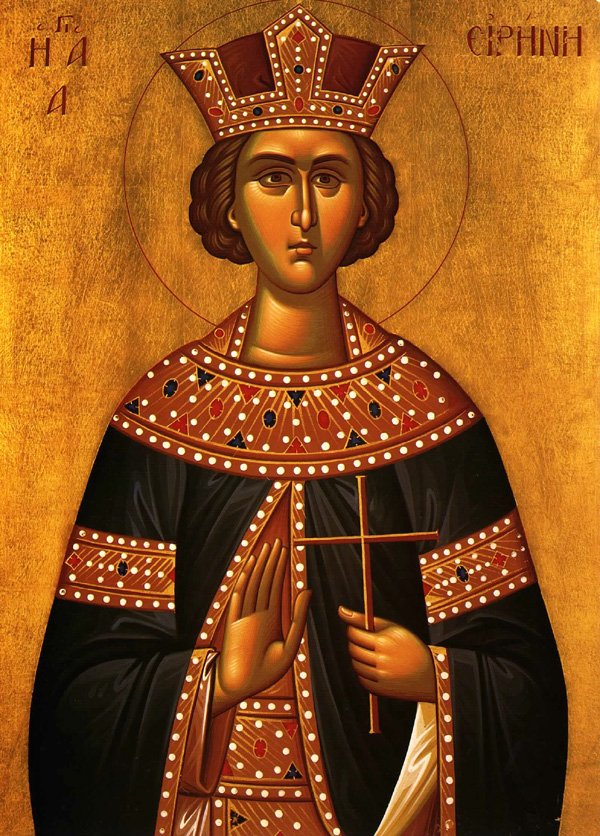
Great Martyr Irene of Thessalonica
The holy Great Martyr Irene was born in the city of Magedon in Persia during the fourth century. She was the daughter of Licinius, the pagan ruler of a certain small kingdom, and his wife Licinia, and at birth her parents named her Penelope.
Penelope was very beautiful, and her father kept her isolated in a high tower from the time she was six so that she would not be exposed to Christianity.
The holy Great Martyr Irene was born in the city of Magedon in Persia during the fourth century. She was the daughter of Licinius, the pagan ruler of a certain small kingdom, and his wife Licinia, and at birth her parents named her Penelope.
Penelope was very beautiful, and her father kept her isolated in a high tower from the time she was six so that she would not be exposed to Christianity. He also placed thirteen young maidens in the tower with her. An old tutor by the name of Apellian was appointed to give her the best possible education. Apellian was a Christian, and during her lessons, he told the girl about Christ the Savior and taught her about the Christian Faith and Christian virtues.
When Penelope reached adolescence, her parents began to think about her marriage. One night Penelope beheld the following vision: a dove entered the tower with an olive branch in its beak, depositing it on the table. An eagle also flew in carrying a wreath of flowers, and left it on the table. Then a raven flew in through another window and dropped a snake on the table. In the morning Penelope woke up and wondered about the meaning of the things she had seen. She related them to her tutor Apellian and he explained that the dove symbolized her superior education, and that the olive branch represented the grace of God which is received in Baptism. The eagle and the olive branch indicated success in her future life. The snake signified that she would experience suffering and sorrow.
At the end of the conversation Apellian said that the Lord wished to betroth her to Himself and that Penelope would undergo much suffering for her heavenly Bridegroom. After this Penelope refused marriage, was baptized by the priest Timothy, and he named her Irene (peace). She even urged her own parents to become Christians. Shortly after being baptized, she smashed all her father’s idols to pieces.
Since Saint Irene had dedicated herself to Christ, she refused to marry any of the suitors her father had chosen for her. When Licinius learned that his daughter refused to worship the pagan gods, he was furious. He attempted to turn her from Christ by having her tortured. She was tied up and thrown beneath the hooves of wild horses so that they might trample her to death, but the horses remained motionless. Instead of harming the saint, one of the horses charged Licinius, seized his right hand and tore it from his arm. Then it knocked Licinius down and began to trample him to death. This caused a great deal of confusion among the people there but Irene consoled them with the words of Christ: “All things are possible to the one who believes” (Mark 9: 23). And indeed, with wondrous faith, she prayed and through her prayers Licinius rose unharmed in the presence of many eyewitnesses with his hand intact. Then, Licinius and his wife were baptized as Christians, along with almost 3000 others who turned away from the worship of inanimate idols. Licinius abandoned his domain and lived in the tower he had built for his daughter. There he spent the rest of his life in repentance.
Saint Irene lived in the house of her teacher Apellian, and she began to preach Christ among the pagans, leading them to the path of salvation.
When Sedekias (Yesdegerd), the new prefect of the city, heard of the miracles performed by the saint, he summoned Apellian and questioned him about Irene’s manner of life. Apellian replied that Irene, like other Christians, lived in strict temperance, devoting herself to constant prayer and reading holy books. Sedekias summoned the saint to him and urged her to stop preaching about Christ. He also attempted to force her to sacrifice to the idols. Saint Irene staunchly confessed her faith before the prefect, not fearing his wrath, and prepared to undergo suffering for Christ. By order of Sedekias she was thrown into a pit filled with vipers and serpents. The saint spent ten days in the pit and remained unharmed, for an angel of the Lord protected her and brought her food. Sedekias ascribed this miracle to sorcery, and he subjected Saint Irene to many other tortures, but she remained unharmed. Under the influence of her preaching and miracles even more people were converted to Christ, and turned away from the worship of inanimate idols.
Sedekias was deposed by his son Sapor, who persecuted Christians with an even greater zeal than his father had done. Saint Irene went to her home town of Magedon in Persia to meet Sapor and his army, and ask him to end the persecution. When he refused, Saint Irene prayed and his entire army was blinded. She prayed again and they received their sight once more. In spite of this, Sapor refused to recognize the power of God. Because of his insolence, he was struck and killed by a bolt of lightning.
After this, Saint Irene walked into the city and performed many miracles. She returned to the tower built by her father, accompanied by the priest Timothy. Through her teaching, she converted five thousand people to Christ.
Next, the saint went to the city of Callinicus, or Callinicum (possibly on the Euphrates River in Syria). The ruler of that place was King Numerian, the son of Sebastian. When she began to teach about Christ, she was arrested and tortured by the pagan authorities. They enclosed her inside three bronze oxen, one after another, which were heated until they were red-hot. When the Great Martyr was placed within the third ox, it began to walk about, and then it split asunder. Saint Irene emerged from it as if from the fires of hell. This resulted in thousands of souls converting to the faith of Christ.
Sensing the approach of death, Numerian instructed his eparch Babdonus to continue torturing the saint in order to force her to sacrifice to idols. Once again, the tortures were ineffective, and many people turned to Christ.
Christ’s holy martyr then traveled to the city of Constantina, forty miles northeast of Edessa. By 330, the Persian king Sapor II (309-379) had heard of Saint Irene’s great miracles. To prevent her from winning more people to Christ, she was arrested, beheaded, and then buried. However, God sent an angel to raise her up again, and she went into the city of Mesembria. After seeing her alive and hearing her preach, the local king was baptized with many of his subjects.
Wishing to convert even more pagans to Christianity, Saint Irene went to Ephesus, where she taught the people and performed many miracles. The Lord revealed to her that the end of her life was approaching. Then Saint Irene left the city accompanied by six people, including her former teacher Apellian. On the outskirts of the town, she found a new tomb in which no one had ever been buried. After making the Sign of the Cross, she went inside, directing her companions to seal the entrance to the cave with a large stone, which they did. She also told them that that no one should move the stone until four days had passed.
Apellian returned after only two days, and found that the stone had been rolled away and the tomb was empty. There are conflicting accounts about her holy relics being taken to Constantinople and other places, including Patras, Samos, and Patmos. According to the Western Martyrologies, Saint Irene was martyred in Thessaloniki after being thrown into the fire, while according to the Menologion of Emperor Basil II, Saint Irene completed her martyric contest by being beheaded.
Saint Irene led thousands of people to Christ through her preaching, and by her example. The Church continues to honor her memory and to seek her heavenly intercession. She is invoked by those wishing to effect a swift and happy marriage. In Greece, she is also the patron saint of policemen. Saint Irene is also one of the twelve Virgin Martyrs who appeared to Saint Seraphim of Sarov (January 2) and the Diveyevo nun Eupraxia on the Feast of the Annunciation in 1831. By her holy prayers, may the Lord have mercy upon us and save us. Amen.
Fragments of Saint Irene's Holy Relics are located at Kykkos Monastery on Cyprus, and
in the Greek church of Saint George in Venice.
Troparion - Tone 1
Christ called you Irene, because you grant peace to those hastening to your holy temple with hymns and spiritual songs, / for you intercede for all, standing before the Three-Sunned Divinity, / Let everyone celebrate her memory joyously, magnifying Christ, Who glorified her.
Kontakion - Tone 3
Adorned with the beauty of virginity, / you became most beautiful in your brave contest, O Irene; / you were reddened by the blood which you shed, / and you overthrew ungodly error; / therefore, you received the prize of victory from the hand of your Creator.
The Righteous Martyr Ephraim the Younger
Scripture Readings
☩Epistle
Acts 2:22-36
22
Ye men of Israel, hear these words; Jesus of Nazareth, a man approved of God among you by miracles and wonders and signs, which God did by him in the midst of you, as ye yourselves also know:
23
Him, being delivered by the determinate counsel and foreknowledge of God, ye have taken, and by wicked hands have crucified and slain:
24
Whom God hath raised up, having loosed the pains of death: because it was not possible that he should be holden of it.
25
For David speaketh concerning him, I foresaw the Lord always before my face, for he is on my right hand, that I should not be moved:
26
Therefore did my heart rejoice, and my tongue was glad; moreover also my flesh shall rest in hope:
27
Because thou wilt not leave my soul in hell, neither wilt thou suffer thine Holy One to see corruption.
28
Thou hast made known to me the ways of life; thou shalt make me full of joy with thy countenance.
29
Men and brethren, let me freely speak unto you of the patriarch David, that he is both dead and buried, and his sepulchre is with us unto this day.
30
Therefore being a prophet, and knowing that God had sworn with an oath to him, that of the fruit of his loins, according to the flesh, he would raise up Christ to sit on his throne;
31
He seeing this before spake of the resurrection of Christ, that his soul was not left in hell, neither his flesh did see corruption.
32
This Jesus hath God raised up, whereof we all are witnesses.
33
Therefore being by the right hand of God exalted, and having received of the Father the promise of the Holy Ghost, he hath shed forth this, which ye now see and hear.
34
For David is not ascended into the heavens: but he saith himself, The Lord said unto my Lord, Sit thou on my right hand,
35
Until I make thy foes thy footstool.
36
Therefore let all the house of Israel know assuredly, that God hath made that same Jesus, whom ye have crucified, both Lord and Christ.
☩Gospel
John 1:35-51
35
Again the next day after John stood, and two of his disciples;
36
And looking upon Jesus as he walked, he saith, Behold the Lamb of God!
37
And the two disciples heard him speak, and they followed Jesus.
38
Then Jesus turned, and saw them following, and saith unto them, What seek ye? They said unto him, Rabbi, (which is to say, being interpreted, Master,) where dwellest thou?
39
He saith unto them, Come and see. They came and saw where he dwelt, and abode with him that day: for it was about the tenth hour.
40
One of the two which heard John speak, and followed him, was Andrew, Simon Peter’s brother.
41
He first findeth his own brother Simon, and saith unto him, We have found the Messias, which is, being interpreted, the Christ.
42
And he brought him to Jesus. And when Jesus beheld him, he said, Thou art Simon the son of Jona: thou shalt be called Cephas, which is by interpretation, A stone.
43
The day following Jesus would go forth into Galilee, and findeth Philip, and saith unto him, Follow me.
44
Now Philip was of Bethsaida, the city of Andrew and Peter.
45
Philip findeth Nathanael, and saith unto him, We have found him, of whom Moses in the law, and the prophets, did write, Jesus of Nazareth, the son of Joseph.
46
And Nathanael said unto him, Can there any good thing come out of Nazareth? Philip saith unto him, Come and see.
47
Jesus saw Nathanael coming to him, and saith of him, Behold an Israelite indeed, in whom is no guile!
48
Nathanael saith unto him, Whence knowest thou me? Jesus answered and said unto him, Before that Philip called thee, when thou wast under the fig tree, I saw thee.
49
Nathanael answered and saith unto him, Rabbi, thou art the Son of God; thou art the King of Israel.
50
Jesus answered and said unto him, Because I said unto thee, I saw thee under the fig tree, believest thou? thou shalt see greater things than these.
51
And he saith unto him, Verily, verily, I say unto you, Hereafter ye shall see heaven open, and the angels of God ascending and descending upon the Son of man.
Liturgical data sourced from OCA.org and orthocal.info