
Fasting Rules
 Meat
Allowed
 Fish
Allowed
 Dairy
Allowed
 Oil
Allowed
 Wine
Allowed
Saints & Commemorations
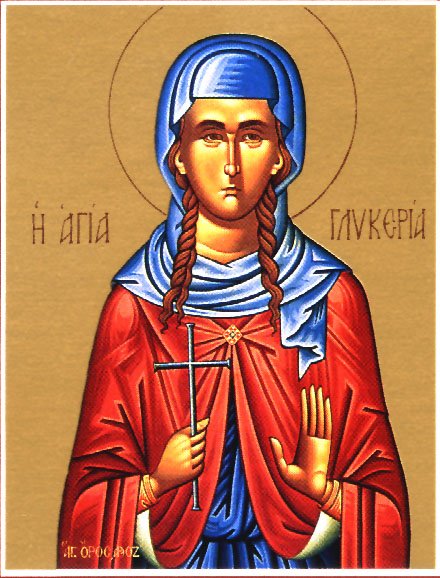
Virgin Martyr Glyceria
Saint Glyceria suffered as a martyr for her faith in Christ in the second century, during a persecution against Christians under the emperor Antoninus (138-161). She came from an illustrious family, and her father Macarius was a high-ranking Roman official. Later, the family moved to the Thracian city of Trajanopolis.
Saint Glyceria suffered as a martyr for her faith in Christ in the second century, during a persecution against Christians under the emperor Antoninus (138-161). She came from an illustrious family, and her father Macarius was a high-ranking Roman official. Later, the family moved to the Thracian city of Trajanopolis.
Saint Glyceria lost both her father and mother at an early age. Falling in with Christians, she converted to the true Faith, and she visited the church every day. Sabinus, the prefect of Trajanopolis, received the imperial edict ordering Christians to offer sacrifice to the idols, and so he designated a certain day for the inhabitants of the city to worship the idol Zeus.
Saint Glyceria firmly resolved to suffer for Christ. She told the Christians of her intention, and she begged them to pray that the Lord would give her the strength to undergo the sufferings. On the appointed day Saint Glyceria made the Sign of the Cross on her forehead, and went into the pagan temple.
The saint stood on a raised spot in the rays of the sun, and removed the veil from her head, showing the holy Cross traced on her forehead. She prayed fervently to God to bring the pagans to their senses and destroy the stone idol of Zeus. Suddenly thunder was heard, and the statue of Zeus crashed to the floor and smashed into little pieces.
In a rage, the prefect Sabinus and the pagan priests commanded the people to pelt Saint Glyceria with stones, but the stones did not touch the saint. They locked Saint Glyceria in prison, where the Christian priest Philokrates came to her and encouraged the martyr in the struggle before her.
In the morning, when the tortures had started, suddenly an angel appeared in the midst of the torturers, and they fell to the ground, overcome with terror. When the vision vanished, Sabinus, who was hardly able to speak, ordered them to throw the saint into prison.
They shut the door securely and sealed it with the prefect’s own ring, so that no one could get in to her. While she was in prison, angels of God brought Saint Glyceria food and drink. Many days afterwards, Sabinus came to the prison and he himself removed the seal. Going in to the saint, he was shaken when he saw her alive and well.
Setting off for the city of Heraclea in Thrace, Sabinus gave orders to bring Saint Glyceria there also. The Christians of Heraclea came out to meet her with Bishop Dometius at their head, and he prayed that the Lord would strengthen the saint to endure martyrdom.
At Heraclea they cast Saint Glyceria into a red-hot furnace, but the fire was extinguished at once. Then the prefect, in a mindless fury, gave orders to rip the skin from Saint Glyceria’s head. Then they threw the martyr into prison onto sharp stones. She prayed incessantly, and at midnight an angel appeared in the prison and healed her of her wounds.
When the jailer Laodicius came for the saint in the morning, he did not recognize her. Thinking that the martyr had been taken away, he feared he would be punished for letting her escape. He wanted to kill himself, but Saint Glyceria stopped him. Shaken by the miracle, Laodicius believed in the true God, and he entreated the saint to pray that he might suffer and die for Christ with her.
“Follow Christ and you will be saved,” the holy martyr replied. Laodicius placed upon himself the chains with which the saint was bound, and at the trial he told the prefect and everyone present about the miraculous healing of Saint Glyceria by an angel, then he confessed himself a Christian.
The newly chosen one of God was beheaded by the sword. Christians secretly took up his remains, and reverently buried them. Saint Glyceria was sentenced to be eaten by wild beasts. She went to execution with great joy, but the lioness set loose upon the saint meekly crawled up to her and lay at her feet.
Finally, the saint prayed to the Lord, imploring that He take her unto Himself. In answer she heard a Voice from Heaven, summoning her to heavenly bliss. At that moment, another lioness was set loose upon the saint. It pounced upon the martyr and killed her, but did not tear her apart. Bishop Dometius and the Christians of Heraclea reverently buried the holy martyr Glyceria. She suffered for Christ around the year 177. Her holy relics were glorified with a flow of healing myrrh.
Saint Glyceria, whose name means “sweetness,” now rejoices in the unending sweetness of the heavenly Kingdom.
Troparion - Tone 3
Let us honor Christ's beautiful virgin who excelled in the pain of contest. / She trampled upon the serpent although she was weak in the flesh. / For the love of Christ she despised her torments and was therefore glorified by God. / Let us cry to her: / “Rejoice, O godly-minded Glykeria.”
Kontakion - Tone 3
Through your love for Mary, the Virgin Theotokos, / you preserved your virginity, O Glykeria. / You surrendered your heart to the Lord / and fought bravely until your death. / Therefore, Christ God has granted you a double crown.
Pausikakos, Bishop of Synnada
Saint Pausicacus, Bishop of Synnada, lived at the end of the sixth century in the Syrian city of Apamea. He had been raised in the Christian Faith by his pious parents, and he began to lead an ascetic life of prayer, vigil and fasting in his youth.
The Lord gave him the gift of healing sicknesses of both soul and body.
Saint Pausicacus, Bishop of Synnada, lived at the end of the sixth century in the Syrian city of Apamea. He had been raised in the Christian Faith by his pious parents, and he began to lead an ascetic life of prayer, vigil and fasting in his youth.
The Lord gave him the gift of healing sicknesses of both soul and body. Patriarch Cyriacus of Constantinople (591-606) consecrated Saint Pausicacus as Bishop of Synnada. Saint Pausicacus wanted neither heretics nor dissolute people in his flock. He constantly taught his flock about the virtuous life, and his discourse was always powerful and lively.
Having come to Constantinople on affairs of the Church, he healed the emperor Mauricius of sickness, and on his return journey he asked the Lord for water to quench the thirst of his companions. After the prayer of the saint, a spring of pure water sprang up from the ground. Saint Pausicacus died peacefully in the year 606.
Troparion - Tone 4
In truth you were revealed to your flock as a rule of faith, / an image of humility and a teacher of abstinence; / your humility exalted you; / your poverty enriched you. / Hierarch Father Pausicacus, / entreat Christ our God / that our souls may be saved.
Holy Martyr Alexander of Rome (298)
The Holy Martyr Alexander suffered for Christ at the beginning of the fourth century. He was a soldier serving in the regiment of the tribune Tiberian at Rome. When he was eighteen, the Roman emperor Maximian Hercules (284-305) issued an edict that all citizens were to go to the temple of Jupiter outside the city on a designated day to offer sacrifice.
The Holy Martyr Alexander suffered for Christ at the beginning of the fourth century. He was a soldier serving in the regiment of the tribune Tiberian at Rome. When he was eighteen, the Roman emperor Maximian Hercules (284-305) issued an edict that all citizens were to go to the temple of Jupiter outside the city on a designated day to offer sacrifice.
The tribune Tiberian assembled his soldiers and he ordered them to go to this festival, but Alexander, raised from childhood in the Christian Faith, refused and said that he would not offer sacrifice to devils. Tiberian reported to the emperor Maximian that there was a soldier in his regiment who was a Christian. Soldiers were immediately sent to arrest Alexander.
Alexander was asleep, but an angel woke him and warned him of his impending martyrdom, saying that he would be with him during this time. When the soldiers arrived, Alexander came out to meet them. His face shone with a light so bright that the soldiers fell to the ground when they saw him. The saint upbraided them and told them to carry out their orders.
Standing before Maximian, Saint Alexander boldly confessed his faith in Christ and he refused to worship the idols. He said that he was not afraid of the emperor, nor of his threats. The emperor tried to persuade the young man with promises of honors, but Alexander remained steadfast in his confession, and denounced the emperor and all the pagans. They tortured the holy martyr, but he bravely endured all the sufferings.
Maximian remanded Saint Alexander to the tribune Tiberian, who was being sent to Thrace to persecute Christians there. So they brought the martyr to Thrace, fettered in chains. At this time an angel told Saint Alexander’s mother, Pimenia, of her son’s martyrdom. Pimenia found her son in Carthage, where he stood before Tiberian and again he steadfastly confessed himself a Christian.
They subjected him to torture before the eyes of his mother, and then they took the prisoner on his final journey, walking behind Tiberian’s chariot. The brave Pimenia asked the soldiers to let her go to her son, and she encouraged him to undergo torments for Christ. The soldiers were astonished at the stoic strength of the martyr and they said one to another, “Great is the God of the Christians!”
The angel appeared to the martyr several times, strengthening him. By night a fearsome angel appeared to Tiberian with sword in hand, and commanded the tribune to hasten to Byzantium, since the martyr’s end was drawing near. Tiberian hurried on his way.
In the city of Philippopolis, Tiberian retried Saint Alexander in the presence of the city dignitaries gathered for this event. At this trial Saint Alexander remained steadfast. During his grievous journey the holy martyr had been repeatedly subjected to cruel tortures. He was strengthened by God, however, and he endured all the torments.
He gave strength to the soldiers weakened by thirst, asking the Lord to provide a spring of water for them. During the journey, the martyr prayed beneath a tree, asking for strength in his sufferings, and the fruit and leaves of this tree received a curative power. At a place named Burtodexion, the saint again met his mother Pimenia, who fell weeping at his feet. The holy martyr said to her, “Do not weep , my mother, for the day after tomorrow, the Lord shall help me finish matters.”
In the city of Drizipera Tiberian imposed the death sentence on the saint. The holy martyr gave thanks to the Lord for giving him the strength to endure all the torments, and to accept martyrdom. The soldier who was supposed to carry out the execution asked the saint’s forgiveness, and for a long time he could not bring himself to raise his sword, for he saw angels waiting to take the soul of the martyr.
The saint prayed and asked God to remove the angels, since he wanted to go to the Lord. Only then was the executioner able to cut off the saint’s holy head. The saint’s body was cast into a river, but four dogs dragged it out of the water, and they would not let anyone near it, until Saint Alexander’s mother Pimenia came. She took up the remains of her martyred son and reverently buried them near the River Ergina.
Healings began to take place at the grave of Saint Alexander. Soon the holy martyr appeared to his mother in a dream, in which he comforted her and said that soon she too would be transported to the heavenly habitations.
Troparion - Tone 3
Your holy martyr Alexander, O Lord, / through his sufferings has received an incorruptible crown from You, our God. / For having Your strength, he laid low his adversaries, / and shattered the powerless boldness of demons. / Through his intercessions, save our souls!
Kontakion - Tone 2
You appeared as a bright star announcing Christ with your radiance, / which is repulsive to this world, O Martyr Alexander; / extinguishing the allure of false gods, / you enlighten the faithful, / always interceding for us all.
Scripture Readings
☩Epistle
Acts 4:23-31
23
And being let go, they went to their own company, and reported all that the chief priests and elders had said unto them.
24
And when they heard that, they lifted up their voice to God with one accord, and said, Lord, thou art God, which hast made heaven, and earth, and the sea, and all that in them is:
25
Who by the mouth of thy servant David hast said, Why did the heathen rage, and the people imagine vain things?
26
The kings of the earth stood up, and the rulers were gathered together against the Lord, and against his Christ.
27
For of a truth against thy holy child Jesus, whom thou hast anointed, both Herod, and Pontius Pilate, with the Gentiles, and the people of Israel, were gathered together,
28
For to do whatsoever thy hand and thy counsel determined before to be done.
29
And now, Lord, behold their threatenings: and grant unto thy servants, that with all boldness they may speak thy word,
30
By stretching forth thine hand to heal; and that signs and wonders may be done by the name of thy holy child Jesus.
31
And when they had prayed, the place was shaken where they were assembled together; and they were all filled with the Holy Ghost, and they spake the word of God with boldness.
☩Gospel
John 5:24-30
24
Verily, verily, I say unto you, He that heareth my word, and believeth on him that sent me, hath everlasting life, and shall not come into condemnation; but is passed from death unto life.
25
Verily, verily, I say unto you, The hour is coming, and now is, when the dead shall hear the voice of the Son of God: and they that hear shall live.
26
For as the Father hath life in himself; so hath he given to the Son to have life in himself;
27
And hath given him authority to execute judgment also, because he is the Son of man.
28
Marvel not at this: for the hour is coming, in the which all that are in the graves shall hear his voice,
29
And shall come forth; they that have done good, unto the resurrection of life; and they that have done evil, unto the resurrection of damnation.
30
I can of mine own self do nothing: as I hear, I judge: and my judgment is just; because I seek not mine own will, but the will of the Father which hath sent me.
Liturgical data sourced from OCA.org and orthocal.info