Today

Fasting Rules

Meat allowed Meat Allowed
Fish allowed Fish Allowed
Dairy allowed Dairy Allowed
Oil allowed Oil Allowed
Wine allowed Wine Allowed

☦ Saints & Commemorations

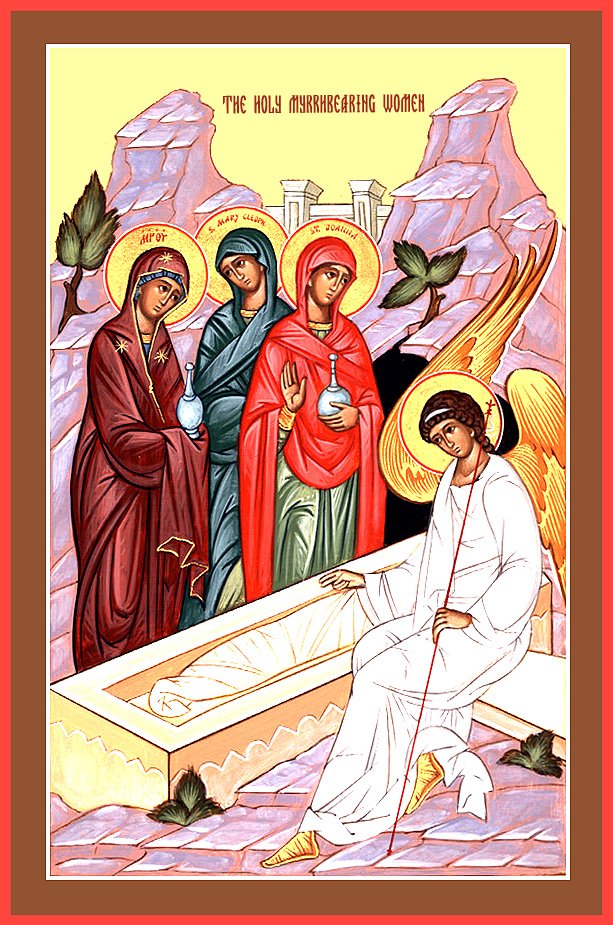
Myrrhbearing Women

Myrrhbearing Women

The Myrrh-bearing women are those women who followed the Lord, along with His Mother. They remained with her during the time of the saving Passion, and anointed the Lord's body with myrrh. Joseph and Νikόdēmos asked for and received the Lord's body from Pilate. They took it down from the Cross, wrapped it in linen cloths and spices, then they laid it in a tomb, and then they placed a great stone over the entrance of the tomb. A The Myrrh-bearing women are those women who followed the Lord, along with His Mother. They remained with her during the time of the saving Passion, and anointed the Lord's body with myrrh. Joseph and Νikόdēmos asked for and received the Lord's body from Pilate. They took it down from the Cross, wrapped it in linen cloths and spices, then they laid it in a tomb, and then they placed a great stone over the entrance of the tomb. According to the Evangelist Matthew (27:57-61) Mary Magdalene and Mary the mother of James and Joses (Mark 15:40) were there sitting opposite the sepulchre, and they saw where He had been laid. This other Mary was the Mother of God. Not only were these present, but also many other women, as Saint Luke says (24:10). Today the Church honors Saints Mary Magdalene (July 22), Mary the wife of Cleopas (May 23), Joanna (June 27), Salome, mother of the sons of Zebedee (August 3), Martha and Mary, sisters of Lazarus (June 4), and the Most Holy Theotokos and Ever-Virgin Mary, who was the stepmother of her husband Joseph’s sons James (October 23) and Joses (October 30). Today we also remember Saint Joseph of Arimathea (July 31), who was a secret disciple (John 19:38), and Saint Νikόdēmos, who was a disciple by night (John 3:3; 19:38). The holy right-believing Queen Tamara of Georgia is honored twice during the year: on May 1, the day of her repose, and also on the Sunday of the Myrrh-Bearing Women. On this day the Church also remembers All Saints of Thessalonica, Saint Seraphim Bishop of Phanar (December 4,1610), the New Martyr Elias Ardunis (January 31, 1686), and the New Martyr Demetrios of the Peloponnesos (April 13, 1803).

Troparion - Tone 2

The comely Joseph, / when he had taken down Your most pure Body from the tree, / wrapped it in fine linen and anointed it with spices, / and placed it in a new tomb. / But You rose on the third day, O Lord, / granting the world great mercy.

Kontakion - Tone 2

Appearing to the Myrrh-bearing Women at the tomb, the Angel exclaimed: / “Myrrh is meet for the dead; / but Christ has shown Himself a stranger to corruption. / So proclaim: ‘The Lord is risen, granting the world great mercy.’”
Ven. Theodore the Sanctified

Ven. Theodore the Sanctified

Saint Theodore was called “Sanctified” because he was the first in his monastery ordained to the priesthood. Saint Theodore came from Egypt and was the son of rich and illustrious Christian parents. The yearning for monastic life appeared early in him. Once there was a large party at the house of his parents during the feast of Theophany. The Saint Theodore was called “Sanctified” because he was the first in his monastery ordained to the priesthood. Saint Theodore came from Egypt and was the son of rich and illustrious Christian parents. The yearning for monastic life appeared early in him. Once there was a large party at the house of his parents during the feast of Theophany. The boy did not want to take part in the festivities, grieving that because of earthly joys he might be deprived of joys in the life to come. He secretly left home when he was fourteen and entered one of the monasteries. Hearing about Pachomius the Great, he burned with the desire to see the ascetic. Saint Pachomius received the young man with love, having been informed by God beforehand about his coming. Remaining at the monastery, Saint Theodore quickly succeeded in all his monastic tasks, particularly in the full obedience to his guide, and in his compassion towards the other brethren. Theodore’s mother, learning that he was at the Tabennisi monastery, came to Saint Pachomius with a letter from the bishop, asking to see her son. Saint Theodore did not wish to break his vow to renounce the world, so he refused to meet with his mother. Seeing Saint Theodore’s strength of mind and ability, Saint Pachomius once told him to instruct the brethren on Holy Scripture. Saint Theodore was then only twenty years old. He obeyed and began to speak, but some of the older brethren took offense that a new monk should teach them, and they departed. Saint Pachomius said to them, “You have given in to the devil and because of your conceit, your efforts will come to naught. You have not rejected Theodore, but rather the Word of God, and have deprived yourselves of the Holy Spirit.” Saint Pachomius appointed Saint Theodore as overseer of the Tabennisi monastery, and withdrew to a more solitary monastery. Saint Theodore with filial love continued to concern himself over his instructor, and he looked after Saint Pachomius in his final illness, and when the great abba reposed in the Lord, he closed his eyes. After the death of Saint Pachomius, Saint Theodore directed the Tabennisi monastery, and later on he was at the head of all the Thebaid monasteries. Saint Theodore the Sanctified was famed for his holiness of life and a great gift of wonderworking, and he was well known to Saint Athanasius, Patriarch of Alexandria. Saint Theodore reposed in his old age in the year 368.

Troparion - Tone 1

Dweller of the desert and angel in the body, / you were shown to be a wonder-worker, our God-bearing Father Theodore. / You received heavenly gifts through fasting, vigil, and prayer: / Healing the sick and the souls of those drawn to you by faith. / Glory to Him who gave you strength! / Glory to Him who granted you a crown! / Glory to Him who through you grants healing to all!

Kontakion - Tone 2

You flourished like a palm tree in the house of God, / bringing forth the fruit of virtues for the Lord through your ascetic efforts. / Therefore, you are called blest, venerable Father Theodore, / for you are equal to the bodiless ones!

Trans. Rel. Ephraim, Abbot of Perekop

The Transfer of the Relics of Saint Ephraim of Perekop occurred on May 16, 1545. This celebration was established at a Moscow Council of the year 1549. Saint Ephraim of Perekop reposed on September 26, 1492. The Life of the saint is found under September 26 .

Troparion - Tone 8

By a flood of tears you made the desert fertile, / and your longing for God brought forth fruits in abundance. / By the radiance of miracles you illumined the whole universe! / O our holy father Ephraim, pray to Christ our God to save our souls!

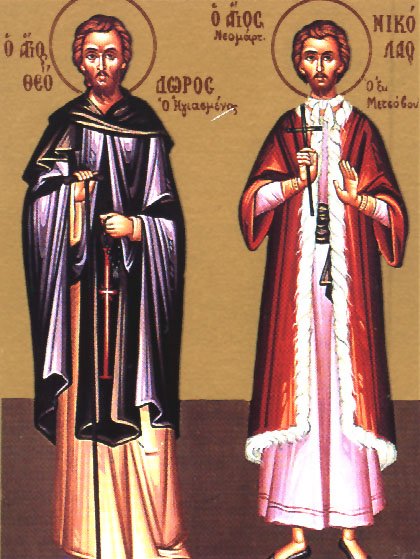
Our Holy Father Theodore the Sanctified (368), disciple of St Pachomius the Great

He was born and raised an unbeliever, but came to faith in Christ as a young man. Not long after being baptised, he heard of Pachomius (May 15) and fled to join him in the desert. Saint Pachomius accepted Theodore as a monk and, because of his humility and obedience, came to esteem him most highly of all the brethren. He was born and raised an unbeliever, but came to faith in Christ as a young man. Not long after being baptised, he heard of Pachomius (May 15) and fled to join him in the desert. Saint Pachomius accepted Theodore as a monk and, because of his humility and obedience, came to esteem him most highly of all the brethren. Theodore’s sister joined him in the desert, taking up life in a women’s monastery and becoming its abbess. When their mother came to bring them back from the desert, she in turn was persuaded to stay in the women’s monastery as a monastic. Finally, Theodore’s brother Paphnutius also came to the monastery and was tonsured. Once the Bishop of Panopolis asked Saint Pachomius to build a monastery for him; Pachomius entrusted Theodore to carry out the work. Some of the brethren grumbled at the authority given to Theodore, for he was younger than many of them; but St Pachomius said: ‘Theodore and I fulfill the same service for God; and he also has the authority to give orders as father.’ When St Pachomius reposed, he left St Theodore to be spiritual father to the monasteries that he had founded, a task which he faithfully fulfilled until his death at a great age.

St Nicholas Mystikos, Patriarch of Constantinople (930)
He was known for the purity and austerity of his life. When the Emperor Leo VI married a fourth time (his three previous wives having died), the Patriarch barred him from the church. The Emperor sent the Patriarch into exile and had his marriage approved by delegates of the Roman Pope. When the Emperor died, Nicholas was restored to the Patriarchal throne, and called a Council in 925, at which fourth marriages were forbidded in the Church under any circumstance. He was known for the purity and austerity of his life. When the Emperor Leo VI married a fourth time (his three previous wives having died), the Patriarch barred him from the church. The Emperor sent the Patriarch into exile and had his marriage approved by delegates of the Roman Pope. When the Emperor died, Nicholas was restored to the Patriarchal throne, and called a Council in 925, at which fourth marriages were forbidded in the Church under any circumstance. He died peacefully. The title Mystikos was given to some high-ranking members of the Imperial council (perhaps because they met in secret). The Patriarch was a courtier with this title before he forsook the world and was tonsured a monk. Note: From early times, the Eastern and Latin churches have differed in their views on marriage. The Latin church held, and still holds, that marriage is dissolved by death, so in theory any number of re-marriages is permissible (a view that the Emperor Leo sought to exploit). The Eastern Church has traditionally been uncomfortable with any second marriage — some of the Fathers even call the re-marriage of widows or widowers “bigamy”. Still the Eastern church tolerates re-marriage (even after divorce) as a concession for the salvation of those who cannot sustain the single state.
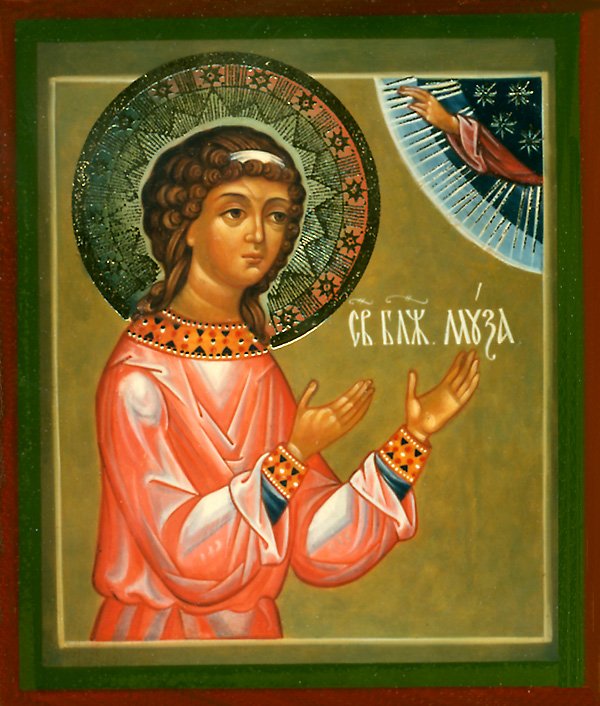
Blessed Musa the Maiden (5th c.)

Blessed Musa the Maiden (5th c.)

Saint Musa lived during the fifth century. She was distinguished for her pure life. Saint Gregory Dialogus included her story in his Dialogues , saying that he had heard these things from Musa’s brother Probus. The Most Holy Theotokos once appeared to Musa in a dream, surrounded by girls dressed in white. S Saint Musa lived during the fifth century. She was distinguished for her pure life. Saint Gregory Dialogus included her story in his Dialogues , saying that he had heard these things from Musa’s brother Probus. The Most Holy Theotokos once appeared to Musa in a dream, surrounded by girls dressed in white. She asked her, “Do you wish to live together with these maidens in my court?” “Yes, I do,” the girl replied. “Do not do anything silly, as little girls often do. Avoid frivolity and joking. In thirty days I shall come for you and you will be with us.” From that moment, Musa’s character was changed. She began to pray earnestly and lived a strict life. In answer to the questions of her astonished parents, Saint Musa told them about the vision. On the twenty-fifth day the maiden developed a fever, and on the thirtieth day she again saw the Mother of God coming to her with the same girls as before. The blessed child reposed with the words, “I am coming, I am coming to you, my Lady!” Saint Musa departed this earthly life and was gathered into the heavenly Kingdom, where she glorifies the Father, the Son, and the Holy Spirit unto ages of ages.

St Brendan the Voyager, abbot of Clonfert (ca. 577)

He was born around 484 at Tralee in Kerry, Ireland. He founded several monasteries in Ireland, of which the chief was Cluain Ferta Brenaind (anglicized as Clonfert) in County Galway. His missionary and pastoral travels took him on voyages to the Scottish islands, and possibly to Wales; thus in his own time he was known as ‘Brendan the Voyager.’ He reposed in peace. Ear He was born around 484 at Tralee in Kerry, Ireland. He founded several monasteries in Ireland, of which the chief was Cluain Ferta Brenaind (anglicized as Clonfert) in County Galway. His missionary and pastoral travels took him on voyages to the Scottish islands, and possibly to Wales; thus in his own time he was known as ‘Brendan the Voyager.’ He reposed in peace. Early in the ninth century, a Latin saga, Navigatio Brendani (The Voyage of Brendan) made him the hero of a Christian adventure that included voyages to unknown lands far to the west of Ireland. The account provides strong evidence that Irish voyagers visited America as early as the 8th century, before the Vikings; but whether St Brendan himself made these voyages is disputed.

Scripture Readings

☩Epistle

Acts 6:1-7

1 And in those days, when the number of the disciples was multiplied, there arose a murmuring of the Grecians against the Hebrews, because their widows were neglected in the daily ministration.
2 Then the twelve called the multitude of the disciples unto them, and said, It is not reason that we should leave the word of God, and serve tables.
3 Wherefore, brethren, look ye out among you seven men of honest report, full of the Holy Ghost and wisdom, whom we may appoint over this business.
4 But we will give ourselves continually to prayer, and to the ministry of the word.
5 And the saying pleased the whole multitude: and they chose Stephen, a man full of faith and of the Holy Ghost, and Philip, and Prochorus, and Nicanor, and Timon, and Parmenas, and Nicolas a proselyte of Antioch:
6 Whom they set before the apostles: and when they had prayed, they laid their hands on them.
7 And the word of God increased; and the number of the disciples multiplied in Jerusalem greatly; and a great company of the priests were obedient to the faith.

☩Gospel

Mark 15:43-16:8

43 Joseph of Arimathea, an honourable counsellor, which also waited for the kingdom of God, came, and went in boldly unto Pilate, and craved the body of Jesus.
44 And Pilate marvelled if he were already dead: and calling unto him the centurion, he asked him whether he had been any while dead.
45 And when he knew it of the centurion, he gave the body to Joseph.
46 And he bought fine linen, and took him down, and wrapped him in the linen, and laid him in a sepulchre which was hewn out of a rock, and rolled a stone unto the door of the sepulchre.
47 And Mary Magdalene and Mary the mother of Joses beheld where he was laid.
1 And when the sabbath was past, Mary Magdalene, and Mary the mother of James, and Salome, had bought sweet spices, that they might come and anoint him.
2 And very early in the morning the first day of the week, they came unto the sepulchre at the rising of the sun.
3 And they said among themselves, Who shall roll us away the stone from the door of the sepulchre?
4 And when they looked, they saw that the stone was rolled away: for it was very great.
5 And entering into the sepulchre, they saw a young man sitting on the right side, clothed in a long white garment; and they were affrighted.
6 And he saith unto them, Be not affrighted: Ye seek Jesus of Nazareth, which was crucified: he is risen; he is not here: behold the place where they laid him.
7 But go your way, tell his disciples and Peter that he goeth before you into Galilee: there shall ye see him, as he said unto you.
8 And they went out quickly, and fled from the sepulchre; for they trembled and were amazed: neither said they any thing to any man; for they were afraid.

Liturgical data sourced from OCA.org and orthocal.info