Today

Fasting Rules

Meat allowed Meat Allowed
Fish allowed Fish Allowed
Dairy allowed Dairy Allowed
Oil allowed Oil Allowed
Wine allowed Wine Allowed

☦ Saints & Commemorations

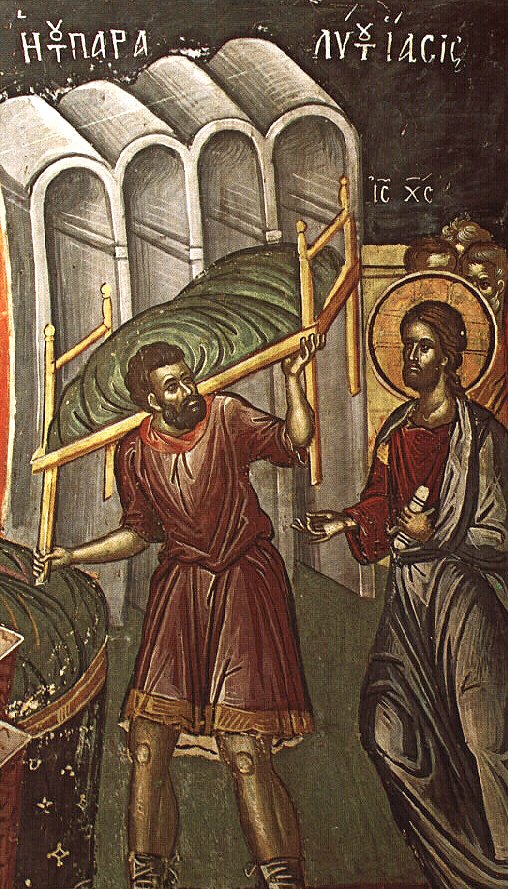
Paralytic

Paralytic

Many miracles in the Old Testament involve water. To name but a few, the water of the Nile turned to blood after Moses lifted his rod and struck the water before Pharaoh and His servants (Exodus 7:20). Not only was the Nile turned to blood, but also "their rivers, their canals, their ponds, and all their pools of water, that they may become blood; and there shall be blood throughout the land of Egypt, both in vessels of wood and in vessels of stone" (Exodus 7:19). Many miracles in the Old Testament involve water. To name but a few, the water of the Nile turned to blood after Moses lifted his rod and struck the water before Pharaoh and His servants (Exodus 7:20). Not only was the Nile turned to blood, but also "their rivers, their canals, their ponds, and all their pools of water, that they may become blood; and there shall be blood throughout the land of Egypt, both in vessels of wood and in vessels of stone" (Exodus 7:19). In chapter 14 of Exodus, Moses divided the waters of the Red Sea, and the Hebrews passed over as if on dry land. When they were safely across, the waters came together, and their Egyptian pursuers were drowned. On their forty year journey to the Promised Land, the Hebrews camped at Rephidem, but there was no water for them to drink. The people murmured against Moses, asking him why he had led them out of Egypt. God told Moses to strike the rock at Horeb. Then water came out of it so that everyone could drink (Exodus 17:6). In Judges 6:36-40 we read about Gideon and the dew on the fleece. When Gideon squeezed the fleece, there was enough to fill a bowl with water. On the Fourth Sunday of Pascha, the Church remembers the man who lay paralyzed at the Sheep Pool in Jerusalem for thirty-eight years, waiting for someone to put him into the pool. The first person to enter the pool after an Angel troubled the water would be healed of his infirmities, but someone always entered the pool before him. Seeing the man, the Lord felt compassion for him and healed him. The Lord healed the paralytic during the days of the Passover, when He had gone to Jerusalem for the Feast, and He remained there teaching and working miracles. According to Saint John the Theologian, this miracle took place on the Sabbath. Like some Old Testament miracles, many of Christ's miracles also involved water, and they prefigure the Church's Baptism, which cleanses us of every sin. In the Sheep Pool, once a year, only one person was healed, but Christ saves endless multitudes by divine Baptism. Sometimes, as in the case of Saint Vladimir (July 15), Baptism can also heal our bodily infirmities. In the Canon for the Paralytic, the Angel who stirred the water in the Sheep Pool is identified as the Archangel Michael. Some of the Troparia call him "Leader of the Angels," and "Supreme Commander" (Ode 1). In Ode 3 we ask him to "protect us from falling into the passions of life." In Ode 6, we ask Saint Michael to guide us on the paths of life." In Ode 8, we ask him to pray with all the Bodiless Hosts, that we may be granted deliverance from our offenses, correction of our life, and the enjoyment of eternal blessings. As we remember the paralytic, let us ask Christ to "raise up our souls, paralyzed by sins and thoughtless acts" (Kontakion of the paralytic).

Troparion - Tone 3

Let the heavens rejoice, / let the earth be glad, / for the Lord has shown strength with His arm. / He has trampled down death by death. / He has become the first born of the dead. / He has delivered us from the depths of hell, / and has granted to the world / great mercy.

Kontakion - Tone 3

(Podoben: “Today the Virgin...” By Your divine authority, O Lord, / as You raised up the paralytic of old, / so raise up my soul, paralyzed by sundry sins and unseemly acts; / so that being saved I may cry: / “Glory to Your power, O compassionate Christ!”
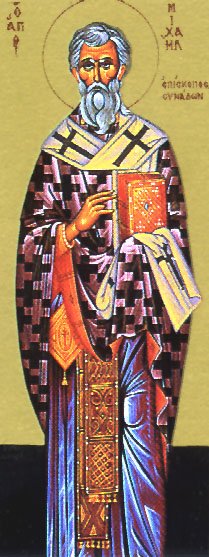
St Michael the Confessor

St Michael the Confessor

Saint Michael the Confessor From his youth he longed for the monastic life and was sent by Patriarch Tarasius (784-806) to a monastery on the coast of the Black Sea. Saint Theophylactus (March 8), the future Bishop of Nicomedia also entered the monastery together with him. At the monastery both monks engaged in spiritual struggles and were soon glorified by gifts from the Lord. Saint Michael the Confessor From his youth he longed for the monastic life and was sent by Patriarch Tarasius (784-806) to a monastery on the coast of the Black Sea. Saint Theophylactus (March 8), the future Bishop of Nicomedia also entered the monastery together with him. At the monastery both monks engaged in spiritual struggles and were soon glorified by gifts from the Lord. Once, during a harvest, when the people were weakened by thirst, an empty metal vessel was filled with water by the prayer of the monks. Patriarch Tarasius consecrated Saint Michael as bishop of the city of Synnada. Through his holy life and wisdom, Saint Michael won the love of believers, and the notice of the emperors Nikēphóros I (802-811) and Michael I Rangabe (811-813). Saint Michael was present at the Seventh Ecumenical Council at Nicea in 787. When the Iconoclast heretic Leo the Armenian (813-820) assumed the throne, he began to expel Orthodox hierarchs from their Sees, appointing heretics in their place. Saint Michael defended Orthodoxy, bravely opposing the heretics and denouncing their error. Leo the Armenian brought Saint Michael to trial, but not fearing torture he answered resolutely, “I venerate the holy icons of my Savior Jesus Christ and the All-Pure Virgin, His Mother, and all the saints, and it is to them I bow down. I shall not obey your decrees to remove icons from churches.” Leo then banished Saint Michael to the city of Eudokiada, where the confessor died about the year 821. The head of Saint Michael is preserved in the Great Lavra of Saint Athanasius on Mount Athos, and part of the relics are at the Ivḗron monastery.

Troparion - Tone 4

From your youth you dedicated your life to God, / and you were proclaimed shepherd and hierarch of Christ, holy Michael. / You endured afflictions and exile / because you honored the icon of Christ; / now you pour forth healings for us all.

Kontakion - Tone 8

As a most honorable hierarch and champion of true piety, / undaunted by fear of the notorious tyrant, / you conquered his heretical opposition, freely proclaiming in a loud voice: / “I venerate the icon of Christ and of His all-pure Mother!” / Therefore, we honor you, O Michael!

Unc. Rel. St Leonty, Bishop of Rostov

No information available at this time.

Troparion - Tone 4

Successor of the Apostles and faithful intercessor with God, / by your virtues you rose to the height of Heaven, / and lovingly you devoted yourself to Him Who loved you, / and brought an unbelieving people to faith. / Therefore, now rejoicing together with the Angels, / you stand before the glorious Throne of Christ God, the King of all. / O Hierarch Leontius, pray that He may save our souls.

Kontakion - Tone 4

Because of the purity of your life, / the All-Seeing Lord has given His light to your soul, / in order to explain your teaching to many, O Venerable Leontius.

St Michael the Confessor, bishop of Synnada (818)

“This Saint was from Synnada in Phrygia of Asia Minor. In Constantinople he met Saint Theophylact (March 8); the holy Patriarch Tarasius, learning that Michael and Theophylact desired to become monks, sent them to a monastery on the Black Sea. Because of their great virtue, St Tarasius afterwards compelled them to accept consecration, Theophylact as Bishop of Nicomedia, and Michael as Bishop of his native Synnada. B “This Saint was from Synnada in Phrygia of Asia Minor. In Constantinople he met Saint Theophylact (March 8); the holy Patriarch Tarasius, learning that Michael and Theophylact desired to become monks, sent them to a monastery on the Black Sea. Because of their great virtue, St Tarasius afterwards compelled them to accept consecration, Theophylact as Bishop of Nicomedia, and Michael as Bishop of his native Synnada. Because St Michael fearlessly confessed the veneration of the holy icons, he was banished by the Iconoclast Emperor Leo V the Armenian, who reigned from 813 to 820. After being driven from one place to another, in many hardships and bitter pains, St Michael died in exile.” (Great Horologion)

Holy Myrrh-bearer Mary, wife of Cleopas

According to Church Tradition, Saint Mary was the daughter of Saint Joseph the Betrothed by his first wife. She was still very young when the Most Holy Virgin Mary was betrothed to the Righteous Joseph and brought to his house. Thus, Saint Mary became the childhood friend of the Most Holy Theotokos. After the Righteous Joseph returned to Nazareth from Egypt with the Savior and the Mother of God, he married his daughter to his younger brother Cleopas, so she is known as Mary, the wife of Cleopas. According to Church Tradition, Saint Mary was the daughter of Saint Joseph the Betrothed by his first wife. She was still very young when the Most Holy Virgin Mary was betrothed to the Righteous Joseph and brought to his house. Thus, Saint Mary became the childhood friend of the Most Holy Theotokos. After the Righteous Joseph returned to Nazareth from Egypt with the Savior and the Mother of God, he married his daughter to his younger brother Cleopas, so she is known as Mary, the wife of Cleopas. The blessed fruit of that marriage was the Holy Hieromartyr Symeon (April 27), an Apostle of the Seventy, a kinsman of the Lord, and the second Bishop of the Church of Jerusalem. Saint Mary, the wife of Cleopas, along with other pious women, accompanied the Lord during His public ministry. She was present during His suffering on the Cross, and at His burial. After the Sabbath had passed, she went to the tomb with other Myrrh-bearers to anoint the body of Jesus. There, she and the others heard the joyous news of the Lord's Resurrection from an Angel (Matthew 27:56; Mark 15:40; Luke 24:4-11; John 19:25). Saint Mary, the wife of Cleopas, is also commemorated on the Sunday of the Myrrh-bearers, the third Sunday of Pascha.

Troparion - Tone 2

The Angel came to the Myrrh-Bearing women at the tomb and said: / “Myrrh is meet for the dead; / but Christ has shown Himself a stranger to corruption! / So proclaim the Lord is risen, / granting the world great mercy!”

Kontakion

When You proclaimed “Rejoice” to the Myrrhbearers, / You caused the lamentation of the first mother Eve to cease by Your Resurrection; O Christ God; / You bade Your Apostles to preach: / “The Savior is risen from the tomb.”

Holy Martyr Michael of St Sabbas' Monastery(9th c.)

The Venerable Michael lived in the ninth century, and was from the city of Edessa in Mesopotamia, the son of Christian parents. After their death he distributed his inheritance to the poor, then went to Jerusalem to venerate the Holy Places. The Holy Land at that time was under Moslem rule. Michael remained in Palestine and settled in the Lavra of Saint Savva, where he became the disciple of his relative, Saint Theodore of Edessa (July 9), who spent his time both in the monastery and living as an anchorite in the Judean desert. The Venerable Michael lived in the ninth century, and was from the city of Edessa in Mesopotamia, the son of Christian parents. After their death he distributed his inheritance to the poor, then went to Jerusalem to venerate the Holy Places. The Holy Land at that time was under Moslem rule. Michael remained in Palestine and settled in the Lavra of Saint Savva, where he became the disciple of his relative, Saint Theodore of Edessa (July 9), who spent his time both in the monastery and living as an anchorite in the Judean desert. Saint Theodore accepted him and tonsured him right away. The two made baskets of reeds together in order to support themselves. Saint Michael would take the baskets to the marketplace in Jerusalem in order to sell them. One day while at the marketplace, the eunuch of the Muslim Queen Seida, seeing that the baskets were both fine and well-made, took him along to the Queen, who was visiting the city with her husband King al-Ma’mun (813-833). The handsome monk aroused the desire of the Queen, who tried to lead him into the sin of adultery, but he did not accept her suggestions. The enraged Seida told her husband to have the monk beaten with rods because he had insulted her, and accused him of being an enemy of Islam. There was a debate about which faith is the true one, Christianity or Islam, and the king said, “Do as I tell you, and confess that Mohammed is a prophet and an apostle of Christ, then I will adopt you as my son.” Saint Michael said, “Mohammad is neither an apostle nor a prophet, but a deceiver and the forerunner of the antichrist. Either send me back to my Elder at the monastery, or be baptized into our Christian faith and reign forever in the heavens, or send me to Christ through martyrdom.” The king gave the Saint a cup with deadly poison to drink. Saint Michael made the Sign of the Cross over the cup, and he drank it, but he remained unharmed, according to the promise of the Lord (Mark16:18). After this the king ordered that he be decapitated. The monks of the Lavra of Saint Savva wanted to take the Saint’s relics to their Lavra, but the Christians of Jerusalem would not permit this. They said that since he was martyred in Jerusalem, his relics ought to remain there.The monks of the Lavra disagreed with them, saying that he was nurtured in the Lavra and so he should be buried there. There was such a heated argument that the king decided that the relics would go to the Lavra. On the same day that Saint Michael was put to death, the Lord revealed this to Saint Theodore. After informing the brethren, he sent some monks to bring the relics to the Lavra. As the relics were carried to the Lavra, there was a pillar of fire from Heaven accompanying the relics, and it remained until they reached the Lavra. Saint Theodore and the monks came out to meet the procession with lit candles, and singing hymns. The holy relics were buried with the other holy Fathers who had endured martyrdom. Many miracles took place before the relics of Saint Michael, as a sign that he had found favor with God. At the beginning of the twelfth century the relics of Saint Michael were seen by Daniel, the Igoumen of the Kiev Caves Monastery, while on pilgrimage to the Holy Land. Saint Michael is commemorated twice during the year: on May 23 (his repose) and July 29 (the transfer of his relics).

Troparion - Tone 1

The image of God was truly preserved in you, O Father, / for you took up the Cross and followed Christ. / By so doing you taught us to disregard the flesh for it passes away / but to care instead for the soul, since it is immortal. / Therefore your spirit, venerable Michael, rejoices with the angels.
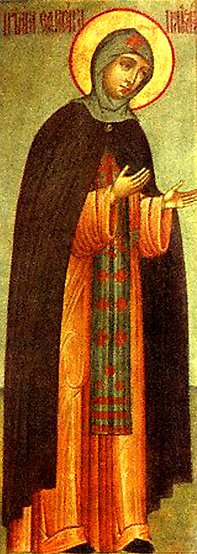
Holy Virgin Euphrosyne, Princess of Polotsk (1173)

Holy Virgin Euphrosyne, Princess of Polotsk (1173)

Saint Euphrosyne (Euphrosynē), Abbess of Polotsk, was named Predslava in the world, and was the daughter of Prince George Vseslavich. From her childhood she was noted for her love of prayer and book learning. After turning down a proposal of marriage, Predslava received monastic tonsure with the name Euphrosyne. Saint Euphrosyne (Euphrosynē), Abbess of Polotsk, was named Predslava in the world, and was the daughter of Prince George Vseslavich. From her childhood she was noted for her love of prayer and book learning. After turning down a proposal of marriage, Predslava received monastic tonsure with the name Euphrosyne. With the blessing of Bishop Elias of Polotsk, she began to live near the Sophia cathedral, where she occupied herself by the copying of books. Around the year 1128 Bishop Elias entrusted the nun with the task of organizing a women’s monastery. Setting out for Seltso, the site of the future monastery, the ascetic took only her holy books. At the newly constructed Savior-Transfiguration monastery the saint taught the girls to copy books, singing, sewing and other handicrafts. Through her efforts, a cathedral was built in 1161, which survives to the present day. Saint Euphrosyne also founded a men’s monastery dedicated to the Mother of God. Patriarch Luke of Constantinople sent a copy of the wonderworking Ephesus Icon of the Mother of God at her request. Shortly before her death, Saint Euphrosyne journeyed on pilgrimage to the Holy Places with her nephew David and sister Eupraxia. After venerating the holy things at Constantinople, she arrived in Jerusalem, where at the Russian monastery of the Most Holy Theotokos the Lord granted her a peaceful end on May 24, 1173. In 1187 the body of the saint was transferred to the Kiev Caves monastery, and the relics were transferred to Polotsk in 1910 to the monastery she founded. Saint Euphrosyne of Polotsk was glorified in the Russian Church as a patroness of women’s monasticism.

Troparion - Tone 8

By a flood of tears you made the desert fertile, / and your longing for God brought forth fruits in abundance. / By the radiance of miracles you illumined the whole universe! / O our holy mother Euphrosynē, pray to Christ our God to save our souls!

Scripture Readings

☩Epistle

Acts 9:32-42

32 And it came to pass, as Peter passed throughout all quarters, he came down also to the saints which dwelt at Lydda.
33 And there he found a certain man named Eneas, which had kept his bed eight years, and was sick of the palsy.
34 And Peter said unto him, Eneas, Jesus Christ maketh thee whole: arise, and make thy bed. And he arose immediately.
35 And all that dwelt at Lydda and Saron saw him, and turned to the Lord.
36 Now there was at Joppa a certain disciple named Tabitha, which by interpretation is called Dorcas: this woman was full of good works and almsdeeds which she did.
37 And it came to pass in those days, that she was sick, and died: whom when they had washed, they laid her in an upper chamber.
38 And forasmuch as Lydda was nigh to Joppa, and the disciples had heard that Peter was there, they sent unto him two men, desiring him that he would not delay to come to them.
39 Then Peter arose and went with them. When he was come, they brought him into the upper chamber: and all the widows stood by him weeping, and shewing the coats and garments which Dorcas made, while she was with them.
40 But Peter put them all forth, and kneeled down, and prayed; and turning him to the body said, Tabitha, arise. And she opened her eyes: and when she saw Peter, she sat up.
41 And he gave her his hand, and lifted her up, and when he had called the saints and widows, presented her alive.
42 And it was known throughout all Joppa; and many believed in the Lord.

☩Gospel

John 5:1-15

1 After this there was a feast of the Jews; and Jesus went up to Jerusalem.
2 Now there is at Jerusalem by the sheep market a pool, which is called in the Hebrew tongue Bethesda, having five porches.
3 In these lay a great multitude of impotent folk, of blind, halt, withered, waiting for the moving of the water.
4 For an angel went down at a certain season into the pool, and troubled the water: whosoever then first after the troubling of the water stepped in was made whole of whatsoever disease he had.
5 And a certain man was there, which had an infirmity thirty and eight years.
6 When Jesus saw him lie, and knew that he had been now a long time in that case, he saith unto him, Wilt thou be made whole?
7 The impotent man answered him, Sir, I have no man, when the water is troubled, to put me into the pool: but while I am coming, another steppeth down before me.
8 Jesus saith unto him, Rise, take up thy bed, and walk.
9 And immediately the man was made whole, and took up his bed, and walked: and on the same day was the sabbath.
10 The Jews therefore said unto him that was cured, It is the sabbath day: it is not lawful for thee to carry thy bed.
11 He answered them, He that made me whole, the same said unto me, Take up thy bed, and walk.
12 Then asked they him, What man is that which said unto thee, Take up thy bed, and walk?
13 And he that was healed wist not who it was: for Jesus had conveyed himself away, a multitude being in that place.
14 Afterward Jesus findeth him in the temple, and said unto him, Behold, thou art made whole: sin no more, lest a worse thing come unto thee.
15 The man departed, and told the Jews that it was Jesus, which had made him whole.

Liturgical data sourced from OCA.org and orthocal.info