
Fasting Rules
 Meat
Allowed
 Fish
Allowed
 Dairy
Allowed
 Oil
Allowed
 Wine
Allowed
Saints & Commemorations
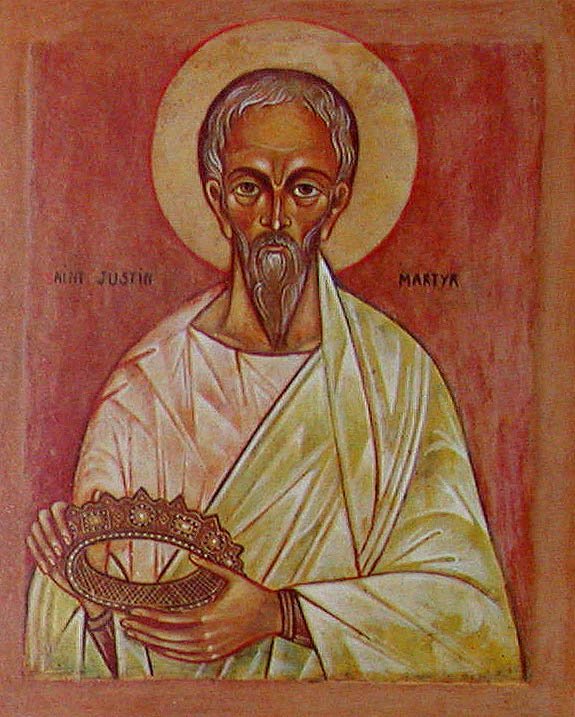
Martyr Justin the Philosopher
The Holy Martyr Justin the Philosopher was born around 114 at Sychem, an ancient city of Samaria. Justin’s parents were pagan Greeks. From his childhood the saint displayed intelligence, love for knowledge and a fervent devotion to the knowledge of Truth. When he came of age he studied the various schools of Greek philosophy: the Stoics, the Peripatetics, the Pythagoreans, the Platonists, and he concluded that none of these pagan teachings revealed the way to knowledge of the true God.
The Holy Martyr Justin the Philosopher was born around 114 at Sychem, an ancient city of Samaria. Justin’s parents were pagan Greeks. From his childhood the saint displayed intelligence, love for knowledge and a fervent devotion to the knowledge of Truth. When he came of age he studied the various schools of Greek philosophy: the Stoics, the Peripatetics, the Pythagoreans, the Platonists, and he concluded that none of these pagan teachings revealed the way to knowledge of the true God.
Once, when he was strolling in a solitary place beyond the city and pondering about where to seek the way to the knowledge of Truth, he met an old man. In the ensuing conversation he revealed to Justin the essential nature of the Christian teaching and advised him to seek the answers to all the questions of life in the books of Holy Scripture. “But before anything else,” said the holy Elder, “pray diligently to God, so that He might open to you the doors of Light. No one is able to comprehend Truth, unless he is granted understanding from God Himself, Who reveals it to each one who seeks Him in prayer and in love.”
In his thirtieth year, Justin accepted holy Baptism (between the years 133 and 137). From this time Saint Justin devoted his talents and vast philosophical knowledge to preaching the Gospel among the pagans. He began to journey throughout the Roman Empire, sowing the seeds of faith. “Whosoever is able to proclaim Truth and does not proclaim it will be condemned by God,” he wrote.
Justin opened a school of Christian philosophy. Saint Justin subsequently defended the truth of Christian teaching, persuasively confuting pagan sophistry (in a debate with the Cynic philosopher Crescentius) and heretical distortions of Christianity. He also spoke out against the teachings of the Gnostic Marcian.
In the year 155, when the emperor Antoninus Pius (138-161) started a persecution against Christians, Saint Justin personally gave him an Apology in defense of two Christians innocently condemned to execution, Ptolemy and Lucias. The name of the third remains unknown.
In the Apology he demonstrated the falseness of the slander against Christians accused unjustly for merely having the name of Christians. The Apology had such a favorable effect upon the emperor that he ceased the persecution. Saint Justin journeyed, by decision of the emperor, to Asia Minor where they were persecuting Christians with particular severity. He proclaimed the joyous message of the imperial edict throughout the surrounding cities and countryside.
The debate of Saint Justin with the Rabbi Trypho took place at Ephesus. The Orthodox philosopher demonstrated the truth of the Christian teaching of faith on the basis of the Old Testament prophetic writings. Saint Justin gave an account of this debate in his work Dialogue with Trypho the Jew.
A second Apology of Saint Justin was addressed to the Roman Senate. It was written in the year 161, soon after Marcus Aurelius (161-180) ascended the throne.
When he returned to Italy, Saint Justin, like the Apostles, preached the Gospel everywhere, converting many to the Christian Faith. When the saint arrived at Rome, the envious Crescentius, whom Justin always defeated in debate, brought many false accusations against him before the Roman court. Saint Justin was put under guard, subjected to torture and suffered martyrdom in 165. The relics of Saint Justin the Philosopher rest in Rome.
In addition to the above-mentioned works, the following are also attributed to the holy martyr Justin the Philosopher:
2) A Hortatory Address to the Greeks
3) On the Sole Government of God
Saint John of Damascus preserved a significant part of Saint Justin’s On the Resurrection, which has not survived. The church historian Eusebius asserts that Saint Justin wrote books entitled
Denunciation of all Existing Heresies and
In the Russian Church the memory of the martyr is particularly glorified in temples of his name. He is invoked by those who seek help in their studies.
The holy martyrs Justin, Chariton, Euelpistus, Hierax, Peonus, Valerian, Justus and the martyr Charito suffered with Saint Justin the Philosopher in the year 166. They were brought to Rome and thrown into prison. The saints bravely confessed their faith in Christ before the court of the prefect Rusticus. Rusticus asked Saint Justin, whether he really thought that after undergoing tortures he would go to heaven and receive a reward from God. Saint Justin answered, “Not only do I think this, but I know and am fully assured of it.”
The prefect proposed to all the Christian prisoners that they offer sacrifice to the pagan gods. When they refused he issued a sentence of death, and the saints were beheaded.
Troparion - Tone 5
You emptied the cup of the wisdom of the Greeks, / but you thirsted again, until you came to the well where you found water springing unto eternal life.1 / And having drunk deeply, you also drank from the cup2 which Christ gave to His disciples. / Therefore, O Justin, / we praise you as a Philosopher and Martyr of Christ.1 John 4:14.
2 Mark 10:39.
Kontakion - Tone 2
You emptied the cup of the wisdom of the Greeks, / but you thirsted again, until you came to the well where you found water springing unto eternal life.1 / And having drunk deeply, you also drank from the cup2 which Christ gave to His disciples. / Therefore, O Justin, / we praise you as a Philosopher and Martyr of Christ.
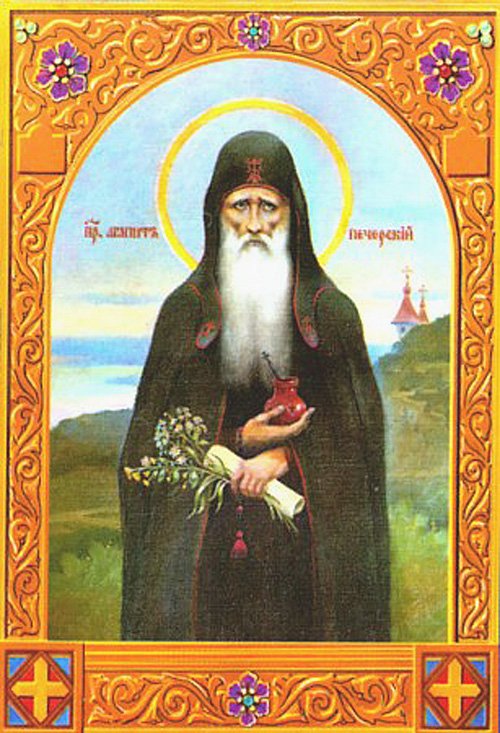
Our Holy Father Agapitus of the Kiev Caves (1095)
Saint Agapitus of the Caves. This holy Unmercenary Physician was born at Kiev. He was a novice and disciple of Saint Anthony of the Caves, and lived during the eleventh century. If any of the monastic brethren fell ill, Saint Agapitus came to him and selflessly attended to the sick one. He fed his patient boiled herbs which he himself prepared, and the person recovered through the prayers of the saint.
Saint Agapitus of the Caves. This holy Unmercenary Physician was born at Kiev. He was a novice and disciple of Saint Anthony of the Caves, and lived during the eleventh century. If any of the monastic brethren fell ill, Saint Agapitus came to him and selflessly attended to the sick one. He fed his patient boiled herbs which he himself prepared, and the person recovered through the prayers of the saint. Many laymen also turned to the monastic physician with the gift of healing.
In Kiev at this time was an experienced Armenian physician, who was able to diagnose the nature of the illness and even accurately determine the day of death just by looking at a patient. When one of these doomed patients turned to Saint Agapitus, the grace-bearing healer gave him some food from the monastery trapeza (dining area), and the patient became well. Enflamed with envy, the physician wanted to poison Saint Agapitus, but the Lord preserved him, and the poison had no effect.
Saint Agapitus healed Prince Vladimir Monomakh of Chernigov, the future Great Prince of Kiev (1114-1125), by sending him boiled herbs. The grateful prince went to the monastery and wanted to see his healer, but the humble ascetic hid himself and would not accept gifts.
When the holy healer himself became sick, that same Armenian physician came to him and after examining him, he said that he would die in three days. He swore to became an Orthodox monk if his prediction were not fulfilled. The saint said that the Lord had revealed to him that He would summon him only after three months.
Saint Agapitus died after three months (on June 1, not later than 1095), and the Armenian went to the igumen of the Caves monastery and received monastic tonsure. “It is certain that Agapitus was a saint of God,” he said. “I well knew, that it was impossible for him to last three days in his sickness, but the Lord gave him three months.” Thus did the monk heal sickness of the soul and guide to the way of salvation.
Troparion - Tone 5
O righteous Agapitus, you healed the infirm with edible herbs, / and with humility like Anthony the Great. / So doing, you brought the unbelieving physician to the Faith, / guiding him on the path of salvation. / Heal our infirmities and pray to Christ our God for those who sing to you!
Kontakion
You proclaimed your faith as a good physician. / You rebuked the Armenian and brought him to piety. / When dying you asked God for life, / and by this wonder brought him to Christ. / Now standing joyfully before the Lord / Pray for us, O righteous one!
Scripture Readings
☩Epistle
Acts 12:25-13:12
25
And Barnabas and Saul returned from Jerusalem, when they had fulfilled their ministry, and took with them John, whose surname was Mark.
1
Now there were in the church that was at Antioch certain prophets and teachers; as Barnabas, and Simeon that was called Niger, and Lucius of Cyrene, and Manaen, which had been brought up with Herod the tetrarch, and Saul.
2
As they ministered to the Lord, and fasted, the Holy Ghost said, Separate me Barnabas and Saul for the work whereunto I have called them.
3
And when they had fasted and prayed, and laid their hands on them, they sent them away.
4
So they, being sent forth by the Holy Ghost, departed unto Seleucia; and from thence they sailed to Cyprus.
5
And when they were at Salamis, they preached the word of God in the synagogues of the Jews: and they had also John to their minister.
6
And when they had gone through the isle unto Paphos, they found a certain sorcerer, a false prophet, a Jew, whose name was Bar–jesus:
7
Which was with the deputy of the country, Sergius Paulus, a prudent man; who called for Barnabas and Saul, and desired to hear the word of God.
8
But Elymas the sorcerer (for so is his name by interpretation) withstood them, seeking to turn away the deputy from the faith.
9
Then Saul, (who also is called Paul,) filled with the Holy Ghost, set his eyes on him,
10
And said, O full of all subtilty and all mischief, thou child of the devil, thou enemy of all righteousness, wilt thou not cease to pervert the right ways of the Lord?
11
And now, behold, the hand of the Lord is upon thee, and thou shalt be blind, not seeing the sun for a season. And immediately there fell on him a mist and a darkness; and he went about seeking some to lead him by the hand.
12
Then the deputy, when he saw what was done, believed, being astonished at the doctrine of the Lord.
☩Gospel
John 8:51-59
51
Verily, verily, I say unto you, If a man keep my saying, he shall never see death.
52
Then said the Jews unto him, Now we know that thou hast a devil. Abraham is dead, and the prophets; and thou sayest, If a man keep my saying, he shall never taste of death.
53
Art thou greater than our father Abraham, which is dead? and the prophets are dead: whom makest thou thyself?
54
Jesus answered, If I honour myself, my honour is nothing: it is my Father that honoureth me; of whom ye say, that he is your God:
55
Yet ye have not known him; but I know him: and if I should say, I know him not, I shall be a liar like unto you: but I know him, and keep his saying.
56
Your father Abraham rejoiced to see my day: and he saw it, and was glad.
57
Then said the Jews unto him, Thou art not yet fifty years old, and hast thou seen Abraham?
58
Jesus said unto them, Verily, verily, I say unto you, Before Abraham was, I am.
59
Then took they up stones to cast at him: but Jesus hid himself, and went out of the temple, going through the midst of them, and so passed by.
Liturgical data sourced from OCA.org and orthocal.info