
Fasting Rules
 Meat
Allowed
 Fish
Allowed
 Dairy
Allowed
 Oil
Allowed
 Wine
Allowed
Saints & Commemorations
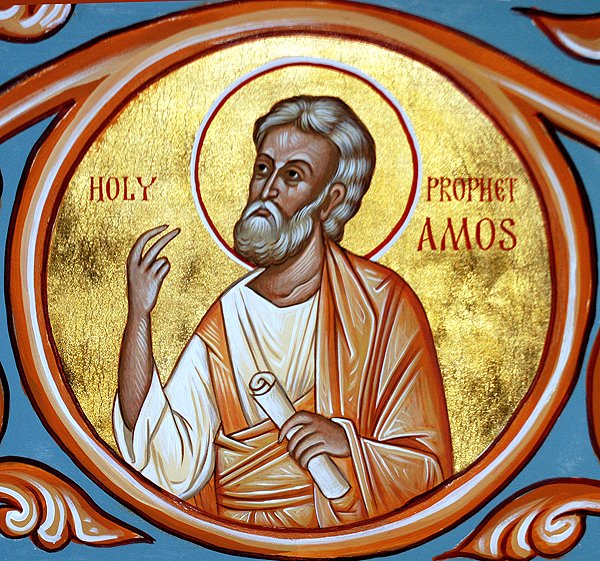
Prophet Amos
The Holy Prophet Amos, the third of the Twelve Minor Prophets, 1 lived during the eighth century before Christ. He was from Judah, and was born at Tekoah in the land of Zebulon, six miles south of Bethlehem.
At that time, the Hebrew nation was divided into two Kingdoms: Judah in the south, and Israel in the north.
The Holy Prophet Amos, the third of the Twelve Minor Prophets, 1 lived during the eighth century before Christ. He was from Judah, and was born at Tekoah in the land of Zebulon, six miles south of Bethlehem.
At that time, the Hebrew nation was divided into two Kingdoms: Judah in the south, and Israel in the north. King Uzziah ruled in Jerusalem, but the other ten tribes of Israel were ruled by Jeroboam II, who was an idolater. At Bethel he set up an idol in the shape of a golden calf, which the people worshipped, turning away from the true God.
Simple and uneducated, yet fervent in his faith and zealous for the glory of God, this former shepherd of sheep and goats, and dresser of sycamore trees (Amos 7:14-15) was chosen by the Lord for prophetic service. He was sent to the Kingdom of Israel to denounce King Jeroboam's impiety, as well as that of the Israelites. The Prophet predicted great misfortunes which would befall Israel because of its ungodliness. As a result of his denunciations, Amos repeatedly endured beatings and torture.
Amaziah, the chief priest of the royal sanctuary at Bethel, hated Amos, who predicted that the Gentiles would conquer Israel; that they will slay the King, as well as Amaziah's children; that Amaziah's wife would become a harlot; and that Amaziah himself would die in a pagan land, because he led the people into adultery with idols (7:17). Amaziah became furious and had Amos beaten, but all of these prophecies were fulfilled.
According to a later tradition, Uzziah, the son of Amaziah, struck the Prophet Amos with a club, seriously wounding him. He was taken to his native village of Tekoah in Judah, and died there after two days (circa 787 B.C.) He should not be confused with Amoz, the father of the Prophet Isaiah.
In iconography Amos is depicted as an old man with a pointed beard. His scroll reads: It is he who builds his ascent up to Heaven (Amos 9:6).
1 The terms major and minor Prophets refer to the length of their books, not to their individual prominence. Although Amos is ranked third, his prophecy was the first to be recorded.
Troparion - Tone 2
We celebrate the memory / of Your prophet Amos, O Lord; / through him we entreat You, / "Save our souls."
Kontakion - Tone 4
Having purified your heart spiritually, O glorious Prophet Amos, / you received the gift of prophecy from on high / and proclaimed to all: / “This is our God and beside Him there is no other.”
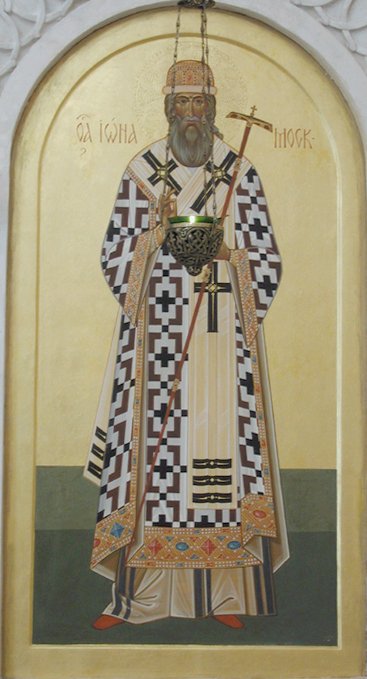
St Jonah, Metr. of Moscow
Saint Jonah, Metropolitan of Moscow and Wonderworker of All Russia, was born in the city of Galich into a pious Christian family. The father of the future saint was named Theodore. The youth received monastic tonsure in one of the Galich monasteries when he was only twelve years old. From there, he transferred to the Moscow Simonov monastery, where he fulfilled various obediences for many years.
Saint Jonah, Metropolitan of Moscow and Wonderworker of All Russia, was born in the city of Galich into a pious Christian family. The father of the future saint was named Theodore. The youth received monastic tonsure in one of the Galich monasteries when he was only twelve years old. From there, he transferred to the Moscow Simonov monastery, where he fulfilled various obediences for many years.
Once, Saint Photius, Metropolitan of Moscow (May 27 and July 2), visited the Simonov monastery. After the Molieben, he blessed the archimandrite and brethren, and also wished to bless those monks who were fulfilling their obediences in the monastery.
When he came to the bakery, he saw Saint Jonah sleeping, exhausted from his work. The fingers of the saint’s right hand were positioned in a gesture of blessing. Saint Photius said not to wake him. He blessed the sleeping monk and predicted to those present that this monk would be a great hierarch of the Russian Church, and would guide many on the way to salvation.
The prediction of Saint Photius was fulfilled. Several years later, Saint Jonah was made Bishop of Ryazan and Murom.
Saint Photius died in 1431. Five years after his death, Saint Jonah was chosen Metropolitan of All Russia for his virtuous and holy life. The newly-elected Metropolitan journeyed to Constantinople in order to be confirmed as Metropolitan by Patriarch Joseph II (1416-1439). Shortly before this the nefarious Isidore, a Bulgarian, had already been established as Metropolitan. Spending a short time at Kiev and Moscow, Isidore journeyed to the Council of Florence (1438), where he embraced Catholicism.
A Council of Russian hierarchs and clergy deposed Metropolitan Isidore, and he was compelled to flee secretly to Rome (where he died in 1462). Saint Jonah was unanimously chosen Metropolitan of All Russia. He was consecrated by Russian hierarchs in Moscow, with the blessing of Patriarch Gregory III (1445-1450) of Constantinople. This was the first time that Russian bishops consecrated their own Metropolitan. Saint Jonah became Metropolitan on December 15, 1448. With archpastoral zeal he led his flock to virtue and piety, spreading the Orthodox Faith by word and by deed. Despite his lofty position, he continued with his monastic struggles as before.
In 1451 the Tatars unexpectedly advanced on Moscow; they burned the surrounding area and prepared for an assault on the city. Metropolitan Jonah led a procession along the walls of the city, tearfully entreating God to save the city and the people. Seeing the dying monk Anthony of the Chudov monastery, who was noted for his virtuous life, Saint Jonah said, “My son and brother Anthony! Pray to the Merciful God and the All-Pure Mother of God for the deliverance of the city and for all Orthodox Christians.”
The humble Anthony replied, “Great hierarch! We give thanks to God and to His All-Pure Mother. She has heard your prayer and has prayed to Her Son. The city and all Orthodox Christians will be saved through your prayers. The enemy will soon take flight. The Lord has ordained that I alone am to be killed by the enemy.” Just as the Elder said this, an enemy arrow struck him.
The prediction of Elder Anthony was made on July 2, on the Feast of the Placing of the Robe of the Most Holy Theotokos. Confusion broke out among the Tatars, and they fled in fear and terror. In his courtyard, Saint Jonah built a church in honor of the Placing of the Robe of the Most Holy Theotokos, to commemorate the deliverance of Moscow from the enemy.
Saint Jonah reposed in the year 1461, and miraculous healings began to take place at his grave.
In 1472 the incorrupt relics of Metropolitan Jonah were uncovered and placed in the Dormition Cathedral of the Kremlin (the Transfer of the holy Relics is celebrated May 27). A Council of the Russian Church in 1547 established the commemoration of Saint Jonah, Metropolitan of Moscow. In 1596, Patriarch Job added Saint Jonah to the Synaxis of the Moscow Hierarchs (October 5).
Saint Jonah, Metropolitan of Moscow is also commemorated on March 31.
Troparion - Tone 4
Having dedicated your whole life to the Lord from your youth, / you were a paradigm of virtue in prayer, labor and fasting. / God, having seen your good intent, / raised you up as a high priest and shepherd of His Church. / Therefore, even after your repose, / your honorable body was preserved whole and incorrupt. / Hierarch Jonah, pray to Christ God that He may save our souls.
Kontakion - Tone 8
Since you served the Lord from your youth, O wise one, / and disciplined your body through fasting and vigil, / you were revealed to be a pure vessel and the dwelling place of the All-holy Spirit. / Thus, the Church established you to be a hierarch and shepherd, / and having tended it well, you departed to the Lord, whom you loved. / Therefore, we entreat you to remember us who honor your holy memory with faith, / so that we may cry to you: “Rejoice, Father Jonah, most honorable hierarch.”
Holy Prophet Amos (8th c. BC)
He was an unlearned shepherd from the village of Tekoa in Zabulon, near Bethlehem. His prophecies, made during the reign of King Uzziah, make up the Old Testament book which bears his name. He is ranked third among the “minor prophets” of the Old Testament.
Our Righteous Father Hieronymus
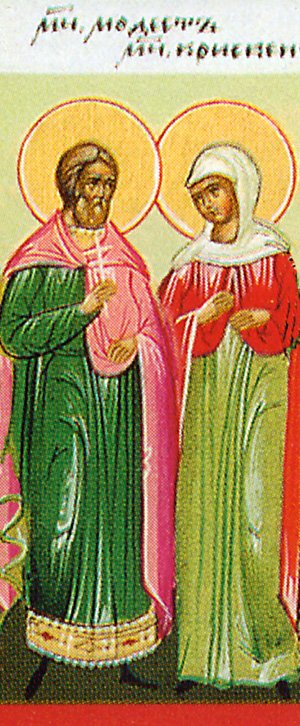
Holy Martyr Vitus, with Modestus and Crescentia (303)
Saint Crescentia suffered for Christ during the reign of Emperor Diocletian (284-305) with the holy martyrs Vitus and Modestus. She was the governess of Saint Vitus, and tried to save the boy when his father wanted to kill him because he would not abandon his faith in Christ.
Saint Crescentia and the boy’s tutor Saint Modestus, who were Christians, secretly took him from his parental home. T
Saint Crescentia suffered for Christ during the reign of Emperor Diocletian (284-305) with the holy martyrs Vitus and Modestus. She was the governess of Saint Vitus, and tried to save the boy when his father wanted to kill him because he would not abandon his faith in Christ.
Saint Crescentia and the boy’s tutor Saint Modestus, who were Christians, secretly took him from his parental home. They found a boat at the river, and an angel entered the boat with them. They reached the Italian district of Lucanium, where the saints lived quietly, hiding from those who would persecute them. The holy youth continued to heal the sick and convert pagans to Christianity. His fame soon spread throughout the region.
Saints Vitus and Modestus were arrested and thrown into prison, then Diocletian had them tortured. Saint Crescentia came out of the crowd of spectators and confessed herself a Christian. She reproached the emperor for his cruelty, and he also sentenced her to torture.
Saint Vitus called out to God, “O God, save us by Thy power and deliver us.” Then an earthquake struck, and many pagans perished beneath the collapsed buildings. Diocletian fled to his chambers in fear. An angel released the martyrs from the pillars and took them to Lucanium.
Saint Vitus prayed that God would accept their souls in peace and not deprive those who kept their memory of His benefaction. A Voice came from Heaven, “Thy prayer is heard.” Then the saints joyfully surrendered their souls to God.
Saint Crescentia is also commemorated on May 16.
Troparion - Tone 4
Your holy martyrs O Lord, / through their sufferings have received incorruptible crowns from You, our God. / For having Your strength, they laid low their adversaries, / and shattered the powerless boldness of demons. / Through their intercessions, save our souls!
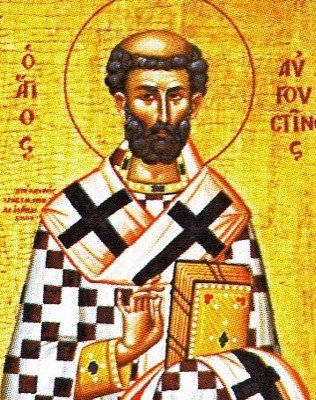
Blessed Augustine, bishop of Hippo (430), and his mother Monica (387)
Saint Augustine was born in the city of Thagaste in northern Africa. He was raised by his mother, Saint Monica (May 4), and he received his education at Carthage. In the capacity of professor of rhetoric, Augustine arrived at Milan, Italy where Saint Ambrose (December 7) was bishop. Under the guidance of Saint Ambrose, Augustine studied the Holy Scriptures.
Saint Augustine was born in the city of Thagaste in northern Africa. He was raised by his mother, Saint Monica (May 4), and he received his education at Carthage. In the capacity of professor of rhetoric, Augustine arrived at Milan, Italy where Saint Ambrose (December 7) was bishop. Under the guidance of Saint Ambrose, Augustine studied the Holy Scriptures. The Word of God produced in his soul a radical crisis; he accepted holy Baptism, gave all his wealth to the poor and was tonsured as a monk.
In the year 391 Valerian, Bishop of Hippo, ordained Saint Augustine a priest, and in 395, appointed him vicar bishop of the see of Hippo. After the death of Bishop Valerian, Saint Augustine took his place.
During his 35 years as bishop, Saint Augustine wrote many works devoted to combating the Donatist, Manichaean and Pelagian heresies.
Saint Augustine wrote many works (according to his student and biographer Possidias, the number approached 1030). Of his works the best known are: The City of God (De civitate Dei), The Confessions, 17 Books against the Pelagians and Handbook of Christian Knowledge (The Enchiridion). Saint Augustine was concerned above all else that his writings be intelligent and edifying. “It is better,” he said, “for them to condemn our grammar, than for people not to understand.” Saint Augustine died on August 28, 430.
The Orthodox Church commemorates Saint Augustine on June 15, while the West commemorates him on August 28.
The Saint's Holy Relics are located in the Roman Catholic church of Saint Peter Ciel D' Oro Pavia, Italy; and a piece of his relics is to be found in the Monastery of Saint Meletios of Oinoi Villion in Attica, Greece.
Troparion - Tone 4
Let us praise the great Augustine, / a divine Hierarch of Christ's Church and a wise guide; / a renowned theologian of the city on high,1 / a lover of prayer, and a pillar of repentance; / “Intercede with the Lord, that He may have mercy on our souls.”;1 A reference to his book The City of God.
Kontakion - Tone 2
Let us praise the great Augustine, / a divine Hierarch of Christ's Church and a wise guide; / a renowned theologian of the city on high,1 / a lover of prayer, and a pillar of repentance; / “Intercede with the Lord, that He may have mercy on our souls.”;
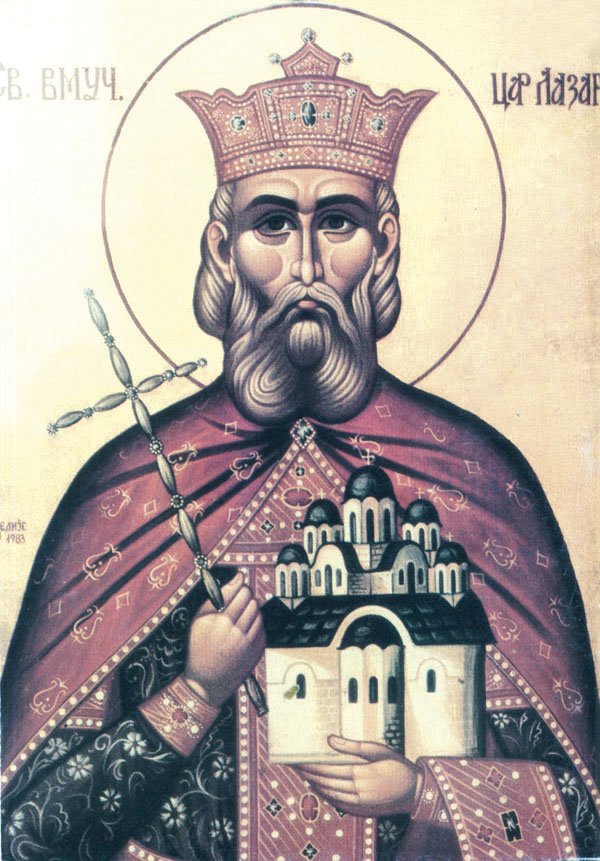
Holy Martyr Lazar, Prince of Serbia (1389)
The Holy Prince Lazar of Serbia lived during the fourteenth century at a time when the Turks, having conquered neighboring lands, were preparing to invade Serbia.
Saint Lazar was raised at the court of the holy King Dushan, and was appointed governor of one of the Serbian districts. In the year 1371 he was chosen King of all Serbia and he toiled much at strengthening the condition of the country.
The Holy Prince Lazar of Serbia lived during the fourteenth century at a time when the Turks, having conquered neighboring lands, were preparing to invade Serbia.
Saint Lazar was raised at the court of the holy King Dushan, and was appointed governor of one of the Serbian districts. In the year 1371 he was chosen King of all Serbia and he toiled much at strengthening the condition of the country. He pacified neighboring princes, who had wronged or plundered Serbian settlements. He was concerned also for the Christian enlightenment of the nation, he built churches, supported the monasteries and charitable establishments. In 1380 the saint established the monastery at Rovanetz. Saint Lazar petitioned the Patriarch of Constantinople to remove the anathema from the people of Serbia. During the course of the ten years of his rule, Serbia was at peace.
Afterwards there began war with the Turks. At the time of the Battle of Kosovo, the wounded king was taken prisoner. On the orders of Sultan Bayazet, he was beheaded with a sword on June 15, 1389. The body of the holy King Lazar was buried at a nearby church. In 1391 his incorrupt relics were transferred to the Ravanica monastery. The monastery was destroyed by the Turks in 1683, and the relics of King Lazar were transferred to the monastery of New Ravanica on Mount Thruzh. He was the founder of the Monastery of Saint Panteleimon on the Holy Mountain, as well as numerous other monasteries and churches.
Troparion - Tone 3
Longing for the beauty of God’s glory, / you were found pleasing to Him while yet in the flesh / and by good deeds multiplied the talents entrusted to you. / Having suffered greatly, even to the shedding of your blood, / you received the crown of martyrdom from Christ. / By your prayers, O Lazar, entreat Him to save us who sing to you.
Kontakion - Tone 8
Your flock glorifies you as a valiant champion of true piety / and a glorious martyr, O most wise Lazar. / Since you have boldness before Christ our God, entreat Him to grant peace to those who praise you, / that we may cry: “Rejoice, O praise-worthy Lazar!”
Scripture Readings
☩Epistle
Acts 21:26-32
26
Then Paul took the men, and the next day purifying himself with them entered into the temple, to signify the accomplishment of the days of purification, until that an offering should be offered for every one of them.
27
And when the seven days were almost ended, the Jews which were of Asia, when they saw him in the temple, stirred up all the people, and laid hands on him,
28
Crying out, Men of Israel, help: This is the man, that teacheth all men every where against the people, and the law, and this place: and further brought Greeks also into the temple, and hath polluted this holy place.
29
(For they had seen before with him in the city Trophimus an Ephesian, whom they supposed that Paul had brought into the temple.)
30
And all the city was moved, and the people ran together: and they took Paul, and drew him out of the temple: and forthwith the doors were shut.
31
And as they went about to kill him, tidings came unto the chief captain of the band, that all Jerusalem was in an uproar.
32
Who immediately took soldiers and centurions, and ran down unto them: and when they saw the chief captain and the soldiers, they left beating of Paul.
☩Gospel
John 16:2-13
2
They shall put you out of the synagogues: yea, the time cometh, that whosoever killeth you will think that he doeth God service.
3
And these things will they do unto you, because they have not known the Father, nor me.
4
But these things have I told you, that when the time shall come, ye may remember that I told you of them. And these things I said not unto you at the beginning, because I was with you.
5
But now I go my way to him that sent me; and none of you asketh me, Whither goest thou?
6
But because I have said these things unto you, sorrow hath filled your heart.
7
Nevertheless I tell you the truth; It is expedient for you that I go away: for if I go not away, the Comforter will not come unto you; but if I depart, I will send him unto you.
8
And when he is come, he will reprove the world of sin, and of righteousness, and of judgment:
9
Of sin, because they believe not on me;
10
Of righteousness, because I go to my Father, and ye see me no more;
11
Of judgment, because the prince of this world is judged.
12
I have yet many things to say unto you, but ye cannot bear them now.
13
Howbeit when he, the Spirit of truth, is come, he will guide you into all truth: for he shall not speak of himself; but whatsoever he shall hear, that shall he speak: and he will shew you things to come.
Liturgical data sourced from OCA.org and orthocal.info