
Fasting Rules
 Meat
Allowed
 Fish
Allowed
 Dairy
Allowed
 Oil
Allowed
 Wine
Allowed
Saints & Commemorations
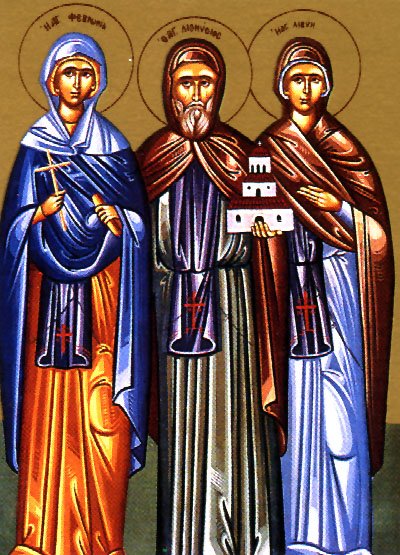
Virgin Martyr Febronia
The Virgin Martyr Febronia suffered during the reign of Diocletian (284-305). She was raised at a monastery in the city of Sivapolis (Assyria). The head of the women’s monastery was the abbess Bryaίnē, the aunt of Saint Febronia. Being concerned about her niece’s salvation, she assigned her a stricter form of life than the other nuns. Accor
The Virgin Martyr Febronia suffered during the reign of Diocletian (284-305). She was raised at a monastery in the city of Sivapolis (Assyria). The head of the women’s monastery was the abbess Bryaίnē, the aunt of Saint Febronia. Being concerned about her niece’s salvation, she assigned her a stricter form of life than the other nuns. According to their monastic rule, on Fridays the sisters put aside their other duties and spent the whole day in prayer and the reading of Holy Scripture. The abbess usually assigned the reading to Saint Febronia.
News of her pious life spread throughout the city. The illustrious young widow Hieria, a pagan, began to visit her, and under the influence of her guidance and prayer she accepted holy Baptism, bringing her parents and kinsfolk to the Christian Faith.
Diocletian sent a detachment of soldiers to Assyria under the command of Lysimachus, Selinus and Primus for the destruction of Christians. Selenos, the uncle of Lysimachus, was noted for his fierce attitude against Christians, but Lysimachus was of a different frame of mind from him, since his mother had sought to inspire love for the Christian faith in her son, and she had died a Christian. Lysimachus had discussed with his kinsman Primus how it would be possible to deliver Christians from the hands of the torturer. When the detachment of soldiers approached the convent, its inhabitants hid. There remained only the abbess Bryaίnē, her helper Thomais and Saint Febronia, who was seriously ill at the time.
It grieved the abbess terribly that her niece might fall into the hands of the torturers, who might defile her. She prayed fervently that the Lord would preserve her and strengthen her in the confession of Christ the Savior. Selinus gave orders to bring him all the nuns of the convent. Primus with the detachment of soldiers found no one, except the two old women and Saint Febronia. He regretted that they had not hidden, and he suggested to the nuns that they flee. But the nuns decided not to leave the place of their labors and they entrusted themselves to the will of the Lord.
Primus told Lysimachus about the particular beauty of Saint Febronia and advised him to take her for himself. Lysimachus said that he would not seduce a virgin dedicated to God, and he asked Primus to hide the other nuns somewhere so that they would not fall into the hands of Selinus. One of the soldiers overheard the conversation and told Selinus. They led Saint Febronia off to the military commander with her hands bound and a chain around her neck. Selinus urged her to deny Christ, promising her honors, rewards, and marriage with Lysimachus. The holy virgin firmly and fearlessly answered that she had an Immortal Bridegroom, and she would not exchange Him for any mortal man. Selinus subjected her to fierce torture. The saint prayed, “My Savior, do not abandon me in this terrible hour!”
They beat the martyr for a long time, and blood flowed from her wounds. In order to intensify the suffering of Saint Febronia, they tied her to a tree and set a fire under it. The tortures were so inhuman, that the people began to demand an end to the torture, since there was no confession of guilt by the girl. Selinus continued to mock and jeer at the martyr, but Saint Febronia became silent. Because of weakness she was unable to utter a word. In a rage Selinus gave orders to tear out her tongue, smash her teeth, and finally, to cut off both hands and feet. The people were unable to bear such a horrid spectacle and they left the scene of the torture, cursing Diocletian and his gods.
Among the crowd was the nun Thomais, who afterwards recorded Saint Febronia’s martyrdom in detail, and also her student Hieria. She came forth out of the crowd and in the hearing of all reproached Selinus for his boundless cruelty. He gave orders to arrest her, but learning that Hieria was of illustrious standing whom he could not readily subject to torture, he said, “By your speech you have brought on Febronia even greater torment.” Finally, they beheaded the holy Martyr Febronia.
Departing the place of execution, Lysimachus wept and withdrew to his quarters. Selinus made ready to eat, but he was not able to take food, and went off to the quiet of his own chambers. Suddenly, he became like one deranged. Looking up to the heavens, he raved and bellowed like a bull, then fell down and struck his head on a marble column and died. When Lysimachus learned of this, he said, “ Great is the God of the Christians, Who has avenged Febronia’s blood, so unrighteously shed!” He prepared a coffin, placed the martyr’s body in it, and took it to the convent.
Abbess Bryaίnē fell senseless, seeing the mutilated remains of Saint Febronia. Later, she recovered her senses and gave orders to open the convent gates so that all would be able to come and venerate the holy martyr and glorify God Who had given her such endurance in suffering for Christ. Lysimachus and Primus renounced their idol worship and accepted both Baptism and monasticism. Hieria gave her wealth to the convent and petitioned Abbess Bryaίnē to accept her at the convent in place of Saint Febronia.
Every year, on the day of the martyric death of Saint Febronia, a solemn feast was celebrated at the convent. During the time of the all-night Vigil the nuns always saw Saint Febronia, at her usual place in church. From the relics of Saint Febronia occurred numerous miracles and healings. The Life of Saint Febronia was recorded by the nun Thomais, an eyewitness to her deeds.
In the year 363 the relics of Saint Febronia were transferred to Constantinople.
Soon after the death of Saint Febronia, Saint James the Bishop of Nisibis (January 13) built a church and transferred into it a portion of the of the holy martyr’s relics.
Troparion - Tone 3
Like a fragrant rose in the ascetic life, / you breathed forth the myrrh of Christ. / Therefore he has glorified you as a righteous martyr, O Febronia. / Now intercede with him for those who cry: / “Rejoice, O noble and blessed martyr!”
Kontakion - Tone 3
Your lamb Febronia, calls out to You, O Jesus, in a loud voice: / “I love You, my Bridegroom, and in seeking You I endure suffering. / In baptism I was crucified so that I might reign in You, and I died so that I might live with You. / Accept me as a pure sacrifice, / for I have offered myself in love.” / Through her prayers save our souls, since You are merciful.
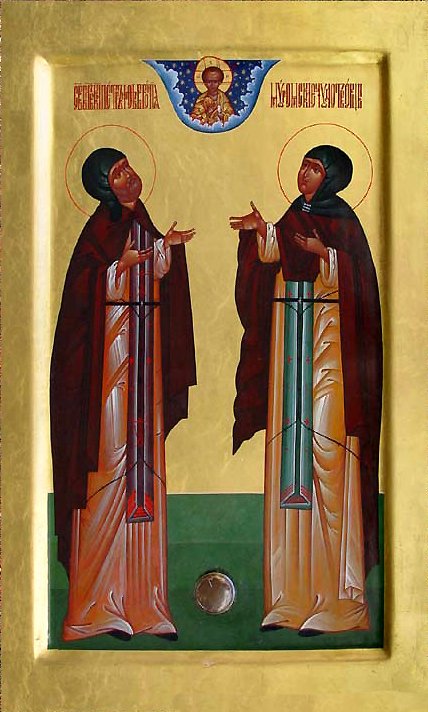
Peter and Fevronia of Murom
Holy Prince Peter (David in monasticism) and Holy Princess Febronia (Euphrosyne - Euphrosynē - in monasticism), Wonderworkers of Murom. Prince Peter was the second son of the Murom prince Yuri Vladimirovich. He entered upon the throne of Murom in the year 1203. Several years before this Saint Peter had fallen ill with leprosy, from which no one was able to heal him.
Holy Prince Peter (David in monasticism) and Holy Princess Febronia (Euphrosyne - Euphrosynē - in monasticism), Wonderworkers of Murom. Prince Peter was the second son of the Murom prince Yuri Vladimirovich. He entered upon the throne of Murom in the year 1203. Several years before this Saint Peter had fallen ill with leprosy, from which no one was able to heal him. In a vision it was revealed to the prince that the daughter of a bee-keeper would be able to heal him: the pious maiden Febronia, a peasant of Laskova village in Ryazan gubernia. Saint Peter sent his emissaries to this village.
When the prince saw Saint Febronia, he fell in love with her because of her piety, wisdom and virtue, and vowed to marry her after being healed. Saint Febronia healed the prince and became his wife. The holy couple loved each other through all their ordeals. The haughty boyars did not wish to have a princess of common origin, and they urged that the prince leave her. Saint Peter refused, and so they banished the couple. They sailed off on a boat from their native city along the River Oka, and Saint Febronia continued to console Saint Peter. Soon the wrath of God fell upon the city of Murom, and the people begged the prince return together with Saint Febronia.
The holy couple was famous for their piety and charity. They died on the same day and hour, June 25, 1228, having received the monastic tonsure with the names David and Evphrosyne. The bodies of the saints were put in the same grave.
Sts Peter and Febronia showed themselves exemplary models of Christian marriage, and are considered as the patron saints of newly-weds.
Troparion - Tone 8
You were a precious branch from a pious root O blessed Peter, having lived devoutly in the world, / and then with your wife, the most wise Febronia, you pleased God by your alms and prayers. / Therefore, you were found worthy of the monastic life. / Entreat the Lord to preserve our land from harm, so that unceasingly we may glorify you.
Kontakion - Tone 8
Regarding the princedom and the glory of this world as temporary, / you lived devoutly, O Peter, with your wife, the most wise Febronia, / giving alms and offering God-pleasing prayers. / Therefore, after death, you rest inseparably in one tomb, invisibly bestowing healings; / now entreat Christ to preserve the city and the people who glorify you.
Prokopios the New Martyr
Our Holy Father Dionysios, founder of the Monastery of St John the Forerunner on Mt Athos (1380)
He was born in Koritza in Albania. His elder brother Theodosius went to the Holy Mountain and in time became abbot of the monastery of Philotheou. A few years later Dionysios followed his brother and became a monk under him at Philotheou. A heavenly light began to appear to Dionysios every night at the same place, some distance from his monastery.
He was born in Koritza in Albania. His elder brother Theodosius went to the Holy Mountain and in time became abbot of the monastery of Philotheou. A few years later Dionysios followed his brother and became a monk under him at Philotheou. A heavenly light began to appear to Dionysios every night at the same place, some distance from his monastery. Believing that the light was a divine sign that he was to build a monastery, Dionysios left the Holy Mountain to seek the help of his brother (now Metropolitan of Trebizond) and the Emperor Alexios Comnenis. From the Emperor he received both money and a Royal Charter, which is still kept at the Monastery of St John the Forerunner, which Dionysios founded in 1380, and which is often referred to as the Dionysiou Monastery. Later, pirates plundered the monastery, and Dionysius went to Trebizond, where he reposed at the age of seventy-two.
Scripture Readings
☩Epistle
Romans 2:14-29
14
For when the Gentiles, which have not the law, do by nature the things contained in the law, these, having not the law, are a law unto themselves:
15
Which shew the work of the law written in their hearts, their conscience also bearing witness, and their thoughts the mean while accusing or else excusing one another;)
16
In the day when God shall judge the secrets of men by Jesus Christ according to my gospel.
17
Behold, thou art called a Jew, and restest in the law, and makest thy boast of God,
18
And knowest his will, and approvest the things that are more excellent, being instructed out of the law;
19
And art confident that thou thyself art a guide of the blind, a light of them which are in darkness,
20
An instructor of the foolish, a teacher of babes, which hast the form of knowledge and of the truth in the law.
21
Thou therefore which teachest another, teachest thou not thyself? thou that preachest a man should not steal, dost thou steal?
22
Thou that sayest a man should not commit adultery, dost thou commit adultery? thou that abhorrest idols, dost thou commit sacrilege?
23
Thou that makest thy boast of the law, through breaking the law dishonourest thou God?
24
For the name of God is blasphemed among the Gentiles through you, as it is written.
25
For circumcision verily profiteth, if thou keep the law: but if thou be a breaker of the law, thy circumcision is made uncircumcision.
26
Therefore if the uncircumcision keep the righteousness of the law, shall not his uncircumcision be counted for circumcision?
27
And shall not uncircumcision which is by nature, if it fulfil the law, judge thee, who by the letter and circumcision dost transgress the law?
28
For he is not a Jew, which is one outwardly; neither is that circumcision, which is outward in the flesh:
29
But he is a Jew, which is one inwardly; and circumcision is that of the heart, in the spirit, and not in the letter; whose praise is not of men, but of God.
☩Gospel
Matthew 5:33-41
33
Again, ye have heard that it hath been said by them of old time, Thou shalt not forswear thyself, but shalt perform unto the Lord thine oaths:
34
But I say unto you, Swear not at all; neither by heaven; for it is God’s throne:
35
Nor by the earth; for it is his footstool: neither by Jerusalem; for it is the city of the great King.
36
Neither shalt thou swear by thy head, because thou canst not make one hair white or black.
37
But let your communication be, Yea, yea; Nay, nay: for whatsoever is more than these cometh of evil.
38
Ye have heard that it hath been said, An eye for an eye, and a tooth for a tooth:
39
But I say unto you, That ye resist not evil: but whosoever shall smite thee on thy right cheek, turn to him the other also.
40
And if any man will sue thee at the law, and take away thy coat, let him have thy cloke also.
41
And whosoever shall compel thee to go a mile, go with him twain.
Liturgical data sourced from OCA.org and orthocal.info