
Fasting Rules
 Meat
Allowed
 Fish
Allowed
 Dairy
Allowed
 Oil
Allowed
 Wine
Allowed
Saints & Commemorations
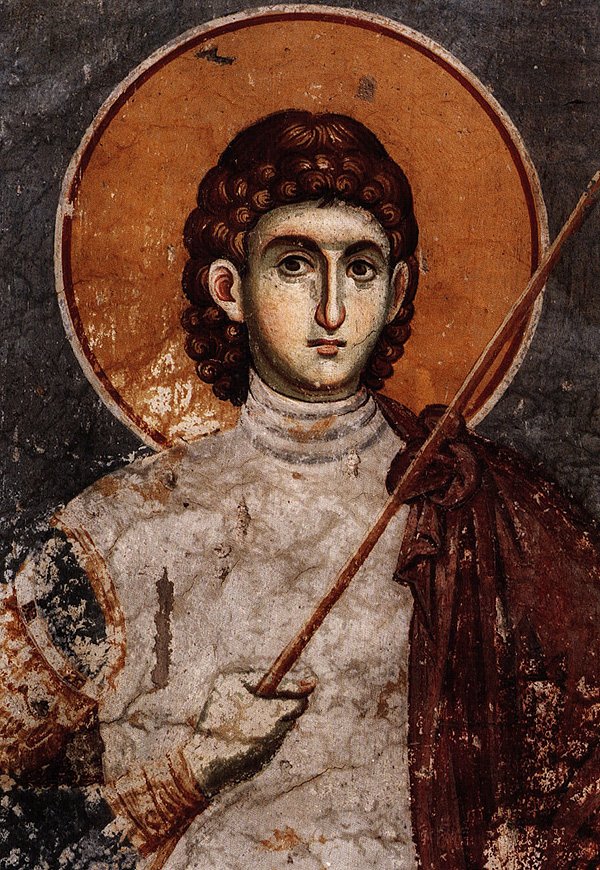
Great Martyr Procopius of Caesarea
The Holy Great Martyr Procopius, in the world Neanius, a native of Jerusalem, lived and suffered during the reign of the emperor Diocletian (284-305). His father, an eminent Roman by the name of Christopher, was a Christian, but the mother of the saint, Theodosia, remained a pagan. He was early deprived of his father, and the young child was raised by his mother.
The Holy Great Martyr Procopius, in the world Neanius, a native of Jerusalem, lived and suffered during the reign of the emperor Diocletian (284-305). His father, an eminent Roman by the name of Christopher, was a Christian, but the mother of the saint, Theodosia, remained a pagan. He was early deprived of his father, and the young child was raised by his mother. Having received an excellent secular education, he was introduced to Diocletian in the very first year of the emperor’s accession to the throne, and he quickly advanced in government service. Towards the year 303, when open persecution against Christians began, Neanius was sent as a proconsul to Alexandria with orders to mercilessly persecute the Church of God.
On the way to Egypt, near the Syrian city of Apamea, Neanius had a vision of the Lord Jesus, similar to the vision of Saul on the road to Damascus. A divine voice exclaimed, “Neanius, why do you persecute Me?”
Neanius asked, “Who are you, Lord?”
“I am the crucified Jesus, the Son of God.”
At that moment a radiant Cross appeared in the air. Neanius felt an inexpressible joy and spiritual happiness in his heart and he was transformed from being a persecutor into a zealous follower of Christ. From this point in time Neanius became favorably disposed towards Christians and fought victoriously against the barbarians.
The words of the Savior came true for the saint, “A man’s foes shall be those of his own household” (Mt. 10:36). His mother, a pagan herself, went to the emperor to complain that her son did not worship the ancestral gods. Neanius was summoned to the procurator Judaeus Justus, where he was solemnly handed the decree of Diocletian. Having read through the blasphemous directive, Neanius quietly tore it up before the eyes of everyone. This was a crime, which the Romans regarded as an “insult to authority.” Neanius was held under guard and in chains sent to Caesarea of Palestine, where the Apostle Paul once languished. After terrible torments, they threw the saint into a dark prison. That night, a light shone in the prison, and the Lord Jesus Christ Himself baptized the suffering confessor, and gave him the name Procopius.
Repeatedly they led Saint Procopius to the courtroom, demanding that he renounce Christ, and they subjected him to more tortures. The stolidity of the martyr and his fiery faith brought down God’s abundant grace on those who witnessed the execution.
Inspired by the example of Procopius, many of the holy martyr’s former guards and Roman soldiers went beneath the executioner’s sword together with their tribunes Nikostrates and Antiochus. Twelve Christian women received martyr’s crowns, after they came to the gates of the Caesarea Praetorium.
Struck by the great faith and courage of the Christians, and seeing the firmness of her son in bearing terrible sufferings, Theodosia became repentant and stood in the line of confessors and was executed. Finally the new procurator, Flavian, convinced of the futility of the tortures, sentenced the holy Great Martyr Procopius to beheading by the sword. By night Christians took up his much-tortured body, and with tears and prayers, they committed it to the earth. This was the first martyrdom at Caesarea (303).
Troparion - Tone 4
Your holy martyr Procopius, O Lord, / through his suffering has received an incorruptible crown from You, our God. / For having Your strength, he laid low his adversaries, / and shattered the powerless boldness of demons. / Through his intercessions save our souls!
Kontakion - Tone 2
Set ablaze by divine zeal for Christ and protected by the might of the Cross, / you cast down the insolence and boldness of the enemy, Procopius. / You exalted the honorable Church, / excelling in faith and giving light to us all!
Ven. Theophilus the Myrrhgusher of Macedonia
Saint Theophilus was from Ziki in Macedonia, and lived during the sixteenth century. He had a very good education, but more importantly he dedicated himself to God, purifying himself from every soul-destroying passion, and acquiring every virtue which filled him with the grace of the All-Holy Spirit.
Saint Theophilus was from Ziki in Macedonia, and lived during the sixteenth century. He had a very good education, but more importantly he dedicated himself to God, purifying himself from every soul-destroying passion, and acquiring every virtue which filled him with the grace of the All-Holy Spirit.
He travelled to Alexandria, at the request of Patriarch Niphon of Constantinople, in order to determine whether the stories about Patriarch Joachim being able to move mountains and to drink poison with no ill effects were true or not. After looking into the matter, he was able to verify that these stories were true.
After completing this work, Saint Theophilus went to struggle on the Holy Mountain, living first at Vatopedi, then at Ivḗron before settling at Saint Basil’s cell near Karyes. Although he did not seek the praise of men, the fame of the holy ascetic became known on Mount Athos, and in other places as well. His holy life and spiritual gifts could not be hidden, but were revealed by the Lord.
When the Archbishop of Thessalonica reposed, Saint Theophilus was nominated for this office. Out of humility, however, he declined to accept the position.
In 1548, as he felt the approach of death, Saint Theophilus told his disciple Isaac not to give him an honorable burial, but to tie a cord around his feet and drag him out of the monastery, and then to throw his body into a nearby stream.
When the saint fell asleep in the Lord on July 8, 1548, Isaac carried out the instructions of his Elder. Although he was reluctant to do this, he obeyed the saint just as he had always done when Saint Theophilus was alive.
By God’s will, the holy relics of Saint Theophilus were later found and brought to his cell. Then a fragrant myrrh began to flow from the saint’s incorrupt body, which was later enshrined at the Pantokrator Monastery.
Troparion - Tone 8
By a flood of tears you made the desert fertile, / and your longing for God brought forth fruits in abundance. / By the radiance of miracles you illumined the whole universe! / O our holy father Theophilus, pray to Christ our God to save our souls!
Appearance of the "Kazan" icon of the Most Holy Theotokos (1579)
The Kazan-Yaroslavl Icon of the Most Holy Theotokos was found in the year 1588 by a man named Gerasimos, who had traveled to Kazan to pray before its famous Icon, because his right hand had become crippled. The Mother of God appeared to him and ordered him to go to a certain place, and then to take her Icon and bring it to the city of Romanov and place it in a church.
The Kazan-Yaroslavl Icon of the Most Holy Theotokos was found in the year 1588 by a man named Gerasimos, who had traveled to Kazan to pray before its famous Icon, because his right hand had become crippled. The Mother of God appeared to him and ordered him to go to a certain place, and then to take her Icon and bring it to the city of Romanov and place it in a church. After the man had followed these directives to the letter, his hand was healed.
The holy Kazan Icon remained at Romanov for twenty-one years, but on March 9,1609 the city was taken by the Polish-Lithuanian forces. A Lithuanian officer stole the Icon from the Kazan cathedral in Romanov. When it was learned that the holy Icon had been found in the officer's home, the citizens of Yaroslavl begged him to let their city have it. He said he would give it to them if they paid him a considerable sum of money. For a long time the officer rejected their offers, but then suddenly, on March 18, he brought it to one of Yaroslav's most honorable citizens - Basil Lytkin. The Icon was solemnly transferred to the country parish church of the "Laudation of the Virgin” Icon (Fifth Saturday of Great Lent). When the Polish-Lithuanian troops attacked Tver that year the holy Icon was taken into the city to the church of the Nativity of the Lord on the banks of the Volga. Then the Mother of God appeared twice to Deacon Eleazar, commanding him to build a new church to house the Icon.
The people of Yaroslavl placed the wonderworking Kazan Icon in that church, and many miracles occurred. They also worked most energetically to build a women's monastery for seventy-two sisters whose own monastery had been destroyed by the Polish-Lithuanian army.
In 1610, the residents of Romanov begged Tsar Basil IV Shuisky to allow the Icon to be taken from Yaroslavl and returned to Romanov. Then new healings took place before the Icon that same day. The nun Anysia, who was unable to move her hands or feet recovered, and a man named Constantine was delivered from his madness. In view of these miracles, the citizens of Yaroslavl, in their turn, asked the Tsar to let the Icon remain at Yaroslavl. From Moscow there came a request for detailed information about the Icon, and the Tsar decided that the Icon would remain at Yaroslavl. However, the people of Yaroslavl were ordered to make an exact copy of the Icon, and to adorn it with an oklad (metal cover), just like the one on the wonderworking Icon, and then send the copy to Romanov. All this was done. In 1611, the copy was taken to Romanov and it was placed in the Kazan church, where the wonderworking Icon had once stood. Every year the original wonderworking Icon was brought to the city of Romanov with great ceremony.
Troparion - Tone 4
O fervent intercessor, Mother of the Lord Most High, / you pray to your Son, Christ our God for all, and save all those who have recourse to your powerful protection. / Defend us, O Lady, Queen, and Sovereign Lady, / when we who are burdened with many sins, stand before you in misfortune, sorrow, and sickness, / praying to you with tender souls and a contrite heart, / shedding tears before this, your most pure Icon, and having steadfast hope in you who deliver us from all evils. / Grant us what is profitable for our souls and save all, O Virgin Theotokos, / for you are the Divine protection of your God-fearing servants.
Kontakion - Tone 8
Let us run to the quiet and good refuge, / and to the speedy helper, ardent and eager to save all. / Let us run to the Virgin’s protection and hasten to repentance; / for the Most Pure Theotokos grants us unfailing mercy as she comes to help all, / delivering her devout and God-fearing servants from great troubles and evils.
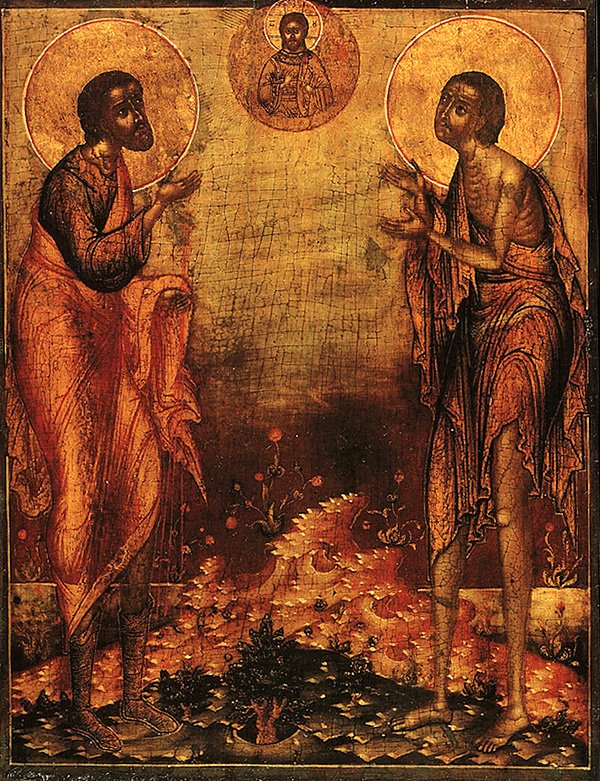
St Procopius, Fool for Christ (1303)
The incorrupt relics of Saint Procopius were uncovered during the eighteenth century near the Entry of the Theotokos parish church in Ustya (Vologda diocese) and placed in the church, where for two hundred years they remained in open view, a source of numerous healings. No account of the origin and life of the holy saint of God has been preserved.
The incorrupt relics of Saint Procopius were uncovered during the eighteenth century near the Entry of the Theotokos parish church in Ustya (Vologda diocese) and placed in the church, where for two hundred years they remained in open view, a source of numerous healings. No account of the origin and life of the holy saint of God has been preserved. His name became known when he himself revealed it in a vision to a pious local inhabitant named Savela.
In connection with an increase in the number of miraculous healings, the relics of Saint Procopius were examined in 1696 (or 1645) and in 1739. After this a chapel in honor of the saint was consecrated in the church where his relics rest. His icon was painted, and a service to him was composed.
In 1818 the universal celebration of the saint was established.
Scripture Readings
☩Epistle
Romans 8:22-27
22
For we know that the whole creation groaneth and travaileth in pain together until now.
23
And not only they, but ourselves also, which have the firstfruits of the Spirit, even we ourselves groan within ourselves, waiting for the adoption, to wit, the redemption of our body.
24
For we are saved by hope: but hope that is seen is not hope: for what a man seeth, why doth he yet hope for?
25
But if we hope for that we see not, then do we with patience wait for it.
26
Likewise the Spirit also helpeth our infirmities: for we know not what we should pray for as we ought: but the Spirit itself maketh intercession for us with groanings which cannot be uttered.
27
And he that searcheth the hearts knoweth what is the mind of the Spirit, because he maketh intercession for the saints according to the will of God.
☩Gospel
Matthew 10:23-31
23
But when they persecute you in this city, flee ye into another: for verily I say unto you, Ye shall not have gone over the cities of Israel, till the Son of man be come.
24
The disciple is not above his master, nor the servant above his lord.
25
It is enough for the disciple that he be as his master, and the servant as his lord. If they have called the master of the house Beelzebub, how much more shall they call them of his household?
26
Fear them not therefore: for there is nothing covered, that shall not be revealed; and hid, that shall not be known.
27
What I tell you in darkness, that speak ye in light: and what ye hear in the ear, that preach ye upon the housetops.
28
And fear not them which kill the body, but are not able to kill the soul: but rather fear him which is able to destroy both soul and body in hell.
29
Are not two sparrows sold for a farthing? and one of them shall not fall on the ground without your Father.
30
But the very hairs of your head are all numbered.
31
Fear ye not therefore, ye are of more value than many sparrows.
Liturgical data sourced from OCA.org and orthocal.info