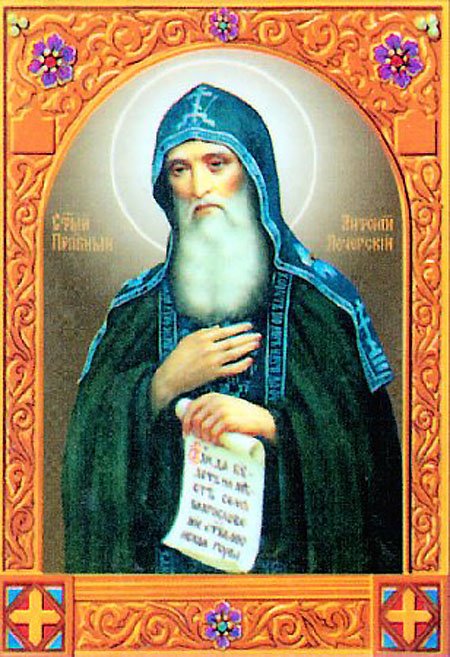
Saint Anthony of the Kiev Caves was born in the year 983 at Liubech, not far from Chernigov, and was named Antipas in Baptism. Possessing the fear of God from his youth, he desired to be clothed in the monastic schema. When he reached a mature age, he wandered until he arrived on Mt. Athos, burning with the desire to emulate the deeds of its holy inhabitants.
Saint Anthony of the Kiev Caves was born in the year 983 at Liubech, not far from Chernigov, and was named Antipas in Baptism. Possessing the fear of God from his youth, he desired to be clothed in the monastic schema. When he reached a mature age, he wandered until he arrived on Mt. Athos, burning with the desire to emulate the deeds of its holy inhabitants. Here he received monastic tonsure, and the young monk pleased God in every aspect of his spiritual struggles on the path of virtue. He particularly excelled in humility and obedience, so that all the monks rejoiced to see his holy life.
The igumen saw in Saint Anthony the great future ascetic, and inspired by God, he sent him back to his native land, saying, “Anthony, it is time for you to guide others in holiness. Return to your own Russian land, and be an example for others. May the blessing of the Holy Mountain be with you.”
Returning to the land of Rus, Anthony began to make the rounds of the monasteries about Kiev, but nowhere did he find that strict life which had drawn him to Mt. Athos.
Through the Providence of God, Anthony came to the hills of Kiev by the banks of the River Dnieper. The forested area near the village of Berestovo reminded him of his beloved Athos. There he found a cave which had been dug out by the Priest Hilarion, who later became Metropolitan of Kiev (October 21). Since he liked the spot, Anthony prayed with tears, “Lord, let the blessing of Mt. Athos be upon this spot, and strengthen me to remain here.” He began to struggle in prayer, fasting, vigil and physical labor. Every other day, or every third day, he would eat only dry bread and a little water. Sometimes he did not eat for a week. People began to come to the ascetic for his blessing and counsel, and some decided to remain with the saint.
Among Anthony’s first disciples was Saint Nikon (March 23), who tonsured Saint Theodosius of the Caves (May 3) at the monastery in the year 1032.
The virtuous life of Saint Anthony illumined the Russian land with the beauty of monasticism. Saint Anthony lovingly received those who yearned for the monastic life. After instructing them how to follow Christ, he asked Saint Nikon to tonsure them. When twelve disciples had gathered about Saint Anthony, the brethren dug a large cave and built a church and cells for the monks within it.
After he appointed Abbot Barlaam to guide the brethren, Saint Anthony withdrew from the monastery. He dug a new cave for himself, then hid himself within it. There too, monks began to settle around him. Afterwards, the saint built a small wooden church in honor of the Dormition of the Mother of God over the Far Caves.
At the insistence of Prince Izyaslav, the igumen Barlaam withdrew to the Dimitriev monastery. With the blessing of Saint Anthony and with the general agreement of the brethren, the meek and humble Theodosius was chosen as igumen. By this time, the number of brethren had already reached a hundred men. The Kiev Great Prince Izyaslav (+ 1078) gave the monks the hill on which the large church and cells were built, with a palisade all around. Thus, the renowned monastery over the caves was established. Describing this, the chronicler remarks that while many monasteries were built by emperors and nobles, they could not compare with those which are built with holy prayers and tears, and by fasting and vigil. Although Saint Anthony had no gold, he built a monastery which became the first spiritual center of Rus.
For his holiness of life, God glorified Saint Anthony with the gift of clairvoyance and wonderworking. One example of this occurred during the construction of the Great Caves church. The Most Holy Theotokos Herself stood before him and Saint Theodosius in the Blachernae church in Constantinople, where they had been miraculously transported without leaving their own monastery. Actually, two angels appeared in Constantinople in their forms (See May 3, the account of the Kiev Caves Icon of the Most Holy Theotokos). Having received gold from the Mother of God, the saints commissioned master architects, who came from Constantinople to the Russian land on the command of the Queen of Heaven to build the church at the Monastery of the Caves. During this appearance, the Mother of God foretold the impending death of Saint Anthony, which occurred on July 10, 1073.
Through Divine Providence, the relics of Saint Anthony remain hidden.
Troparion - Tone 4
Having departed from worldly tumults, / in leaving the world you followed Christ according to the Gospel. / You reached the quiet refuge of the Holy Mount Athos, / living there a life equal to the angels. / Therefore, with the blessing of the Fathers, / you came to the Kievan hills. / There having fulfilled a life loving of labors, / you illumined your homeland. / And having shown a multitude of monastics / the pathway leading to the heavenly kingdom, / you led them to Christ. / Beseech him, O Venerable Anthony, / that he may save our souls!
Kontakion - Tone 8
From your youth you gave yourself to God whom you loved above all, O Venerable One; / and in love you followed after him with your whole soul. / Scorning the passing corruption of the world, you made a cave in the earth; / and in it you struggled nobly facing the snares of the invisible enemy, / while illumining the ends of the earth like a bright, shining sun. / Therefore, with rejoicing you entered into the heavenly chambers. / Standing now before the throne of the Master together with the angels, / remember us who honor your holy memory, / that we may cry out to you: Rejoice, Anthony our Holy Father!
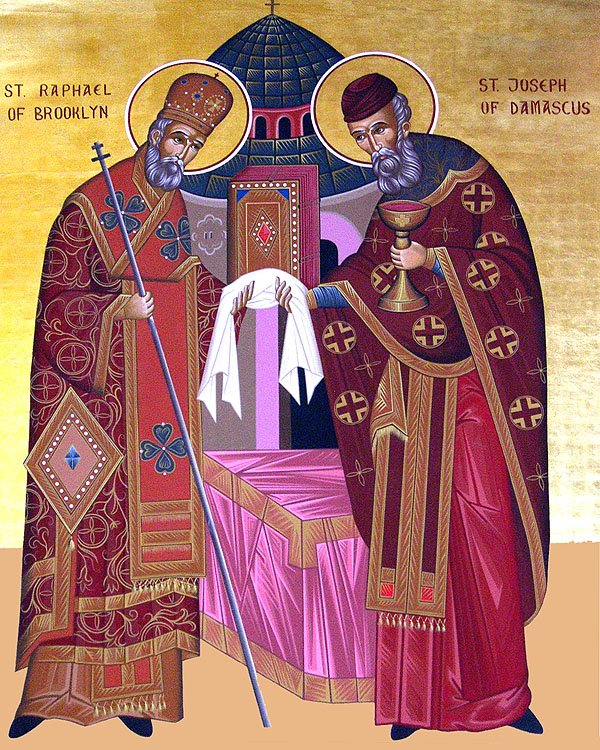
Hieromartyr Joseph of Damascus & His Companions
No information available at this time.
Troparion - Tone 5
O faithful, let us honor the martyr of Christ, / the priest of the Church of Antioch, / who baptized the land, the churches, and the people of Syria, / in the word of the Lord, / in his blood and in the blood of his companions. / Being baptized, since his youth, by the light of the Gospel, / he labored, taught and kept the Church of Christ with her sheep. / Therefore, O Joseph the Damascene, / be our example and our protector / and our fervent intercessor with the Savior.
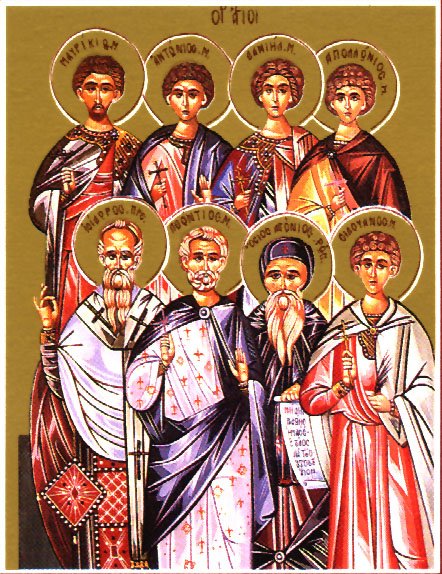
Holy 45 Martyrs of Nikopolis in Armenia (319)
The Forty-five Martyrs of Nicopolis in Armenia suffered during the reign of Emperor Licinius (311-324), who was then co-regent with Saint Constantine the Great (May 21). Licinius, the ruler of the Eastern Empire, fiercely persecuted Christians and issued an edict to put to death any Christian who would not return to paganism.
The Forty-five Martyrs of Nicopolis in Armenia suffered during the reign of Emperor Licinius (311-324), who was then co-regent with Saint Constantine the Great (May 21). Licinius, the ruler of the Eastern Empire, fiercely persecuted Christians and issued an edict to put to death any Christian who would not return to paganism. When the persecutions began at Nicopolis, more than forty of those being persecuted for Christ decided to appear voluntarily before their persecutors, to confess openly their faith in the Son of God, and to accept martyrdom. The holy confessors were headed by Leontius, Mauricius, Daniel, Anthony, Alexander, Sisinius, Meneus, and Belerad (Virilad), and they were distinguished by their virtuous life.
Lycias, the procurator of the Armenian district, before whom the holy confessors presented themselves, was amazed at the boldness and bravery of those who condemned themselves voluntarily to torture and death. He tried to persuade them to renounce Christ and offer sacrifice to the pagan gods, but the saints remained steadfast. They refuted all the ruler’s arguments, pointing out to him the falseness of their vile and vice-filled pagan gods, leading those who worship them to ruin. The procurator ordered the confessors to be beaten about the face with stones, and then to be shackled and imprisoned.
In the prison the saints rejoiced and sang the Psalms of David. Saint Leontius inspired and encouraged the brethren, preparing them to accept new tortures for the true Faith, and telling them of the bravery of all those who had suffered previously for Christ. In the morning, after repeated refusals to offer sacrifice to the idols, the saints were subjected to further tortures.
Saint Leontius, seeing the intense suffering of the martyrs, and fearful that some of them might falter and lose faith, prayed to God that these torments would end quickly for all of them.
When the holy martyrs were singing Psalms at midnight, an Angel of the Lord suddenly appeared to them, and the prison blazed with light. The Angel declared to the martyrs that their contest was coming to an end, and their names already were inscribed in Heaven. Two of the prison guards, Meneus and Virilad, saw what was happening and believed in Christ.
On the following morning, Lysias decided to ask them if they had changed their minds and were willing to worship the idols. With one mouth, the Saints replied: “We are Christians! We are Christians!” Insane with rage, Lysias ordered that their hands and feet be cut off, and then threw them into the fire. After this, their bones were tossed into a river. Later on, when freedom had been given to the Church of Christ, a church was built on the spot and was dedicated to the 45 Holy Martyrs of Nikopolis.
Troparion - Tone 4
You were chosen from on high as a holy army, / O Forty-five Martyrs of Christ, / lawfully contesting for the glory of Christ, / and by your struggles you freed us from the delusion of polytheism. / Because of these struggles, we glorify all of you.
Kontakion - Tone 8
Your holy martyrs, O Lord, / through their suffering have received incorruptible crowns from You, our God. / For having Your strength, they laid low their adversaries, / and shattered the powerless boldness of demons. / Through their intercessions save our souls!
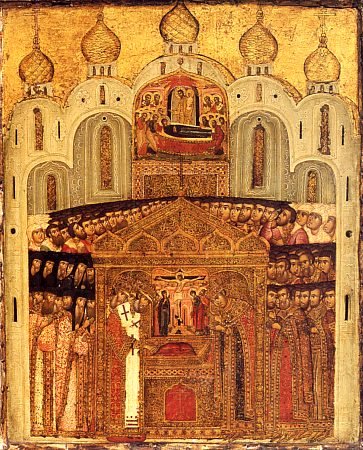
The Placing of the Precious Robe of the Lord in Moscow (1625)
The Placing of the Precious Robe of Our Lord Jesus Christ at Moscow (1625): The Savior’s precious Robe [ Greek “himatia”, literally “over-garments”] is not identically the same thing as His seamless coat [Greek “khiton”, literally “under-garb tunic”]. They are clearly distinct within Holy Scripture. “Then the soldier
The Placing of the Precious Robe of Our Lord Jesus Christ at Moscow (1625): The Savior’s precious Robe [ Greek “himatia”, literally “over-garments”] is not identically the same thing as His seamless coat [Greek “khiton”, literally “under-garb tunic”]. They are clearly distinct within Holy Scripture. “Then the soldiers, when they had crucified Jesus, took His garments (ta himatia) and divided them into four parts, to every soldier a part, and the coat (kai ton khitona). Now the coat was without seam, woven whole from the top down. Therefore, they said among themselves, let us not tear it, but cast lots for it, whose it will become. Thus the saying in Scripture was fulfilled: they divided My raiment (ta imatia) among them, and upon My vesture (epi ton himatismon) did they cast lots” (John. 19: 23-24; Ps. 21 [22]: 18-19).
According to the tradition of the Georgian Orthodox Church, the Chiton of the Lord was carried by the Hebrew rabbi Elioz from Jerusalem to Mtsket and at present is beneath a crypt in the foundations of the Mtsket Patriarchal cathedral of Svetitskhoveli (the Feast in honor of the Chiton of the Lord is celebrated on October 1). None of the Mohammedan invaders ever ventured to encroach upon this spot, glorified with a sign by the mercy of God, the Life-Creating Pillar.
The Robe of the Lord, actually one of its four parts, the lower portion specifically (other parts of the Robe of the Lord are also known in Western Europe: in the city of Trier in Germany, and in Argenteuil near Paris in France), just like the Chiton of the Lord, came to be in Georgia. In contrast to the Chiton, the Robe portion was not kept underground, but was in the treasury of the Svetitskhoveli cathedral right up to the seventeenth century. Then the Persian Shah Abbas I, in devastating Georgia, along with other treasures also carried off the Robe of the Lord. In order to ingratiate himself with Tsar Michael Feodorovich, the Shah sent the Robe of the Lord as a gift to Patriarch Philaret (1619-1633) and Tsar Michael in 1625. The authenticity of the Robe was attested by Nectarius, Archbishop of Vologda, also by Patriarch Theophanes of Jerusalem, who had come from Byzantium, and by Joannicius the Greek, but especially also by the miraculous signs worked by the Lord through the venerable relic.
Afterwards two parts of the Robe came to be in Peterburg: one in the cathedral at the Winter Palace, and the other in Saints Peter and Paul cathedral. A portion of the Robe was also preserved at the Dormition cathedral in Moscow, and small portions at Kiev’s Sophia cathedral, at the Ipatiev monastery near Kostroma and at certain other old temples. At Moscow annually on July 10 the Robe of the Lord is solemnly brought out of a chapel named for the holy Apostles Peter and Paul at the Dormition cathedral, and it is placed on a stand for veneration during the time of divine services. After Liturgy they carry the Robe to its former place.
On this day a service to the Life-Creating Cross of the Lord is proper, since the Placing of the Robe in the Dormition cathedral in 1625 took place on March 29, which happened to be the Sunday of the Veneration of the Cross during the Great Fast.
Troparion - Tone 4
Today, let us the faithful resort to the divine and healing Robe of the Savior, our God, / Who was pleased to wear it on His body and to pour out His holy Blood on the Cross, / with which He redeemed us from slavery to the Enemy. / Therefore, with gratitude we cry out to Him: / “By Your sacred Robe, protect our land, our Hierarchs, our city, and all the people; / and as the lover of mankind, / save our souls.”
Kontakion - Tone 4
O Master, You bestowed Your sacred Robe as a divine treasure, / and as a garment of incorruption, healing, and salvation for all people. / For in it You were pleased to clothe the holy and Life-giving flesh of Your Incarnation. / Receiving it with zeal, we solemnly celebrate, / and with fear and love, we sing to our Benefactor, crying out to You, O Christ: / “Preserve all Orthodox Christians, their Hierarchs, and all people in peace, / according to Your great mercy.”
Scripture Readings
☩Epistle
Romans 3:28-4:3
28
Therefore we conclude that a man is justified by faith without the deeds of the law.
29
Is he the God of the Jews only? is he not also of the Gentiles? Yes, of the Gentiles also:
30
Seeing it is one God, which shall justify the circumcision by faith, and uncircumcision through faith.
31
Do we then make void the law through faith? God forbid: yea, we establish the law.
1
What shall we say then that Abraham our father, as pertaining to the flesh, hath found?
2
For if Abraham were justified by works, he hath whereof to glory; but not before God.
3
For what saith the scripture? Abraham believed God, and it was counted unto him for righteousness.
☩Gospel
Matthew 7:24-8:4
24
Therefore whosoever heareth these sayings of mine, and doeth them, I will liken him unto a wise man, which built his house upon a rock:
25
And the rain descended, and the floods came, and the winds blew, and beat upon that house; and it fell not: for it was founded upon a rock.
26
And every one that heareth these sayings of mine, and doeth them not, shall be likened unto a foolish man, which built his house upon the sand:
27
And the rain descended, and the floods came, and the winds blew, and beat upon that house; and it fell: and great was the fall of it.
28
And it came to pass, when Jesus had ended these sayings, the people were astonished at his doctrine:
29
For he taught them as one having authority, and not as the scribes.
1
When he was come down from the mountain, great multitudes followed him.
2
And, behold, there came a leper and worshipped him, saying, Lord, if thou wilt, thou canst make me clean.
3
And Jesus put forth his hand, and touched him, saying, I will; be thou clean. And immediately his leprosy was cleansed.
4
And Jesus saith unto him, See thou tell no man; but go thy way, shew thyself to the priest, and offer the gift that Moses commanded, for a testimony unto them.

 Meat
Allowed
 Fish
Allowed
 Dairy
Allowed
 Oil
Allowed
 Wine
Allowed