
Fasting Rules
 Meat
Abstain
 Fish
Abstain
 Dairy
Abstain
 Oil
Abstain
 Wine
Abstain
Saints & Commemorations
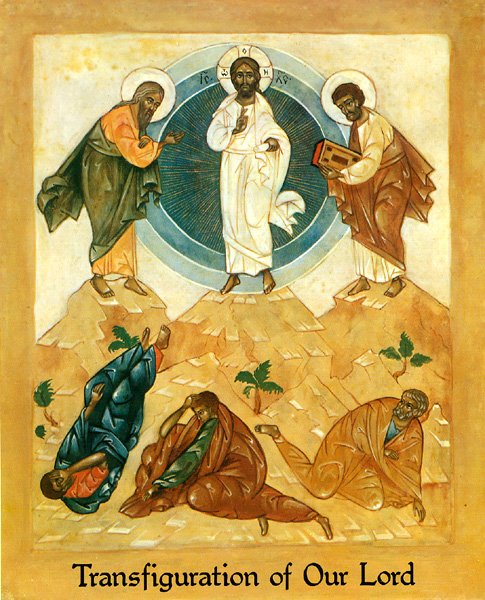
Forefeast of Transfiguration
The Lord had begun warning his disciples about the dangers they would face, and also about His Passion and death. He also told them that they would be persecuted by pagans and enemies of the Gospel. He explained that these things pertain to the present life, but what is essential is eternal life. Desiring to give His disciples a foretaste of eternal life, he took three of them, Peter, James and John, and brought them up to Mount Tabor.
The Lord had begun warning his disciples about the dangers they would face, and also about His Passion and death. He also told them that they would be persecuted by pagans and enemies of the Gospel. He explained that these things pertain to the present life, but what is essential is eternal life. Desiring to give His disciples a foretaste of eternal life, he took three of them, Peter, James and John, and brought them up to Mount Tabor.
There He was transfigured before them and His face shone like light. Moses and Elias appeared and spoke with Jesus. The Lord took only those disciples because they were more pre-eminent than the others. Peter was chosen because he loved Christ very much, John because he also loved Christ, and James because he was able to drink the cup that Christ drank (Matthew 20:23). The Lord showed them Moses and
Elias in order to correct their erroneous ideas of who He was, as though He were Saint John the Baptist, or some great prophet. That is why He revealed His glory to them ‘as far as they could bear it.’ All this took place during the Transfiguration of our Lord Jesus Christ on Mount Tabor.
Troparion - Tone 4
Come, you faithful, let us meet the Transfiguration of Christ in advance, / and celebrating the prefeast, let us cry aloud, / “Now the day of divine gladness is at hand; / the Master ascends Mount Tabor / to flash forth with the beauty of His divinity.”
Kontakion - Tone 4
Now, beforehand, all of mortal nature divinely shines today / with the divine Transfiguration; / and in gladness she cries out: “Christ is
transfigured, saving all.”
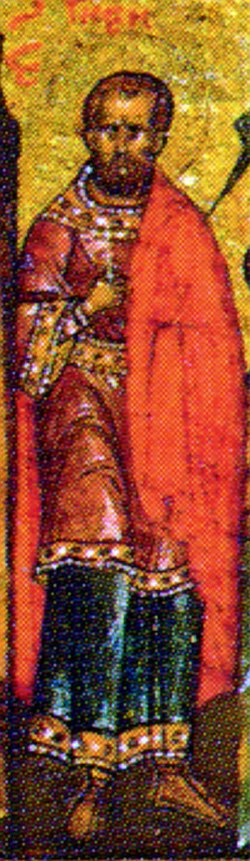
Martyr Eusignius of Antioch
The Martyr Eusignius was born at Antioch in the mid-third century. For sixty years he served in the Roman armies of the emperors Diocletian, Maximian Hercules, Constantius Chlorus, Constantine the Great and his sons. Saint Eusignius was a companion of Saint Basiliscus (March 3 and May 22), and he provided an account of his martyrdom.
The Martyr Eusignius was born at Antioch in the mid-third century. For sixty years he served in the Roman armies of the emperors Diocletian, Maximian Hercules, Constantius Chlorus, Constantine the Great and his sons. Saint Eusignius was a companion of Saint Basiliscus (March 3 and May 22), and he provided an account of his martyrdom. At the beginning of the reign of Saint Constantine the Great, Saint Eusignius was a witness to the appearance of the Cross in the sky, a prediction of victory.
Saint Eusignius retired in his old age from military service and returned to his own country. There he spent his time in prayer, fasting, and attending the church of God. So he lived until the reign of Julian the Apostate (361-363), who yearned for a return to paganism. Through the denunciation of one of the Antiochian citizens, Saint Eusignius stood trial as a Christian before the emperor Julian in the year 362. He fearlessly accused the emperor of apostasy from Christ, and reproached him with the example of his relative, Constantine the Great, and he described in detail how he himself had been an eyewitness to the appearance of the sign of the Cross in the sky. Julian did not spare the aged Saint Eusignius, then 110 years old, but ordered him beheaded.
Troparion - Tone 8
Today the Church honors a man martyred for his piety and devotion: / The sincere and Godly-minded Eusignius the Wise. / She glorifies his spiritual struggles, and cries out fervently: / O Most Merciful One, guard Your servants through his intercessions!
Kontakion - Tone 2
You appeared as a bright star announcing Christ with your radiance, / which is repulsive to this world, O Martyr Eusignius; / extinguishing the allure of false gods, / you enlighten the faithful, / always interceding for us all.
Christos the New Martyr of Prevezis
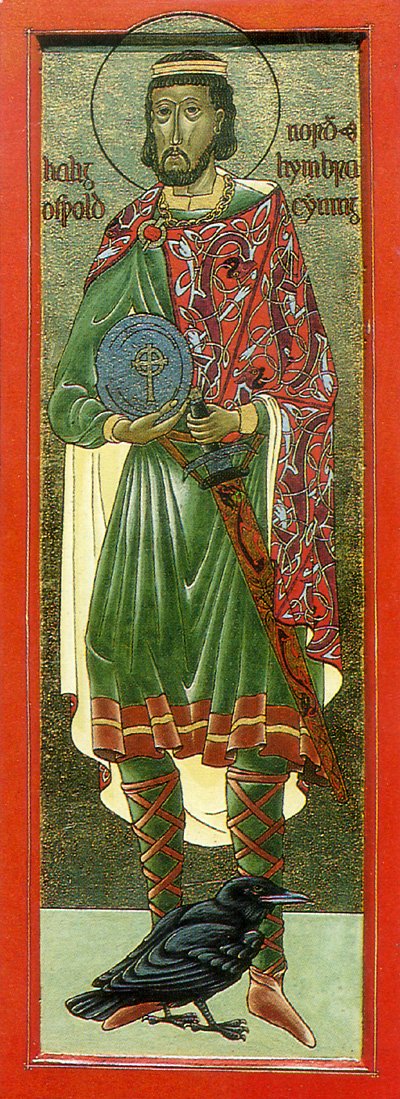
Oswald the Martyr, King of Northumbria
Saint Oswald was born around 605, the second of the seven sons of the Anglo-Saxon king Aethelfrith, who was the first ruler to unite the provinces of Bernicia and Deira into the kingdom of Northumbria.
King Edwin of Deira refused to accept the Bernician control of both provinces, so he attempted a coup while Aethelfrith was away in the north.
Saint Oswald was born around 605, the second of the seven sons of the Anglo-Saxon king Aethelfrith, who was the first ruler to unite the provinces of Bernicia and Deira into the kingdom of Northumbria.
King Edwin of Deira refused to accept the Bernician control of both provinces, so he attempted a coup while Aethelfrith was away in the north. Edwin was defeated and driven into exile. When Aethelfrith was killed later, Edwin became King of Northumbria.
Oswald’s mother Acha (Edwin’s sister) fled to Ireland (then called Scotland) with her children. It is believed that during his seventeen years of exile, Saint Oswald received Christian baptism at Iona and also learned the Gaelic language.
Edwin was killed in 633 while fighting King Penda of Mercia and King Caedwalla of Cwynedd (North Wales). Eanfrith, Oswald’s older brother, returned to paganism and was killed in battle against Caedwalla. Now Oswald had to lead the struggle against the Britons.
In 634 Oswald assembled an army and prepared to meet the forces of Penda and Caedwalla at Heavenfield (Hefenfelth) near the Roman Wall seven miles north of Hexham. On the eve of the battle, Saint Oswald set up a great wooden cross on the field. With his own hands, the king steadied the cross while his men filled in the hole which had been dug to receive it. Although only a few of his men were Christians, Oswald ordered the army to kneel and pray to the true and living God to grant them victory.
“Let us now kneel down and pray to the omnipotent and only true God, that He will mercifully defend us from our proud enemy,” he told them, “for He knows that we fight in a just war in defense of our lives and our country.”
A modern replica of this cross now stands on the site, near the church of Saint Oswald.
The night before the battle, King Oswald had a vision of Saint Columba of Iona (June 9), who stretched his cloak over the sleeping soldiers and promised that the Saxon army would defeat Caedwalla the next day. Following the battle, Oswald established his supremacy in Northumbria and his right to the title of Bretwalda (High King of England). He was godfather to King Cynegils of Wessex at his baptism, and married his daughter in 635. By 637, Oswald’s authority was recognized by almost everyone.
For the next five years Britain was blessed with a rare period of stability. While governing his earthly realm, Saint Oswald also labored to attain a heavenly crown and to bring his people into the Kingdom of God. Turning to the Celtic monks of Iona, rather than the Roman clergy at Canterbury, Oswald invited missionaries to proclaim the Gospel to his subjects. The first bishop sent to lead the mission proved unsuitable, for he alienated many people by his harshness. The bishop was recalled, and an ideal candidate was found to replace him.
Saint Aidan (August 31) was consecrated bishop and sent to Northumbria to take charge of the mission. King Oswald gave him the island of Lindisfarne near the royal residence of Bamburg for his episcopal see. Saint Aidan also founded the famous monastery on Lindisfarne.
Since Bishop Aidan was not yet fluent in the Anglo-Saxon tongue, Saint Oswald would accompany him on his missionary journeys. The king translated the bishop’s words and explained the Word of God to his subjects, playing an active role in the evangelization of his kingdom. People flocked to receive baptism, drawn partly by Aidan’s preaching, and partly by King Oswald’s example of godliness and virtue.
Saint Oswald was a devout and sincere Christian who was often seen sitting with his hands resting palms upwards on his knees in a gesture of prayer. He granted land and money for the establishment of monasteries, and he was famous for his generosity to the poor.
One year, after attending the services of Pascha, King Oswald sat down to a meal with Bishop Aidan. Just as the bishop was about to bless the food, a servant came in and informed the king that a great number of needy folk were outside begging for alms. The king ordered that his own food be served to the poor on silver platters, and that the silver serving dishes be broken up and distributed to them.There is a charming illustration of this incident in the thirteenth century Berthold Missal in New York’s Pierpont Morgan Library (Morgan MS 710, fol. 101v). Aidan, deeply moved by Saint Oswald’s charity, took him by the right hand and said, “May this hand never perish.” According to tradition, Saint Oswald’s hand remained incorrupt for centuries after his death. Saint Bede (May 27) says that the hand was kept in the church of Saint Peter at Bamburgh, where it was venerated by all. The present location of the hand, if it still survives, is not known.
Saint Oswald was killed in battle against the superior forces of King Penda on August 5, 642 at a place called Maserfield. He was only thirty-eight years old. Before his death, Saint Oswald prayed for the souls of his soldiers.This has become almost proverbial: “‘O God, be merciful to their souls,’ said Oswald when he fell.”
Some identify the battle site with Oswestry (Oswald’s tree, or cross) in Shropshire, but this seems an unlikely place for a battle between Mercians and Northumbrians. Others believe that Lichfield is the probable site. Lichfield means “field of the body,” and was founded by Oswald’s brother Oswy. The city was an archbishopric for seventeen years under Offa, who had a particular veneration for Saint Oswald.
Following the Battle of Maserfield, Saint Oswald’s body was dismembered, and his head and arms were displayed on poles. Many miraculous healings took place at the site of the battle. This is not surprising, for during his lifetime Saint Oswald always helped the sick and the needy. Pilgrims took earth from the place where Saint Oswald fell, and many sick people were healed by mixing some of the dust with water and drinking it.
A year after his death, Saint Oswald’s arms were brought to Bamburgh by Oswy, and his head was brought to Lindisfarne. There the grief-stricken Bishop Aidan interred it in the monastery church.
According to William of Malmesbury (twelfth century), Saint Oswald is the first English saint whose relics worked miracles. Portions of his relics were distributed to several churches in England in Europe. Today Saint Oswald’s head is in Durham Cathedral in Saint Cuthbert’s coffin, but the rest of his relics seem to have been lost.
In December of 1069 a clergyman named Earnan had a vision of Saints Cuthbert (March 20) and Oswald. He described the king as being clad in a scarlet cloak, tall in stature, with a thin beard and boyish face. This is recorded by the historian Simeon of Durham.
In the Middle Ages, devotion to Saint Oswald spread from Britain to Spain, Italy, and Germany. Unfortunately, the fame of this most Christian king is somewhat obscured today, and his popularity diminished after the Norman Conquest in 1066. Before that, the Danish invaders destroyed many Anglo-Saxon political and legal institutions, as well as written records and oral traditions which had been preserved in the monasteries.
Though King Alfred the Great and even William the Conquerer were anxious to link themselves with Saint Oswald, the kings who reigned after the Conquest were less inclined to associate themselves to Saint Oswald’s reputation as king. For three centuries the Norman kings of England spoke French, which became the language of the court, and they showed little interest in English history.
There were significant changes to the monastic culture after the Conquest as well. A number of monks were brought over from France, and they began to populate the English monasteries. By this time the English Church had become more solidly allied with Rome, and the old Celtic traditions began to disappear.
Saint Oswald deserves to be better known, but he has not been completely forgotten. There are over sixty churches dedicated to him in England, and his name is also associated with several place names and holy wells.
Saint Oswald is also commemorated on June 20 (the Transfer of his Relics).
Troparion - Tone 3
Your holy martyr Oswald, O Lord, / through his sufferings has received an incorruptible crown from You, our God. / For having Your strength, he laid low his adversaries, / and shattered the powerless boldness of demons. / Through his intercessions, save our souls!
Kontakion - Tone 2
You appeared as a bright star announcing Christ with your radiance, / which is repulsive to this world, O Martyr Oswald; / extinguishing the allure of false gods, / you enlighten the faithful, / always interceding for us all.
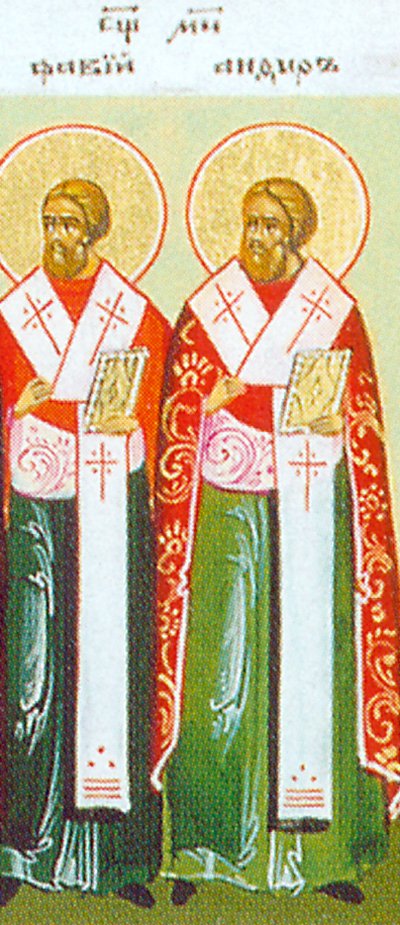
Holy Hieromartyr Fabian, Pope of Rome (250)
Saint Fabian, as a presbyter, fearlessly gave burial to the bodies of martyrs. After the death of Hieromartyr Antherus (Antheros) Pope of Rome, Saint Fabian succeeded him as Pope.
Saint Fabian loved Saint Pontius as though he were his own son. Saint Pontius distributed with Saint Fabian all his substance on the needs of the poor.
Saint Fabian, as a presbyter, fearlessly gave burial to the bodies of martyrs. After the death of Hieromartyr Antherus (Antheros) Pope of Rome, Saint Fabian succeeded him as Pope.
Saint Fabian loved Saint Pontius as though he were his own son. Saint Pontius distributed with Saint Fabian all his substance on the needs of the poor. After the death of the impious Maximian, the new emperor Gordian (238-244) did not persecute Christians. The emperor Philip (244-249), together with his son and co-regent Philip, was persuaded by the conversations and preaching of Saint Pontius to believe in Christ and to accept Baptism from Saint Fabian.
With the permission of the emperors, Saints Pontius and Fabian destroyed the statue of Jupiter in the pagan temple and built a church on this place. For four years the Church of Christ dwelt in peace and tranquility. Then Decius (249-251) ascended the throne, after organizing a rebellion and murdering the emperor Philip and his son.
And during this time Saint Fabian, Bishop of Rome (+ 250), accepted death for Christ. Saint Pontius left Rome for the city of Cimelum (on the border of Italy and Gaul) and lived there as a stranger. During the time of the emperor Valerian (253-259), cruel torturers were sent out with full authority to seek out and kill Christians. Thus Claudius and Anubius arrived in the city of Cimelum for this purpose.
Saint Pontius fearlessly confessed himself a Christian and refused to offer sacrifice to idols. They shackled him in irons and threw him in prison. From the very beginning of the torture the saint calmly admonished the torturers, saying that the Lord would bring the torture to naught, and they would see the power of God. As soon as the servants attempted to tie Saint Pontius to the rack, it fell to pieces, and the torturers fell on the ground as though dead.
“Be convinced, O man of little faith, of the power of my Lord,” said Saint Pontius to Claudius, but on the advice of Anubius he gave Saint Pontius over to be eaten by two bears in the circus. The wild beasts, while not touching the saint, fell instead upon their keepers and mauled them. The spectators began to shout: “The only God is the Christian God, in Whom Pontius believes.” By order of the torturers a fire was built, but it burned out and the saint remained alive. Not even his clothes were burnt. The crowd shouted all the more strongly: “Great is the God of the Christians!” Saint Pontius then was sentenced to beheading by the sword, and his execution took place in the year 257. The body of Saint Pontius was given burial by his friend Valerian.
Troparion - Tone 1
By sharing in the ways of the Apostles, / you became a successor to their throne. / Through the practice of virtue, / you found the way to divine contemplation, O inspired one of God; / by teaching the word of truth without error, / you defended the Faith, even to the shedding of your blood. / Hieromartyr Fabian entreat Christ God to save our souls.
Kontakion
Your holy martyrs, O Lord, / through their sufferings have received an incorruptible crown from You, our God. / For having Your strength, they laid low their adversaries, / and shattered the powerless boldness of demons. / Through their intercessions, save our souls!
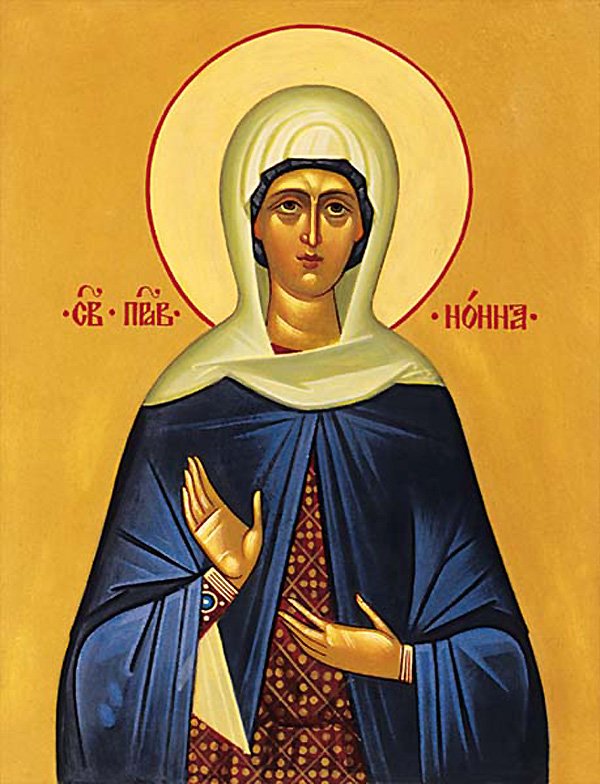
Righteous Nonna (374), Mother of St Gregory the Theologian
Saint Nonna, the mother of Saint Gregory the Theologian (January 25, 389), was the daughter of Christians named Philotatos and Gorgonia, who raised her in Christian piety. Saint Nonna was also an aunt of Saint Amphilochius, Bishop of Iconium (November 23).
Saint Nonna entered into marriage with Gregory of Arianzus (January 1), the rich landowner of an estate in the Arianzus and Nazianzos districts.
Saint Nonna, the mother of Saint Gregory the Theologian (January 25, 389), was the daughter of Christians named Philotatos and Gorgonia, who raised her in Christian piety. Saint Nonna was also an aunt of Saint Amphilochius, Bishop of Iconium (November 23).
Saint Nonna entered into marriage with Gregory of Arianzus (January 1), the rich landowner of an estate in the Arianzus and Nazianzos districts. The marriage was advantageous by earthly considerations, but grievous for the pious soul of Nonna. Her husband Gregory was a pagan, a follower of the sect of the Supremists (Hypsistarii), who venerated a supreme god and observed certain Jewish rituals, while at the same time they worshipped fire.
Saint Nonna prayed that her spouse would turn to the holy truth. Saint Nonna’s son, Saint Gregory the Theologian, wrote about this: “She could not bear this, being half united to God, because he who was part of her remained apart from God. She wanted a spiritual union in addition to the bodily union. Day and night she turned to God with fasting and many tears, entreating Him to grant salvation to her husband.”
Through the prayers of Saint Nonna, her husband Gregory had a vision in his sleep. “It seemed to my father,” writes Saint Gregory, “as though he was singing the following verse of David: ‘I was glad when they said to me, let us go into the house of the Lord’ (Ps. 121/122: 1). He had never done this before, though his wife had often offered her supplications and prayers for it.”
The Psalm was strange to him, but along with its words, the desire also came to him to go to church. When she heard about this, Saint Nonna told her husband that the vision would bring the greatest pleasure if it were fulfilled.
The elder Gregory went to the First Ecumenical Council at Nicea, where he made known his conversion to Christ. He was baptized, ordained presbyter, and then Bishop of Nazianzos devoting himself totally to the Church. At the same time as his consecration as bishop, his wife Saint Nonna was made a deaconness. With the same zeal with which she had raised her children, she now occupied herself in performing works of charity.
“She knew,” says Saint Gregory the Theologian, “one thing to be truly noble: to be pious and to know from where we have come and where we are going; and that there is one innate and trusty wealth: to use one’s substance on God and on the poor, especially the impoverished kin.
“One woman may be distinguished for frugality, and another for piety, while she, difficult as it is to combine both qualities, excelled all others in both of them. In each she attained the height of perfection, and both were combined in her. She did not permit one duty to interfere with the other, but rather each supported the other.
“What time and place of prayer ever eluded her? She was drawn to this each day before anything else, and she had complete faith that her prayers would be answered. Although greatly moved by the sorrows of strangers, she never yielded to grief to the extent that she allowed any sound of woe to escape her lips before the Eucharist, or a tear to fall from her eye, or for any trace of mourning to remain on a Feast day, though she repeatedly endured many sorrows. She subjected every human thing to God.”
Her final years brought Saint Nonna many sorrows. In the year 368 her younger son Caesarios died, a young man of brilliant expectations; and in the following year, her daughter died. The brave old woman bore these losses submitting to the will of God.
In the year 370 Bishop Gregory, then already an old man, participated in the consecration of Saint Basil the Great as Bishop of Caesarea. Saint Nonna, who was somewhat younger than her husband, was also ready to enter into the next life, but through the prayers of her beloved son her time on earth was prolonged.
“My mother,” wrote her son, “was always strong and vigorous, and free from sickness all her life, but then she became ill. Because of much distress... caused by her inability to eat, her life was in danger for many days, and no cure could be found. How then did God sustain her? He did not send down manna, as for Israel of old; He did not split open a rock, in order to provide water for the thirsty people; nor did He send food by ravens, as with Elias, nor did He feed her..., as He once fed Daniel, who felt hunger in the pit. But how?
“It seemed to her that I, her favorite son (not even in dreams did she prefer anyone else), had appeared to her suddenly by night with a basket of the whitest bread. Then I blessed these loaves with the Sign of the Cross, as is my custom, and I gave her to eat, and with this her strength increased.”
Saint Nonna believed the vision was real. She became stronger, and more like her old self.
Saint Gregory visited her early the next morning and, as usual, asked what sort of night she had, and if she required anything. “She replied, ‘My son, you have fed me and now you ask about my health. I am well.’ At this moment her maids made signs to me that I should not contradict her, but to accept her words so that the actual truth should not distress her.”
Early in the year 374 the hundred-year-old Saint Gregory the Elder reposed. After this, Saint Nonna almost never emerged from the church. Soon after his death, she died at prayer in the temple on August 5, 374.
Saint Nonna was a model wife and mother, a remarkable woman who devoted her life to God and the Church without neglecting her other responsibilities. Because of her spiritual, social, and domestic concerns, Saint Nonna would be a most fitting patron for Orthodox women’s organizations.
Scripture Readings
☩Epistle
1 Corinthians 7:24-35
24
Brethren, let every man, wherein he is called, therein abide with God.
25
Now concerning virgins I have no commandment of the Lord: yet I give my judgment, as one that hath obtained mercy of the Lord to be faithful.
26
I suppose therefore that this is good for the present distress, I say, that it is good for a man so to be.
27
Art thou bound unto a wife? seek not to be loosed. Art thou loosed from a wife? seek not a wife.
28
But and if thou marry, thou hast not sinned; and if a virgin marry, she hath not sinned. Nevertheless such shall have trouble in the flesh: but I spare you.
29
But this I say, brethren, the time is short: it remaineth, that both they that have wives be as though they had none;
30
And they that weep, as though they wept not; and they that rejoice, as though they rejoiced not; and they that buy, as though they possessed not;
31
And they that use this world, as not abusing it: for the fashion of this world passeth away.
32
But I would have you without carefulness. He that is unmarried careth for the things that belong to the Lord, how he may please the Lord:
33
But he that is married careth for the things that are of the world, how he may please his wife.
34
There is difference also between a wife and a virgin. The unmarried woman careth for the things of the Lord, that she may be holy both in body and in spirit: but she that is married careth for the things of the world, how she may please her husband.
35
And this I speak for your own profit; not that I may cast a snare upon you, but for that which is comely, and that ye may attend upon the Lord without distraction.
☩Gospel
Matthew 15:12-21
12
Then came his disciples, and said unto him, Knowest thou that the Pharisees were offended, after they heard this saying?
13
But he answered and said, Every plant, which my heavenly Father hath not planted, shall be rooted up.
14
Let them alone: they be blind leaders of the blind. And if the blind lead the blind, both shall fall into the ditch.
15
Then answered Peter and said unto him, Declare unto us this parable.
16
And Jesus said, Are ye also yet without understanding?
17
Do not ye yet understand, that whatsoever entereth in at the mouth goeth into the belly, and is cast out into the draught?
18
But those things which proceed out of the mouth come forth from the heart; and they defile the man.
19
For out of the heart proceed evil thoughts, murders, adulteries, fornications, thefts, false witness, blasphemies:
20
These are the things which defile a man: but to eat with unwashen hands defileth not a man.
21
Then Jesus went thence, and departed into the coasts of Tyre and Sidon.
Liturgical data sourced from OCA.org and orthocal.info