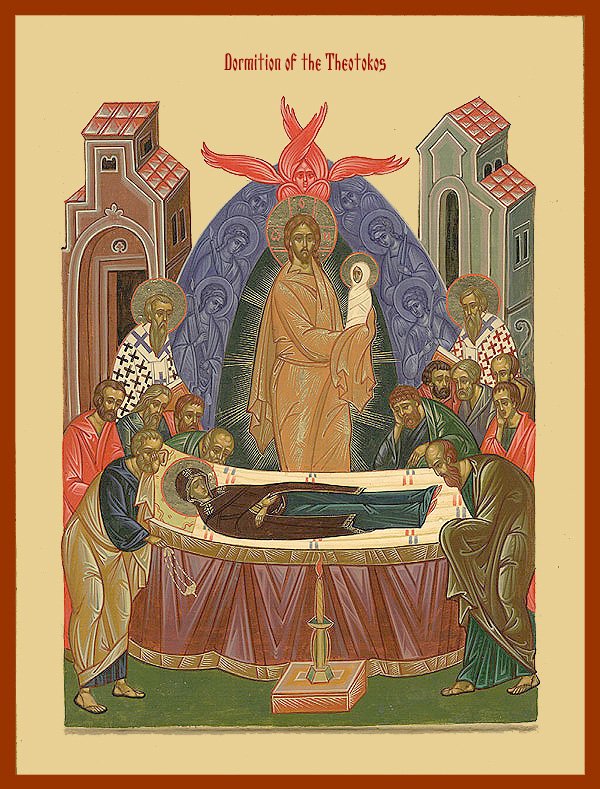
The Troparion of the Forefeast invites us to gather on this day in gladness, for the Theotokos is about to depart from earth to heaven.
Troparion - Tone 4
Dance with joy, O peoples! / Clap your hands with gladness! / Gather today with fervor and jubilation; / sing with exultation. / The Mother of God is about to rise in glory, / ascending from earth to heaven. / We ceaselessly praise her in song as truly Theotokos.
Kontakion - Tone 4
Today the universe dances with joy at your glorious memorial, / and cries out to you, O Mother of God: / “Rejoice, O Virgin, pride of Christians!”
Prophet Micah
The Prophet Micah, the sixth of the Twelve Minor Prophets, was descended from the Tribe of Judah and was a native of the city of Moresheth, to the south of Jerusalem. His prophetic service began around the year 778 before Christ and continued for almost 50 years under the kings of Judah: Jotham, Ahaz, and Righteous Hezekiah (721-691 B.C., August 28).
The Prophet Micah, the sixth of the Twelve Minor Prophets, was descended from the Tribe of Judah and was a native of the city of Moresheth, to the south of Jerusalem. His prophetic service began around the year 778 before Christ and continued for almost 50 years under the kings of Judah: Jotham, Ahaz, and Righteous Hezekiah (721-691 B.C., August 28).
He was a contemporary of the Prophet Isaiah. His denunciations and predictions were in regard to the separate kingdoms of Judah and Israel. He foresaw the misfortunes threatening the kingdom of Israel before its destruction, and the sufferings of Judah during the incursions under the Assyrian emperor Sennacherib.
To him belongs a prophecy about the birth of the Savior of the world: “And thou, Bethlehem, house of Ephratha, art too few in number to be reckoned with the thousands of Judah; yet out of thee shall come forth to Me, one who is to be a ruler in Israel, and His goings forth were from the beginning, even from eternity” (Mic. 5: 2). From the words of the Prophet Jeremiah (Jer. 26: 18-19), the Jews evidently were afraid to kill the Prophet Micah. His relics were discovered in the fourth century after the Birth of Christ at Baraphsatia, through a revelation to the Bishop of Eleutheropolis, Zeuinos.
Troparion - Tone 2
We celebrate the memory / of Your prophet Micah, O Lord; / through him we entreat You, / save our souls.
Kontakion - Tone 4
Enlightened by the Spirit, your pure heart became the dwelling place of most splendid prophecy; / for you saw things far off as if they were near. / Therefore, we honor you, blessed and glorious Prophet Micah.
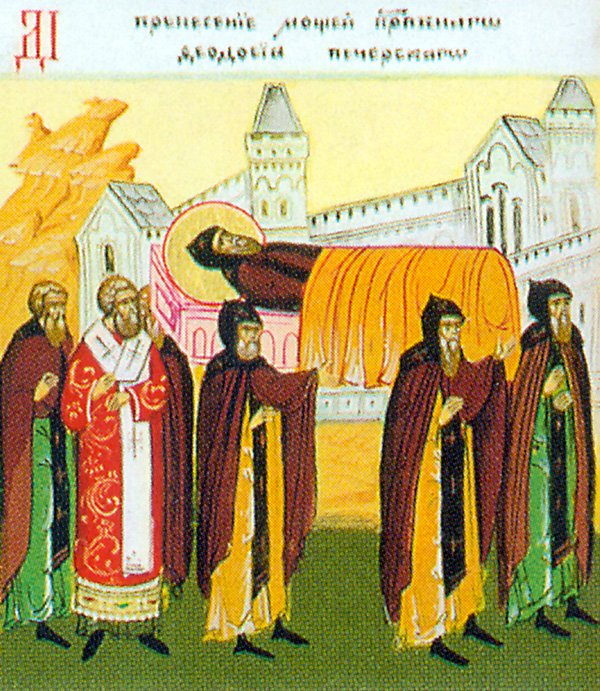
Translation of the Relics of St Theodosius of the Kiev Caves
Saint Theodosius of the Caves was the Father of monasticism in Russia. He was born at Vasilevo, not far from Kiev. From his youth he felt an irresistible attraction for the ascetic life, and led an ascetic lifestyle while still in his parental home. He disdained childish games and attractions, and constantly went to church.
Saint Theodosius of the Caves was the Father of monasticism in Russia. He was born at Vasilevo, not far from Kiev. From his youth he felt an irresistible attraction for the ascetic life, and led an ascetic lifestyle while still in his parental home. He disdained childish games and attractions, and constantly went to church. He asked his parents to let him study the holy books, and through his evident abilities and rare zeal, he quickly learned to read the books, so that everyone was amazed at his intellect.
When he was fourteen, he lost his father and remained under the supervision of his mother, a strict and domineering woman who loved her son very much. Many times she chastised her son for his yearning for asceticism, but he remained firmly committed to his path.
At the age of twenty-four, he secretly left his parental home and Saint Anthony at the Kiev Caves monastery blessed him to receive monastic tonsure with the name Theodosius. After four years his mother found him and with tearfully begged him to return home, but the saint persuaded her to remain in Kiev and to become a nun in the monastery of Saint Nicholas at the Askold cemetery.
Saint Theodosius toiled at the monastery more than others, and he often took upon himself some of the work of the other brethren. He carried water, chopped wood, ground up the grain, and carried the flour to each monk. On cold nights he uncovered his body and let it be food for gnats and mosquitoes. His blood flowed, but the saint occupied himself with handicrafts, and sang Psalms. In church he appeared before others and, standing in one place, he did not leave it until the end of services. He also listened to the readings with particular attention.
In 1054 Saint Theodosius was ordained a hieromonk, and in 1057 he was chosen igumen. The fame of his deeds attracted a number of monks to the monastery, at which he built a new church and cells, and he introduced the cenobitic rule of the Studion monastery, a copy of which he commissioned at Constantinople. As igumen, Saint Theodosius continued his arduous duties at the monastery. He usually ate only dry bread and cooked greens without oil. He spent his nights in prayer without sleep, and the brethren often took notice of this, although the chosen one of God tried to conceal his efforts from others.
No one saw when Saint Theodosius dozed lightly, and usually he rested while sitting. During Great Lent the saint withdrew into a cave near the monastery, where he struggled unseen by anyone. His attire was a coarse hairshirt worn next to his body. He looked so much like a beggar that it was impossible to recognize in this old man the renowned igumen, deeply respected by all who knew him.
Once, Saint Theodosius was returning from Great Prince Izyaslav. The coachman, not recognizing him, said gruffly, “You, monk, are always on holiday, but I am constantly at work. Take my place, and let me ride in the carriage.” The holy Elder meekly complied and drove the servant. Seeing how nobles along the way bowed to the monk driving the horses, the servant took fright, but the holy ascetic calmed him, and gave him a meal at the monastery. Trusting in God’s help, the saint did not keep a large supply of food at the monastery, and therefore the brethren were in want of their daily bread. Through his prayers, however, unknown benefactors appeared at the monastery and furnished the necessities for the brethren.
The Great Princes, and especially Izyaslav, loved to listen to the spiritual discourses of Saint Theodosius. The saint was not afraid to denounce the mighty of this world. Those unjustly condemned always found a defender in him, and judges would review matters at the request of the igumen. He was particularly concerned for the destitute. He built a special courtyard for them at the monastery where anyone in need could receive food and drink. Sensing the approach of death, Saint Theodosius peacefully fell asleep in the Lord in the year 1074. He was buried in a cave which he dug, where he secluded himself during fasting periods.
The relics of the ascetic were found incorrupt in the year 1091. Saint Theodosius was numbered among the saints in 1108. Of the written works of Saint Theodosius six discourses, two letters to Great Prince Izyaslav, and a prayer for all Christians have survived to our time.
The Life of Saint Theodosius was written by Saint Nestor the Chronicler (October 27), a disciple of the great Abba, only thirty years after his repose, and it was always one of the favorite readings of the Russian nation. The Life of Saint Theodosius is found under September 28.
Troparion - Tone 8
By a flood of tears you made the desert fertile, / and your longing for God brought forth fruits in abundance. / By the radiance of miracles you illumined the whole universe! / O our holy father Theodosius, pray to Christ our God to save our souls!
Hieromartyr Marcellus, Bishop of Apamea (389)
The Hieromartyr Marcellus, Bishop of Apamea, was born of illustrious parents on the island of Cyprus. Having received a fine education, he occupied a high civil office. Everyone marveled at his purity of life, mildness, kindness and eloquence. In the year 375, the saint left his wife and children, and devoted himself to a monastic life in Syria.
The Hieromartyr Marcellus, Bishop of Apamea, was born of illustrious parents on the island of Cyprus. Having received a fine education, he occupied a high civil office. Everyone marveled at his purity of life, mildness, kindness and eloquence. In the year 375, the saint left his wife and children, and devoted himself to a monastic life in Syria. The people of Apamea, having him come to the city on some practical matter, elected him as bishop.
From the account of Theodoret of Cyrrhus we learn that Saint Marcellus received permission from the emperor Saint Theodosius the Great (379-395) to destroy a strongly built temple of Jupiter at Apamea, but the saint didn’t know how to accomplish this. A certain worker promised to help him. He undermined three of the huge columns, propping them up temporarily with olive wood. Then he tried to set them afire, but the wood would not burn. When Saint Marcellus learned of this, he performed the Lesser Blessing of Water, and he commanded that this water be faithfully sprinkled around the wood. After this, the wood burned quickly, the columns fell down and the whole pagan temple collapsed in upon itself.
When soldiers near Aulona in the Apamea district demolished another pagan temple, the saint, watching from a distance, was seized by pagans and thrown into a fire. The killers were found, and the saint’s sons wanted to take revenge. A local Council forbade them to do this, decreeing that it would be wrong to avenge such a death as the saint had received. Instead, they ought to give thanks to God.
Troparion - Tone 4
By sharing in the ways of the Apostles, / you became a successor to their throne. / Through the practice of virtue, you found the way to divine contemplation, O inspired one of God; / by teaching the word of truth without error, you defended the Faith, / even to the shedding of your blood. / Hieromartyr Marcellus, entreat Christ God to save our souls.
Scripture Readings
☩Epistle
Romans 13:1-10
1
Let every soul be subject unto the higher powers. For there is no power but of God: the powers that be are ordained of God.
2
Whosoever therefore resisteth the power, resisteth the ordinance of God: and they that resist shall receive to themselves damnation.
3
For rulers are not a terror to good works, but to the evil. Wilt thou then not be afraid of the power? do that which is good, and thou shalt have praise of the same:
4
For he is the minister of God to thee for good. But if thou do that which is evil, be afraid; for he beareth not the sword in vain: for he is the minister of God, a revenger to execute wrath upon him that doeth evil.
5
Wherefore ye must needs be subject, not only for wrath, but also for conscience sake.
6
For for this cause pay ye tribute also: for they are God’s ministers, attending continually upon this very thing.
7
Render therefore to all their dues: tribute to whom tribute is due; custom to whom custom; fear to whom fear; honour to whom honour.
8
Owe no man any thing, but to love one another: for he that loveth another hath fulfilled the law.
9
For this, Thou shalt not commit adultery, Thou shalt not kill, Thou shalt not steal, Thou shalt not bear false witness, Thou shalt not covet; and if there be any other commandment, it is briefly comprehended in this saying, namely, Thou shalt love thy neighbour as thyself.
10
Love worketh no ill to his neighbour: therefore love is the fulfilling of the law.
☩Gospel
Matthew 12:30-37
30
He that is not with me is against me; and he that gathereth not with me scattereth abroad.
31
Wherefore I say unto you, All manner of sin and blasphemy shall be forgiven unto men: but the blasphemy against the Holy Ghost shall not be forgiven unto men.
32
And whosoever speaketh a word against the Son of man, it shall be forgiven him: but whosoever speaketh against the Holy Ghost, it shall not be forgiven him, neither in this world, neither in the world to come.
33
Either make the tree good, and his fruit good; or else make the tree corrupt, and his fruit corrupt: for the tree is known by his fruit.
34
O generation of vipers, how can ye, being evil, speak good things? for out of the abundance of the heart the mouth speaketh.
35
A good man out of the good treasure of the heart bringeth forth good things: and an evil man out of the evil treasure bringeth forth evil things.
36
But I say unto you, That every idle word that men shall speak, they shall give account thereof in the day of judgment.
37
For by thy words thou shalt be justified, and by thy words thou shalt be condemned.

 Meat
Abstain
 Fish
Abstain
 Dairy
Abstain
 Oil
Allowed
 Wine
Allowed