
Fasting Rules
 Meat
Allowed
 Fish
Allowed
 Dairy
Allowed
 Oil
Allowed
 Wine
Allowed
Saints & Commemorations
Hieromartyr Eutychius
He was a disciple and friend of St John the Theologian, and worked with the Apostle Paul, and is himself named as an Apostle though he is not one of the Seventy. He travelled widely in the ministry of the Gospel of Christ, suffering many imprisonments and tortures. He died in Sebastia, the place of his birth.
He was a disciple and friend of St John the Theologian, and worked with the Apostle Paul, and is himself named as an Apostle though he is not one of the Seventy. He travelled widely in the ministry of the Gospel of Christ, suffering many imprisonments and tortures. He died in Sebastia, the place of his birth. The Prologue says that he was beheaded, the Great Horologion that he reposed in peace “in deep old age.”
Trans. Rel. Peter, Metr. Kiev
See December 21 for his life.
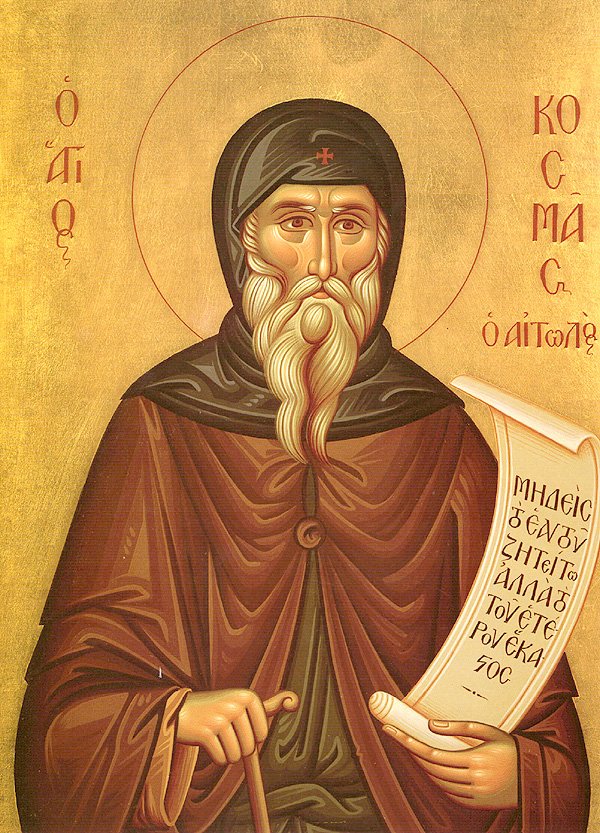
New Hieromartyr Kosmas of Aitolia, Equal-to-the-Apostles (1779)
The New Hieromartyr Cosmas, Equal of the Apostles, in the world Constas, was a native of Aitolia. He studied at first under the guidance of the archdeacon Ananias Dervisanos, and afterwards continued his education on Mount Athos, at the Vatopedi school renowned for teachers such as Nicholas Tzartzoulios (from Metsovo) and Eugenius Voulgaris (afterwards in the years 1775-1779 the archbishop of Ekaterinoslav and the Chersonessus).
The New Hieromartyr Cosmas, Equal of the Apostles, in the world Constas, was a native of Aitolia. He studied at first under the guidance of the archdeacon Ananias Dervisanos, and afterwards continued his education on Mount Athos, at the Vatopedi school renowned for teachers such as Nicholas Tzartzoulios (from Metsovo) and Eugenius Voulgaris (afterwards in the years 1775-1779 the archbishop of Ekaterinoslav and the Chersonessus).
Remaining on Athos at the Philotheou monastery to devote himself to spiritual labors, he was tonsured a monk with the name Cosmas, and later was ordained hieromonk. The desire to benefit his fellow Christians, to guide them upon the way of salvation and strengthen their faith, impelled Saint Cosmas to seek the blessing of his spiritual fathers and go to Constantinople. There he mastered the art of rhetoric and, having received a written permit of Patriarch Seraphim II (and later from his successor Sophronius) to preach the Holy Gospel.
So the saint began to proclaim the Gospel at first in the churches of Constantinople and the surrounding villages, then in the Danube regions, in Thessalonica, in Verroia, in Macedonia, Chimaera, Akarnania, Aitolia, on the islands of Saint Maura, Kephalonia and other places.
His preaching, filled with the grace of the Holy Spirit, was simple, calm, and gentle. It brought Christians great spiritual benefit. The Lord Himself assisted him and confirmed his words with signs and miracles, just as He had confirmed the preaching of the Apostles.
Preaching in the remote areas of Albania, where Christian piety had almost disappeared among the rough and coarse people entrenched in sin, Saint Cosmas led them to sincere repentance and improvement with the Word of God.
Under his guidance, church schools were opened in the towns and villages. The rich offered their money for the betterment of the churches, for the purchase of Holy Books (which the saint distributed to the literate), veils (which he gave women, admonishing them to come to church with covered heads),for prayer ropes and crosses (which he distributed to the common folk), and for baptismal fonts so that children could be baptized in the proper manner.
Since the churches could not accommodate everyone wanting to hear the wise preacher, Saint Cosmas with forty or fifty priests served the Vigil in the fields, and in city squares, where thousands of people prayed for the living and for the dead, and were edified by his preaching. Everywhere that Saint Cosmas halted and preached, the grateful listeners set up a large wooden cross, which remained thereafter in memory of this.
The apostolic service of Saint Cosmas was brought to a close by his martyric death in the year 1779. At 65 years of age, he was seized by the Turks and strangled. His body was thrown into a river, and after three days, was found by the priest Mark and buried near the village of Kolikontasi at the monastery of the Entrance into the Temple of the Most Holy Theotokos. Afterwards, part of his relics were transferred to various places as a blessing.
He was glorified by the Ecumenical Patriarchate in 1961.
Troparion - Tone 3
By teaching the Divine Faith, / you richly adorned the Church / and became a zealous emulator of the Apostles; / for being lifted up on the wings of divine love, / you spread the message of the Gospel far and wide. / O glorious Cosmas, / entreat Christ God that He may grant us great mercy.
Kontakion - Tone 4
Let us gather to acclaim the renowned Cosmas with odes, / who excelled gloriously among the choirs of the Martyrs, Priests, and Ascetics; / for he dispenses healing to those who have recourse to him with faith, / since, as an equal of the Apostles, / he has boldness before Christ.
Scripture Readings
☩Epistle
1 Corinthians 15:29-38
29
Else what shall they do which are baptized for the dead, if the dead rise not at all? why are they then baptized for the dead?
30
And why stand we in jeopardy every hour?
31
I protest by your rejoicing which I have in Christ Jesus our Lord, I die daily.
32
If after the manner of men I have fought with beasts at Ephesus, what advantageth it me, if the dead rise not? let us eat and drink; for to morrow we die.
33
Be not deceived: evil communications corrupt good manners.
34
Awake to righteousness, and sin not; for some have not the knowledge of God: I speak this to your shame.
35
But some man will say, How are the dead raised up? and with what body do they come?
36
Thou fool, that which thou sowest is not quickened, except it die:
37
And that which thou sowest, thou sowest not that body that shall be, but bare grain, it may chance of wheat, or of some other grain:
38
But God giveth it a body as it hath pleased him, and to every seed his own body.
☩Gospel
Matthew 21:23-27
23
And when he was come into the temple, the chief priests and the elders of the people came unto him as he was teaching, and said, By what authority doest thou these things? and who gave thee this authority?
24
And Jesus answered and said unto them, I also will ask you one thing, which if ye tell me, I in like wise will tell you by what authority I do these things.
25
The baptism of John, whence was it? from heaven, or of men? And they reasoned with themselves, saying, If we shall say, From heaven; he will say unto us, Why did ye not then believe him?
26
But if we shall say, Of men; we fear the people; for all hold John as a prophet.
27
And they answered Jesus, and said, We cannot tell. And he said unto them, Neither tell I you by what authority I do these things.
Liturgical data sourced from OCA.org and orthocal.info