
Fasting Rules
 Meat
Allowed
 Fish
Allowed
 Dairy
Allowed
 Oil
Allowed
 Wine
Allowed
Saints & Commemorations
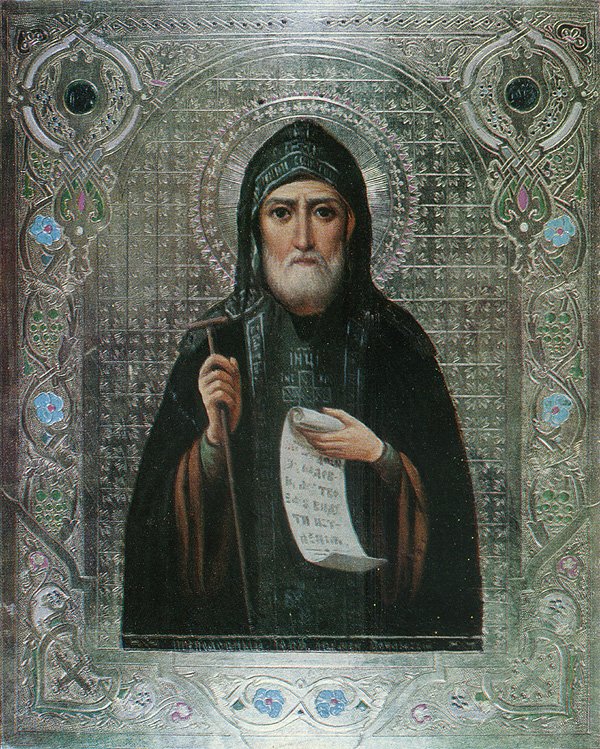
Ven. Job of Pochaev
Saint Job of Pochaev reposed on October 28, 1651, and his relics were recovered and transferred to the Cathedral of the Life-giving Trinity on August 28, 1659.
The Uniates returned Pochaev Monastery to the Russian Orthodox Church in 1831, after they had held it from 1720 - 1831. During that time the present Cathedral of the Dormition was built at Pochaev Lavra.
Miraculous cures prompted the Holy Synod to uncover the relics a second time, which occurred on August 28, 1833 with Metropolitan Dionysios presiding. There was no sign of corruption, and an ineffable fragrance came forth from his grave.
In the year 1902, the Holy Synod decreed that on this day the holy relics of Saint Job be carried around the Dormition Cathedral of Pochaev Lavra following the Divine Liturgy.
Troparion - Tone 4
Taking the yoke of Christ upon yourself1 from your youth, O Venerable Father Job, / for many years you contested in the field of piety at Ugornitsky Monastery on the island of Dubensk; / and arriving at Pochaev Mountain, marked by the healing footprint of the Most Holy Theotokos, / you often enclosed yourself in a narrow rock cave, for the sake of divine contemplation and prayers. / Strengthened by the grace of God, / you labored courageously for the good of Christ's Church and of your community, / against the enemies of Orthodoxy, and for Christian piety, / as well as instructing a multitude of monks, / whom you brought as victors to our Master and God. / Entreat Him that our souls may be saved.1 Matthew 11:29-30.
Kontakion - Tone 8
Taking the yoke of Christ upon yourself1 from your youth, O Venerable Father Job, / for many years you contested in the field of piety at Ugornitsky Monastery on the island of Dubensk; / and arriving at Pochaev Mountain, marked by the healing footprint of the Most Holy Theotokos, / you often enclosed yourself in a narrow rock cave, for the sake of divine contemplation and prayers. / Strengthened by the grace of God, / you labored courageously for the good of Christ's Church and of your community, / against the enemies of Orthodoxy, and for Christian piety, / as well as instructing a multitude of monks, / whom you brought as victors to our Master and God. / Entreat Him that our souls may be saved.
Synaxis of the Kiev Cave Fathers
St Moses of Ethiopia (400)
He is also called Moses the Black. He was a slave, but was cast out by his master due to his evil life. He then became the leader of a murderous band of robbers in Egypt. He came to repentance and took up monastic life in the desert under St Isidore of Sketis. For many years he struggled tirelessly, through prayer, fasting and vigils, with lustful and violent thoughts; he was finally freed of them through the prayers of St Isidore.
He is also called Moses the Black. He was a slave, but was cast out by his master due to his evil life. He then became the leader of a murderous band of robbers in Egypt. He came to repentance and took up monastic life in the desert under St Isidore of Sketis. For many years he struggled tirelessly, through prayer, fasting and vigils, with lustful and violent thoughts; he was finally freed of them through the prayers of St Isidore. He was revered by all the brethren for his ascetical life, his wisdom, and his deep humility. Once a brother committed some sin and the monks gathered to judge him. Moses at first refused to go at all, but when they insisted, he filled an old, leaky basket with sand and carried it into the assembly on his back. When the brethren asked him what his action meant, he said “My sins run out behind me, and I do not even see them, and I have come to judge my brother.” The monk was forgiven. In time the fame of this humblest of monks spread so far that kings and bishops traveled into the desert to seek his wisdom and his blessing. In his old age, he was warned that a band of brigands was coming to attack the Skete. He refused to leave saying, “It is written: he who lives by the sword shall die by the sword.” So, mindful that he had slain others by the sword, he willingly awaited his own murder. Six other monks who remained with him were also slain.

Righteous Anna the Prophetess (1st c.)
Righteous Anna the Prophetess was descended from the tribe of Aser, and was the daughter of Phanuel. She lived with her husband for seven years until he died. After his death, Righteous Anna led a strict and pious life, “not leaving the Temple, and serving God both day and night in fasting and prayer” (Luke. 2:
Righteous Anna the Prophetess was descended from the tribe of Aser, and was the daughter of Phanuel. She lived with her husband for seven years until he died. After his death, Righteous Anna led a strict and pious life, “not leaving the Temple, and serving God both day and night in fasting and prayer” (Luke. 2: 37). When Righteous Anna was 84 years old, she saw the Infant Jesus Christ at the Temple of Jerusalem. He was brought to be dedicated to God as a firstborn child according to the Mosaic law.
Righteous Anna also heard the prophetic words of Saint Simeon the God-Receiver spoken to the Most Holy Theotokos. The Prophetess Anna together with Saint Simeon glorified God, and told everyone that the Messiah had come into the world (Luke. 2: 38).
Troparion - Tone 2
We celebrate the memory / of Your prophetess Anna, O Lord; / through her we entreat You, / save our souls.
Kontakion - Tone 4
Enlightened by the Spirit, your pure heart became the dwelling place of most splendid prophecy; / for you saw things far off as if they were near. / Therefore, we honor you, blessed and glorious Prophetess Anna.

Righteous Hezekiah, King of Judah (691 BC)
Righteous Hezekiah was the son of the impious King Ahaz. The life of King Hezekiah is described in the Bible (4/2 Kings 18-20). However, many scholars disagree about the dates of King Hezekiah's life. According to the Hebrew Bible Hezekiah was born around 741 B.C. and died from an unknown illness circa 687 B.C.
Righteous Hezekiah was the son of the impious King Ahaz. The life of King Hezekiah is described in the Bible (4/2 Kings 18-20). However, many scholars disagree about the dates of King Hezekiah's life. According to the Hebrew Bible Hezekiah was born around 741 B.C. and died from an unknown illness circa 687 B.C. at the age of 54.
A zealous worshipper of the True God, Hezekiah reopened the Temple of Solomon (2 Chron. 20:3). At the time of the celebration of the Passover, to which he summoned all the subjects of the kingdom of Israel, Hezekiah gave orders to destroy the idols throughout his kingdom, reminding the people of the punishments which befell their ancestors for forsaking the True God. After this, idolatry ceased not only in the kingdom of Judah, but also in many places in the kingdom of Israel.
Therefore, God delivered him from his enemies and fulfilled his petitions. Thus, in the fourteenth year of the reign of Hezekiah, the Assyrian king Sennacherib son of Salmanassar, having conquered Israel, gathered his forces to make war upon Hezekiah.
The Assyrian king took the fortress of Lachis and sent an army towards Jerusalem, demanding that the Jewish king surrender. Hezekiah turned to God in prayer, and an angel of the Lord struck down 185,000 soldiers in the Assyrian camp. Soon after the withdrawal of Sennacherib, Hezekiah fell ill. The Prophet Isaiah came to him through the will of God and told him to set his affairs in order, since he would soon die. But the power of Hezekiah’s prayer was so great that God prolonged his life for another fifteen years.
His prayer was fervent when he besought God to help him. But even more ardent was his prayer of thanks. Hezekiah died at age 54 and was buried with great reverence at Jerusalem. The memory of the Righteous Hezekiah is also celebrated on Cheesefare Saturday.
New Hieromartyr Chrysostom, metropolitan of Smyrna (1922)
Repose of Elder Joseph the Hesychast of Mt Athos (1959) (August 15 OC)
Born on the island of Paros in 1898, he entered monastic life in 1921 in response to a heavenly vision. Traveling to Mt Athos he first lived the communal monastic life, but later moved to a Skete for greater solitude. There he received the gift of ceaseless prayer. Elder Joseph and his companion in struggle, Elder Arsenios, moved to St Anne’s Skete, where they remained for the rest of their lives. H
Born on the island of Paros in 1898, he entered monastic life in 1921 in response to a heavenly vision. Traveling to Mt Athos he first lived the communal monastic life, but later moved to a Skete for greater solitude. There he received the gift of ceaseless prayer. Elder Joseph and his companion in struggle, Elder Arsenios, moved to St Anne’s Skete, where they remained for the rest of their lives. Here a small company of disciples slowly gathered around them. Many of these, like silent Apostles, have spread out through the Orthodox world, contributing much to its spiritual renewal.
Scripture Readings
☩Epistle
Romans 15:30-33
30
Now I beseech you, brethren, for the Lord Jesus Christ’s sake, and for the love of the Spirit, that ye strive together with me in your prayers to God for me;
31
That I may be delivered from them that do not believe in Judea; and that my service which I have for Jerusalem may be accepted of the saints;
32
That I may come unto you with joy by the will of God, and may with you be refreshed.
33
Now the God of peace be with you all. Amen.
☩Gospel
Matthew 17:24-18:4
24
And when they were come to Capernaum, they that received tribute money came to Peter, and said, Doth not your master pay tribute?
25
He saith, Yes. And when he was come into the house, Jesus prevented him, saying, What thinkest thou, Simon? of whom do the kings of the earth take custom or tribute? of their own children, or of strangers?
26
Peter saith unto him, Of strangers. Jesus saith unto him, Then are the children free.
27
Notwithstanding, lest we should offend them, go thou to the sea, and cast an hook, and take up the fish that first cometh up; and when thou hast opened his mouth, thou shalt find a piece of money: that take, and give unto them for me and thee.
1
At the same time came the disciples unto Jesus, saying, Who is the greatest in the kingdom of heaven?
2
And Jesus called a little child unto him, and set him in the midst of them,
3
And said, Verily I say unto you, Except ye be converted, and become as little children, ye shall not enter into the kingdom of heaven.
4
Whosoever therefore shall humble himself as this little child, the same is greatest in the kingdom of heaven.
Liturgical data sourced from OCA.org and orthocal.info