
Fasting Rules
 Meat
Allowed
 Fish
Allowed
 Dairy
Allowed
 Oil
Allowed
 Wine
Allowed
Saints & Commemorations
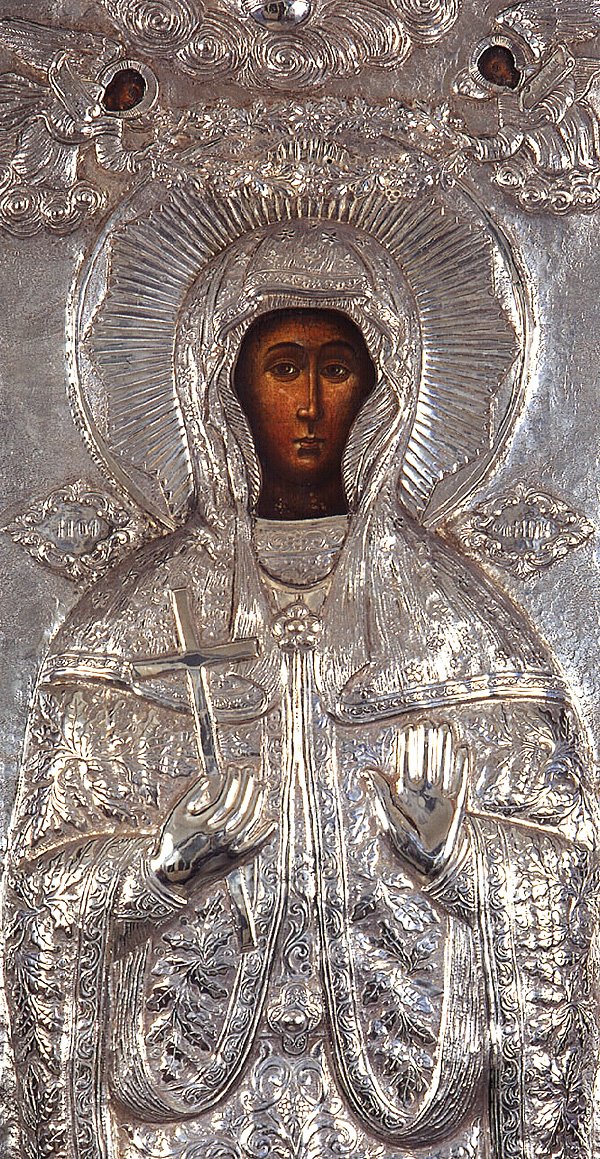
Great Martyr Euphemia the All-Praised
The Holy Great Martyr Euphemia (Euphēmia / Ευφημία) was the daughter of Christian parents, the senator Philophronos and his wife Theodosia. She suffered for Christ in the year 304 in the city of Chalcedon, on the Bosphorus opposite Constantinople, the Queen of Cities.
Priscus, the Proconsul of Chalcedon, issued a decree which required all the inhabitants of Chalcedon and the surrounding area to attend a pagan festival, in order to worship and offer sacrifice to the idol of Ares. He thre
The Holy Great Martyr Euphemia (Euphēmia / Ευφημία) was the daughter of Christian parents, the senator Philophronos and his wife Theodosia. She suffered for Christ in the year 304 in the city of Chalcedon, on the Bosphorus opposite Constantinople, the Queen of Cities.
Priscus, the Proconsul of Chalcedon, issued a decree which required all the inhabitants of Chalcedon and the surrounding area to attend a pagan festival, in order to worship and offer sacrifice to the idol of Ares. He threatened grave torments for anyone who failed to appear. During this impious festival, 49 Christians were hidden in one house, where they worshiped the true God in secret. The young virgin Euphemia was among those who prayed there.
Soon their hiding place was discovered, and they were brought before Priscus to answer the charges against them. For nineteen days the martyrs were subjected to various torments, but none of them wavered in their faith, nor did they consent to offer sacrifice to the idol. The governor, beside himself with rage and not knowing any other way of forcing the Christians to abandon their faith, sent them to Emperor Diocletian for trial. He kept the youngest, the virgin Euphemia, hoping that she would not persevere if she were left all alone.
Separated from her fellow-Christians, Saint Euphemia fervently prayed that the Lord Jesus Christ would strengthen her for her impending ordeal. Priscus urged the Saint to offer sacrifice to the idol, promising her many rewards. When she refused, he ordered that she be tortured.
The martyr was tied to a wheel with sharp knives attached to it, which slashed her body. The Saint prayed aloud, and miraculously, the wheel stopped by itself and would not move despite all the efforts of the executioners. An angel of the Lord, came down from Heaven, removed Euphemia from the wheel, and healed her of her wounds, and the Saint gave thanks to God.
Priscus did not notice the miracle which had taken place, so he ordered the soldiers Victor and Sosthenes to take the Saint to a red-hot furnace. But the soldiers, seeing two Angels in the midst of the flames, refused to carry out the Proconsul's order and declared that they believed in the God Whom Euphemia worshipped. Boldly proclaiming that they were Christians, Victor and Sosthenes awaited punishment. They were sentenced to be devoured by wild beasts. In the arena, they begged God to forgive the sins they had committed, asking the Lord to receive them into the Heavenly Kingdom. A Divine voice was heard, and the two soldiers entered into eternal life. The beasts, however, did not harm their bodies.
Saint Euphemia, cast into the fire by other soldiers, did not suffer. With God's help she emerged unscathed after many other torments. Ascribing these things to sorcery, Priscus ordered a pit to be dug. Filling it with knives, he had it covered over with earth and grass, so that the martyr would not notice this trap.
Once again, Saint Euphemia remained safe, walking over the pit. Finally, she was sentenced to be devoured by wild beasts in the arena. Before her execution the Saint prayed that the Lord would deem her worthy of martyrdom. But none of the bears or lions attacked her, but only licked her feet. Finally, one she-bear wounded her foot, which bled slightly, and the Holy Great Martyr Euphemia died right away. As her soul departed, there was an earthquake. The city was shaken, the walls fell down, and the pagan temples crumbled. As Saint Euphemia lay dead in the sand, the guards and spectators fled in terror, so that the Saint's parents were able to take her body and bury it near Chalcedon.
Later, a majestic church was built over the grave of the Great Martyr Euphemia. The sessions of the Fourth Ecumenical Council took place there in the year 451. At that time, the Holy Great Martyr Euphemia confirmed the Orthodox confession of faith in a miraculous way, exposing the Monophysite heresy. That miracle is commemorated on July 11.
When the Persians captured Chalcedon in the year 617, the relics of the holy Great Martyr Euphemia were transferred to Constantinople (around the year 620). During the Iconoclast heresy, the reliquary containing Saint Euphemia's relics seems to have been thrown into the sea, but pious sailors recovered them. They were brought to the island of Lemnos, and they were returned to Constantinople in 796.
The incorrupt body of Saint Euphemia is in the Patriarchal Church of Saint George at the Phanar in Constantinople. Portions of her relics are to be found in Kykkos Monastery on Cyprus, and in the Saint Alexander Nevsky Lavra at Saint Petersburg.
Troparion - Tone 4
Your lamb Euphēmia calls out to You, O Jesus, in a loud voice: / “I love You, my Bridegroom, and in seeking You I endure suffering. / In Baptism I was crucified so that I might reign in You, / and I died so that I might live with You. / Accept me as a pure sacrifice, / for I have offered myself in love.” / Through her prayers, save our souls, since You are merciful.
Kontakion - Tone 4
(Slavic usage)
You loved your Bridegroom Christ, / and your lamp was well trimmed1 shining with virtue, O All-praised Euphēmia, / and so you went in with Him to the wedding feast,2 / receiving from Him a crown of martyrdom. / Deliver us from misfortune, who revere your memory with faith.1 Matthew 25:7
2 Matthew 25:10
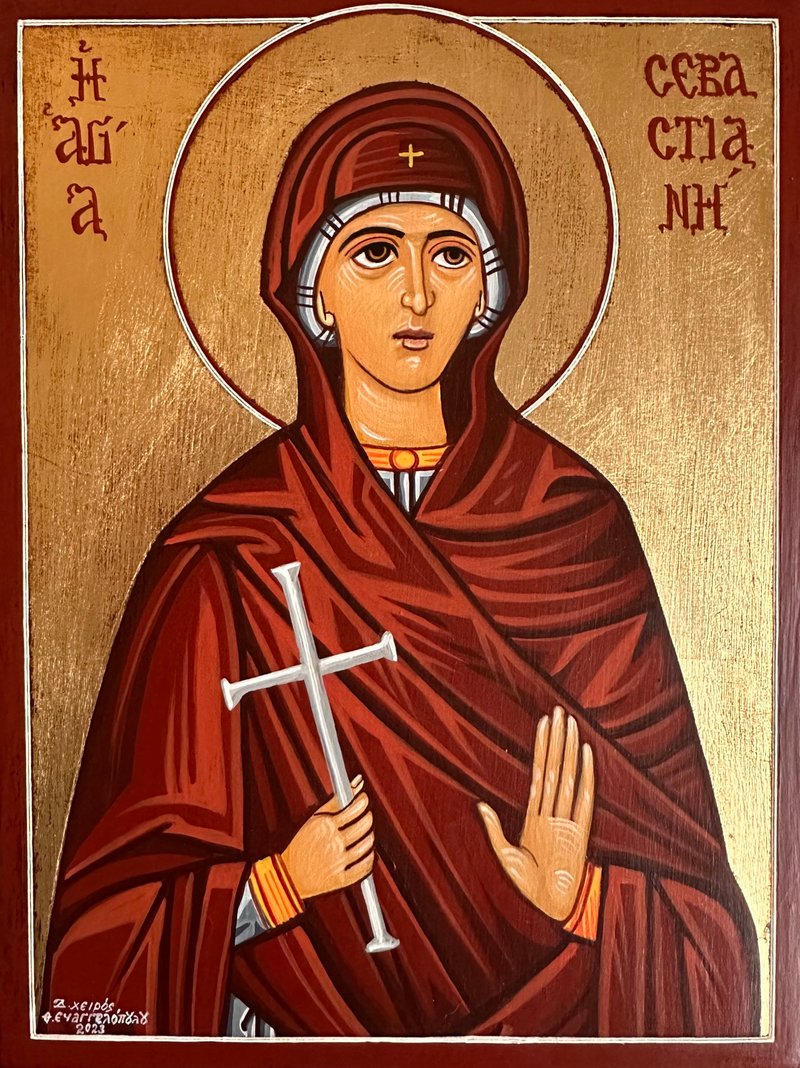
Sebastiana, Disciple of St. Paul the Apostle
The Holy Martyr Sebastiana was a follower of the holy Apostle Paul. During a persecution against Christians under the emperor Dometian (81-96), she was on trial as a Christian before the governor named Georgios in the city of Marcianopolis in the Mizea region.
Saint Sebastiana firmly confessed her faith in Christ, and for this she was subjected to cruel tortures.
The Holy Martyr Sebastiana was a follower of the holy Apostle Paul. During a persecution against Christians under the emperor Dometian (81-96), she was on trial as a Christian before the governor named Georgios in the city of Marcianopolis in the Mizea region.
Saint Sebastiana firmly confessed her faith in Christ, and for this she was subjected to cruel tortures. At first they beat her, and then they threw her into a red-hot oven, from which she emerged unharmed. They sent the saint to the city of Heraklea, where sentence was pronounced on her a second time.
The governor, named Pompian, gave orders to tie the saint to a tree and lacerate her body with roof-tiles. The martyr remained unbroken in her faith. Then the governor gave her to be eaten by wild beasts. There too, the Lord preserved the holy martyr, and the beasts refused to touch her. Then, by order of the governor, Saint Sebastiana was beheaded. Her body, thrown into the sea, was taken by angels to the island of Rhodes (in Thrace, in the Sea of Marmara).
Troparion - Tone 4
Your lamb Sebastiana, / calls out to You, O Jesus, in a loud voice: / “I love You, my Bridegroom, / and in seeking You, I endure suffering. / In baptism I was crucified so that I might reign in You, / and I died so that I might live with You. / Accept me as a pure sacrifice, / for I have offered myself in love.” / Through her prayers save our souls, since You are merciful.
Melitina the Martyr
Holy Hieromartyr Cyprian of Carthage (258)
He was born to wealthy and noble parents in Carthage (north Africa), and became a prominent lawyer in that city. Around the year 246 he embraced the Christian faith and was baptized by the priest Caecilianus. Immediately he gave all his goods to the poor and retired to a quiet place in the country to devote himself to prayer and study of Christian writings.
He was born to wealthy and noble parents in Carthage (north Africa), and became a prominent lawyer in that city. Around the year 246 he embraced the Christian faith and was baptized by the priest Caecilianus. Immediately he gave all his goods to the poor and retired to a quiet place in the country to devote himself to prayer and study of Christian writings. In 248 or 249 he was elected Bishop of Carthage by the insistence of the people, though some priests opposed the consecration of such a new Christian.
Soon after his election, the Emperor Decius began a terrible persecution of Christians, during which Cyprian, in hiding, upheld his flock by letters. During this time many Christians gave in to fear of death and either sacrificed to the idols or signed statements that they had done so. When the persecution ended, the problem arose of how to treat the apostates who wished to be received back into the Church. Rigorist groups such as the Novatians and Montanists held that these lapsi had removed themselves from all hope of salvation and could never re-enter the Church. Cyprian rejected this view (as well as the position of some who would immediately reconcile the apostates); he established the position, still standard in the Church, that apostates could be restored after confession and long penance. His position led to a schism in the Church at Carthage when Cyprian’s opponents set up Maximus the Montanist as a rival Bishop. The schism was only ended by a plague that swept the Empire and the city of Carthage in 253-254, together with a renewed persecution of Christians. Saint Cyprian’s tireless care for the suffering during this time won most of the schismatics back to his side. When peace returned, Cyprian called a series of Councils in Carthage to resolve the conflicts that had troubled the Church. He upheld the African (and Eastern) churches’ practice of reconciling heretics to the Church by Baptism rather than by laying on of hands, as was done in Rome; though Cyprian did not seek to impose this practice on other churches, Rome was not so tolerant and broke with the African church until the death of Pope Stephen.
In 256, yet another persecution broke out under the Emperor Valerian. Cyprian was arrested and brought before the Proconsul of the region. He refused to defend himself, and when told that he was to be executed, said only Deo Gratias!(Thanks be to God!). At his execution the holy bishop ordered that twenty-five gold pieces be given to the executioner, and put on the blindfold with his own hands.
Note: St Cyprian is missing on this date from traditional martyrologies because he was once confused with St Cyprian of Antioch (October 2). Today is the date of his martyrdom and the date of his commemoration on the Latin calendar.
St Ninian, Enlightener of Scotland (432)
One of the great missionaries and early Saints of the British Isles, he was born in Britain around the year 360. Though Britain was still mostly pagan, Ninian was born of Christian parents. He traveled to Rome as a young man, and spent several years there engaged in study and ascetic struggle. He was ordained in Rome and sent back as a missionary to Britain around the year 400.
One of the great missionaries and early Saints of the British Isles, he was born in Britain around the year 360. Though Britain was still mostly pagan, Ninian was born of Christian parents. He traveled to Rome as a young man, and spent several years there engaged in study and ascetic struggle. He was ordained in Rome and sent back as a missionary to Britain around the year 400. On the way he probably met St Martin of Tours: many of the churches he founded, including his cathedral in Whithorn, were named in honor of St Martin. He established several monasteries, ministered to his Christian Briton countrymen and converted many more Britons to the Faith. He also converted many of the fierce Picts, inhabitants of today’s Scotland, to faith in Christ. He reposed in peace in Whithorn in 432.
Our Holy Father Dorotheos the Solitary of Egypt (4th c.)
He was one of the great company of Egyptian desert fathers of the fourth century. He lived alone in a cell in the Thebaid for sixty years, devoting himself to prayer, asceticism and renowned love of labor. He spent his days building cells for new monks, his nights making plaited mats, all the while immersed in prayer and psalmody.
Scripture Readings
☩Epistle
2 Corinthians 10:7-18
7
Do ye look on things after the outward appearance? If any man trust to himself that he is Christ’s, let him of himself think this again, that, as he is Christ’s, even so are we Christ’s.
8
For though I should boast somewhat more of our authority, which the Lord hath given us for edification, and not for your destruction, I should not be ashamed:
9
That I may not seem as if I would terrify you by letters.
10
For his letters, say they, are weighty and powerful; but his bodily presence is weak, and his speech contemptible.
11
Let such an one think this, that, such as we are in word by letters when we are absent, such will we be also in deed when we are present.
12
For we dare not make ourselves of the number, or compare ourselves with some that commend themselves: but they measuring themselves by themselves, and comparing themselves among themselves, are not wise.
13
But we will not boast of things without our measure, but according to the measure of the rule which God hath distributed to us, a measure to reach even unto you.
14
For we stretch not ourselves beyond our measure, as though we reached not unto you: for we are come as far as to you also in preaching the gospel of Christ:
15
Not boasting of things without our measure, that is, of other men’s labours; but having hope, when your faith is increased, that we shall be enlarged by you according to our rule abundantly,
16
To preach the gospel in the regions beyond you, and not to boast in another man’s line of things made ready to our hand.
17
But he that glorieth, let him glory in the Lord.
18
For not he that commendeth himself is approved, but whom the Lord commendeth.
☩Gospel
Mark 3:28-35
28
Verily I say unto you, All sins shall be forgiven unto the sons of men, and blasphemies wherewith soever they shall blaspheme:
29
But he that shall blaspheme against the Holy Ghost hath never forgiveness, but is in danger of eternal damnation:
30
Because they said, He hath an unclean spirit.
31
There came then his brethren and his mother, and, standing without, sent unto him, calling him.
32
And the multitude sat about him, and they said unto him, Behold, thy mother and thy brethren without seek for thee.
33
And he answered them, saying, Who is my mother, or my brethren?
34
And he looked round about on them which sat about him, and said, Behold my mother and my brethren!
35
For whosoever shall do the will of God, the same is my brother, and my sister, and mother.
Liturgical data sourced from OCA.org and orthocal.info