
Fasting Rules
 Meat
Allowed
 Fish
Allowed
 Dairy
Allowed
 Oil
Allowed
 Wine
Allowed
Saints & Commemorations
Sunday after Elevation
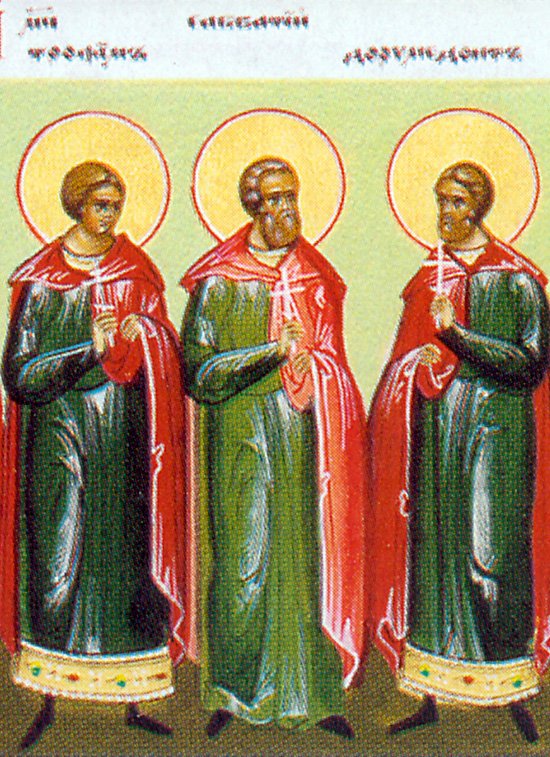
Martyrs Trophimus, Sabbatius, Dorymedon
The Holy Martyrs Trophimus, Sabbatius and Dorymedon suffered for Christ during the reign of the Roman emperor Probus (276-282). A pagan festival was being celebrated in the city of Antioch. Sacrificial offerings were brought, the wine was poured, and vile acts were performed. The Christians Trophimus and Sabbatius arrived in the city just as the festival was taking place, and were saddened by this loud and indecent spectacle.
The Holy Martyrs Trophimus, Sabbatius and Dorymedon suffered for Christ during the reign of the Roman emperor Probus (276-282). A pagan festival was being celebrated in the city of Antioch. Sacrificial offerings were brought, the wine was poured, and vile acts were performed. The Christians Trophimus and Sabbatius arrived in the city just as the festival was taking place, and were saddened by this loud and indecent spectacle. They prayed that the Lord would guide the errant on the way of salvation. As they said this, the idolaters noticed their presence. Seeing that the strangers did not worship the idols, they arrested them and took them to the governor.
At their interrogation, the saints firmly confessed their faith. When they were told to renounce Christ, they resolutely refused to do so. Saint Sabbatius died under the fierce torment. Saint Trophimus was sent to the city of Synnada in Phrygia for even more terrible tortures.
For three days Saint Trophimus walked shod in iron sandals with sharp nails, driven on by a cavalry guard. The governor of Frigius, Dionysius, infamous as a torturer and executioner, used all manner of tortures to break the will of the brave Christian. Saint Trophimus merely repeated the words of Scripture: “many afflictions has the righteous one, but from them all will the Lord deliver him” (Ps 33/34:20).
The senator Dorymedon, a secret Christian, visited Saint Trophimus in prison, washing and binding his wounds. When the pagans learned that the senator would not participate in the festival of Castor and Pollux, they asked the reason for his refusal. He said that he was a Christian, and would not attend a festival in honor of the demons. He and Saint Trophimus were thrown to the wild beasts to be eaten by them, but the martyrs remained unharmed. Then they were beheaded with the sword.
Troparion - Tone 8
God praised in Trinity has glorified a trinity of martyrs: / Trophimus, Sabbatius, and Dorymedon. / By their faith, they overthrew the adversary. / Through their prayers, O Christ our God, have mercy on us.
Kontakion - Tone 8
As the foundation of athletes and the confirmation of piety / the Church honors and glorifies your brilliant suffering, / wise and glorious Trophimus, ever-praised and blessed athlete. / Together with your fellow sufferers, ask cleansing for those who hymn you, / for you are invincible.
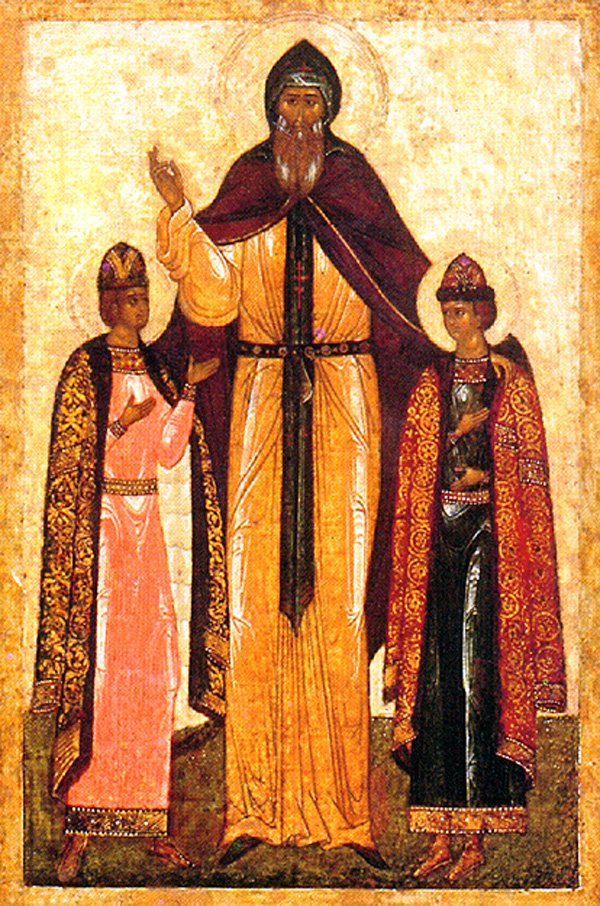
Rt. Blv. Theodore, Prince of Smolensk, and his sons Ss David and Constantine of Yaroslavl
The holy right-believing Prince Theodore of Smolensk and Yaroslavl, nicknamed the “Black” [i.e. “dark” or “swarthy”], was born at a terrible time for Rus: the Mongol invasion of 1237-1239. At Baptism he was named for the holy Great Martyr Theodore Stratelates (February 8), who was particularly esteemed by the Russian warrior-princes.
Prince The
The holy right-believing Prince Theodore of Smolensk and Yaroslavl, nicknamed the “Black” [i.e. “dark” or “swarthy”], was born at a terrible time for Rus: the Mongol invasion of 1237-1239. At Baptism he was named for the holy Great Martyr Theodore Stratelates (February 8), who was particularly esteemed by the Russian warrior-princes.
Prince Theodore was famed for his military exploits. The child Theodore was not in the city when, through the prayers of the Most Holy Theotokos, the holy Martyr Mercurius (November 24) delivered Smolensk from being captured by Batu in the year 1239. They had taken him away and hidden him in a safe place during the warfare. In 1240 his father, Prince Rostislav died. He was a great-grandson of the holy Prince Rostislav of Smolensk and Kiev (March 14).
His elder brothers as heirs divided their father’s lands among themselves, allotting to the child Theodore the small holding of Mozhaisk. Here he spent his childhood, and here he studied Holy Scripture, the church services and military science.
In the year 1260, Prince Theodore was married to Maria Vasilievna, daughter of holy Prince Basil of Yaroslavl (July 3), and Theodore became Prince of Yaroslavl. They had a son named Michael, but Saint Theodore was soon widowed. He spent much of his time on military campaigns, and his son was raised by his mother-in-law, Princess Xenia.
In 1277, the allied forces of the Russian princes, in union with the Tatar forces, took part in a campaign in the Osetian land and in the taking of “its famed city Tetyakov.” In this war the allied forces won a complete victory. From the time of Saint Alexander Nevsky (November 23), the khans of the Golden Horde, seeing the uncrushable spiritual and the military strength of Orthodox Russia, were compelled to change their attitude. They began to draw the Russian princes into alliances, and the khans turned to them for military assistance.
The Russian Church made use of these providentially improved relations for the Christian enlightenment of the foreigners. Already in 1261, through the efforts of Saint Alexander Nevsky and Metropolitan Cyril III at Sarai, the capital of the Golden Horde, a diocese of the Russian Orthodox Church was established. In the year 1276, a Constantinople Council presided over by Patriarch John Bekkos (1275-1282) replied to questions of the Russian Bishop Theognostus of Sarai concerning the order for baptizing Tatars, and also for receiving Monophysite and Nestorian Christians among them into Orthodoxy.
During these years Prince Theodore was at the Horde. Having distinguished himself by military exploits on the Osetian campaign, he won the favorable attention of Khan Mengu-Temir, who regarded the Orthodox Church with respect, and who as Khan issued the first decree exempting the church from taxes for Metropolitan Cyril.
The Chronicles say: “The emperor Mengu-Temir and his empress were fond of Prince Theodore Rostislavich, and did not want to permit him return back to Rus because of his bravery and the comeliness of his face.”
Saint Theodore spent three years at the Horde. Finally, “the emperor sent him off with great honor,” and the prince arrived in Yaroslavl. His wife Maria had already died, and in the city Princess Xenia ruled with her grandson Michael. The people of Yaroslavl would not receive the prince returning from the Horde, “not allowing him to enter the city but saying to him, ‘this is Princess Xenia’s city, and Michael is our prince.’”
Saint Theodore had to return to the Horde. The empress, wife of khan Mengu-Temir, “had a great fondness for him and wished for him to marry her own daughter.” Such a marriage had tremendous significance for Rus. For a long time the Khan would not agree to it, regarding the Russian princes as mere vassals or subjects.
To give his daughter in marriage to a Russian prince meant to acknowledge him as an equal. More importantly, it meant that the khan would acknowledge the primacy of Orthodoxy, since before the wedding, the Tatar princess had to accept holy Baptism. The khan went along with this, since an alliance with Russia was very important for him, “and he ordered his daughter to be given to Prince Theodore, and for her to be baptized first, and he commanded that the Orthodox Faith not be insulted.” Thus Saint Theodore was married to the mighty khan's daughter, who was baptized with the name Anna. “The emperor held him in great esteem and commanded that he be seated opposite himself, he built him a palace, and gave him princes and nobles in retinue.”
There at the Golden Horde Saint Theodore’s sons, Prince David and Prince Constantine were also born. The tremendous influence which Saint Theodore gained at the Horde, he used to the glory of the Russian Land and the Russian Church. Orthodoxy gained strength among the Tatars, and the Horde began to adopt Russian customs, morals and piety. Russian merchants, architects, and skilled craftsmen carried Russian culture to the shores of the Don, the Volga, the Urals and even into Mongolia itself.
From this period archeologists find Orthodox icons, and crosses and lampadas, throughout all the former territories of the Golden Horde, since included as part of Russia. So began a great missionary movement of the Russian Church towards the East, and the enlightening of all the tribes with the light of the Gospel truth all the way to the Great Ocean (i.e. the Pacific). Russian Orthodox princes and their retinues, participating as allies in the Mongol campaigns, learned of and became familiar with the boundless expanses of Asia, Siberia and the Far East. In the year 1330, more than thirty years after the death of Saint Theodore, Chinese chronicles mention Russians in Peking.
Saint Theodore lived in Sarai until 1290, when “news reached him from Rus, from the city of Yaroslavl, that his first son, Prince Michael, had died.” Having given the prince rich gifts and a large retinue, the khan sent him back to Rus. Again he became the prince at Yaroslavl. Saint Theodore began zealously to concern himself with strengthening and building up his city and principality. He had a special love for the monastery of the Transfiguration of the Lord.
His fame resounded throughout Rus, and all the princes sought friendship and alliances with him. But most of all, he was fond of the son of Saint Alexander Nevsky, Andrew Alexandrovich, supporting him in all undertakings. When Prince Andrew became Great Prince of Vladimir, he went with him on military campaigns. He was gladdened by the victories, and he grieved over his defeat. In 1296, a bloody fratricidal war was just breaking out between two groups of princes: on the one side was Saint Theodore and Great Prince Andrew, and on the other side, Saint Michael of Tver (November 22) and Saint Daniel of Moscow (March 4). But with the help of God the bloodshed was successfully averted.
At a meeting of the princes (in 1296) Bishop Simeon of Vladimir and Bishop Ishmael of Sarai managed to bring peace to both sides. This fact, that holy Prince Theodore and Bishop Ishmael participated in the meeting, shows that Saint Theodore used all his diplomatic talents and influence at the Horde to establish peace in the Russian Land.
Saint Theodore the Black’s ties to his Smolensk origins were not sundered, though it would have been difficult for him to be Prince of Smolensk. Thus, in the year 1297, Saint Theodore went on a campaign to Smolensk to reclaim his lawful rights to the Smolensk principality, which had been usurped by his nephews. But he did not take the city and become the Prince of Smolensk again.
Soon after this campaign the holy warrior-prince became ill. On September 18, 1299 the saint gave orders that he be carried to the Savior-Transfiguration monastery, and there he received monastic tonsure. Towards the end of the ritual, Saint Theodore asked that the service be interrupted. With the blessing of the igumen, and to grant the wish of the dying prince, they carried him into the monastery courtyard, where a throng of the Yaroslavl people had already gathered. “And the prince repented before all the people, if he had sinned against anyone or held ill-feelings against anyone. He blessed all those who had sinned against him or borne him enmity, and begged their pardon. He accepted his responsibility for all his deeds before God and man.” Only after this did the humble warrior achieve his desire to finish his unusual and much-troubled life’s path by accepting the angelic schema.
All night the igumen and the brethren prayed over the holy prince. At the second hour of the night they began to ring the bell for Matins. Saint Theodore lay silently upon his monk’s cot and received the Holy Mysteries of Christ. When the monks began the third “Glory” of the Psalter, he made the Sign of the Cross and gave up his soul to the Lord. His appearance at the grave was extraordinary: “Wondrous indeed was the appearance of the blessed one. He lay upon the cot not as one dead, but as one alive. His face shone like as the rays of the sun, adorned by his venerable grey hair, bearing witness to his purity of soul and his benevolence.”
After him, his son Saint David (+ 1321) ruled at Yaroslavl. The second of his sons, Constantine, had evidently died earlier. The Church veneration of Prince Theodore in the Yaroslavl region began soon after his death. During the years 1322-1327, Bishop Prochorus of Rostov commissioned the famous Theodorov Gospel, adorned with miniatures, in memory of Saint Theodore. Previously, Bishop Prochorus had been igumen of the Savior-Transfiguration monastery at Yaroslavl. Actually, he knew the holy prince personally, and witnessed his tonsure and public repentance before the people. Historians think that the fine miniatures sewn into this precious manuscript had come from an earlier Gospel owned by Saint Theodore himself, and which he had brought with him to Yaroslavl as a blessing from his native Smolensk.
On March 5, 1463, at Yaroslavl the relics of holy Prince Theodore and his sons, David and Constantine were uncovered. The chronicler, an eyewitness to the event, recorded under that year: “At the city of Yaroslavl in the monastery of the Holy Savior they unearthed three Great Princes: Prince Theodore Rostislavich and his sons David and Constantine, and brought them above the ground. Great Prince Theodore was a man of great stature, and they placed his sons David and Constantine beside him. Their stature was less than his. They had lain in a single grave.” The physical appearance of the holy prince so impressed the eyewitnesses and those present at the uncovering of the relics, that an account of this was entered into the Prologue (lives of saints) in Saint Theodore’s Life, and also into the text of the Manual for Iconographers.
The Life of the holy Prince Theodore the Black was written shortly after the uncovering of the relics, by the hieromonk Anthony of the Yaroslav Savior monastery, with the blessing of the Metropolitan Philip of Moscow and All Rus. Another version of the Life was written by Andrew Yuriev at the Saint Cyril of White Lake monastery. A third and more detailed Life of Saint Theodore was included in the “Book of Ranks of Imperial Geneology,” compiled under Tsar Ivan the Terrible and Metropolitan Macarius.
The Russian people composed spiritual songs about Prince Theodore, which they sang over the centuries in “their destitute wanderings.” The verses glorify the saint’s piety and discernment, beneficence and kind-heartedness, and his concern for building and adorning churches. The complexity of historical destinies, the roughness of the era, the multitude of enemies (not personal, but enemies of Russia and the Church), reveal to us the great exploits of the saintly builders of the Russian Land.
Troparion - Tone 4
From your youth you clung to Christ’s love / and you eagerly kept his laws. / You were enriched with miraculous gifts / and now pour forth healings, Theodore, David and Constantine / pray to Christ our God to save those who honor you!
Kontakion - Tone 8
While in the flesh you were radiant lamps living like the angels. / By fasting, vigils and faith you grew like the trees in paradise. / You blossomed in prayer through the grace you received. / You have become mighty physicians, healing infirmity of souls. / O glorious wonderworkers Theodore, David, and Constantine, / pray to Christ our God for the forgiveness of those who venerate your memory!
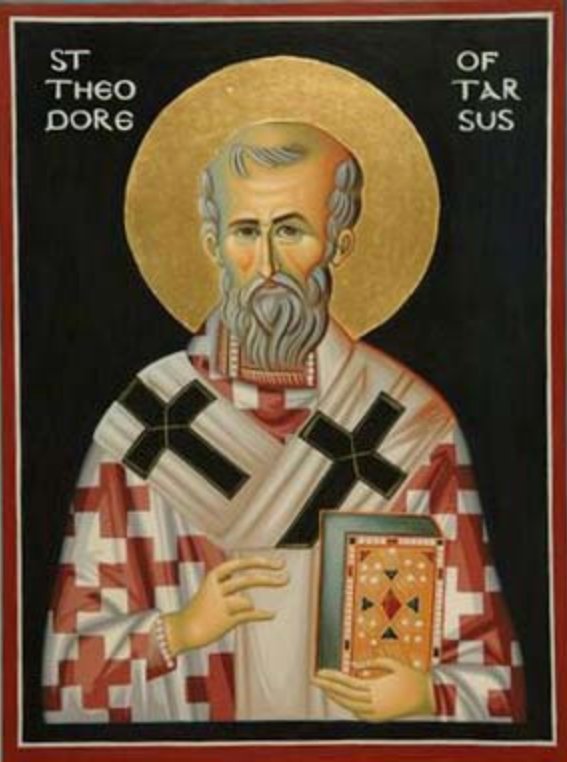
Theodore of Tarsus, Archbishop of Canterbury
Saint Theodore was the eighth Archbishop of Canterbury (668-690), and one of England’s great saints. He was a Greek from Tarsus, the home of Saint Paul. He was a highly-educated monk living in Rome who was quickly advanced through all the clerical ranks and consecrated as Archbishop of Canterbury at the age of sixty-five. S
Saint Theodore was the eighth Archbishop of Canterbury (668-690), and one of England’s great saints. He was a Greek from Tarsus, the home of Saint Paul. He was a highly-educated monk living in Rome who was quickly advanced through all the clerical ranks and consecrated as Archbishop of Canterbury at the age of sixty-five. Saint Adrian (January 9), an African who was the abbot of a monastery near Naples, was sent to assist Saint Theodore.
Saint Theodore arrived in Kent in 669, when he was almost seventy. In spite of his age, he was quite energetic, traveling throughout England founding churches and consecrating bishops to fill those Sees which were left vacant by an outbreak of plague. He also created new Sees and established a school in Canterbury where Greek was taught.
In Northumbria, Saint Theodore settled a dispute involving episcopal succession. Saint Wilfrid (October 12) had been elected Bishop of Lindisfarne (the See was later transferred to York), and he traveled to Gaul to be consecrated by a Roman bishop, because he would not accept consecration from a Celtic bishop. In the meantime, Saint Chad, or Ceadda (March 2), had been elected and uncanonically consecrated because Wilfrid remained in Gaul for three years. Although Saint Theodore deposed Saint Chad, he recognized his worthiness to be a bishop. He regularized the consecration, then sent Saint Chad to be Bishop of Mercia. Saint Wilfred was restored to his See.
Saint Theodore summoned a council of the entire English Church at Hertford in 672. Not only was this the first church council in England, it was the first assembly of any kind attended by representatives from all over the country. In 679 he convened another synod at Hatfield to maintain the purity of Orthodox doctrine and to condemn the heresy of Monothelitism.
Saint Theodore fell asleep in the Lord in 690, and his body remained incorrupt for a long time. Under his leadership, the English Church became united in a way that the various tribal kingdoms did not. The diocesean structures which he established continue to serve as the basis for church administration in England. He was respected for his administrative skills, and also for his moral and canonical decisions.
Troparion - Tone 4
In truth you were revealed to your flock as a rule of faith, / an image of humility and a teacher of abstinence; / your humility exalted you; / your poverty enriched you. / Hierarch Father Theodore, / entreat Christ our God / that our souls may be saved.
Holy Martyr Zosimas the Hermit of Cilicia (4th c.)
The Martyr Zosimas the Desert Dweller lived during the fourth century. Once, while hunting, Dometian, the governor of Sicily, saw the Elder calmly and amiably conversing with the beasts around him.
Seeing the hunters, the beasts fled. They then interrogated the Elder, asking who he was and why he lived in the wilderness.
The Martyr Zosimas the Desert Dweller lived during the fourth century. Once, while hunting, Dometian, the governor of Sicily, saw the Elder calmly and amiably conversing with the beasts around him.
Seeing the hunters, the beasts fled. They then interrogated the Elder, asking who he was and why he lived in the wilderness. The Elder answered that he was a Christian called Zosimas, and that he could not live in the city with the enemies of the Lord Jesus Christ. Therefore, he lived alone among the wild animals.
Then Dometian said threateningly: “If you worship the Nazarene, I shall subject you to fierce tortures at Nazareth, and you will renounce Christ.”
When asked what kind of magic he used to tame wild beasts, Saint Zosimas replied, “I am a Christian.” At Nazareth the tortures began. They tied the Elder head downwards, with a large stone around his neck, and they began to lacerate his body with iron hooks.
The torturers taunted the sufferer: “If the beasts do listen to you, tell one of them to come here, and then we will believe in your God.” The holy martyr turned to God in prayer, and suddenly a huge lion came forth.
Everyone fled in terror, and the lion went up to the Elder, and began to lift the stone around the martyr’s neck with its paw in order to ease the suffering of the saint. The governor implored the martyr to keep the lion calm, and he gave orders to untie the saint, and to bring him to the emperor, but Saint Zosimas was already dead, having given up his pure soul to God.
Troparion - Tone 1
The image of God was truly preserved in you, O Father, / for you took up the Cross and followed Christ. / By so doing you taught us to disregard the flesh for it passes away / but to care instead for the soul, since it is immortal. / Therefore your spirit, venerable Zosimas, rejoices with the angels.
Kontakion - Tone 2
As a venerable and proven ascetic, as an honorable and renowned martyr, / and as a model of the desert life, O most exalted Zosimas, / we sing hymns of praise to you, / for you have trampled upon serpents.
Scripture Readings
☩Epistle
1 Corinthians 16:13-24
13
Watch ye, stand fast in the faith, quit you like men, be strong.
14
Let all your things be done with charity.
15
I beseech you, brethren, (ye know the house of Stephanas, that it is the firstfruits of Achaia, and that they have addicted themselves to the ministry of the saints,)
16
That ye submit yourselves unto such, and to every one that helpeth with us, and laboureth.
17
I am glad of the coming of Stephanas and Fortunatus and Achaicus: for that which was lacking on your part they have supplied.
18
For they have refreshed my spirit and yours: therefore acknowledge ye them that are such.
19
The churches of Asia salute you. Aquila and Priscilla salute you much in the Lord, with the church that is in their house.
20
All the brethren greet you. Greet ye one another with an holy kiss.
21
The salutation of me Paul with mine own hand.
22
If any man love not the Lord Jesus Christ, let him be Anathema Maran-atha.
23
The grace of our Lord Jesus Christ be with you.
24
My love be with you all in Christ Jesus. Amen. The first epistle to the Corinthians was written from Philippi by Stephanas, and Fortunatus, and Achaicus, and Timotheus.
☩Gospel
Matthew 21:33-42
33
Hear another parable: There was a certain householder, which planted a vineyard, and hedged it round about, and digged a winepress in it, and built a tower, and let it out to husbandmen, and went into a far country:
34
And when the time of the fruit drew near, he sent his servants to the husbandmen, that they might receive the fruits of it.
35
And the husbandmen took his servants, and beat one, and killed another, and stoned another.
36
Again, he sent other servants more than the first: and they did unto them likewise.
37
But last of all he sent unto them his son, saying, They will reverence my son.
38
But when the husbandmen saw the son, they said among themselves, This is the heir; come, let us kill him, and let us seize on his inheritance.
39
And they caught him, and cast him out of the vineyard, and slew him.
40
When the lord therefore of the vineyard cometh, what will he do unto those husbandmen?
41
They say unto him, He will miserably destroy those wicked men, and will let out his vineyard unto other husbandmen, which shall render him the fruits in their seasons.
42
Jesus saith unto them, Did ye never read in the scriptures, The stone which the builders rejected, the same is become the head of the corner: this is the Lord’s doing, and it is marvellous in our eyes?
Liturgical data sourced from OCA.org and orthocal.info