
Fasting Rules
 Meat
Allowed
 Fish
Allowed
 Dairy
Allowed
 Oil
Allowed
 Wine
Allowed
Saints & Commemorations
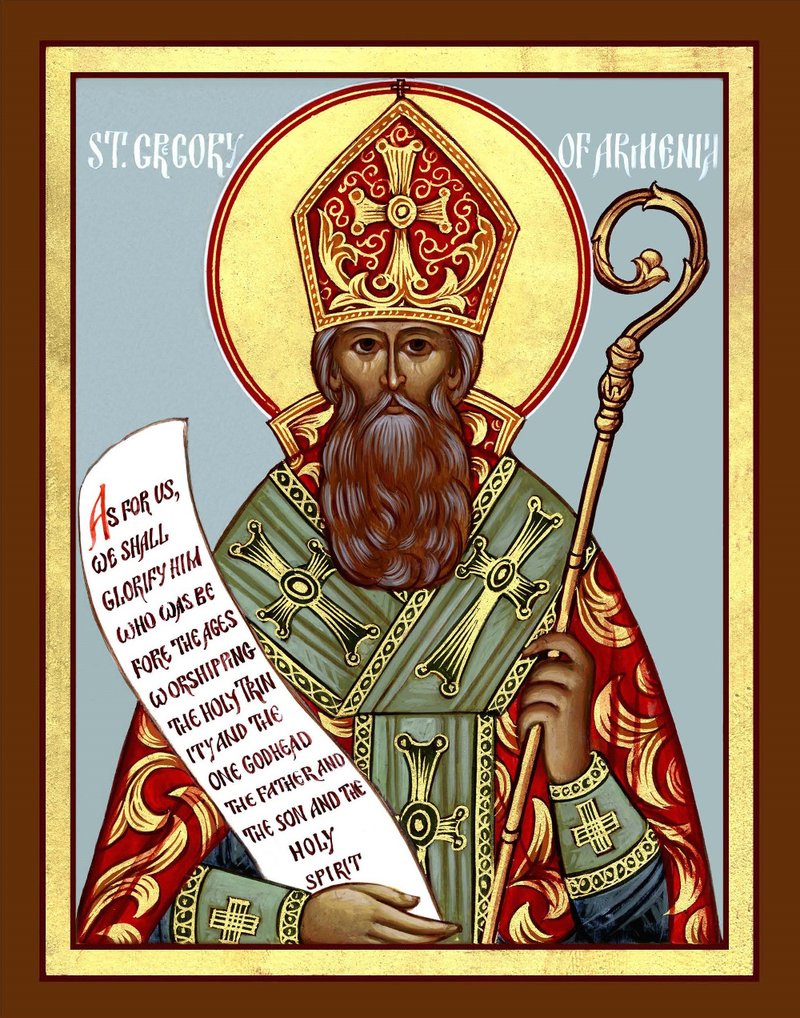
Hieromartyr Gregory of Armenia
The Hieromartyr Gregory, Enlightener of Greater Armenia, was born in the year 257. He was descended from a line of Parthian Arsakid kings. Anak, the father of Saint Gregory, was a Parthian by birth. In his quest for the Armenian throne, Anak and his brother attacked their kinsman, King Kursar with their swords, leaving him mortally wounded.
The Hieromartyr Gregory, Enlightener of Greater Armenia, was born in the year 257. He was descended from a line of Parthian Arsakid kings. Anak, the father of Saint Gregory, was a Parthian by birth. In his quest for the Armenian throne, Anak and his brother attacked their kinsman, King Kursar with their swords, leaving him mortally wounded. The King's servants found him still alive, and he was able to tell them what had happened. Before he expired, the King ordered the execution of Anak, his brother, and also their wives and children. The murderers were caught by a river, where they were slain and their bodies were thrown into the water.
One of Anak's relatives saved Gregory and his brother, who were infants, and hid them in his home. There was a revolt in Armenia, and King Artasirus of Persia was able to conquer Armenia and bring it under his rule. As for Arak's sons: one was taken to Persia, and Gregory was sent to the Roman Empire.
When he reached adulthood, Gregory lived in Caesarea in Cappadocia, where he was converted to the Christian Faith. Gregory married, and had two sons, but soon was left a widower. Gregory raised his sons in piety. One of them, Orthanes, later became a priest, and the other, Arostanes, was tonsured as a monk and went into the wilderness to live in solitude.
In order to atone for the sin of his father, who had murdered the father of Tiridates, Gregory entered into the latter's service, and was a faithful servant to him. Tiridates, who was serving in the Roman army, loved Gregory like a friend, but when he learned that Gregory was a Christian, he became angry. Saint Gregory, however, ignored his master's unjust wrath.
When the Goths attacked the Roman Empire, the Prince of the Goths challenged the Emperor to single combat. The Emperor was afraid to fight the Prince, so he had Tiridates put on his armor and take his place. Tiridates defeated his adversary without using his sword, and led him as a captive to the Emperor. Then the entire Gothic army was defeated. In gratitude, the Emperor made Tiridates King of Armenia. When Tiridates offered sacrifice to his "gods" for his new position, he wanted Gregory to sacrifice with him. Gregory refused, and so Tiridates ordered that he be tortured.
The Saint was suspended head downward, with a stone about his neck, and for several days they choked him with a foul-smelling smoke, they beat and ridiculed him, and forced him to walk in iron sandals inset with nails.
During these torments, Saint Gregory sang Psalms. In prison the Lord healed all his wounds. When Gregory stood before the King cheerful and unharmed, he was astonished and ordered that the torments be repeated. Saint Gregory endured them, not wavering, with his former determination and bearing. They then poured hot tin over him and threw him into a pit filled with snakes, scorpions, and other poisonous creatures. The Lord, however, spared His chosen one, and he was left unharmed.
Some pious women kept him alive for fourteen years by feeding him with bread, secretly lowering it into the pit. A holy angel appeared to the martyr, strengthening and encouraging him. During this time King Tiridates killed the holy virgin Saint Ripsimia (Ριψιμία, or Ριψίμη), the Eldress Gaianḗ (Γαϊανή), and 32 other Virgin Martyrs (some sources say 35) from Asia Minor. Tiridates, who seemed to have lost his mind after this, recovered six days later. Then the wrath of God struck King Tiridates, his associates, and the soldiers who had participated in the execution of the virgins. Beset by demons, their appearance resembled wild boars, as once happened to Nebuchadnezzar (Daniel 4:30). Running through forests and fields, they tore their clothes and devoured their own flesh.
Saint Gregory was taken from from the pit, and then he was washed, dressed in clean clothes, and fed. Then he was led to the King. Everyone bowed before him, begging him to ask God to heal the King as well as the others responsible for killing the Holy Virgin Martyrs. First, the Saint asked about their relics, which remained unburied for nine days. Saint Gregory buried the bodies, and then began preaching to the people, urging them to turn away from the darkness of idolatry and toward Christ. The people came to believe in Christ, and wanted to build a large church. When it was completed, Saint Gregory had the relics of the holy nuns brought into it. Then he led King Tiridates to the church before the bodies of the Saints whom he had slain, so that they might pray to Christ for him. He repented, and at once his face was restored to its original appearance once more.
Soon all of Armenia was converted to Christ. The temples of the idols were destroyed, and churches for the worship of the only true God were built. Saint Gregory ordained priests, established schools, founded monasteries, and provided for the good order of the Church.
After this, Saint Gregory went into the wilderness, where he ended his earthly life in a manner pleasing to the Lord. His son Aristanes was made a bishop in Cappadocia, and was one of the 318 Holy Fathers of the Council of Nicea.
Troparion - Tone 4
By sharing in the ways of the Apostles, / you became a successor to their throne. / Through the practice of virtue, you found the way to divine contemplation, / O inspired one of God; / by teaching the word of truth without error, / you defended the Faith, even to the shedding of your blood. / Hieromartyr Gregory entreat Christ God to save our souls.
Kontakion - Tone 2
Today, let us the faithful, praise with songs and hymns / the admirable hierarch Gregory as an initiate in the sacred mysteries. / He was a contender for the truth, a vigilant pastor and teacher, / a light for the whole world, / interceding with Christ that our souls may be saved!
Ven. Gregory of Vologda
Saint Gregory of Pelsheme, Vologda, was born in the city of Galich, Kostroma governia. He came from the line of the Lopotov nobility. When the youth reached age fifteen, his parents wanted him to marry, but they died, without seeing this come to pass. Young Gregory distributed the inheritance left him to the poor, and entered the monastery of the Most Holy Theotokos on the shore of Lake Galich.
Saint Gregory of Pelsheme, Vologda, was born in the city of Galich, Kostroma governia. He came from the line of the Lopotov nobility. When the youth reached age fifteen, his parents wanted him to marry, but they died, without seeing this come to pass. Young Gregory distributed the inheritance left him to the poor, and entered the monastery of the Most Holy Theotokos on the shore of Lake Galich.
The Igumen of the monastery regarded the new monk with mistrust because of his youth and noble parentage. Therefore, he placed Gregory in obedience to an experienced Elder. With great humility Saint Gregory served all the brethren. After a certain while he was ordained a priest. Soon Saint Gregory’s fame as a pastor spread, and many began to arrive for spiritual guidance and counsels.
The Galich prince asked the monk to be godfather for his children. Burdened by fame and the nearness of his relatives, the monk went to Rostov to venerate the relics of Saint Leontius (May 23), and he settled in the monastery of Saint Abramius, (October 29). But here also news of the saint’s ascetic feats quickly spread.
The monks of the Savior (Yakovlev) monastery turned to Archbishop Dionysius of Rostov (1418-1425) with a request to assign Saint Gregory to head their monastery. Out of humility the monk accepted the guidance over the monastery, but after two years he secretly left the monastery and withdrew into the Vologda forest.
In the Sosnovetsk wilderness he became acquainted with Saint Dionysius of Glushitsa (June 1). When the Lord prompted the holy ascetic to found his own monastery, Saint Dionysius approved his friend’s intention. With a cross on his shoulders, Saint Gregory crossed over the River Pelsheme and planted the cross in a thicket by the river bank.
The first monk in the new monastery was the priest Alexis, in monasticism Alexander. In 1426 a church was built at the monastery in honor of the Most Holy Theotokos. Its icons were painted by Saint Dionysius, and Saint Gregory himself copied the sacred texts for the monastery. Gradually the number of monks increased, the monastery grew and became more famous.
Saint Gregory concerned himself with the nurturing of piety at the monastery, and at the same time he shared in the destiny of his country. In the year 1433, he went to Moscow in order to prevail upon the Galich prince Yuri Dimitrievich, who had seized the Moscow principality from Basil the Dark, to return Moscow to Prince Basil. Prince Yuri obeyed the monastic Elder.
But in 1434 the son of Prince Yuri, Demetrius Shemyaka, began to ravage the Vologda lands belonging to the Great Prince. Saint Gregory, distraught over the discord and violence, went to Demetrius Shemyaka and addressed him with bold words. “Prince Demetrius,” said the monk, “you do things that are not Christian. It would be better if you had gone into a pagan land to a vile people ignorant of God. Widows and orphans cry out against you to God. How many people will perish from hunger and cold because of you, and if you don’t stop the fratricide, the bloodshed and violence soon, then you shall lose both your glory and your princedom.”
After this bold denunciation, Shemyaka gave orders to throw the holy Elder off a bridge. For several hours the monk lay there unmoving. His denunciations produced the desired effect, and Shemyaka soon quit Vologda. The courage of the monk only increased the veneration of him. Before his death, he received the Holy Mysteries, spoke a word of guidance to the brethren, and appointed as igumen of the monastery his fellow ascetic Alexander. Saint Gregory reposed on September 30, 1442 and was buried in the monastery he founded.
Troparion - Tone 8
By a flood of tears you made the desert fertile, / and your longing for God brought forth fruits in abundance. / By the radiance of miracles you illumined the whole universe! / O our holy father Gregory, pray to Christ our God to save our souls!
Venerable Gregory of Pelshma (1441 or 1451)
He was born into a powerful boyar family in the city of Galich. Early in life he was drawn to the ascetical life, and was distressed when his parents arranged for him to be married at the age of only fifteen. By a mysterious providence, both his parents died before the wedding could be held, and St Gregory very soon distributed his considerable wealth to the poor, freed all his serfs, and went to the nearest monastery.
He was born into a powerful boyar family in the city of Galich. Early in life he was drawn to the ascetical life, and was distressed when his parents arranged for him to be married at the age of only fifteen. By a mysterious providence, both his parents died before the wedding could be held, and St Gregory very soon distributed his considerable wealth to the poor, freed all his serfs, and went to the nearest monastery. Such was his holiness of life that he rose to be abbot of the monastery, but as in his youth he felt burdened by the admiration and attention of men, so he left for the monastery of St Dionysius of Glushitsa, where he strove to live a hidden life. His starets, St Dionysius, discerned Gregory’s spiritual gifts and wanted him to found his own monastery, but the Saint resisted, desiring only to live in humility and obedience, unknown to the world. At the age of 104 Gregory, with his elder’s blessing, went to live as a hermit in a small cell on the banks of the River Pelshma. After a few years other monks came to live the hesychastic life with him and, as his elder had desired, Gregory against his will became the abbot of a new monastery.
Abbot Gregory excelled not only in prayer but in his works of love for the poor, many of whom came to him in times of famine, when he would give them the small reserves of the monastery. More than once he traveled to Moscow to rebuke the Princes for their evil deeds. One of these, Prince Basil II, was so angered by the ‘presumption’ of the Saint that he had him thrown from a bridge into a deep gorge, but he emerged miraculously unharmed.
At the age of 127, St Gregory felt his end approaching and prepared himself. He told his disciples to throw his body into a swamp when he died, but after his repose they disobeyed and gave him honorable burial. A beautiful fragrance filled the church and, for the first time, a miracle of healing was performed through the Saint’s relics, which from that time forward were the source of countless wonders.
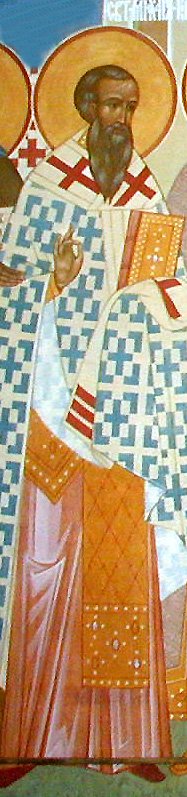
Our Father among the Saints Michael, Metropolitan of Kiev (992)
Saint Michael the first Metropolitan of Kiev, according to the Joakimov chronicle, was a Syrian by birth, but according to other chronicles, he was a Bulgarian or Serb. In the year 989, he arrived at Korsun with other clergy for holy Prince Vladimir (July 15), not long after Vladimir’s Baptism (988).
Saint Michael the first Metropolitan of Kiev, according to the Joakimov chronicle, was a Syrian by birth, but according to other chronicles, he was a Bulgarian or Serb. In the year 989, he arrived at Korsun with other clergy for holy Prince Vladimir (July 15), not long after Vladimir’s Baptism (988).
As first metropolitan of the Russian Church his service was difficult, but grace-filled. He zealously made the rounds of the newly-enlightened Russian Land, preaching the Holy Gospel, baptizing and teaching the newly-illumined people, founding the first churches and religious schools.
In Rostov he established the first wooden church in honor of the Dormition of the Most Holy Theotokos and installed Theodore the Greek there as bishop. Saint Michael was a wise and gentle, but also strict hierarch. The Russian Church has preserved the memory of the saint’s praiseworthy deeds. In the Synodikon of the Novgorod and Kiev Sophia cathedrals he is rightfully called the initiator.
Saint Michael died in the year 992 and was buried in the Desyatin-Tithe church of the Most Holy Theotokos in Kiev. In about the year 1103, under the Igumen Saint Theoctistus (afterwards Bishop of Chernigov, August 5), his relics were transferred to the Antoniev Cave, and on October 1, 1730 into the Great Church of the Caves.
Formerly, his memory was celebrated on September 2, along with Saints Anthony and Theodosius of the Caves. There is a trace of this earlier celebration in the service to Saint Michael. In the second verse of the “Praises” we sing: “Having begun the new year, we offer you our first songs, O blessed one, for you were the beginning of the hierarchy in the Russian land.”
Saint Michael is commemorated twice during the Church year. His principal Feast Day is on June 15 ( his blessed repose in 992 ). He is also commemorated on September 30 (the transfer of his relics).
Troparion - Tone 4
The prophecy of the first-called apostle has been fulfilled today: / Grace has illumined the hills of Kiev and the faith is increased. / Those who were not a people / are now the people of God, a holy nation, / a flock of Christ of which you, O Michael, are first shepherd, / and you serve it by bringing baptism. / O Hierarch, standing before God pray that all may be saved!
Kontakion - Tone 2
You appeared as a second Moses, / bringing the vine from Egyptian idolatry into the land of promise. / You said of it: Faith shall be established in this land, / and fruit to nourish the world shall flourish on the summits of Kiev, / more than on the heights of Lebanon. / Having this harvest we bless you, O Hierarch Michael!
Scripture Readings
☩Epistle
Galatians 3:23-4:5
23
But before faith came, we were kept under the law, shut up unto the faith which should afterwards be revealed.
24
Wherefore the law was our schoolmaster to bring us unto Christ, that we might be justified by faith.
25
But after that faith is come, we are no longer under a schoolmaster.
26
For ye are all the children of God by faith in Christ Jesus.
27
For as many of you as have been baptized into Christ have put on Christ.
28
There is neither Jew nor Greek, there is neither bond nor free, there is neither male nor female: for ye are all one in Christ Jesus.
29
And if ye be Christ’s, then are ye Abraham’s seed, and heirs according to the promise.
1
Now I say, That the heir, as long as he is a child, differeth nothing from a servant, though he be lord of all;
2
But is under tutors and governors until the time appointed of the father.
3
Even so we, when we were children, were in bondage under the elements of the world:
4
But when the fulness of the time was come, God sent forth his Son, made of a woman, made under the law,
5
To redeem them that were under the law, that we might receive the adoption of sons.
☩Gospel
Luke 6:12-19
12
And it came to pass in those days, that he went out into a mountain to pray, and continued all night in prayer to God.
13
And when it was day, he called unto him his disciples: and of them he chose twelve, whom also he named apostles;
14
Simon, (whom he also named Peter,) and Andrew his brother, James and John, Philip and Bartholomew,
15
Matthew and Thomas, James the son of Alpheus, and Simon called Zelotes,
16
And Judas the brother of James, and Judas Iscariot, which also was the traitor.
17
And he came down with them, and stood in the plain, and the company of his disciples, and a great multitude of people out of all Judea and Jerusalem, and from the sea coast of Tyre and Sidon, which came to hear him, and to be healed of their diseases;
18
And they that were vexed with unclean spirits: and they were healed.
19
And the whole multitude sought to touch him: for there went virtue out of him, and healed them all.
Liturgical data sourced from OCA.org and orthocal.info