Today

Fasting Rules

Meat allowed Meat Allowed
Fish allowed Fish Allowed
Dairy allowed Dairy Allowed
Oil allowed Oil Allowed
Wine allowed Wine Allowed

☦ Saints & Commemorations

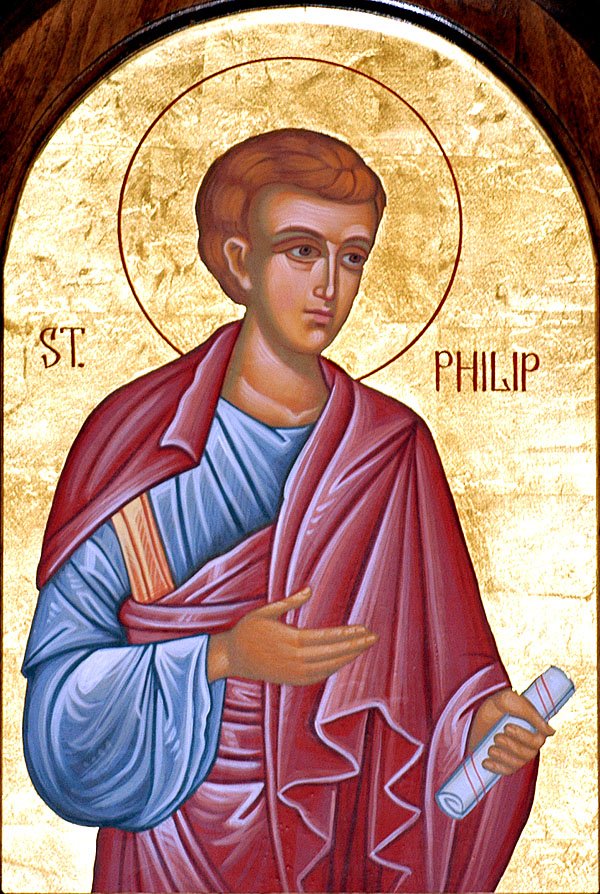
Apostle Philip of the Seventy

Apostle Philip of the Seventy

Holy Apostle Philip of the Seventy, one of the 7 Deacons is not to be confused with Saint Philip one of the Twelve Apostles (November 14). This Philip was born in Palestine, was married and had children. After the Descent of the Holy Spirit, the Twelve Apostles made Philip a deacon in the Church of Jerusalem. Holy Apostle Philip of the Seventy, one of the 7 Deacons is not to be confused with Saint Philip one of the Twelve Apostles (November 14). This Philip was born in Palestine, was married and had children. After the Descent of the Holy Spirit, the Twelve Apostles made Philip a deacon in the Church of Jerusalem. Along with the other six deacons, they appointed him to deal with the offerings of the faithful and attend to the concerns of the widowed, the orphaned and the needy. The eldest among the seven deacons was the holy Archdeacon Stephen. When the persecution of Christians began, the Jews stoned the Protomartyr Stephen. The Apostle Philip left Jerusalem and settled in Samaria. There he successfully preached Christianity. Among the disciple’s converts was the noted magician Simon, who “after being baptized, continued with Philip.” (Acts 8:9-13) At the command of an angel of the Lord, Saint Philip set out upon the road connecting Jerusalem with Gaza. There he met an official of the empress of Ethiopia, whom also he converted to Christianity (Acts 8:26-39). The holy disciple Philip tirelessly preached the Word of God in many of the lands of the Near East adjoining Palestine. At Jerusalem the Apostles made him a bishop and sent him to Tralles in Asia Minor, where he also baptized many. Saint Philip died in old age.

Troparion - Tone 3

Filled with divine grace, / you served God the Word as a deacon of the Church, O Apostle Philip. / By the working of miracles and by signs from God / you enlightened the multitudes of Samaria. / O blessed one, entreat Christ our God to grant us His great mercy.

Kontakion - Tone 4

Inspired by the All-Holy Spirit, / you enlightened the entire world by your teachings and resplendent miracles, / Apostle Philip, sacred initiate.

Ethelburga, Abbess of Barking

Saint Ethelburga (Aethelburh) was born into the royal family of East Anglia in the seventh century. She was the sister of Saint Erconwald (May 13), who founded the monastery of Barking (Berecingum) in Essex. Saint Ethelburga became the first abbess of this monastery. Saint Bede (May 27) says ( History of the English Church and People , Book IV, Chapters. Saint Ethelburga (Aethelburh) was born into the royal family of East Anglia in the seventh century. She was the sister of Saint Erconwald (May 13), who founded the monastery of Barking (Berecingum) in Essex. Saint Ethelburga became the first abbess of this monastery. Saint Bede (May 27) says ( History of the English Church and People , Book IV, Chapters. 6-9) that she was worthy of her holy brother in every way. She led a virtuous life and guided those who were under her. It is said that many miracles took place at the monastery during her time. Shortly before Saint Ethelburga’s death, a nun called Tortgith had a vision in which she saw a body wrapped in a shroud, and shining with a bright light. She watched as the body was drawn up to Heaven on cords which seemed brighter than gold. Sister Tortgith had no doubt that this vision signified the imminent death of one of the nuns. Not many days later, Saint Ethelburga fell asleep in the Lord. Years later, when the nun Tortgith was dying, Saint Ethelburga appeared to her and told her that the hour of her passing was at hand. This Saint Ethelburga should not be confused with another saint of the same name (April 5), who was married to the holy martyred King Edwin of Northumbria (October 12).

Troparion - Tone 8

By a flood of tears you made the desert fertile, / and your longing for God brought forth fruits in abundance. / By the radiance of miracles you illumined the whole universe! / O our holy mother Ethelburga, pray to Christ our God to save our souls!
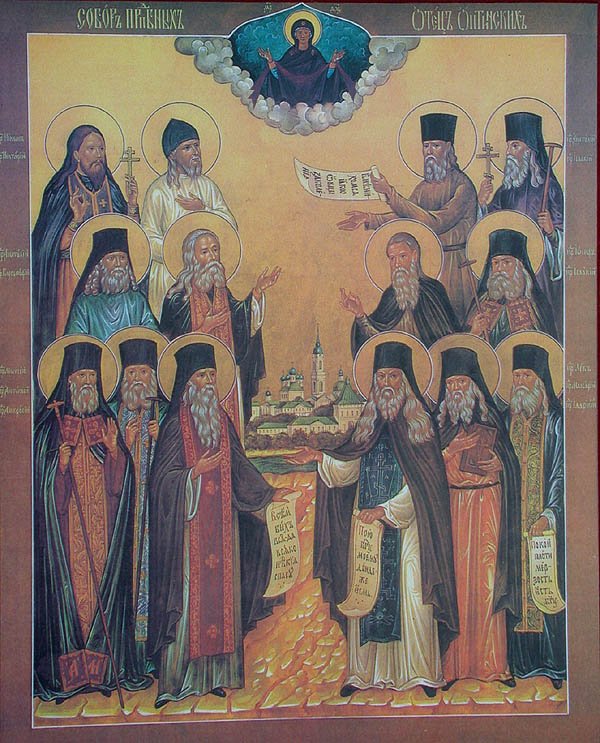
Synaxis of the Holy Startsi of Optina Monastery

Synaxis of the Holy Startsi of Optina Monastery

Today the Church honors the memory of the Holy Elders of Optina Monastery:

Troparion - Tone 6

O lamps of the Orthodox Faith, unshakable pillars of monasticism, / intercessors for the land of Russia, Venerable Elders of Optina, / who acquired the love of Christ and devoted your lives to your children; / entreat the Lord that your earthly homeland may be established in Orthodoxy and piety, and that our souls may be saved.

Kontakion - Tone 4

Truly wondrous is God in His Saints, Who revealed the Hermitage of Optina as a garden of eldership, / where the God-enlightened Fathers, knowing the secrets of the human heart, became valiant protectors of the people of God; / for they set those burdened by sin on the path of repentance, / enlightening those whose faith was wavering with the light of Christ's teachings, / and teaching them the wisdom of God, / they felt compassion for the sick and healed them. / Now, in God's glory, they pray unceasingly for our souls.
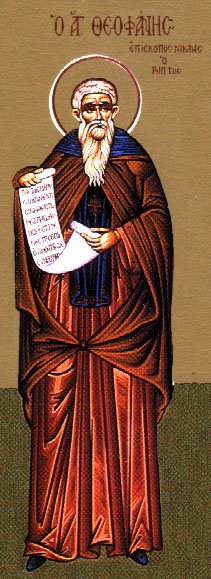
Saint Theophanes the Hymnographer (the Branded) (847)

Saint Theophanes the Hymnographer (the Branded) (847)

Saint Theophanes, Confessor and Hymnographer, Bishop of Nicea was the younger brother of the Saint Theodore the Branded (December 27). The brothers received an excellent education and were particularly involved in philosophy. Striving towards the knowledge of God, they settled in the Lavra of Saint Savva. Saint Theophanes, Confessor and Hymnographer, Bishop of Nicea was the younger brother of the Saint Theodore the Branded (December 27). The brothers received an excellent education and were particularly involved in philosophy. Striving towards the knowledge of God, they settled in the Lavra of Saint Savva. Here Saint Theophanes was tonsured, and later became a hieromonk. The holy brothers were famed as advocates of icon veneration. They boldly fulfilled the mission entrusted them by the Patriarch of Jerusalem and went to Constantinople to denounce the iconoclast emperor Leo the Armenian (813-820). Afterwards, they also denounced the iconoclast emperors Michael Balbos (820-829) and Theophilus (829-842). The saints had to endure imprisonment, hunger, even torture. The emperor Theophilus gave orders to inscribe a phrase insulting to the glorious confessors upon their faces with red-hot needles. Therefore, they are called “Branded”. “Write whatever you wish, but at the Last Judgment you shall read your own writing,” said the agonized brothers to the emperor. They sent Theodore to prison, where also he died (+ 833), but Theophanes was sent into exile. With the restoration of Icon veneration Saint Theophanes was returned from exile and consecrated Bishop of Nicea. The saint wrote about 150 canons, among which is a beautiful canon in defense of holy icons. He died peacefully around the year 850.

Troparion - Tone 5

Having attained an angelic state, / you sounded forth as a golden trumpet of revelation / and nourished the chosen people with your words. / The singing of your hymns gladdens the Church, / for which you struggled, O Theophanes.

Kontakion - Tone 4

You dawned on the Church like a second sun, venerable Theophanes, / enlightening her with the beams of your teachings / as a priest of Christ our God.

Our Holy Father Philotheos Kokkinos,Patriarch of Constantinople (1379)

He was born in Thessalonika around 1300; his mother was a convert from Judaism. He entered monastic life, first at Mt Sinai, then at the Great Lavra on Mt Athos. The so-called “Hesychast controversy” was then raging, and St Philotheos became one of the firmest and most effective supporters of St Gregory Palamas (November 14) in his defense of Orthodoxy against western-inspired attacks on the doctrines of uncreated Grace and the possibility of true union with God. It He was born in Thessalonika around 1300; his mother was a convert from Judaism. He entered monastic life, first at Mt Sinai, then at the Great Lavra on Mt Athos. The so-called “Hesychast controversy” was then raging, and St Philotheos became one of the firmest and most effective supporters of St Gregory Palamas (November 14) in his defense of Orthodoxy against western-inspired attacks on the doctrines of uncreated Grace and the possibility of true union with God. It was St Philotheos who drafted the Hagiorite Tome, the manifesto of the monks of Mt Athos setting forth how the Saints partake of the Divine and uncreated Light which the Apostles beheld at Christ’s Transfiguration. In 1351, he took part in the “Hesychast Council” in Constantinople, and wrote its Acts. In 1354 he was made Patriarch of Constantinople; he stepped down after one year, but was recalled to the Patriarchal throne in 1364. He continued to be a zealous champion of undiluted Orthodoxy, writing treatises setting forth the theology of the Uncreated Energies of God and refuting the scholastic philosophy that was then infecting the Western church. Despite (or because of?) his uncompromising Orthodoxy, he always sought a true, rather than political, reconciliation with the West, and even worked to convene an Ecumenical Council to resolve the differences between the churches. This holy Patriarch was deposed in 1376 when the Emperor Andronicus IV came to the throne; he died in exile in 1379. St Philotheos composed the Church’s services to St Gregory Palamas. He is not listed in the Synaxaria, but is venerated as a Saint in the Greek church.

Scripture Readings

☩Epistle

Ephesians 1:22-2:3

22 And hath put all things under his feet, and gave him to be the head over all things to the church,
23 Which is his body, the fulness of him that filleth all in all.
1 And you hath he quickened, who were dead in trespasses and sins;
2 Wherein in time past ye walked according to the course of this world, according to the prince of the power of the air, the spirit that now worketh in the children of disobedience:
3 Among whom also we all had our conversation in times past in the lusts of our flesh, fulfilling the desires of the flesh and of the mind; and were by nature the children of wrath, even as others.

☩Gospel

Luke 7:36-50

36 And one of the Pharisees desired him that he would eat with him. And he went into the Pharisee’s house, and sat down to meat.
37 And, behold, a woman in the city, which was a sinner, when she knew that Jesus sat at meat in the Pharisee’s house, brought an alabaster box of ointment,
38 And stood at his feet behind him weeping, and began to wash his feet with tears, and did wipe them with the hairs of her head, and kissed his feet, and anointed them with the ointment.
39 Now when the Pharisee which had bidden him saw it, he spake within himself, saying, This man, if he were a prophet, would have known who and what manner of woman this is that toucheth him: for she is a sinner.
40 And Jesus answering said unto him, Simon, I have somewhat to say unto thee. And he saith, Master, say on.
41 There was a certain creditor which had two debtors: the one owed five hundred pence, and the other fifty.
42 And when they had nothing to pay, he frankly forgave them both. Tell me therefore, which of them will love him most?
43 Simon answered and said, I suppose that he, to whom he forgave most. And he said unto him, Thou hast rightly judged.
44 And he turned to the woman, and said unto Simon, Seest thou this woman? I entered into thine house, thou gavest me no water for my feet: but she hath washed my feet with tears, and wiped them with the hairs of her head.
45 Thou gavest me no kiss: but this woman since the time I came in hath not ceased to kiss my feet.
46 My head with oil thou didst not anoint: but this woman hath anointed my feet with ointment.
47 Wherefore I say unto thee, Her sins, which are many, are forgiven; for she loved much: but to whom little is forgiven, the same loveth little.
48 And he said unto her, Thy sins are forgiven.
49 And they that sat at meat with him began to say within themselves, Who is this that forgiveth sins also?
50 And he said to the woman, Thy faith hath saved thee; go in peace.

Liturgical data sourced from OCA.org and orthocal.info