
Fasting Rules
 Meat
Allowed
 Fish
Allowed
 Dairy
Allowed
 Oil
Allowed
 Wine
Allowed
Saints & Commemorations
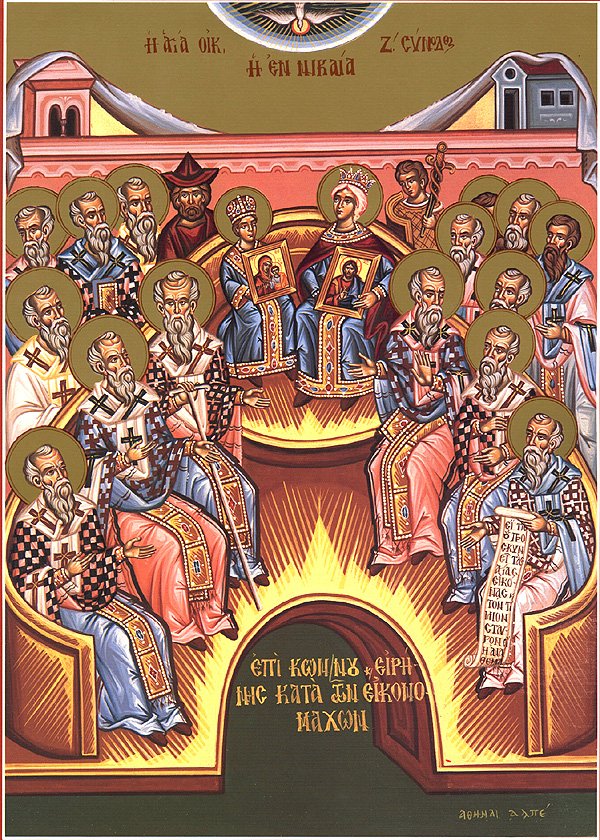
Fathers of the Seventh Ecumenical Council
Today the Church remembers the 350 holy Fathers of the Seventh Ecumenical Council under the holy Patriarch Tarasius (February 25).
The Synod of 787, the second to meet at Nicea, refuted the Iconoclast heresy during the reign of Empress Irene and her son Constantine VI.
The Council decreed that the veneration of icons was not idolatry (Exodus 20:4-5), because the honor shown to them is not directed to the wood or paint, but passes to the prototype (the person depicted).
Today the Church remembers the 350 holy Fathers of the Seventh Ecumenical Council under the holy Patriarch Tarasius (February 25).
The Synod of 787, the second to meet at Nicea, refuted the Iconoclast heresy during the reign of Empress Irene and her son Constantine VI.
The Council decreed that the veneration of icons was not idolatry (Exodus 20:4-5), because the honor shown to them is not directed to the wood or paint, but passes to the prototype (the person depicted). It also upheld the possibility of depicting Christ, Who became man and took flesh at His Incarnation. The Father, on the other hand, cannot be represented in His eternal nature, because “no man has seen God at any time” (John 1:18).
In Greek practice, the holy God-bearing Fathers of the Seventh Ecumenical Council are commemorated on October 11 (if it is a Sunday), or on the Sunday which follows October 11. According to the Slavic menaion, however, if the eleventh falls on Monday, Tuesday, or Wednesday, the service is moved to the preceding Sunday.
Troparion - Tone 8
Most glorious art Thou, O Christ our God, / Who hast established the Holy Fathers as luminaries on the earth. / By them Thou hast guided us on the path of the True Faith. / O Most Merciful One, glory to Thee!
Kontakion - Tone 6
The Son, Who shone forth ineffably from the Father, / was born of a woman, in two natures. / Beholding Him, we do not deny the image of His form, / but depicting it piously, we revere it with faith. / Therefore, the Church, holding the True Faith, / venerates the Icon of Christ's Incarnation.
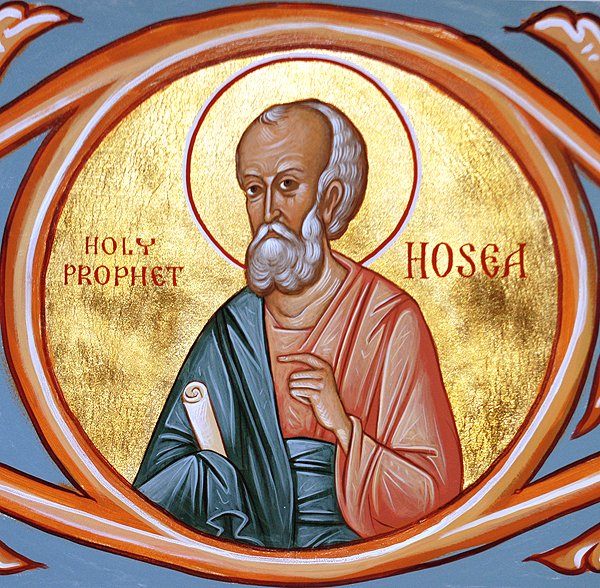
Prophet Hosea
The Holy Prophet Hosea the first of the minor prophets, belonged to the tribe of Issachar. He lived during the ninth Century before Christ, in the kingdom of Israel. He was a contemporary of the holy Prophets Isaiah, Micah and Amos. During this time, many of his fellow Israelites had forgotten the true God, and worshipped idols.
The Holy Prophet Hosea the first of the minor prophets, belonged to the tribe of Issachar. He lived during the ninth Century before Christ, in the kingdom of Israel. He was a contemporary of the holy Prophets Isaiah, Micah and Amos. During this time, many of his fellow Israelites had forgotten the true God, and worshipped idols. The holy Prophet Hosea attempted to turn them again to the faith of their Fathers by his wise counsels. Denouncing the iniquities of the people of Israel (i.e. the northern kingdom Israel), the prophet proclaimed to them great misfortunes from a foreign people and their removal into captivity by Assyria.
Almost a thousand years before the coming of the Savior, and through the inspiration of the Holy Spirit, the prophet foretold the end of sacrificial offerings and of the priesthood of Aaron (Hos. 3:4-5), and that the knowledge of the True God would spread through all the earth (Hos. 2:20-23). Hosea spoke also about Christ, how He would return from out of Egypt (Hos. 11:1; compare Mt. 2:15), that He would be resurrected on the third day (Hos. 6 and especially Hos.6:2; compare with 1 Cor.15:4), and that He would conquer death (Hos.13-14. Compare 1 Cor.15:54-55).
The prophesies of Saint Hosea are included in the book that bears his name. The prophetic service of Saint Hosea continued for more than sixty years. The God-inspired prophet died in deep old age, having devoted all his life to fulfilling the Will of God.
Troparion - Tone 2
We celebrate the memory / of Your prophet Hosea, O Lord; / through him we entreat You, / save our souls.
Kontakion - Tone 4
Enlightened by the Spirit, your pure heart became the dwelling place of most splendid prophecy; / for you saw things far off as if they were near. / Therefore, we honor you, blessed and glorious Prophet Hosea.
Monastic Martyr Andrew of Crete
The Hieromartyr Andrew of Crete lived during the reign of the iconoclast emperor Constantine Kopronymos (741-775), who ordered Christians, under penalty of death, to remove the holy icons from their churches and homes. Believers, who fearlessly resisted the impious iconoclast, and held firmly to the traditions of the holy Fathers, were locked in prison.
The Hieromartyr Andrew of Crete lived during the reign of the iconoclast emperor Constantine Kopronymos (741-775), who ordered Christians, under penalty of death, to remove the holy icons from their churches and homes. Believers, who fearlessly resisted the impious iconoclast, and held firmly to the traditions of the holy Fathers, were locked in prison. When the venerable Andrew heard that the emperor was throwing virtuous and pious Christians into prison instead of thieves and robbers, he went to the Church of the Great Martyr Mamas (September 2) in Constantinople and in front of everyone, denounced the heretic for persecuting the true Faith.
In an attempt to justify himself the emperor said that it was folly to bestow veneration on wood and paint. To this the monk replied that whoever suffers for holy icons suffers for Christ, but whoever reviles the icon upon which Christ is depicted, offers insult to Christ Himself. The enraged iconoclast gave orders to torture Saint Andrew without mercy.
As he was being dragged through the streets to the place of execution, someone cut off the saint’s feet. As a result, Saint Andrew was freed from his torments by death. A hundred years later a Canon was written to the saint by Saint Joseph the Hymnographer (April 4). The saint heals those afflicted with seizures.
Troparion - Tone 4
Trained in asceticism on the mountain, / with the weapon of the Cross you destroyed the spiritual assaults of the hostile powers, all-blessed one; / Again you bravely prepared for combat / and slew Copronymus with the sword of faith; / for both struggles you have been crowned by God, monk-martyr Andrew of eternal memory.
Kontakion - Tone 3
Today the Queen of cities / celebrates the radiant feast of your light-bearing memory, / and invites every city and country to join her. / She rejoices for she has gained a great treasure: / your body which sustained many struggles, martyr Andrew, beacon of Orthodoxy.
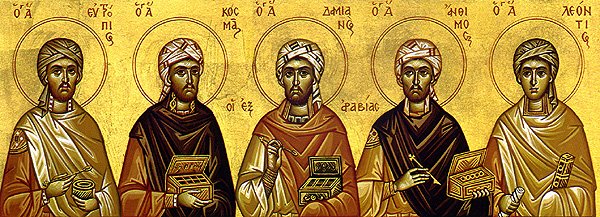
Holy Martyrs Cosmas and Damian, the Unmercenaries of Cilicia (4th c.)
The Martyrs and Unmercenaries Cosmas and Damian in Cilicia (Arabia), and the Martyrs Leontius, Anthimus and Eutropius. The holy brothers Cosmas and Damian were physicians in Arabia, who believed in Christ. They traveled through the cities and the villages, preaching Christ and healing the sick. The saints would not take any sort of payment for the help they rendered.
The Martyrs and Unmercenaries Cosmas and Damian in Cilicia (Arabia), and the Martyrs Leontius, Anthimus and Eutropius. The holy brothers Cosmas and Damian were physicians in Arabia, who believed in Christ. They traveled through the cities and the villages, preaching Christ and healing the sick. The saints would not take any sort of payment for the help they rendered. In Cilicia, pagans seized the holy physicians and led them before the governor, Lysias. Since they refused to renounce Christianity, the governor ordered the saints to be brutally beaten, and then cast into the sea.
An angel of God rescued them from the sea and brought them to shore. Then the pagans beheaded the saints and three other Christians: Leontius, Anthimus, and Eutropius.
The Unmercenary Saints Cosmas and Damian of Arabia should not be confused with the Unmercenary Saints Cosmas and Damian of Asia Minor (November 1), or the Unmercenary Saints Cosmas and Damian of Rome (July 1).
Troparion - Tone 4
Your holy martyrs O Lord, / through their sufferings have received incorruptible crowns from You, our God. / For having Your strength, they laid low their adversaries, / and shattered the powerless boldness of demons. / Through their intercessions, save our souls!
Scripture Readings
☩Epistle
2 Corinthians 6:16-7:1
16
And what agreement hath the temple of God with idols? for ye are the temple of the living God; as God hath said, I will dwell in them, and walk in them; and I will be their God, and they shall be my people.
17
Wherefore come out from among them, and be ye separate, saith the Lord, and touch not the unclean thing; and I will receive you,
18
And will be a Father unto you, and ye shall be my sons and daughters, saith the Lord Almighty.
1
Having therefore these promises, dearly beloved, let us cleanse ourselves from all filthiness of the flesh and spirit, perfecting holiness in the fear of God.
☩Gospel
Luke 8:5-15
5
A sower went out to sow his seed: and as he sowed, some fell by the way side; and it was trodden down, and the fowls of the air devoured it.
6
And some fell upon a rock; and as soon as it was sprung up, it withered away, because it lacked moisture.
7
And some fell among thorns; and the thorns sprang up with it, and choked it.
8
And other fell on good ground, and sprang up, and bare fruit an hundredfold. And when he had said these things, he cried, He that hath ears to hear, let him hear.
9
And his disciples asked him, saying, What might this parable be?
10
And he said, Unto you it is given to know the mysteries of the kingdom of God: but to others in parables; that seeing they might not see, and hearing they might not understand.
11
Now the parable is this: The seed is the word of God.
12
Those by the way side are they that hear; then cometh the devil, and taketh away the word out of their hearts, lest they should believe and be saved.
13
They on the rock are they, which, when they hear, receive the word with joy; and these have no root, which for a while believe, and in time of temptation fall away.
14
And that which fell among thorns are they, which, when they have heard, go forth, and are choked with cares and riches and pleasures of this life, and bring no fruit to perfection.
15
But that on the good ground are they, which in an honest and good heart, having heard the word, keep it, and bring forth fruit with patience.
Liturgical data sourced from OCA.org and orthocal.info