
Fasting Rules
 Meat
Allowed
 Fish
Allowed
 Dairy
Allowed
 Oil
Allowed
 Wine
Allowed
Saints & Commemorations
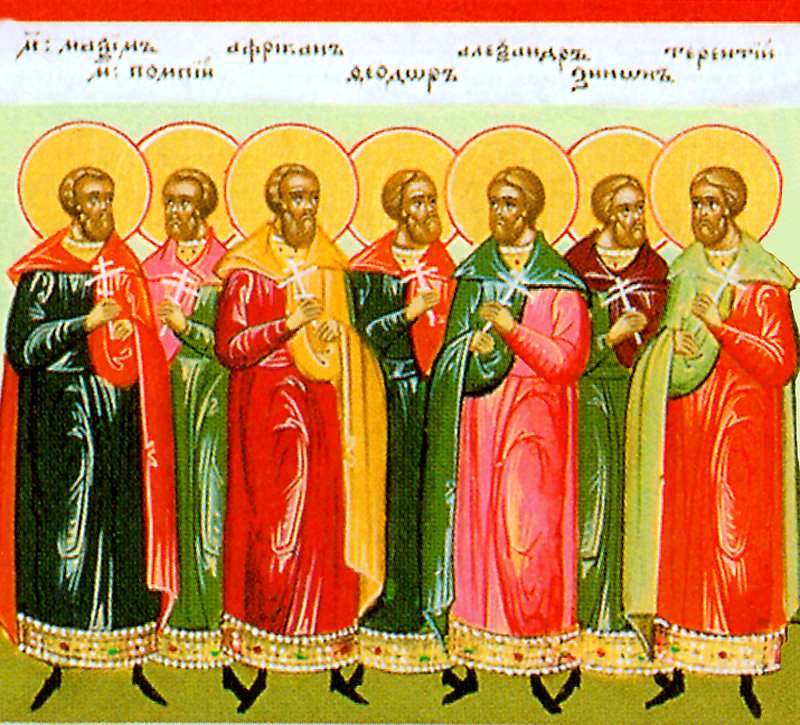
Martyrs Terence, Neonila and Children
Saint Terence was from Syria, and suffered for Christ with his wife Neonila and their seven children Sabelus, Photius, Theodoulus, Vele, Hierax, Nitus, and Eunice. They were denounced as Christians and brought before the authorities for interrogation.
The saints confessed Christ and mocked the pagan gods, even as their sides were raked with iron hooks.
Saint Terence was from Syria, and suffered for Christ with his wife Neonila and their seven children Sabelus, Photius, Theodoulus, Vele, Hierax, Nitus, and Eunice. They were denounced as Christians and brought before the authorities for interrogation.
The saints confessed Christ and mocked the pagan gods, even as their sides were raked with iron hooks. Vinegar was poured into their wounds, which were then set afire. The saints encouraged one another and prayed to God to help them. He sent angels to free them from their bonds and to heal their wounds.
Then the saints were thrown to the wild beasts, who became gentle and did not harm them. Afterward, they were thrown into a cauldron filled with hot pitch, but they were not burned. Seeing that nothing could harm the saints, the pagans beheaded them.
Troparion - Tone 3
Bound together by natural bonds / and clothed with the might of faith, / you walked the path of martyrdom with your seven children. / O holy Martyrs Terence and Neonilla, / pray that those who honor your contest may receive forgiveness of their sins.
Kontakion - Tone 4
The universe rejoices at the honorable commemoration of the martyrs: / Terence the most-wise, his wife Neonila, and their children. / Therefore, let us hasten that we may receive healing; / for he has received grace from the Holy Spirit / to cure the sicknesses and ills of our souls.
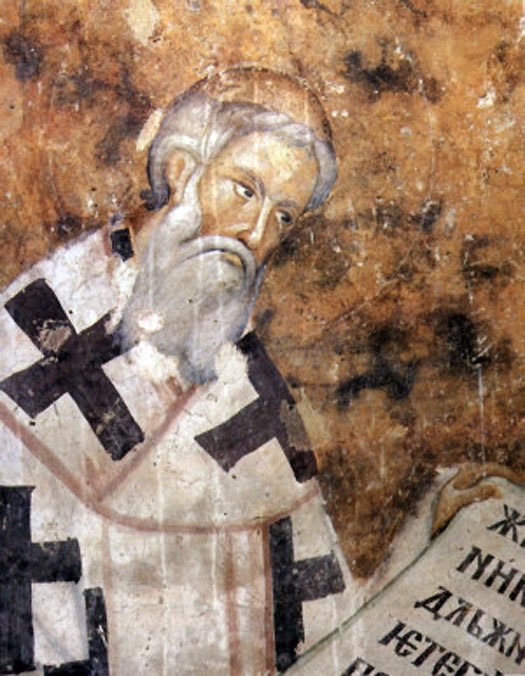
St Arsenius of Serbia
Saint Arsenius, Archbishop of Pec, was born in Srem. He spent a large part of his life as a monk at the Zhicha monastery under the spiritual direction of Saint Savva (January 14). Because of his strict ascetic life, Saint Savva made him the igumen of the monastery.
When Serbia was invaded by Hungary, Saint Savva sent Saint Arsenius to find a safer place in the south for a new episcopal See.
Saint Arsenius, Archbishop of Pec, was born in Srem. He spent a large part of his life as a monk at the Zhicha monastery under the spiritual direction of Saint Savva (January 14). Because of his strict ascetic life, Saint Savva made him the igumen of the monastery.
When Serbia was invaded by Hungary, Saint Savva sent Saint Arsenius to find a safer place in the south for a new episcopal See. Arsenius chose Pec, where he built a monastery and a church which was dedicated to the Holy Apostles, and then to the Lord’s Ascension.
Before leaving for Jerusalem, Saint Savva designated Arsenius as his successor.
In 1223, Saint Savva died in Trnovo on the way home, and Saint Arsenius urged King Vladislav to bring his body home for burial in Serbia. After thirty-three years of wisely guiding his flock, Saint Arsenius fell asleep in the Lord in the year 1266. His relics were buried at the Pec monastery, but now rest in the Zhrebaonik, Montenegro.
Troparion - Tone 4
In truth you were revealed to your flock as a rule of faith, / an image of humility and a teacher of abstinence; / your humility exalted you; / your poverty enriched you. / Hierarch Father Arsenius, / entreat Christ our God / that our souls may be saved.
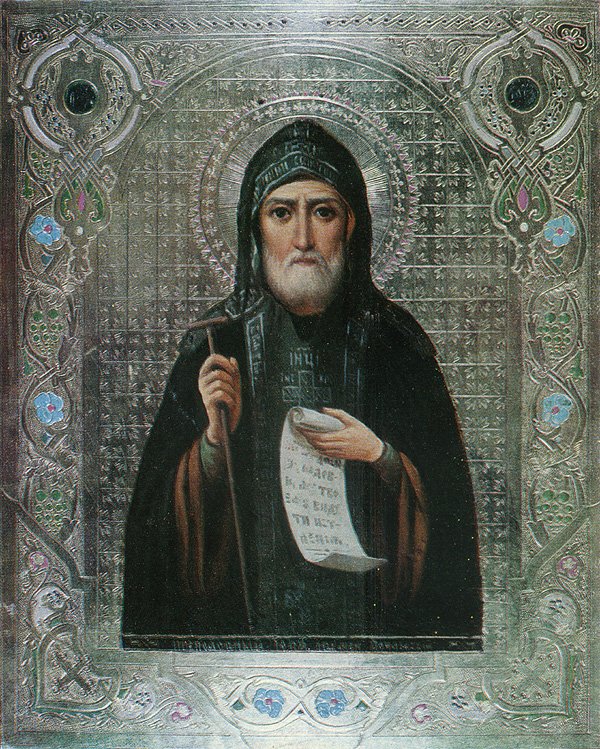
Rep. Ven. Job of Pochaev
Saint Job, Abbot and Wonderworker of Pochaev (in the world named Ivan Zhelezo), was born around 1551 in Pokutia in Galicia. At age ten he came to the Transfiguration Ugornits monastery, and at age twelve he received monastic tonsure with the name Job. The venerable Job from his youth was known for his great piety and strict ascetic life, and he was accounted worthy of the priestly office.
Saint Job, Abbot and Wonderworker of Pochaev (in the world named Ivan Zhelezo), was born around 1551 in Pokutia in Galicia. At age ten he came to the Transfiguration Ugornits monastery, and at age twelve he received monastic tonsure with the name Job. The venerable Job from his youth was known for his great piety and strict ascetic life, and he was accounted worthy of the priestly office.
Around the year 1580, at the request of the renowned champion of Orthodoxy Prince Constantine Ostrozhsky, Saint Job was appointed the head of the Exaltation of the Cross monastery near the city of Dubno, and for more than twenty years he governed the monastery amidst the growing persecution of Orthodoxy on the part of the Catholics and Uniates.
At the beginning of the seventeenth century, Saint Job withdrew to Pochaev hill and settled in a cave not far from the ancient Dormition monastery, famed for its wonderworking Pochaev Icon of the Mother of God (July 23). The holy hermit, beloved by the brethren of the monastery, was chosen as their Igumen. Saint Job zealously fulfilled his duty as head of the monastery, kind and gentle with the brethren, he did much of the work himself, planting trees in the garden, and strengthening the waterworks at the monastery.
Saint Job was an ardent defender of the Orthodox Faith against the persecution of the Catholics. Following the Union of Brest (1596), many Orthodox living in Poland were deprived of their rights, and attempts were made to force them to convert to Catholicism. Many Orthodox hierarchs became apostates to Uniatism, but Saint Job and others defended Orthodoxy by copying and disseminating Orthodox books. Prince Ostrozhsky was also responsible for the first printed edition of the Orthodox Bible (1581).
In taking an active part in the defense of Orthodoxy and the Russian people, Saint Job was present at the 1628 Kiev Council, convened against the Unia. After 1642, he accepted the great schema with the name John.
Sometimes he completely secluded himself within the cave for three days or even a whole week. The Jesus Prayer was an unceasing prayer in his heart. According to the testimony of his disciple Dositheus, and author of the Life of Saint Job, once while praying in his cave, the saint was illumined by a heavenly light. Saint Job reposed in the year 1651. He was more than 100 years old, and had directed the Pochaev monastery for more than fifty years.
The uncovering of Saint Job’s relics took place on August 28, 1659. There was a second uncovering of the relics on August 27-28, 1833.
Troparion - Tone 4
Attaining the patience of our long-suffering Forefather, / and similar to the abstinence of John the Baptist, partaking of the divine fervor of both, / you were worthy to receive their names, / and you were a fearless preacher of the true Faith, / thereby you brought a multitude of monks to Christ, / and you confirmed all the people in Orthodoxy. / O Venerable Father Job, pray that our souls may be saved.
Kontakion - Tone 4
You appeared as a pillar of the true Faith and as one zealous for the Gospel's commandments, a denouncer of pride, and an intercessor and instructor of the humble, / therefore, pray for the remission of sins of those who glorify you, / and preserve your Monastery unharmed, / O Job our Father, resembling the much-suffering Job.
St Dimitri (Demetrius) of Rostov (1709)
Born near Kiev, he was raised in piety and, at the early age of eleven, entered the Ecclesiastical Academy of Kiev. At the age of seventeen he was professed as a monk. A few years later he was ordained to the priesthood. Despite his constant desire to retire into a life of asceticism and solitude, his many gifts were needed by the Church and, much against his will, he spent most of his life engaged in writing and other labors.
Born near Kiev, he was raised in piety and, at the early age of eleven, entered the Ecclesiastical Academy of Kiev. At the age of seventeen he was professed as a monk. A few years later he was ordained to the priesthood. Despite his constant desire to retire into a life of asceticism and solitude, his many gifts were needed by the Church and, much against his will, he spent most of his life engaged in writing and other labors. The Abbot of the Lavra of the Kiev Caves, knowing his scholarly abilities, called him to compile a Russian-language Lives of the Saints, a work to which he devoted himself tirelessly for twenty-five years.
This compilation was not a dry exercise for him; he approached each Saint’s life with prayer, and was often granted visions. The holy Martyr Barbara appeared to him in his sleep in 1685; when he asked her to intercede for him to the Lord, she chided him for praying “in the Latin Way,” that is, for using short prayers. Seeing his distress at being so rebuked, she smiled and said “Do not be afraid!”
St Demetrius was elevated to the episcopal throne (of Metropolitan of Tobolsk and Siberia) in 1701, but asked to be transferred due to ill health, and because the Siberian see would not allow him to continue his research. So he was appointed to the Diocese of Rostov in 1702; he received a divine revelation that he would end his years there. He completed his monumental Lives of the Saints in 1705; thereafter he devoted his energies to the care of his flock, the education of priests, and many spiritual writings, including several addressed to the schismatic “Old Believers,” pleading with them to rejoin the canonical Church.
Despite his poor health, he maintained a life of strict prayer and fasting, and encouraged his faithful, in his sermons and writings, to do the same. He predicted his own death three days beforehand. The Synaxarion concludes: “the holy Bishop fell at the feet of his servants and chanters, and asked their forgiveness. Then, with an ardent prayer on his lips, he shut himself in his cell. The next morning, 28 October 1709, they discovered him dead upon his knees. The relics of Saint Demetrius were found incorrupt in 1752 and they wrought many healings. He was formally glorified by the Church in 1757.”
Our Holy Father Firmilian, Bishop of Caesarea (268)
Born to a noble family of Caesarea in Cappadocia, he studied under Origen with his friend St Gregory the Wonderworker (November 17). He became Bishop of Caesarea around 230. In 252 he took part in the Council of Antioch, which condemned the schismatic Novatian and his followers, who denied all hope of repentance and restoration to the Church for those who had denied the Faith to avoid persecution.
Born to a noble family of Caesarea in Cappadocia, he studied under Origen with his friend St Gregory the Wonderworker (November 17). He became Bishop of Caesarea around 230. In 252 he took part in the Council of Antioch, which condemned the schismatic Novatian and his followers, who denied all hope of repentance and restoration to the Church for those who had denied the Faith to avoid persecution.
Firmilian devoted much energy to defending the churches of Asia and Africa from unlawful domination by Pope Stephen of Rome. The Asian and African churches baptized heretics who returned to the Church; Rome reconciled them simply by the laying on of hands. Firmilian did not condemn the Roman practice, but zealously defended the local churches’ right to keep their practice, rather than have the Pope dictate the practices of the entire Church.
The holy Bishop was then called upon to combat the heresy of Paul of Samosata, Bishop of Antioch. Paul taught that the Word of God is not one in essence with the Father, but is only a word of divine inspiration sent to the man Jesus. (This is undoubtedly the belief of many ‘Christians’ today!) Seeing in this teaching a complete denial of our salvation in Christ, fully man and fully God, Firmilian called three successive Councils (in 263, 266 and 268) to deal with the heresy. The first two were undermined by Paul and his party; but at the third the heresy was finally condemned and Paul of Samosata excommunicated. Saint Firmilian died in the city of Tarsus while traveling to this Council.
Holy Hieromartyr Cyriacus, Bishop of Jerusalem, and his mother Anna (4th c.)
The Hieromartyr Cyriacus, Patriarch of Jerusalem, was a Jew who pointed out to the holy Empress Helen the place where the Life-Creating Cross of Christ lay buried (September 14). Being present at the discovery of the Cross, Cyriacus (before Baptism he was named Jude) sincerely came to believe in Christ the true God, and he became a Christian.
The Hieromartyr Cyriacus, Patriarch of Jerusalem, was a Jew who pointed out to the holy Empress Helen the place where the Life-Creating Cross of Christ lay buried (September 14). Being present at the discovery of the Cross, Cyriacus (before Baptism he was named Jude) sincerely came to believe in Christ the true God, and he became a Christian. Cyriacus, because of his pure and virtuous life, was later chosen to be Patriarch of Jerusalem. He suffered martyrdom under the emperor Julian.
During the cruel persecution under Julian the Apostate, in the year 363, Saint Cyriacus accepted suffering for the Faith. He was killed after prolonged tortures.
Troparion - Tone 4
By sharing in the ways of the Apostles, / you became a successor to their throne. / Through the practice of virtue, you found the way to divine contemplation, O inspired one of God; / by teaching the word of truth without error, you defended the Faith, / even to the shedding of your blood. / Hieromartyr Cyriacus, entreat Christ God to save our souls.
Scripture Readings
☩Epistle
Philippians 1:20-27
20
According to my earnest expectation and my hope, that in nothing I shall be ashamed, but that with all boldness, as always, so now also Christ shall be magnified in my body, whether it be by life, or by death.
21
For to me to live is Christ, and to die is gain.
22
But if I live in the flesh, this is the fruit of my labour: yet what I shall choose I wot not.
23
For I am in a strait betwixt two, having a desire to depart, and to be with Christ; which is far better:
24
Nevertheless to abide in the flesh is more needful for you.
25
And having this confidence, I know that I shall abide and continue with you all for your furtherance and joy of faith;
26
That your rejoicing may be more abundant in Jesus Christ for me by my coming to you again.
27
Only let your conversation be as it becometh the gospel of Christ: that whether I come and see you, or else be absent, I may hear of your affairs, that ye stand fast in one spirit, with one mind striving together for the faith of the gospel;
☩Gospel
Luke 11:14-23
14
And he was casting out a devil, and it was dumb. And it came to pass, when the devil was gone out, the dumb spake; and the people wondered.
15
But some of them said, He casteth out devils through Beelzebub the chief of the devils.
16
And others, tempting him, sought of him a sign from heaven.
17
But he, knowing their thoughts, said unto them, Every kingdom divided against itself is brought to desolation; and a house divided against a house falleth.
18
If Satan also be divided against himself, how shall his kingdom stand? because ye say that I cast out devils through Beelzebub.
19
And if I by Beelzebub cast out devils, by whom do your sons cast them out? therefore shall they be your judges.
20
But if I with the finger of God cast out devils, no doubt the kingdom of God is come upon you.
21
When a strong man armed keepeth his palace, his goods are in peace:
22
But when a stronger than he shall come upon him, and overcome him, he taketh from him all his armour wherein he trusted, and divideth his spoils.
23
He that is not with me is against me: and he that gathereth not with me scattereth.
Liturgical data sourced from OCA.org and orthocal.info