
Fasting Rules
 Meat
Allowed
 Fish
Allowed
 Dairy
Allowed
 Oil
Allowed
 Wine
Allowed
Saints & Commemorations
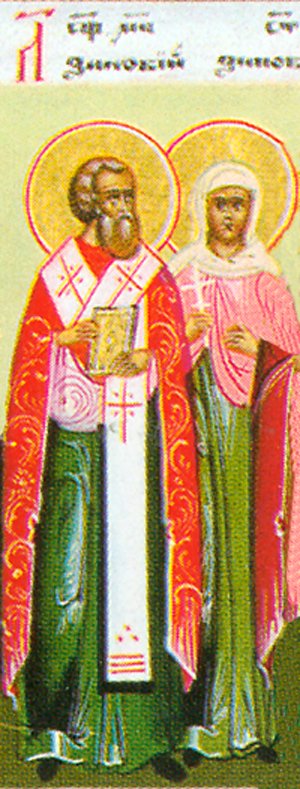
Hieromartyr Zenobius and His Sister Zenobia
The Hieromartyr Zenobius, Bishop of Aegea, and his sister Zenobia suffered a martyr’s death in the year 285 in Cilicia. From childhood they were raised in the holy Christian Faith by their parents, and they led pious and chaste lives. In their mature years, shunning the love of money, they distributed away their inherited wealth giving it to the poor. F
The Hieromartyr Zenobius, Bishop of Aegea, and his sister Zenobia suffered a martyr’s death in the year 285 in Cilicia. From childhood they were raised in the holy Christian Faith by their parents, and they led pious and chaste lives. In their mature years, shunning the love of money, they distributed away their inherited wealth giving it to the poor. For his beneficence and holy life the Lord rewarded Zenobius with the gift of healing various maladies. He was also chosen bishop of a Christian community in Cilicia.
As bishop, Saint Zenobius zealously spread the Christian Faith among the pagans. When the emperor Diocletian (284-305) began a persecution against Christians, Bishop Zenobius was the first one arrested and brought to trial to the governor Licius. “I shall only speak briefly with you,” said Licius to the saint, “for I propose to grant you life if you worship our gods, or death, if you do not.” The saint answered, “This present life without Christ is death. It is better that I prepare to endure the present torment for my Creator, and then with Him live eternally, than to renounce Him for the sake of the present life, and then be tormented eternally in Hades.”
By order of Licius, they nailed him to a cross and began the torture. The bishop’s sister, seeing him suffering, wanted to stop it. She bravely confessed her own faith in Christ before the governor, therefore, she also was tortured.
By the power of the Lord they remained alive after being placed on a red-hot iron bed, and then in a boiling kettle. The saints were then beheaded. The priest Hermogenes secretly buried the bodies of the martyrs in a single grave.
Saint Zenobius is invoked by those suffering from breast cancer.
Troparion - Tone 4
O glorious Zenobios and pure Zenobia, / as siblings united in godliness, / you contested together, and obtained incorruptible crowns; / you are also worthy of everlasting glory, / for together you shine forth upon those in the world with the grace of healing.
Kontakion - Tone 8
With God-inspired hymns, let us honor the two Martyrs and preachers of piety, / Zenobios and the glorious Zēnobίa, / who lived and suffered together / and through martyrdom, / they have obtained incorruptible crowns.
Holy Apostle Cleopas
He is numbered among the Seventy. On the day of the Resurrection, Cleopas and St Luke were walking on the road from Jerusalem to Emmaus when the Risen Christ appeared to them, as recounted in the twenty-fourth chapter of St Luke’s Gospel.
The Gospel account does not name St Cleopas’ companion, but the holy tradition of the Church tells us that it was
He is numbered among the Seventy. On the day of the Resurrection, Cleopas and St Luke were walking on the road from Jerusalem to Emmaus when the Risen Christ appeared to them, as recounted in the twenty-fourth chapter of St Luke’s Gospel.
The Gospel account does not name St Cleopas’ companion, but the holy tradition of the Church tells us that it was St Luke himself, and thus that the story is a first-hand account.
St Joseph I, Patriarch of Constantinople (1283)
Once a married priest, he entered monastic life when his wife died, and became the spiritual father of the Emperor Michael VIII Paleologus, during whose reign he was elevated to the Patriarchate. Despite this patronage, St Joseph’s integrity was inviolable: At his first Divine Liturgy as Patriarch, he required the Emperor publicly to confess and repent of several sins before admitting him to Communion. H
Once a married priest, he entered monastic life when his wife died, and became the spiritual father of the Emperor Michael VIII Paleologus, during whose reign he was elevated to the Patriarchate. Despite this patronage, St Joseph’s integrity was inviolable: At his first Divine Liturgy as Patriarch, he required the Emperor publicly to confess and repent of several sins before admitting him to Communion. He fiercely opposed the Emperor’s expedient policy of union with Rome, and was therefore deposed, retiring once more to monastic life. In old age, he was restored to the Patriarchal throne upon the death of Emperor Michael, but died a few months later.
Holy Martyr Hermengild, Prince of the Visigoths (486)
He was the son and appointed heir of Leuvgild, King of the Visigoths, who had embraced the Christianity of the Arian heretics. But through the teaching of Bishop Leander of Seville (February 27), Hermengild was converted to the fullness of the Orthodox faith, for which his father the King had him thrown in prison.
He was the son and appointed heir of Leuvgild, King of the Visigoths, who had embraced the Christianity of the Arian heretics. But through the teaching of Bishop Leander of Seville (February 27), Hermengild was converted to the fullness of the Orthodox faith, for which his father the King had him thrown in prison. On the day of Pascha 486, the King sent one of his priests to give his son communion. But Hermengild refused, proclaiming that to commune with heretics is to assent to their belief and to sink into their error; going further, he told the priest that the heretics’ communion was nothing but bread and wine, for the Body and Blood of Christ are found only in the Offering made by the Church. The enraged King sent soldiers, who at his orders put his own son to death. Later, the King repented of this inhuman deed and asked Bishop Leander to instruct his youngest son Recared in the Orthodox faith. Thus the Visigoth people was brought into the Faith.
Holy Hieromartyr John Kochurov, First Hieromartyr of the Russian Revolution (1917)
He was born in Russia in 1871, and as a young priest was sent to America as a missionary. There he worked zealously (he was instrumental in the building of the Orthodox cathedral in Chicago) until he was called back to Russia just before the October Revolution in 1917. Only six days after the Bolsheviks seized power, he was beaten to death in the street by a gang of Bolshevik sailors in Tsarskoye Selo near St Petersburg.
He was born in Russia in 1871, and as a young priest was sent to America as a missionary. There he worked zealously (he was instrumental in the building of the Orthodox cathedral in Chicago) until he was called back to Russia just before the October Revolution in 1917. Only six days after the Bolsheviks seized power, he was beaten to death in the street by a gang of Bolshevik sailors in Tsarskoye Selo near St Petersburg. Thus he became the first of countless Priest-Martyrs of Russia’s atheist yoke.
Scripture Readings
☩Epistle
1 Corinthians 15:58-16:3
58
Therefore, my beloved brethren, be ye stedfast, unmoveable, always abounding in the work of the Lord, forasmuch as ye know that your labour is not in vain in the Lord.
1
Now concerning the collection for the saints, as I have given order to the churches of Galatia, even so do ye.
2
Upon the first day of the week let every one of you lay by him in store, as God hath prospered him, that there be no gatherings when I come.
3
And when I come, whomsoever ye shall approve by your letters, them will I send to bring your liberality unto Jerusalem.
☩Gospel
Luke 8:16-21
16
No man, when he hath lighted a candle, covereth it with a vessel, or putteth it under a bed; but setteth it on a candlestick, that they which enter in may see the light.
17
For nothing is secret, that shall not be made manifest; neither any thing hid, that shall not be known and come abroad.
18
Take heed therefore how ye hear: for whosoever hath, to him shall be given; and whosoever hath not, from him shall be taken even that which he seemeth to have.
19
Then came to him his mother and his brethren, and could not come at him for the press.
20
And it was told him by certain which said, Thy mother and thy brethren stand without, desiring to see thee.
21
And he answered and said unto them, My mother and my brethren are these which hear the word of God, and do it.
Liturgical data sourced from OCA.org and orthocal.info