
Fasting Rules
 Meat
Abstain
 Fish
Abstain
 Dairy
Abstain
 Oil
Abstain
 Wine
Abstain
Saints & Commemorations
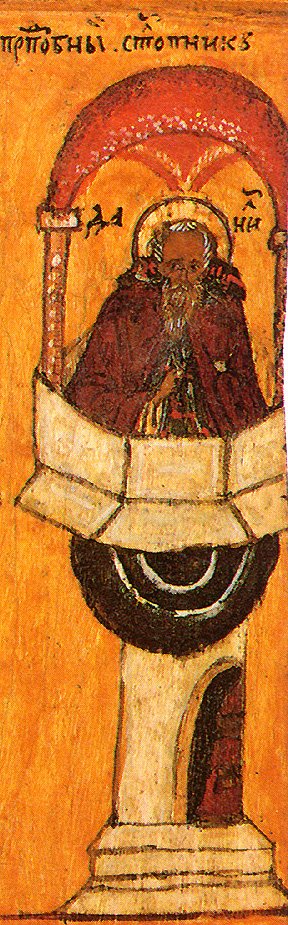
Ven. Daniel the Stylite
Saint Daniel the Stylite was born in the village of Bethara, near the city of Samosata in Mesopotamia. His mother Martha was childless for a long while and in her prayers she vowed that if she had a child, she would dedicate him to the Lord. Her prayers were heard, and Martha soon gave birth to a son, who was without a name until he was five years of age.
Saint Daniel the Stylite was born in the village of Bethara, near the city of Samosata in Mesopotamia. His mother Martha was childless for a long while and in her prayers she vowed that if she had a child, she would dedicate him to the Lord. Her prayers were heard, and Martha soon gave birth to a son, who was without a name until he was five years of age.
The boy’s parents desired that since he was born through the good-will of God, he should also receive his name from God. They took their son to a monastery located nearby and approached the igumen. The igumen gave orders to take down one of the service books, and unrolled it at random. He found the Prophet Daniel (December 17) mentioned in it. Thus did the boy receive his name. The parents asked that he might remain at the monastery, but the igumen would not accept him, since he was still only a small boy. At twelve years of age, saying nothing to anyone, the child left home for the monastery.
His parents were happy when they learned where their son was, and they went to the monastery. Seeing that he was still going about in his worldly clothes, they besought that the igumen should clothe him in the angelic garb. That Sunday the igumen fulfilled their request, but permitted them often to visit their son. The brethren of the monastery were astonished at the saint’s ascetical efforts.
Once, Saint Simeon the Stylite (September 1) visited the monastery. He foretold to the young monk that he too would undertake the feat of pillar-dwelling. Saint Daniel continued with his ascetic life in seclusion. When the place of a new exploit was revealed to him in a vision, he withdrew into the Thracian wilderness together with two disciples. They set up a pillar, upon which Saint Daniel dwelt for 33 years. People thronged to the pillar, the unfortunate and those who were sick, and all received help and healing from Saint Daniel. Byzantine emperors also sought the prayers of the holy ascetic. The most notable of the saint’s predictions was about a great fire in Constantinople. Saint Daniel possessed also the gift of gracious words. He guided many onto the path of correcting their lives. The monk reposed in his eightieth year.
Troparion - Tone 1
You were a pillar of patient endurance, / having imitated the forefathers, O Venerable One: / Job in suffering, and Joseph in temptations. / You lived like the bodiless ones while yet in the flesh, O Daniel, our Father. / Beseech Christ God that our souls may be saved.
Kontakion - Tone 8
You ascended your pillar like a brightly shining star, O blest One; / you illumined the world with your venerable deeds dispersing the darkness of error. / Therefore we pray you, Father Daniel, / now illumine the hearts of your servants with the never-setting light of wisdom.
Saint Nikon the Dry of the Kiev Caves (1101)
Saint Nikon the Dry, the son of rich and illustrious parents, gave up everything for Christ and became a monk at the Kiev Caves monastery. In the year 1096, during the incursions of Khan Bonyak, he was taken into captivity with some other monks. The captors treated Saint Nikon harshly, while waiting for a ransom to be paid.
Saint Nikon the Dry, the son of rich and illustrious parents, gave up everything for Christ and became a monk at the Kiev Caves monastery. In the year 1096, during the incursions of Khan Bonyak, he was taken into captivity with some other monks. The captors treated Saint Nikon harshly, while waiting for a ransom to be paid. When the saint refused to be ransomed, his masters began to torment him with hunger, and left him exposed in the heat of summer and the cold of winter. He was mistreated and beaten every day for about three years, for his captors thought he would change his mind and send word to his relatives, asking to be ransomed.
The saint gave thanks to God for everything, and once said to his tormentor that the Lord, through the prayers of Saints Anthony and Theodosius would return him to his monastery within three days, as Saint Eustratius (March 28) had predicted while appearing to him.
The captor cut the tendons in Saint Nikon’s legs and set a strong guard over him. But suddenly, on the third day at the sixth hour, the holy captive became invisible. At the moment the guard heard the words, “Praise the Lord from the Heavens” (Ps. 148).
Saint Nikon was transported to the Dormition church, where the Divine Liturgy was being served. The brethren surrounded him and began to ask how he got there. Saint Nikon wanted to conceal the miracle, but the brethren implored him to tell the truth.
Saint Nikon did not want to have his fetters removed, but the igumen said, “If the Lord had wanted you to remain fettered, He would not have delivered you from captivity.”
After a long while Saint Nikon’s former master came to the Kiev Caves monastery and recognized his former captive, who was withered from hunger and the loss of blood from his wounds. He came to believe in Christ, and accepted Baptism. After receiving monastic tonsure, he became a novice under Saint Nikon’s direction.
Saint Nikon died at the beginning of the twelfth century and was buried in the Near Caves. Though he did not enjoy good health in this life, his holy relics were glorified by incorruption. His memory is celebrated also on September 28 and on the second Sunday of Great Lent.
Troparion - Tone 8
By a flood of tears you made the desert fertile, / and your longing for God brought forth fruits in abundance. / By the radiance of miracles you illumined the whole universe! / O our holy father Nikon, pray to Christ our God to save our souls!
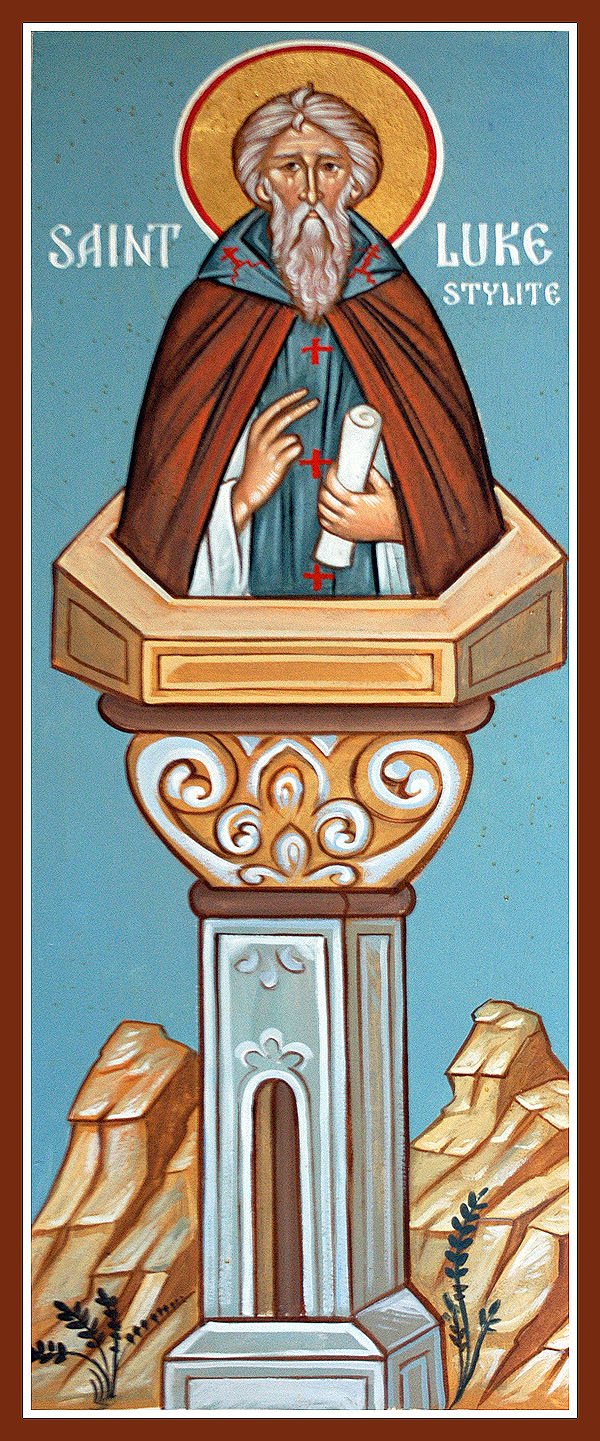
Our Venerable Father Luke the New Stylite (979)
Saint Luke the New Stylite was a soldier under the Byzantine emperor Constantine Porphyrogenitos (912-959). During a war with Bulgaria (917), Saint Luke remained unharmed through the Providence of God. After this he became a monk, and having succeeded in his efforts, was ordained as a presbyter. Striving for an even higher degree of perfection, the monk put chains upon himself and ascended a pillar.
Saint Luke the New Stylite was a soldier under the Byzantine emperor Constantine Porphyrogenitos (912-959). During a war with Bulgaria (917), Saint Luke remained unharmed through the Providence of God. After this he became a monk, and having succeeded in his efforts, was ordained as a presbyter. Striving for an even higher degree of perfection, the monk put chains upon himself and ascended a pillar.
After three years standing on the pillar, through divine inspiration, he went to Mount Olympos, and then to Constantinople, and finally to Chalcedon, where he chose a pillar upon which he remained for 45 years, manifesting a gift of wonderworking. He died in about the year 980.
Troparion - Tone 8
By a flood of tears you made the desert fertile, / and your longing for God brought forth fruits in abundance. / By the radiance of miracles you illumined the whole universe! / O our holy father Luke, pray to Christ our God to save our souls!
Scripture Readings
☩Epistle
Titus 1:15-2:10
15
Unto the pure all things are pure: but unto them that are defiled and unbelieving is nothing pure; but even their mind and conscience is defiled.
16
They profess that they know God; but in works they deny him, being abominable, and disobedient, and unto every good work reprobate.
1
But speak thou the things which become sound doctrine:
2
That the aged men be sober, grave, temperate, sound in faith, in charity, in patience.
3
The aged women likewise, that they be in behaviour as becometh holiness, not false accusers, not given to much wine, teachers of good things;
4
That they may teach the young women to be sober, to love their husbands, to love their children,
5
To be discreet, chaste, keepers at home, good, obedient to their own husbands, that the word of God be not blasphemed.
6
Young men likewise exhort to be sober minded.
7
In all things shewing thyself a pattern of good works: in doctrine shewing uncorruptness, gravity, sincerity,
8
Sound speech, that cannot be condemned; that he that is of the contrary part may be ashamed, having no evil thing to say of you.
9
Exhort servants to be obedient unto their own masters, and to please them well in all things; not answering again;
10
Not purloining, but shewing all good fidelity; that they may adorn the doctrine of God our Saviour in all things.
☩Gospel
Luke 21:37-22:8
37
And in the day time he was teaching in the temple; and at night he went out, and abode in the mount that is called the mount of Olives.
38
And all the people came early in the morning to him in the temple, for to hear him.
1
Now the feast of unleavened bread drew nigh, which is called the Passover.
2
And the chief priests and scribes sought how they might kill him; for they feared the people.
3
Then entered Satan into Judas surnamed Iscariot, being of the number of the twelve.
4
And he went his way, and communed with the chief priests and captains, how he might betray him unto them.
5
And they were glad, and covenanted to give him money.
6
And he promised, and sought opportunity to betray him unto them in the absence of the multitude.
7
Then came the day of unleavened bread, when the passover must be killed.
8
And he sent Peter and John, saying, Go and prepare us the passover, that we may eat.
Liturgical data sourced from OCA.org and orthocal.info