
Fasting Rules
 Meat
Abstain
 Fish
Allowed
 Dairy
Abstain
 Oil
Allowed
 Wine
Allowed
Saints & Commemorations
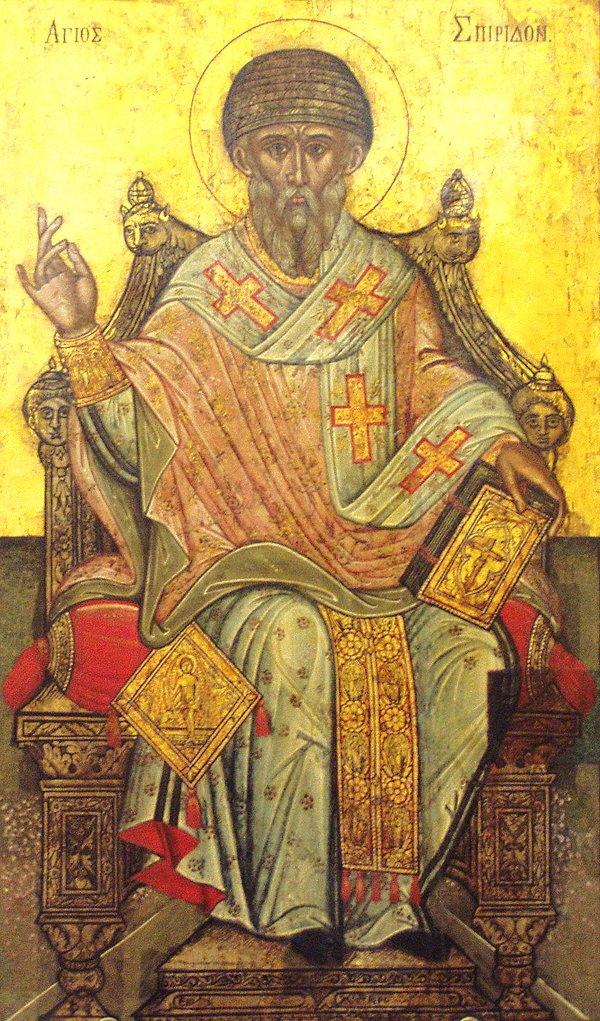
St Spyridon the Wonderworker
Saint Spyridon of Tremithus was born towards the end of the third century on the island of Cyprus. He was a shepherd, and had a wife and children. He used all his substance for the needs of his neighbors and the homeless, for which the Lord rewarded him with a gift of wonderworking. He healed those who were incurably sick, and cast out demons.
Saint Spyridon of Tremithus was born towards the end of the third century on the island of Cyprus. He was a shepherd, and had a wife and children. He used all his substance for the needs of his neighbors and the homeless, for which the Lord rewarded him with a gift of wonderworking. He healed those who were incurably sick, and cast out demons.
After the death of his wife, during the reign of Constantine the Great (306-337), he was made Bishop of Tremithus, Cyprus. As a bishop, the saint did not alter his manner of life, but combined pastoral service with deeds of charity.
According to the witness of Church historians, Saint Spyridon participated in the sessions of the First Ecumenical Council in the year 325. At the Council, the saint entered into a dispute with a Greek philosopher who was defending the Arian heresy. The power of Saint Spyridon’s plain, direct speech showed everyone the importance of God’s wisdom before human wisdom: “Listen, philosopher, to what I tell you. There is one God Who created man from dust. He has ordered all things, both visible and invisible, by His Word and His Spirit. The Word is the Son of God, Who came down upon the earth on account of our sins. He was born of a Virgin, He lived among men, and suffered and died for our salvation, and then He arose from the dead, and He has resurrected the human race with Him. We believe that He is one in essence (consubstantial) with the Father, and equal to Him in authority and honor. We believe this without any sly rationalizations, for it is impossible to grasp this mystery by human reason.”
As a result of their discussion, the opponent of Christianity became the saint’s zealous defender and later received holy Baptism. After his conversation with Saint Spyridon, the philosopher turned to his companions and said, “Listen! Until now my rivals have presented their arguments, and I was able to refute their proofs with other proofs. But instead of proofs from reason, the words of this Elder are filled with some sort of special power, and no one can refute them, since it is impossible for man to oppose God. If any of you thinks as I do now, let him believe in Christ and join me in following this man, for God Himself speaks through his lips.”
At this Council, Saint Spyridon displayed the unity of the Holy Trinity in a remarkable way. He took a brick in his hand and squeezed it. At that instant fire shot up from it, water dripped on the ground, and only dust remained in the hands of the wonderworker. “There was only one brick,” Saint Spyridon said, “but it was composed of three elements. In the Holy Trinity there are three Persons, but only one God.”
The saint cared for his flock with great love. Through his prayers, drought was replaced by abundant rains, and incessant rains were replaced by fair weather. Through his prayers the sick were healed and demons cast out.
A woman once came up to him with a dead child in her arms, imploring the intercession of the saint. He prayed, and the infant was restored to life. The mother, overcome with joy, collapsed lifeless. Through the prayers of the saint of God, the mother was restored to life.
Another time, hastening to save his friend, who had been falsely accused and sentenced to death, the saint was hindered on his way by the unanticipated flooding of a stream. The saint commanded the water: “Halt! For the Lord of all the world commands that you permit me to cross so that a man may be saved.” The will of the saint was fulfilled, and he crossed over happily to the other shore. The judge, apprised of the miracle that had occurred, received Saint Spyridon with esteem and set his friend free.
Similar instances are known from the life of the saint. Once, he went into an empty church, and ordered that the lampadas and candles be lit, and then he began the service. When he said, “Peace be unto all,” both he and the deacon heard from above the resounding of a great multitude of voices saying, “And with thy spirit.” This choir was majestic and more sweetly melodious than any human choir. To each petition of the litanies, the invisible choir sang, “Lord, have mercy.” Attracted by the church singing, the people who lived nearby hastened towards it. As they got closer and closer to the church, the wondrous singing filled their ears and gladdened their hearts. But when they entered into the church, they saw no one but the bishop and several church servers, and they no longer heard the singing which had greatly astonished them.
Saint Simeon Metaphrastes (November 9), the author of his Life, likened Saint Spyridon to the Patriarch Abraham in his hospitality. Sozomen, in his Church History , offers an amazing example from the life of the saint of how he received strangers. One time, at the start of the Forty-day Fast, a stranger knocked at his door. Seeing that the traveller was very exhausted, Saint Spyridon said to his daughter, “Wash the feet of this man, so he may recline to dine.” But since it was Lent there were none of the necessary provisions, for the saint “partook of food only on certain days, and on other days he went without food.” His daughter replied that there was no bread or flour in the house. Then Saint Spyridon, apologizing to his guest, ordered his daughter to cook a salted ham from their larder. After seating the stranger at table, he began to eat, urging that man to do the same. When the latter refused, calling himself a Christian, the saint rejoined, “It is not proper to refuse this, for the Word of God proclaims, ‘Unto the pure all things are pure’” (Titus 1:15).
Another historical detail reported by Sozomen, was characteristic of the saint. It was his custom to distribute one part of the gathered harvest to the destitute, and another portion to those having need while in debt. He did not take a portion for himself, but simply showed them the entrance to his storeroom, where each could take as much as was needed, and could later pay it back in the same way, without records or accountings.
There is also the tale by Socrates Scholasticus about how robbers planned to steal the sheep of Saint Spyridon. They broke into the sheepfold at night, but here they found themselves all tied up by some invisible power. When morning came the saint went to his flock, and seeing the tied-up robbers, he prayed and released them. For a long while he advised them to leave their path of iniquity and earn their livelihood by respectable work. Then he made them a gift of a sheep and sending them off, the saint said kindly, “Take this for your trouble, so that you did not spend a sleepless night in vain.”
All the Lives of the saint speak of the amazing simplicity and the gift of wonderworking granted him by God. Through a word of the saint the dead were awakened, the elements of nature tamed, the idols smashed. At one point, a Council had been convened at Alexandria by the Patriarch to discuss what to do about the idols and pagan temples there. Through the prayers of the Fathers of the Council all the idols fell down except one, which was very much revered. It was revealed to the Patriarch in a vision that this idol had to be shattered by Saint Spyridon of Tremithus. Invited by the Council, the saint set sail on a ship, and at the moment the ship touched shore and the saint stepped out on land, the idol in Alexandria with all its offerings turned to dust, which then was reported to the Patriarch and all the bishops.
Saint Spyridon lived his earthly life in righteousness and sanctity, and prayerfully surrendered his soul to the Lord. His relics repose on the island of Corfu (Kerkyra), in a church named after him (His right hand, however, is located in Rome).
His memory is also celebrated on Cheesefare Saturday.
Troparion - Tone 1
At the First Council you appeared as a champion of Truth and a Wonderworker, O our God-bearing Father Spyridon. / For you spoke to one dead in her grave, and transformed a serpent into gold; / while chanting your holy prayers / you had Angels serving with you, most holy one. / Glory to Him Who glorified you. / Glory to Him Who crowned you. / Glory to Him Who, through you, grants healing to all.
Kontakion - Tone 2
Wounded by the love of Christ, most holy one, your mind was given wings by the radiance of the Spirit, O God-inspired one, / you found your work in active contemplation, O God-pleasing Spyridon, / becoming a godly sacrifice, and entreating divine illumination for all.
St Herman, Wonderworker of Alaska (1836)
He is also commemorated tomorrow, December 13. See his life there.
Our Holy Godbearing Father Spyridon the Wonderworker (348).
He was a humble shepherd who lived on the island of Cyprus with his wife and his one child, a daughter named Irene. Though he was poor himself, his house and table were always open to travelers and those in need. He kept his money in a box which he left open and available to all, not concerning himself with who took from it or whether they were deserving or not.
He was a humble shepherd who lived on the island of Cyprus with his wife and his one child, a daughter named Irene. Though he was poor himself, his house and table were always open to travelers and those in need. He kept his money in a box which he left open and available to all, not concerning himself with who took from it or whether they were deserving or not. In time, his wife died and, with less worldly cares, he redoubled his prayers and his almsgiving.
He became so well-loved on the island that, when the bishop of the town of Tremithos died, the faithful unanimously chose Spyridon to succeed him, and he thus became a shepherd of rational sheep as well as the beasts he had tended. Despite his sudden elevation in rank, he kept to his former manner of life, traveling everywhere on foot, tending his animals as before, while fulfilling all the duties of a bishop as well. (To portray this godly humility, his icon shows him wearing bishop’s vestments and a peasant’s woven straw hat.)
His compassion for others was boundless. Though he was very strict with himself, he would always break a fast to give comfort to a traveler. Once a band of robbers broke into his sheepfold by night, but found themselves confined there by an invisible force. When Spyridon found them in the morning, he freed them, admonished them to live honestly, and gave them two sheep in compensation, he said, for their keeping an all-night vigil.
Pages could be filled with stories of the miracles wrought by the holy bishop for the good of his flock: by his prayers he ended a drought, turned a snake to gold to help a poor man, and even raised the dead son of a poor widow. His radiant virtue touched the consciences of those he met so that many would spontaneously fall at his feet and confess their sins.
When the Emperor Constantine summoned the First Ecumenical Council in 325, Spyridon attended, dressed in his simple peasant’s garb. At one of the sessions, a proud Arian philosopher challenged the Orthodox to a debate about the Holy Trinity, and was amazed when the simple Spyridon stepped forward to accept the challenge. He and all the other bishops were far more amazed when the uneducated peasant bishop confounded all the Arian’s arguments with his eloquent, Spirit-inspired words. The humbled philosopher admitted that he was convinced, embraced the Orthodox faith, and called upon the other Arians to abandon their human wisdom and embrace the true and life-giving Faith.
The holy bishop always celebrated the Divine Liturgy with joy. Once, serving in a remote, almost empty church, he turned to the invisible congregation and said “Peace be unto all!”, and his disciple heard a choir of angels respond “And with thy spirit!”
Saint Spyridon reposed in peace in 348 at the age of seventy-eight. His incorrupt and wonder-working relics poured forth miracles for the people of Cyprus until the seventh century, when they were moved to Constantinople to escape the Arab invasion; when the City fell to the Turks, the relics were again moved to Corfu, where they are venerated to this day. Even after 1,500 years, the holy relics remain incorrupt and work many life-giving wonders. Saint Spyridon is venerated as the Patron of Corfu.
St Finian of Clonard (549)
“St Finian, known as the ‘Tutor of the Saints of Ireland,’ stands with St Enda of Aran at the head of the patriarchs of Irish monasticism. He showed great zeal and piety for God from his youth. He had already founded three churches before he set off for Wales to study at the feet of St Cadoc at Llancarfan (September 25, †577). In Llan
“St Finian, known as the ‘Tutor of the Saints of Ireland,’ stands with St Enda of Aran at the head of the patriarchs of Irish monasticism. He showed great zeal and piety for God from his youth. He had already founded three churches before he set off for Wales to study at the feet of St Cadoc at Llancarfan (September 25, †577). In Llancarfan he became close friends with St Gildas (January 29, †570), another of St Cadoc’s disciples. Upon his return to Ireland, he founded the great Monastery of Clonard during the same year the great St Enda (March 21, †530) reposed in Aran. A multitude of illustrious and holy men studied under St Finian, including the famous ‘Twelve Apostles of Ireland.’ St Finian founded many other monasteries during his lifetime, including the famous island monastery of Skellig Michael off the southwest coast of Ireland.” (Saint Herman Calendar 2003)
Scripture Readings
☩Epistle
Ephesians 1:16-23
16
Cease not to give thanks for you, making mention of you in my prayers;
17
That the God of our Lord Jesus Christ, the Father of glory, may give unto you the spirit of wisdom and revelation in the knowledge of him:
18
The eyes of your understanding being enlightened; that ye may know what is the hope of his calling, and what the riches of the glory of his inheritance in the saints,
19
And what is the exceeding greatness of his power to us-ward who believe, according to the working of his mighty power,
20
Which he wrought in Christ, when he raised him from the dead, and set him at his own right hand in the heavenly places,
21
Far above all principality, and power, and might, and dominion, and every name that is named, not only in this world, but also in that which is to come:
22
And hath put all things under his feet, and gave him to be the head over all things to the church,
23
Which is his body, the fulness of him that filleth all in all.
☩Gospel
Luke 13:18-29
18
Then said he, Unto what is the kingdom of God like? and whereunto shall I resemble it?
19
It is like a grain of mustard seed, which a man took, and cast into his garden; and it grew, and waxed a great tree; and the fowls of the air lodged in the branches of it.
20
And again he said, Whereunto shall I liken the kingdom of God?
21
It is like leaven, which a woman took and hid in three measures of meal, till the whole was leavened.
22
And he went through the cities and villages, teaching, and journeying toward Jerusalem.
23
Then said one unto him, Lord, are there few that be saved? And he said unto them,
24
Strive to enter in at the strait gate: for many, I say unto you, will seek to enter in, and shall not be able.
25
When once the master of the house is risen up, and hath shut to the door, and ye begin to stand without, and to knock at the door, saying, Lord, Lord, open unto us; and he shall answer and say unto you, I know you not whence ye are:
26
Then shall ye begin to say, We have eaten and drunk in thy presence, and thou hast taught in our streets.
27
But he shall say, I tell you, I know you not whence ye are; depart from me, all ye workers of iniquity.
28
There shall be weeping and gnashing of teeth, when ye shall see Abraham, and Isaac, and Jacob, and all the prophets, in the kingdom of God, and you yourselves thrust out.
29
And they shall come from the east, and from the west, and from the north, and from the south, and shall sit down in the kingdom of God.
Liturgical data sourced from OCA.org and orthocal.info