
Fasting Rules
 Meat
Allowed
 Fish
Allowed
 Dairy
Allowed
 Oil
Allowed
 Wine
Allowed
Saints & Commemorations
20,000 Martyrs of Nicomedia
The Holy 20,000 Martyrs of Nicomedia: At the beginning of the fourth century the emperor Maximian (284-305) gave orders to destroy Christian churches, to burn service books, and to deprive all Christians of rights and privileges of citizenship. At this time the bishop of the city of Nicomedia was Saint Cyril, who by his preaching and life contributed to the spread of Christianity, so that many members of the emperor’s court were also secret Christians.
The Holy 20,000 Martyrs of Nicomedia: At the beginning of the fourth century the emperor Maximian (284-305) gave orders to destroy Christian churches, to burn service books, and to deprive all Christians of rights and privileges of citizenship. At this time the bishop of the city of Nicomedia was Saint Cyril, who by his preaching and life contributed to the spread of Christianity, so that many members of the emperor’s court were also secret Christians.
The pagan priestess Domna was living in the palace at that time. Providentially, she obtained a copy of the Acts of the Apostles and the Epistles of Saint Paul. Her heart burned with the desire to learn more about the Christian teaching. With the help of a young Christian girl, Domna went secretly to Bishop Anthimus (Cyril’s successor) with her faithful servant, the eunuch Indes. Saint Anthimus catechized them, and both received holy Baptism.
Domna began to help the poor: she gave away her valuables with the assistance of Indes, and she also distributed food from the imperial kitchen. The chief eunuch, who was in charge of provisions for the imperial household, found out that Domna and Indes were not eating the food sent them from the emperor’s table. He had them beaten in order to find out why they did not partake of the food, but they remained silent. Another eunuch informed him that the saints were distributing all the emperor’s gifts to the poor. He locked them up in prison to exhaust them with hunger, but they received support from an angel and did not suffer. Saint Domna feigned insanity so she wouldn’t have to live among the pagans. Then she and Indes managed to leave the court, and she went to a women’s monastery. Abbess Agatha quickly dressed her in men’s clothing, cut her hair and sent her off from the monastery.
During this time the emperor returned from battle and ordered that a search be made for the former pagan priestess Domna. The soldiers sent for this purpose found the monastery and destroyed it. The sisters were thrown into prison, subjected to torture and abuse, but not one of them suffered defilement. Sent to a house of iniquity, Saint Theophila was able to preserve her virginity with the help of an angel of the Lord. The angel led her from the brothel and brought her to the cathedral.
At this time the emperor cleared the city square to offer sacrifice to the pagan gods. When they began sprinkling the crowd with the blood of the sacrificial animals, Christians started to leave the square. Seeing this, the emperor became enraged, but in the middle of his rantings a great thunderstorm sprang up. People fled in panic, and the emperor had to retreat to the palace for his own safety.
Later Maximian went to the church with soldiers and told them they could escape punishment if they renounced Christ. Otherwise, he promised to burn the church and those in it. The Christian presbyter Glycerius told him that Christians would never renounce their faith, even under the threat of torture. Hiding his anger, the emperor exited the church, and a short time later commanded the presbyter Glycerius be arrested for trial. The executioners tortured the martyr, who did not cease to pray and to call on the Name of the Lord. Unable to force Saint Glycerius stop confessing Christ, Maximian ordered him to be burned to death.
On the Feast of the Nativity of Christ in the year 302, when about 20,000 Christians had assembled at the cathedral in Nicomedia, the emperor sent a herald into the church. He told the Christians that soldiers were surrounding the building, and that anyone who wished to leave had to offer sacrifice to the pagan gods. Anyone who defied the emperor would perish when the soldiers set fire to the church. All those present refused to worship the idols.
As the pagans prepared to set fire to the church, Bishop Anthimus, baptized all the catechumens and communed everyone with the Holy Mysteries. All 20,000 of those praying died in the fire. Among them were the abbess Agatha and Saint Theophila who had been saved from the den of iniquity by a miracle. Bishop Anthimus, however, managed to escape the fire.
Maximian thought that he had exterminated all the Christians of Nicomedia. He soon learned that there were many more, and that they would confess their faith and were prepared to die for Christ. The emperor wondered how to deal with them. At his command they arrested the regimental commander Zeno, who was openly criticizing the emperor for his impiety and cruelty. Zeno was fiercely beaten and finally beheaded. They jailed the eunuch Indes, formerly a priest of the idols, for refusing to participate in a pagan festival.
The persecution against Christians continued. Dorotheus, Mardonius, Migdonius the deacon and others were thrown into prison. Bishop Anthimus encouraged them by sending letters to them. One of the messengers, the Deacon Theophilus, was captured. They subjected him to torture, trying to learn where the bishop was hiding. The holy martyr endured everything, while revealing nothing. Then they executed him and also those whom the bishop had addressed in his letter. Though they were executed in different ways, they all showed the same courage and received their crowns from God.
For weeks, Saint Domna concealed herself within a cave and sustained herself by eating plants. When she returned to the city, she wept for a long time at the ruins of the church, regretting that she was not found worthy to die with the others. That night she went to the sea shore. At that moment fishermen pulled the bodies of the martyrs Indes, Gorgonius and Peter from the water in their nets.
Saint Domna was still dressed in men’s clothing, and she helped the fishermen to draw in their nets. They left her the bodies of the martyrs. With reverence she looked after the holy relics and wept over them, especially over the body of her spiritual friend, the Martyr Indes.
After giving them an honorable burial, she did not depart from these graves so dear to her heart. Each day she burned incense before them, sprinkling them with fragrant oils. When the emperor was told of an unknown youth who offered incense at the graves of executed Christians, he gave orders to behead the youth. The Martyr Euthymius was also executed along with Domna.
Troparion - Tone 2
Blessed is the earth that received your blood, passion-bearers of the Lord, / and holy is the dwelling place which received your spirits. / You triumphed over the enemy in the stadium / and you preached Christ with boldness. / Since He is good, we pray that you beseech Him to save our souls.
Kontakion - Tone 1
Their souls strengthened by faith, the twenty thousand martyrs accepted their suffering by fire, / and cried out to You, the One born of the Virgin: / “Like gold, myrrh, and frankincense, the gifts of the Persian kings, / receive our whole burnt offering, O Eternal God.”
The Twenty Thousand Martyrs burned to death in their church in Nicomedia (ca. 304).
During a fierce persecution by the Emperor Maximian of all who would not worship the idols, the Christians of Nicomedia were subjected to especially savage treatment. (Eusebius writes that every Christian in the city was killed.) Along with many others put to the sword or otherwise butchered there, we especially commemorate the large company who, despite all danger, gathered in the church to commemorate Christ’s Nativity. T
During a fierce persecution by the Emperor Maximian of all who would not worship the idols, the Christians of Nicomedia were subjected to especially savage treatment. (Eusebius writes that every Christian in the city was killed.) Along with many others put to the sword or otherwise butchered there, we especially commemorate the large company who, despite all danger, gathered in the church to commemorate Christ’s Nativity. The Emperor, hearing of this, sent troops to surround the building so that no-one could escape, and piled heaps of timber and brush around it. Criers then gave notice that any who wished to save their lives must come out and make sacrifice to the pagan gods.
“As this announcement penetrated the church, a divine zeal, more fiery than any flame in the world, seized the deacon Agapius, who rushed to the pulpit and cried out, ‘Brethren, remember how often we have praised and extolled the Three Young Men who, when they were thrown into the Babylonian furnace, called on the whole of Creation to sing the glory of God, and how the All-Creating Word then came down in bodily appearance, to assist them and to render them invulnerable by surrounding them with a moist whistling wind. The time has now come for us to imitate them. Let us offer ourselves to a temporary death for love of our Master, in order to reign everlastingly with Him!’ The whole congregation with one voice then answered Maximian’s criers, ‘We believe in Christ God and we will give up our lives for Him!’
“As the soldiers began to set fire to the piles of wood outside, Saint Anthimus [bishop of the city, commemorated September 3] told his deacons to assemble those who were still catechumens, and he baptized and anointed them with the holy Myron. He then served the divine Liturgy, at which all present communicated in the Body and Blood of Our Lord Jesus Christ. Armed with divine strength and closely united in a single body by Christ who dwelt in them, the holy Martyrs felt no fear as they saw the flames leap up everywhere and thick smoke begin to fill the church. With gladness they sang in unison the Song of the Three Young Men: Bless the Lord, all works of the Lord, sing praise to Him and highly exalt Him for ever (Dan. 3 LXX) until the last among them suffocated and gave up his soul.
“The conflagration lasted for five days. Those who then ventured into the smouldering ruins anticipating the odour of charred flesh, found instead a heavenly scent pervading the air and the place surrounded by a brilliant light. The Saints who were glorified at this time are said to have numbered twenty thousand. Saint Anthimus himself miraculously escaped death, and so was able by his teaching to lead a large number of souls to salvation and to the new birth of holy Baptism before, in his turn, fulfilling his union with Christ by martyrdom.” (Synaxarion)
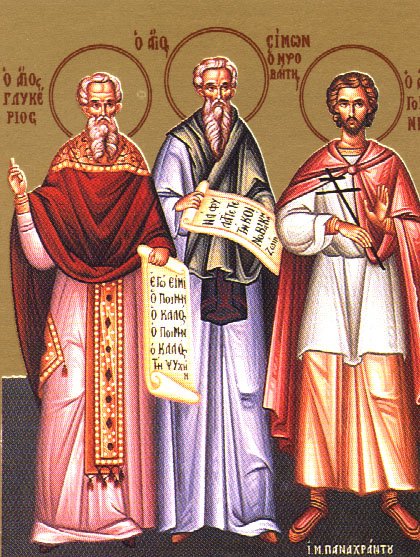
Our Holy Father Simon the Outpourer of Myrrh, Founder of Simonopetra Monastery, Mt Athos (1287)
Saint Simon the Myrrh-Gusher lived an ascetical life on Mt Athos, and was glorified by many miracles. He was the founder of the New Bethlehem monastery, now known as Simonopetra. One night, he saw a star of such brightness that he thought it must be the Star of Bethlehem. Seeing the star remain motionless for several nights, he thought at first that it was a demonic temptation.
Saint Simon the Myrrh-Gusher lived an ascetical life on Mt Athos, and was glorified by many miracles. He was the founder of the New Bethlehem monastery, now known as Simonopetra. One night, he saw a star of such brightness that he thought it must be the Star of Bethlehem. Seeing the star remain motionless for several nights, he thought at first that it was a demonic temptation. On the eve of the Lord’s Nativity the star stood over a high rock, and Saint Simon heard a voice say, “Here, O Simon, you must lay the foundations of your monastery for the salvation of souls.” He built the monastery and called it New Bethlehem.
He reposed in the year 1287, and his holy relics exude myrrh.
Troparion - Tone 8
By a flood of tears you made the desert fertile, / and your longing for God brought forth fruits in abundance. / By the radiance of miracles you illumined the whole universe! / O our holy father Simon, pray to Christ our God to save our souls!
Scripture Readings
☩Epistle
Hebrews 11:17-23, 27-31
17
By faith Abraham, when he was tried, offered up Isaac: and he that had received the promises offered up his only begotten son,
18
Of whom it was said, That in Isaac shall thy seed be called:
19
Accounting that God was able to raise him up, even from the dead; from whence also he received him in a figure.
20
By faith Isaac blessed Jacob and Esau concerning things to come.
21
By faith Jacob, when he was a dying, blessed both the sons of Joseph; and worshipped, leaning upon the top of his staff.
22
By faith Joseph, when he died, made mention of the departing of the children of Israel; and gave commandment concerning his bones.
23
By faith Moses, when he was born, was hid three months of his parents, because they saw he was a proper child; and they were not afraid of the king’s commandment.
27
By faith he forsook Egypt, not fearing the wrath of the king: for he endured, as seeing him who is invisible.
28
Through faith he kept the passover, and the sprinkling of blood, lest he that destroyed the firstborn should touch them.
29
By faith they passed through the Red sea as by dry land: which the Egyptians assaying to do were drowned.
30
By faith the walls of Jericho fell down, after they were compassed about seven days.
31
By faith the harlot Rahab perished not with them that believed not, when she had received the spies with peace.
☩Gospel
Mark 10:46-52
46
And they came to Jericho: and as he went out of Jericho with his disciples and a great number of people, blind Bartimeus, the son of Timeus, sat by the highway side begging.
47
And when he heard that it was Jesus of Nazareth, he began to cry out, and say, Jesus, thou Son of David, have mercy on me.
48
And many charged him that he should hold his peace: but he cried the more a great deal, Thou Son of David, have mercy on me.
49
And Jesus stood still, and commanded him to be called. And they call the blind man, saying unto him, Be of good comfort, rise; he calleth thee.
50
And he, casting away his garment, rose, and came to Jesus.
51
And Jesus answered and said unto him, What wilt thou that I should do unto thee? The blind man said unto him, Lord, that I might receive my sight.
52
And Jesus said unto him, Go thy way; thy faith hath made thee whole. And immediately he received his sight, and followed Jesus in the way.
Liturgical data sourced from OCA.org and orthocal.info