
Fasting Rules
 Meat
Allowed
 Fish
Allowed
 Dairy
Allowed
 Oil
Allowed
 Wine
Allowed
Saints & Commemorations
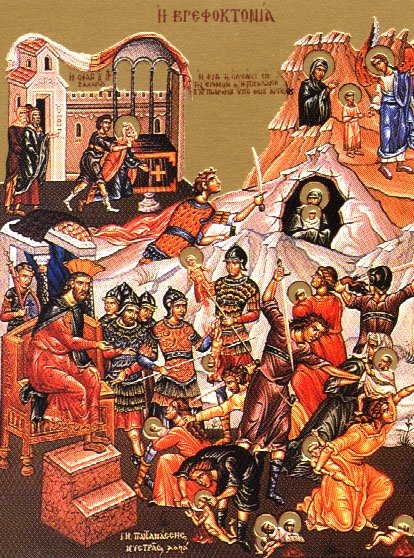
Holy Innocents Slain by Herod
14,000 Holy Infants were killed by King Herod in Bethlehem. When the time came for the Incarnation of the Son of God and His Birth of the Most Holy Virgin Mary, Magi in the East beheld a new star in the heavens, foretelling the Nativity of the King of the Jews. They journeyed immediately to Jerusalem to worship the Child, and the star showed them the way.
14,000 Holy Infants were killed by King Herod in Bethlehem. When the time came for the Incarnation of the Son of God and His Birth of the Most Holy Virgin Mary, Magi in the East beheld a new star in the heavens, foretelling the Nativity of the King of the Jews. They journeyed immediately to Jerusalem to worship the Child, and the star showed them the way. Having worshipped the divine Infant, they did not return to Jerusalem to Herod, as he had ordered them, but being warned by God in a dream, they went back to their country by another way. Herod finally realized that his scheme to find the Child would not be successful, and he ordered that all the male children two years old and younger at Bethlehem and its surroundings be killed. He thought that the divine Infant, Whom he considered a rival, would be among the dead children.
The murdered infants thus became the first martyrs for Christ. The rage of Herod fell also on Simeon the God-Receiver (February 3), who declared before everyone in the Temple that the Messiah had been born. When the holy Elder died, Herod would not give permission for him to be properly buried. On the orders of King Herod, the holy prophet and priest Zachariah was also killed. He was murdered in Jerusalem between the Temple and the altar (Mt. 23:35) because he would not tell the whereabouts of his son John, the future Baptist of the Lord Jesus Christ.
The wrath of God soon fell upon Herod himself: a horrid condition struck him down and he died, eaten by worms while still alive. Before his death, the impious king murdered the chief priests and scribes of the Jews, and also his brother, and his sister and her husband, and also his own wife Mariam, and three of his sons, and seventy men of wisdom who were members of the Sanhedrin. He initiated this bloodbath so that the day of his death would not be one of rejoicing, but one of mourning.
The Christian Church very rightly proclaimed these murdered children as Saints, because they died at an innocent age, and were, in some way, the first martyrs of Christianity. They may not have been baptized in water, but they were baptized in the blessed blood of their martyrdom.
Last but not least, the relics (or perhaps some) of the Holy Infants are found in Constantinople, in the Church of Saint James the Brother of the Lord, which was built by Emperor Justin. Most of their Holy Relics are at the Patriarchate of Jerusalem. Portions of their Holy Relics are also to be found in the Pantokrator Monastery on Mount Athos.
Troparion - Tone 1
As acceptable victims and freshly plucked flowers, / as divine first-fruits and newborn lambs, / you were offered to Christ who was born as a child, holy innocents. / You mocked Herod’s wickedness; / now we beseech you: / “Unceasingly pray for our souls.”
Kontakion - Tone 6
When the King was born in Bethlehem, the Magi came from the east. / Having been guided by the star on high, they brought Him gifts. / But in his exceeding wrath, Herod mowed down the infants as wheat; / lamenting that the rule of his kingdom had come to an end.
Our Righteous Father Thaddeus the Confessor
Saint Thaddeus the Confessor, a disciple of Theodore the Studite, was a defender of the veneration of holy icons. He was brought to trial and suffered during the reign of Leo V (813-820). The heretics, mocking Saint Thaddeus, put an icon of the Savior on the ground, picked the saint up, and stood him upon it.
Saint Thaddeus the Confessor, a disciple of Theodore the Studite, was a defender of the veneration of holy icons. He was brought to trial and suffered during the reign of Leo V (813-820). The heretics, mocking Saint Thaddeus, put an icon of the Savior on the ground, picked the saint up, and stood him upon it.
After this the judge said, “You have trampled upon the icon of Christ. There is no point in further resistance, so join us.” Thaddeus replied that he had been placed upon the icon involuntarily, and he cursed the impiety of the iconoclasts. Enraged by his bold words, they beat him with cudgels. Then they dragged the martyr by the legs and threw him outside the city walls. He appeared to be dead, but he was still alive. A certain Christian took him into his own home and washed his wounds. Saint Thaddeus lived another three days, and then surrendered his soul to God.
Troparion - Tone 8
Champion of Orthodoxy, teacher of purity and of true worship, / the enlightener of the universe and the adornment of hierarchs: / all-wise father Thaddeus, your teachings have gleamed with light upon all things. / Intercede before Christ God to save our souls.
Our Venerable Father Marcellus, Abbot of the Monastery of the Unsleeping Ones (485)
Saint Marcellus, igumen of the Monastery called “the Unsleeping Ones,” was a native of the city of Apamea in Syria. His parents were wealthy, but died when he was young. He received his education first at Antioch, and then at Ephesus. All his possessions left him by his parents he distributed to the poor, thereby sundering his ties to the world.
Un
Saint Marcellus, igumen of the Monastery called “the Unsleeping Ones,” was a native of the city of Apamea in Syria. His parents were wealthy, but died when he was young. He received his education first at Antioch, and then at Ephesus. All his possessions left him by his parents he distributed to the poor, thereby sundering his ties to the world.
Under the guidance of an experienced elder at Ephesus, Marcellus entered upon the path of asceticism. He later went on to Byzantium to Saint Alexander, igumen of the monastery named “the Unsleeping.” The monastery received its name because in it psalmody was done constantly, both day and night, by alternating groups of monks. Saint Alexander accepted Marcellus and tonsured him into the monastic schema. Zealous in the works of watchfulness, fasting and prayer, the saint received great spiritual talents and the gift of clairvoyance. Marcellus foresaw the day of Abba Alexander’s death and his own election as igumen. However, since he was still young, he did not want to rule others. So he slipped out of the monastery to visit other provinces and other monasteries, where he received edification from the monks who lived there.
After the death of Saint Alexander, when Abba John had already been chosen as igumen, Marcellus returned to the great joy of the brethren. Abba John made Marcellus his own closest assistant. After John’s death, Saint Marcellus was chosen igumen of the monastery in spite of his own wishes, and in this position he remained for sixty years.
News of his saintly life spread far. People came to Marcellus from afar, both the illustrious and the common, rich and the poor. Many times they saw angels encircling the saint, attending and guarding him. With the help of God, the monastery of “the Unsleeping Ones” flourished. So many monks came to place themselves under the direction of Saint Marcellus that it became necessary to enlarge the monastery and the church.
Saint Marcellus received donations from believers for expansion, and built a beautiful large church, a hospital, and a hostel for the homeless. By his prayers the monk treated the sick, cast out devils and worked miracles. For example, one of the monks was sent to Ankara and fell ill. Being near death, he called out mentally to his abba. At that very hour Saint Marcellus heard his disciple in the monastery, and he began to pray for him. He who was sick recovered at once.
When a ship with his monks came into danger on the Black Sea, the saint calmed the tempest by his prayers. Another time, when they told him that a fire was raging at Constantinople, he prayed tearfully for the city, and the fire subsided as if extinguished by the tears of the monk.
John, the servant of a certain Arian nobleman named Ardaburios, was unjustly accused of something, and he hid out at the monastery to escape his master’s wrath. Ardaburios twice demanded that Saint Marcellus hand John over to him, but he refused. Ardaburios then sent out a detachment of soldiers, who surrounded the monastery, threatening to slay anyone who interfered with their mission. The brethren went to the abba, asking him to surrender John and save the monastery. Saint Marcellus signed himself with the Sign of the Cross, then boldly went out alone through the monastery gate towards the soldiers. Lightning flashed in the sky, thunder rumbled, and the Cross appeared shining brighter than the sun. The soldiers threw down their weapons and took to flight. Ardaburios, learning from the soldiers what had happened, was frightened, and because of Saint Marcellus he pardoned the servant.
Saint Marcellus peacefully departed to the Lord in the year 485. His faithful disciple Lukian grieved terribly over him, but on the fifth day after the death Saint Marcellus appeared to him and comforted him, foretelling his own impending end.
Troparion - Tone 8
By a flood of tears you made the desert fertile, / and your longing for God brought forth fruits in abundance. / By the radiance of miracles you illumined the whole universe! / O our holy father Marcellus, pray to Christ our God to save our souls!
Scripture Readings
☩Epistle
Hebrews 12:25-26, 13:22-25
25
See that ye refuse not him that speaketh. For if they escaped not who refused him that spake on earth, much more shall not we escape, if we turn away from him that speaketh from heaven:
26
Whose voice then shook the earth: but now he hath promised, saying, Yet once more I shake not the earth only, but also heaven.
22
And I beseech you, brethren, suffer the word of exhortation: for I have written a letter unto you in few words.
23
Know ye that our brother Timothy is set at liberty; with whom, if he come shortly, I will see you.
24
Salute all them that have the rule over you, and all the saints. They of Italy salute you.
25
Grace be with you all. Amen. Written to the Hebrews from Italy by Timothy.
☩Gospel
Mark 11:11-23
11
And Jesus entered into Jerusalem, and into the temple: and when he had looked round about upon all things, and now the eventide was come, he went out unto Bethany with the twelve.
12
And on the morrow, when they were come from Bethany, he was hungry:
13
And seeing a fig tree afar off having leaves, he came, if haply he might find any thing thereon: and when he came to it, he found nothing but leaves; for the time of figs was not yet.
14
And Jesus answered and said unto it, No man eat fruit of thee hereafter for ever. And his disciples heard it.
15
And they come to Jerusalem: and Jesus went into the temple, and began to cast out them that sold and bought in the temple, and overthrew the tables of the moneychangers, and the seats of them that sold doves;
16
And would not suffer that any man should carry any vessel through the temple.
17
And he taught, saying unto them, Is it not written, My house shall be called of all nations the house of prayer? but ye have made it a den of thieves.
18
And the scribes and chief priests heard it, and sought how they might destroy him: for they feared him, because all the people was astonished at his doctrine.
19
And when even was come, he went out of the city.
20
And in the morning, as they passed by, they saw the fig tree dried up from the roots.
21
And Peter calling to remembrance saith unto him, Master, behold, the fig tree which thou cursedst is withered away.
22
And Jesus answering saith unto them, Have faith in God.
23
For verily I say unto you, That whosoever shall say unto this mountain, Be thou removed, and be thou cast into the sea; and shall not doubt in his heart, but shall believe that those things which he saith shall come to pass; he shall have whatsoever he saith.
Liturgical data sourced from OCA.org and orthocal.info