
Fasting Rules
 Meat
Allowed
 Fish
Allowed
 Dairy
Allowed
 Oil
Allowed
 Wine
Allowed
Saints & Commemorations
Memorial Saturday
On the day before Meatfare Sunday, on which we remember the Last Judgment, the Orthodox Church prays for those of its members who may have died unexpectedly because of wars, plagues, starvation, or any other sort of death while they were in a foreign country, or while they were traveling by sea, by land, or by air.
On the day before Meatfare Sunday, on which we remember the Last Judgment, the Orthodox Church prays for those of its members who may have died unexpectedly because of wars, plagues, starvation, or any other sort of death while they were in a foreign country, or while they were traveling by sea, by land, or by air. The Church also prays for the poor, or for those who may not have received a proper burial, or who had no one to request Memorial Services to be offered for them.
We pray for the departed on this Saturday because the Orthodox Church has established Saturday as the proper day of the week for remembering the dead. On this day before we hear the Gospel about the Last Judgment, we should pause to recall our own inescapable death when we shall appear before Christ to give an account of our lives. May we have "an acceptable defense before His dread Judgment Seat."
As we prepare for the spiritual struggles of the Great Fast, we should remember that we have been given this present life for repentance and for entreating God's mercy. When Christ comes in glory to judge the world, it will be too late then to say that we repent, or to ask for mercy. Therefore, we should make the most of the time that has been given us in order to struggle against every sinful impulse which separates us from God, to confess our sins, to correct ourselves, and to pursue a life of virtue and holiness.
During the week leading up to Meatfare Sunday, we do not sing "Alleluia" in place of "God is the Lord," at Matins. "Alleluia" is appointed to be sung on the Wednesday and Friday of Cheesefare Week, and also during Great Lent. See the TYPIKON or the OCA rubrics book for information about the structure of the pre-Lenten and Lenten services.
Troparion - Tone 8
Only Creator, with wisdom profound, You mercifully order all things, / and give that which is needed to all men: / Give rest, O Lord, to the souls of Your servants who have fallen asleep, / for they have placed their trust in You, our Maker and Fashioner, and our God.
Kontakion - Tone 8
With the saints give rest, O Christ, to the souls of Your servants, / where there is neither sickness nor sorrow, and no more sighing, / but life everlasting.
Forty-two Martyrs of Ammoria
During a war between the Byzantine Emperor Theophilus (829-842) and the Saracens, the Saracens managed to besiege the city of Ammoria (in Galicia in Asia Minor). As a result of treason on the part of the military commander Baditses, Ammoria fell, and forty-two of its generals were taken captive and sent off to Syria.
During a war between the Byzantine Emperor Theophilus (829-842) and the Saracens, the Saracens managed to besiege the city of Ammoria (in Galicia in Asia Minor). As a result of treason on the part of the military commander Baditses, Ammoria fell, and forty-two of its generals were taken captive and sent off to Syria.
During the seven years of their imprisonment, their captors tried in vain to persuade them to renounce Christianity and accept Islam. The captives stubbornly resisted all their seductive offers and bravely held out against terrible threats. After many torments that failed to break the spirit of the Christian soldiers, they condemned them to death, hoping to shake the determination of the saints before executing them. The martyrs remained steadfast, saying that the Old Testament Prophets bore witness to Christ, while Mohammed called himself a prophet without any other witnesses to support his claim.
One of the captives, Theodore, had renounced the priestly office to become a general. His captors taunted him, “We know that you forsook the priestly office, became a soldier and shed blood in battle. You can have no hope in Christ, Whom you abandoned voluntarily, so accept Mohammed.” But the martyr replied, “You do not speak truthfully when you say that I abandoned Christ. Moreover, I left the priesthood because of my own unworthiness. Therefore, I must shed my blood for the sake of Christ, so that He might forgive the sins that I have committed against Him.”
The executioners took each one separately and led him off to be beheaded, then threw the bodies into the River Euphrates. In the service to them, these holy passion-bearers are glorified as: the “All-Blessed” Theodore, the “Unconquered” Callistus, the “Valiant” Constantine, the “Wondrous” Theophilus and “the Most Strong” Basoes. Saints Aetius (Aetitus) and Melissenus were also among the martyrs.
The betrayer Baditses did not escape his shameful fate. The enemy knew that it is impossible to trust a traitor, and so they killed him.
Troparion - Tone 4
Your forty-two holy martyrs, O Lord, / through their sufferings have received incorruptible crowns from You, our God. / For having Your strength, they laid low their adversaries, / and shattered the powerless boldness of demons. / Through their intercessions, save our souls!
Kontakion - Tone 4
Forty-two holy martyrs of Ammoria, / you contended for the sake of Christ on earth; / you were revealed as crown-bearing martyrs, / and have been received into the life of the joy of heaven. / Since you overthrew all the wiles of the enemy / by your sufferings and the blood of your wounds, / you continually send down from on high remission of sins to those who praise you.
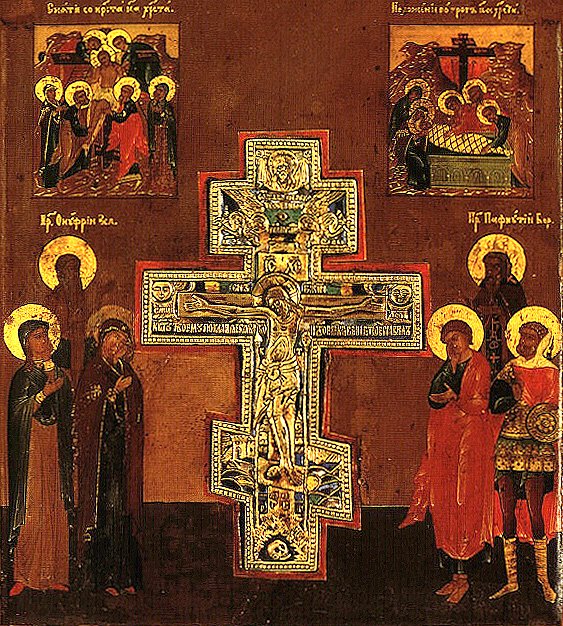
Finding the Precious Cross by St. Helen
The Holy Empress Helen uncovered the Precious Cross and Nails of the Lord at Jerusalem in 326.
At the beginning of the reign of Saint Constantine the Great (306-337), the first Roman emperor to recognize Christianity, he and his pious mother Saint Helen decided to rebuild the city of Jerusalem. They also planned to build a church on the site of the Lord’s suffering and Resurrection, in order to reconsecrate and purify the places connected with the Savior’s death and Resurrection from the foul taint of paganism.
Th
The Holy Empress Helen uncovered the Precious Cross and Nails of the Lord at Jerusalem in 326.
At the beginning of the reign of Saint Constantine the Great (306-337), the first Roman emperor to recognize Christianity, he and his pious mother Saint Helen decided to rebuild the city of Jerusalem. They also planned to build a church on the site of the Lord’s suffering and Resurrection, in order to reconsecrate and purify the places connected with the Savior’s death and Resurrection from the foul taint of paganism.
The empress Helen journeyed to Jerusalem with a large quantity of gold. Saint Constantine wrote a letter to Patriarch Macarius I (313-323), requesting him to assist her in every possible way with her task of the restoring the Christian holy places.
After her arrival in Jerusalem, the holy empress Helen began to destroy all the pagan temples and reconsecrate the places which had been defiled by the pagans.
In her quest for the Life-Creating Cross, she questioned several Christians and Jews, but for a long time her search remained unsuccessful. Finally, an elderly Hebrew named Jude told her that the Cross was buried beneath the temple of Venus. Saint Helen ordered that the pagan temple be demolished, and for the site to be excavated. Soon they found Golgotha and the Lord’s Sepulchre. Not far from the spot were three crosses, a board with the inscription written by Pilate (John 19:19), and four nails which had pierced the Lord’s Body.
Now the task was to determine on which of the three crosses the Savior had been crucified. Patriarch Macarius saw a dead person being carried to his grave, then he ordered that the dead man be placed upon each cross in turn. When the corpse was placed on the Cross of Christ, he was immediately restored to life. After seeing the raising of the dead man, everyone was convinced that the Life-Creating Cross had been found. With great joy the empress Helen and Patriarch Macarius lifted the Life-Creating Cross and displayed it to all the people standing about.
Scripture Readings
☩Epistle
1 Corinthians 10:23-28
23
All things are lawful for me, but all things are not expedient: all things are lawful for me, but all things edify not.
24
Let no man seek his own, but every man another’s wealth.
25
Whatsoever is sold in the shambles, that eat, asking no question for conscience sake:
26
For the earth is the Lord’s, and the fulness thereof.
27
If any of them that believe not bid you to a feast, and ye be disposed to go; whatsoever is set before you, eat, asking no question for conscience sake.
28
But if any man say unto you, This is offered in sacrifice unto idols, eat not for his sake that shewed it, and for conscience sake: for the earth is the Lord’s, and the fulness thereof:
☩Gospel
Luke 21:8-9, 25-27, 33-36
8
And he said, Take heed that ye be not deceived: for many shall come in my name, saying, I am Christ; and the time draweth near: go ye not therefore after them.
9
But when ye shall hear of wars and commotions, be not terrified: for these things must first come to pass; but the end is not by and by.
25
And there shall be signs in the sun, and in the moon, and in the stars; and upon the earth distress of nations, with perplexity; the sea and the waves roaring;
26
Men’s hearts failing them for fear, and for looking after those things which are coming on the earth: for the powers of heaven shall be shaken.
27
And then shall they see the Son of man coming in a cloud with power and great glory.
33
Heaven and earth shall pass away: but my words shall not pass away.
34
And take heed to yourselves, lest at any time your hearts be overcharged with surfeiting, and drunkenness, and cares of this life, and so that day come upon you unawares.
35
For as a snare shall it come on all them that dwell on the face of the whole earth.
36
Watch ye therefore, and pray always, that ye may be accounted worthy to escape all these things that shall come to pass, and to stand before the Son of man.
Liturgical data sourced from OCA.org and orthocal.info