
Fasting Rules
 Meat
Allowed
 Fish
Allowed
 Dairy
Allowed
 Oil
Allowed
 Wine
Allowed
Saints & Commemorations
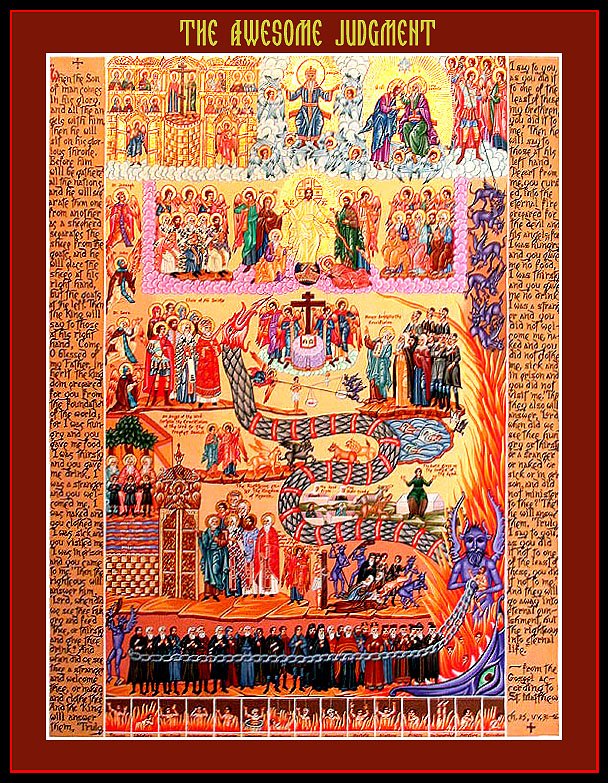
Sunday of the Last Judgment
Today’s Gospel reading is Matthew 25:31-46, the parable of the Last Judgment. It reminds us that while trusting in Christ’s love and mercy, we must not forget His righteous judgment when He comes again in glory. If our hearts remain hardened and unrepentant, we should not expect the Lord to overlook our transgressions simply because He is a good and loving God. Alt
Today’s Gospel reading is Matthew 25:31-46, the parable of the Last Judgment. It reminds us that while trusting in Christ’s love and mercy, we must not forget His righteous judgment when He comes again in glory. If our hearts remain hardened and unrepentant, we should not expect the Lord to overlook our transgressions simply because He is a good and loving God. Although He does not desire the death of a sinner, He also expects us to turn from our wickedness and live (Ezek. 33:11). This same idea is expressed in the prayer read by the priest after the penitent has confessed his or her sins (Slavic practice).
The time for repentance and forgiveness is now, in the present life. At the Second Coming, Christ will appear as the righteous Judge, “Who will render to every man according to his deeds” (Rom. 2:6). Then the time for entreating God’s mercy and forgiveness will have passed.
As Father Alexander Schmemann reminds us in his book GREAT LENT (Ch. 1:4), sin is the absence of love, it is separation and isolation. When Christ comes to judge the world, His criterion for judgment will be love. Christian love entails seeing Christ in other people, our family, our friends, and everyone else we may encounter in our lives. We shall be judged on whether we have loved, or not loved, our neighbor. We show Christian love when we feed the hungry, give drink to the thirsty, clothe the naked, visit those who are sick or in prison. If we did such things for the least of Christ’s brethren, then we also did them for Christ (Mt.25:40). If we did not do such things for the least of the brethren, neither did we do them for Christ (Mt.25:45).
Today is the last day for eating meat and meat products until Pascha, though eggs and dairy products are permitted every day during the coming week. This limited fasting prepares us gradually for the more intense fasting of Great Lent.
Troparion
When You, O God, shall come to earth with glory, / all things shall tremble / and the river of fire shall flow before Your judgment seat; / the books shall be opened and the hidden things disclosed! / Then deliver me from the unquenchable fire, / and make me worthy to stand at Your right hand, Most Righteous Judge!
Seven Hieromartyrs of Cherson
These seven holy Bishops give a vivid picture of the dangers endured by those who traveled to proclaim the Gospel of Christ in the early centuries of the Church. All seven were sent as missionary bishops to Cherson on the Black Sea, and all seven died there as Martyrs. Hermon, Bishop of Jerusalem, first sent Ephraim and Basileus; Basileus raised the son of the prince of Cherson to life, after which many believed and were baptized.
These seven holy Bishops give a vivid picture of the dangers endured by those who traveled to proclaim the Gospel of Christ in the early centuries of the Church. All seven were sent as missionary bishops to Cherson on the Black Sea, and all seven died there as Martyrs. Hermon, Bishop of Jerusalem, first sent Ephraim and Basileus; Basileus raised the son of the prince of Cherson to life, after which many believed and were baptized. The unbelievers, though, bound him by the feet and dragged him through the streets until he died. Ephraim was beheaded when he refused to make sacrifice to the idols. Eugenios, Agathodoros, and Elpidios were then sent by the Bishop of Jerusalem; they were beaten to death with rods and stones. Aetherius was sent during the reign of Constantine the Great, and was able to govern the Church in freedom and peace, and to build a church in Cherson. Capito, the last to be sent, brought the Gospel to the fierce Scythians. To prove the power of his God, they asked him to go into a burning furnace, saying that if he was not consumed, they would believe. Putting all his trust in God, the holy Bishop vested himself, made the sign of the Cross, and entered the furnace. He stood in the flames, fervently praying, for an hour, and came out untouched. The spectators cried out ‘There is one God, the great and powerful God of the Christians, who keeps His servant safe in the burning furnace!’, and all those in the town and the surrounding countryside were baptized. This miracle was spoken of at the Council of Nicea (325). Later, Scythian unbelievers captured Capito and drowned him in the River Dnieper.
The Prologue says that Aetherios ended his life in peace; the Great Horologion, that he was drowned. All these holy missionaries labored around the beginning of the fourth century.
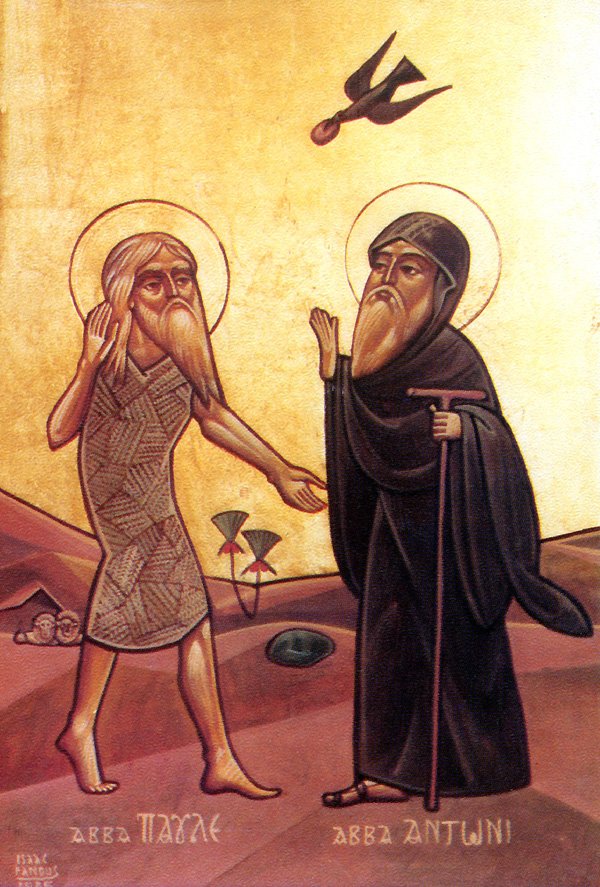
Paul the Simple
Saint Paul the Simple of Egypt also lived in the fourth century and was called the Simple for his simplicity of heart and gentleness. He had been married, but when he discovered his wife’s infidelity, he left her and went into the desert to Saint Anthony the Great (January 17). Paul was already 60 years old, and at first Saint Anthony would not accept Paul, saying that he was unfit for the harshness of the hermit’s life. Pau
Saint Paul the Simple of Egypt also lived in the fourth century and was called the Simple for his simplicity of heart and gentleness. He had been married, but when he discovered his wife’s infidelity, he left her and went into the desert to Saint Anthony the Great (January 17). Paul was already 60 years old, and at first Saint Anthony would not accept Paul, saying that he was unfit for the harshness of the hermit’s life. Paul stood outside the cell of the ascetic for three days, saying that he would sooner die than go from there. Then Saint Anthony took Paul into his cell, and tested his endurance and humility by hard work, severe fasting, with nightly vigils, constant singing of Psalms and prostrations. Finally, Saint Anthony decided to settle Paul into a separate cell.
During the many years of ascetic exploits the Lord granted Saint Paul both discernment, and the power to cast out demons. When they brought a possessed youth to Saint Anthony, he guided the afflicted one to Saint Paul saying, “I cannot help the boy, for I have not received power over the Prince of the demons. Paul the Simple, however, does have this gift.” Saint Paul expelled the demon by his simplicity and humility.
After living for many years, performing numerous miracles, he departed to the Lord. He is mentioned by Saint John, the Abbot of Sinai (Ladder 24:30): “The thrice-blessed Paul the Simple was a clear example for us, for he was the rule and type of blessed simplicity....”
Saint Paul is also commemorated on October 4.
Troparion - Tone 8
By a flood of tears you made the desert fertile, / and your longing for God brought forth fruits in abundance. / By the radiance of miracles you illumined the whole universe! / O our holy father Paul, pray to Christ our God to save our souls!
Scripture Readings
☩Epistle
1 Corinthians 8:8-9:2
8
But meat commendeth us not to God: for neither, if we eat, are we the better; neither, if we eat not, are we the worse.
9
But take heed lest by any means this liberty of yours become a stumblingblock to them that are weak.
10
For if any man see thee which hast knowledge sit at meat in the idol’s temple, shall not the conscience of him which is weak be emboldened to eat those things which are offered to idols;
11
And through thy knowledge shall the weak brother perish, for whom Christ died?
12
But when ye sin so against the brethren, and wound their weak conscience, ye sin against Christ.
13
Wherefore, if meat make my brother to offend, I will eat no flesh while the world standeth, lest I make my brother to offend.
1
Am I not an apostle? am I not free? have I not seen Jesus Christ our Lord? are not ye my work in the Lord?
2
If I be not an apostle unto others, yet doubtless I am to you: for the seal of mine apostleship are ye in the Lord.
☩Gospel
Matthew 25:31-46
31
When the Son of man shall come in his glory, and all the holy angels with him, then shall he sit upon the throne of his glory:
32
And before him shall be gathered all nations: and he shall separate them one from another, as a shepherd divideth his sheep from the goats:
33
And he shall set the sheep on his right hand, but the goats on the left.
34
Then shall the King say unto them on his right hand, Come, ye blessed of my Father, inherit the kingdom prepared for you from the foundation of the world:
35
For I was an hungred, and ye gave me meat: I was thirsty, and ye gave me drink: I was a stranger, and ye took me in:
36
Naked, and ye clothed me: I was sick, and ye visited me: I was in prison, and ye came unto me.
37
Then shall the righteous answer him, saying, Lord, when saw we thee an hungred, and fed thee? or thirsty, and gave thee drink?
38
When saw we thee a stranger, and took thee in? or naked, and clothed thee?
39
Or when saw we thee sick, or in prison, and came unto thee?
40
And the King shall answer and say unto them, Verily I say unto you, Inasmuch as ye have done it unto one of the least of these my brethren, ye have done it unto me.
41
Then shall he say also unto them on the left hand, Depart from me, ye cursed, into everlasting fire, prepared for the devil and his angels:
42
For I was an hungred, and ye gave me no meat: I was thirsty, and ye gave me no drink:
43
I was a stranger, and ye took me not in: naked, and ye clothed me not: sick, and in prison, and ye visited me not.
44
Then shall they also answer him, saying, Lord, when saw we thee an hungred, or athirst, or a stranger, or naked, or sick, or in prison, and did not minister unto thee?
45
Then shall he answer them, saying, Verily I say unto you, Inasmuch as ye did it not to one of the least of these, ye did it not to me.
46
And these shall go away into everlasting punishment: but the righteous into life eternal.
Liturgical data sourced from OCA.org and orthocal.info