
Fasting Rules
 Meat
Abstain
 Fish
Abstain
 Dairy
Abstain
 Oil
Allowed
 Wine
Allowed
Saints & Commemorations
St Gregory Palamas
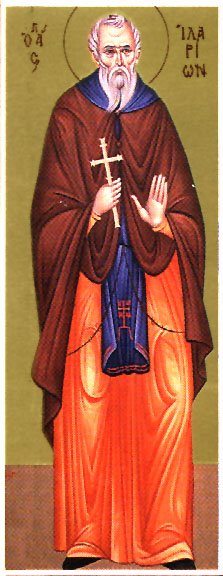
Ven. Hilarion the New
Saint Hilarion the New, Igumen of Pelekete Monastery, from his youth devoted himself to the service of God and spent many years as a hermit. Because of his holy and blameless life he was ordained to the holy priesthood, and later he was made igumen of the Pelekete monastery (near the Dardanelles). Saint Hilarion was granted gifts of clairvoyance and wonderworking by the Lord.
Saint Hilarion the New, Igumen of Pelekete Monastery, from his youth devoted himself to the service of God and spent many years as a hermit. Because of his holy and blameless life he was ordained to the holy priesthood, and later he was made igumen of the Pelekete monastery (near the Dardanelles). Saint Hilarion was granted gifts of clairvoyance and wonderworking by the Lord.
Through prayer he brought down rain during a drought, and like the Prophet Elisha he separated the waters of a river, he drove harmful beasts from the fields, he filled the nets of fishermen when they had no success in fishing, and he did many other miracles. In addition to these things, he was able to heal the sick and cast out demons.
Saint Hilarion suffered on Great and Holy Thursday in the year 754, when the military commander Lakhanodrakon suddenly descended upon the Pelekete monastery in pursuit of icon-venerators, boldly forcing his way into the church, disrupting the service and throwing the Holy Gifts upon the ground. Forty-two monks were arrested, slapped into chains, sent to the Edessa district and murdered. The remaining monks were horribly mutilated: they beat them, they burned their beards with fire, they smeared their faces with tar and cut off the noses of some of the confessors. Saint Hilarion died for the veneration of icons during this persecution.
Saint Hilarion left behind spiritual works containing moral directives for spiritual effort. Saint Joseph of Volokolamsk (September 9 and October 18) was well acquainted with the work of Saint Hilarion, and he also wrote about the significance of monastic struggles in his own theological works.
Troparion - Tone 5
Adorned with gladness of soul / as a pure vessel of the wisdom of Christ, / you were a reflection of the life in God. / Therefore you are resplendent with the light of virtues, / O Father Hilarion, / and you guide us unerringly to the salvation of our souls!
Kontakion - Tone 4
Righteous Hilarion, like a fruitful olive tree that has blossomed, / with your oil you mystically make radiant those who sing to you: / “Rejoice, unwavering rule of the righteous!”
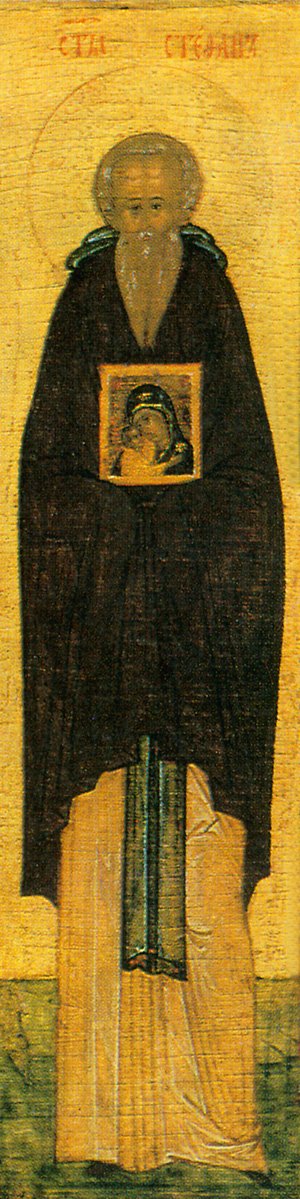
Stephen the Wonderworker
Saint Stephen the Confessor, Igumen of Triglia Monastery, suffered under the iconoclast emperor Leo the Armenian (813-820). From a young age, the holy ascetic dedicated his life to God and received monastic tonsure. He later became head of the Triglia monastery near Constantinople.
When persecution again began against holy icons, the saintly igumen was summoned for questioning, and they tried to force him to sign a document rejecting the veneration of icons.
Saint Stephen the Confessor, Igumen of Triglia Monastery, suffered under the iconoclast emperor Leo the Armenian (813-820). From a young age, the holy ascetic dedicated his life to God and received monastic tonsure. He later became head of the Triglia monastery near Constantinople.
When persecution again began against holy icons, the saintly igumen was summoned for questioning, and they tried to force him to sign a document rejecting the veneration of icons. Saint Stephen steadfastly refused to betray Orthodoxy and he boldly denounced the emperor for his impiety. They subjected the saint to cruel torments, after which they sent him to prison in the year 815. Weakened and sick, the holy Confessor Stephen soon died in prison from his sufferings.
Troparion - Tone 8
Champion of Orthodoxy, teacher of purity and of true worship, / the enlightener of the universe and the adornment of hierarchs: / all-wise father Stephen, your teachings have gleamed with light upon all things. / Intercede before Christ God to save our souls.
Repose of Gerontissa Gavrilia (1992) (March 15 OC)
Mother Gavrilia, who was known to many who are still alive, has not been officially glorified by the Church, but is considered by many to be a Saint of our time. Her fine biography, Ascetic of Love, has been translated into English and several other languages. The account below is excerpted from that on the web site of St Gregory Palamas Monastery.
Mother Gavrilia, who was known to many who are still alive, has not been officially glorified by the Church, but is considered by many to be a Saint of our time. Her fine biography, Ascetic of Love, has been translated into English and several other languages. The account below is excerpted from that on the web site of St Gregory Palamas Monastery.
“The Gerontissa Gabrielia was born in Constantinople a hundred years ago on October 2/15, 1897. She grew up in the City until her family moved to Thessalonika in 1923. She went to England in 1938 and stayed there throughout the Second World War. She trained as a chiropodist and physiotherapist. In 1945 she returned to Greece where she worked with the Friends Refugee Mission and the American Farm School in Thessalonika in early post-war years. Later she opened her own therapy office in Athens until 1954. In March of that year her mother died and the office was closed. Sister Lila left Greece and traveled overland to India where she worked with the poorest of the poor, even the lepers, for five years.
“It was not until 1959 that she went to the Monastery of Mary and Martha in Bethany, Palestine, to become a nun. When she arrived she asked Fr. Theodosius the chaplain for a rule of prayer. Fr. Theodosius was somewhat surprised to find that she could read even ancient Byzantine Greek. Fr. Theodosius said, “The great elders that we hear about no longer exist. I certainly am not one. You came here to save your soul. If I start giving you rules, you will lose you soul and I will as well. But here is Fr. John. He will be your elder.” So for her first year in the monastery he set her to reading only the Gospels and St. John Climacus. (It should be noted that at that time the Ladder had not been published in modern Greek.)
“She was three years in Bethany. In April, 1962, word came that Patriarch Athenagoras of Constantinople sought to send an Orthodox monastic to Taize in France. Sister Gabrielia went by way of Taize (she spoke fluent French from childhood) to America.
“In 1963 she was back in Greece. The Gerontissa was tonsured to the Small Schema by Abbot Amphilochios (Makris) on Patmos in the Cave of St. Anthony under the Monastery of Evangelismos just before she and the nun Tomasina left again for India. Elder Amphilochios was enthusiastic at the idea a nun who would be open to the an active outreach in the world. In India she was for three year in Nani Tal in Uttar Pradesh where Fr. Lazarus Moore was the priest and where he consulted the Gerontissa in his translations of the Psalter and the Fathers. Between 1967 and 1977 the Gerontissa traveled in the Mission field of East Africa, in Europe including visiting old friends and spiritual fathers Lev Gillet and Sophrony of Essex, again to America, and briefly in Sinai where Archbishop Damianos was attempting to reintroduce women’s monasticism. She traveled extensively, with much concern and broad love for the people of God. Some of her spiritual children found her in Jerusalem beside the Tomb of Christ; others found her on the mission field of East Africa. For years beginning in about 1977, she lived hidden in a little apartment, the “House of the Angels” in Patissia in the midst of the noise and smog and confusion of central Athens. A little place, a hidden place, a precious place to those who knew her there.
“In 1989 she moved to Holy Protection hermitage on the island of Aegina, close by the shrine of St. Nectarios. There she called the last two of her spiritual children to become monastics near her, and there she continued to receive many visitors. At the start of Great Lent in 1990 she was hospitalized for lymphatic cancer. She was forty days in the hospital, leaving during Holy Week and receiving communion of Pascha. And to the puzzlement of the doctors, the cancer disappeared. It was not yet her time.
“The Gerontissa finally withdrew to quiet. With only one last nun she moved for the last time in this life, to the island of Leros. There they established the hesychastirion of the Holy Archangels. Only in this last year of her life did she accept the Great Schema at the hands of Fr. Dionysious from Little St. Anne’s Skete on Athos. He came to give her the Schema in the Chapel of the Panaghia in the Kastro on the top of Leros.
“Gerontissa Gabrielia passed from this world on March 28, 1992, having never built a monastery. Over the years, six of her spiritual children did become monastics, but never more that one or two were with her at a time. Only the angels could count the number of lives that God touched and changed through her. Her biography and collected writings were published in Greek in 1996, through the work of her last monastic daughter and the contribution of many, many others who held the Gerontissa dear. An English translation is in process [Note: it has now been published].
“Anyone who knew the Gerontissa realized that God has not left us without His saints, even down to the present day. The few words recorded here scarcely suggest the clarity and love of her soul. Words are only the tools of this world; the wonder of the Gerontissa was wrapped in the mystery of the silence of the world to come.
“She never sought a reputation. She never allowed anything about her to be published during her long life and only allowed her children to take photographs in her very last years. Those whom God touched through her called her Gerontissa; she never made herself anything but the nun Gabrielia.
“She was humility and love incarnate.”
The Gerontissa embodied an ‘ecumenism’ that might serve as a model for many in our time: she was completely loving and open to all people of all faiths, yet while working freely with protestants and Hindus in service to man, she never compromised any aspect of her Orthodox faith. Once, some protestant fellow-workers suggested that they pray together; Mother Gavrilia thanked them lovingly, but said ‘I only pray in church or alone.’
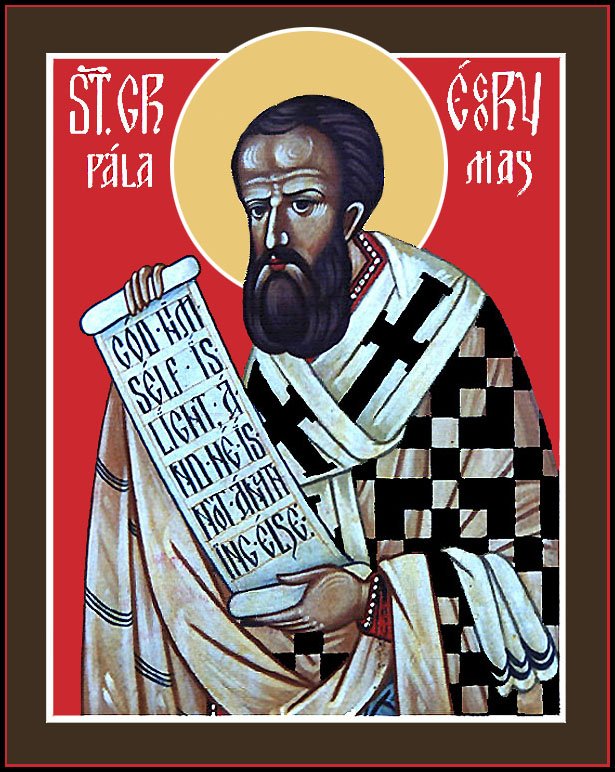
St Gregory Palamas, Archbishop of Thessalonica
This Sunday was originally dedicated to Saint Polycarp of Smyrna (February 23). After his glorification in 1368, a second commemoration of Saint Gregory Palamas (November 14) was appointed for the Second Sunday of Great Lent as a second “Triumph of Orthodoxy.”
Saint Gregory Palamas, Archbishop of Thessalonica, was born in the year 1296 in Constantinople. Sai
This Sunday was originally dedicated to Saint Polycarp of Smyrna (February 23). After his glorification in 1368, a second commemoration of Saint Gregory Palamas (November 14) was appointed for the Second Sunday of Great Lent as a second “Triumph of Orthodoxy.”
Saint Gregory Palamas, Archbishop of Thessalonica, was born in the year 1296 in Constantinople. Saint Gregory’s father became a prominent dignitiary at the court of Andronicus II Paleologos (1282-1328), but he soon died, and Andronicus himself took part in the raising and education of the fatherless boy. Endowed with fine abilities and great diligence, Gregory mastered all the subjects which then comprised the full course of medieval higher education. The emperor hoped that the youth would devote himself to government work. But Gregory, barely twenty years old, withdrew to Mount Athos in the year 1316 (other sources say 1318) and became a novice in the Vatopedi monastery under the guidance of the monastic Elder Saint Νikόdēmos of Vatopedi (July 11). There he was tonsured and began on the path of asceticism. A year later, the holy Evangelist John the Theologian appeared to him in a vision and promised him his spiritual protection. Gregory’s mother and sisters also became monastics.
After the demise of the Elder Νikόdēmos, Saint Gregory spent eight years of spiritual struggle under the guidance of the Elder Nikēphóros, and after the latter’s death, Gregory transferred to the Lavra of Saint Athanasius (July 5). Here he served in the trapeza, and then became a church singer. But after three years, he resettled in the small skete of Glossia, striving for a greater degree of spiritual perfection. The head of this monastery began to teach the young man the method of unceasing prayer and mental activity, which had been cultivated by monastics, beginning with the great desert ascetics of the fourth century: Evagrius Pontikos and Saint Macarius of Egypt (January 19).
Later on, in the eleventh century Saint Simeon the New Theologian (March 12) provided detailed instruction in mental activity for those praying in an outward manner, and the ascetics of Athos put it into practice. The experienced use of mental prayer (or prayer of the heart), requiring solitude and quiet, is called “Hesychasm” (from the Greek “hesychia” meaning calm, silence), and those practicing it were called “hesychasts.”
During his stay at Glossia the future hierarch Gregory became fully embued with the spirit of hesychasm and adopted it as an essential part of his life. In the year 1326, because of the threat of Turkish invasions, he and the brethren retreated to Thessalonica, where he was then ordained to the holy priesthood.
Saint Gregory combined his priestly duties with the life of a hermit. Five days of the week he spent in silence and prayer, and only on Saturday and Sunday did he come out to his people. He celebrated divine services and preached sermons. For those present in church, his teaching often evoked both tenderness and tears. Sometimes he visited theological gatherings of the city’s educated youth, headed by the future patriarch, Isidore. After he returned from a visit to Constantinople, he found a place suitable for solitary life near Thessalonica the region of Bereia. Soon he gathered here a small community of solitary monks and guided it for five years.
In 1331 the saint withdrew to Mt. Athos and lived in solitude at the skete of Saint Savva, near the Lavra of Saint Athanasius. In 1333 he was appointed Igumen of the Esphigmenou monastery in the northern part of the Holy Mountain. In 1336 the saint returned to the skete of Saint Savva, where he devoted himself to theological works, continuing with this until the end of his life.
In the 1330s events took place in the life of the Eastern Church which put Saint Gregory among the most significant universal apologists of Orthodoxy, and brought him great renown as a teacher of hesychasm.
About the year 1330 the learned monk Barlaam had arrived in Constantinople from Calabria, in Italy. He was the author of treatises on logic and astronomy, a skilled and sharp-witted orator, and he received a university chair in the capital city and began to expound on the works of Saint Dionysius the Areopagite (October 3), whose “apophatic” (“negative”, in contrast to “kataphatic” or “positive”) theology was acclaimed in equal measure in both the Eastern and the Western Churches. Soon Barlaam journeyed to Mt. Athos, where he became acquainted with the spiritual life of the hesychasts. Saying that it was impossible to know the essence of God, he declared mental prayer a heretical error. Journeying from Mount Athos to Thessalonica, and from there to Constantinople, and later again to Thessalonica, Barlaam entered into disputes with the monks and attempted to demonstrate the created, material nature of the light of Tabor (i.e. at the Transfiguration). He ridiculed the teachings of the monks about the methods of prayer and about the uncreated light seen by the hesychasts.
Saint Gregory, at the request of the Athonite monks, replied with verbal admonitions at first. But seeing the futility of such efforts, he put his theological arguments in writing. Thus appeared the “Triads in Defense of the Holy Hesychasts” (1338). Towards the year 1340 the Athonite ascetics, with the assistance of the saint, compiled a general response to the attacks of Barlaam, the so-called “Hagiorite Tome.” At the Constantinople Council of 1341 in the church of Hagia Sophia Saint Gregory Palamas debated with Barlaam, focusing upon the nature of the light of Mount Tabor. On May 27, 1341 the Council accepted the position of Saint Gregory Palamas, that God, unapproachable in His Essence, reveals Himself through His energies, which are directed towards the world and are able to be perceived, like the light of Tabor, but which are neither material nor created. The teachings of Barlaam were condemned as heresy, and he himself was anathemized and fled to Calabria.
But the dispute between the Palamites and the Barlaamites was far from over. To these latter belonged Barlaam’s disciple, the Bulgarian monk Akyndinos, and also Patriarch John XIV Kalekos (1341-1347); the emperor Andronicus III Paleologos (1328-1341) was also inclined toward their opinion. Akyndinos, whose name means “one who inflicts no harm,” actually caused great harm by his heretical teaching. Akyndinos wrote a series of tracts in which he declared Saint Gregory and the Athonite monks guilty of causing church disorders. The saint, in turn, wrote a detailed refutation of Akyndinos’ errors. The patriarch supported Akyndinos and called Saint Gregory the cause of all disorders and disturbances in the Church (1344) and had him locked up in prison for four years. In 1347, when John the XIV was replaced on the patriarchal throne by Isidore (1347-1349), Saint Gregory Palamas was set free and was made Archbishop of Thessalonica.
In 1351 the Council of Blachernae solemnly upheld the Orthodoxy of his teachings. But the people of Thessalonica did not immediately accept Saint Gregory, and he was compelled to live in various places. On one of his travels to Constantinople the Byzantine ship fell into the hands of the Turks. Even in captivity, Saint Gregory preached to Christian prisoners and even to his Moslem captors. The Hagarenes were astonished by the wisdom of his words. Some of the Moslems were unable to endure this, so they beat him and would have killed him if they had not expected to obtain a large ransom for him. A year later, Saint Gregory was ransomed and returned to Thessalonica.
Saint Gregory performed many miracles in the three years before his death, healing those afflicted with illness. On the eve of his repose, Saint John Chrysostom appeared to him in a vision. With the words “To the heights! To the heights!” Saint Gregory Palamas fell asleep in the Lord on November 14, 1359. In 1368 he was canonized at a Constantinople Council under Patriarch Philotheus (1354-1355, 1364-1376), who compiled the Life and Services to the saint.
Troparion - Tone 8
O luminary of Orthodoxy, support and teacher of the Church, / ideal of monks and invincible
champion of theologians, / O wonderworker Gregory, boast of Thessalonika and herald of grace, /
always intercede for all of us that our souls may be saved.
Kontakion - Tone 4
Now is the time for action! / Judgment is at the doors! / So let us rise and fast, / offering alms with tears of compunction and crying: / “Our sins are more numerous than the sands of the sea; / but forgive us, O Master of All, / so that we may receive the incorruptible crowns.”
Scripture Readings
☩Epistle
Hebrews 1:10-2:3
10
And, Thou, Lord, in the beginning hast laid the foundation of the earth; and the heavens are the works of thine hands:
11
They shall perish; but thou remainest; and they all shall wax old as doth a garment;
12
And as a vesture shalt thou fold them up, and they shall be changed: but thou art the same, and thy years shall not fail.
13
But to which of the angels said he at any time, Sit on my right hand, until I make thine enemies thy footstool?
14
Are they not all ministering spirits, sent forth to minister for them who shall be heirs of salvation?
1
Therefore we ought to give the more earnest heed to the things which we have heard, lest at any time we should let them slip.
2
For if the word spoken by angels was stedfast, and every transgression and disobedience received a just recompence of reward;
3
How shall we escape, if we neglect so great salvation; which at the first began to be spoken by the Lord, and was confirmed unto us by them that heard him;
☩Gospel
Mark 2:1-12
1
And again he entered into Capernaum after some days; and it was noised that he was in the house.
2
And straightway many were gathered together, insomuch that there was no room to receive them, no, not so much as about the door: and he preached the word unto them.
3
And they come unto him, bringing one sick of the palsy, which was borne of four.
4
And when they could not come nigh unto him for the press, they uncovered the roof where he was: and when they had broken it up, they let down the bed wherein the sick of the palsy lay.
5
When Jesus saw their faith, he said unto the sick of the palsy, Son, thy sins be forgiven thee.
6
But there were certain of the scribes sitting there, and reasoning in their hearts,
7
Why doth this man thus speak blasphemies? who can forgive sins but God only?
8
And immediately when Jesus perceived in his spirit that they so reasoned within themselves, he said unto them, Why reason ye these things in your hearts?
9
Whether is it easier to say to the sick of the palsy, Thy sins be forgiven thee; or to say, Arise, and take up thy bed, and walk?
10
But that ye may know that the Son of man hath power on earth to forgive sins, (he saith to the sick of the palsy,)
11
I say unto thee, Arise, and take up thy bed, and go thy way into thine house.
12
And immediately he arose, took up the bed, and went forth before them all; insomuch that they were all amazed, and glorified God, saying, We never saw it on this fashion.
Liturgical data sourced from OCA.org and orthocal.info