
Fasting Rules
 Meat
Abstain
 Fish
Abstain
 Dairy
Abstain
 Oil
Abstain
 Wine
Abstain
Saints & Commemorations
Hieromartyr Mark, Bishop of Anthusa
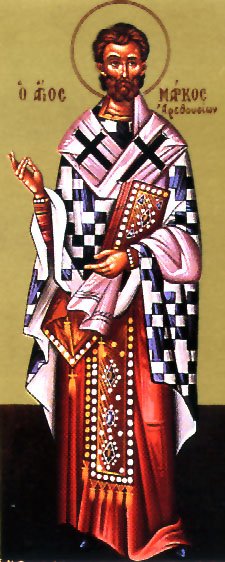
Hieromartyr Mark, Bishop of Arethusa
Hieromartyr Mark, Bishop of Arethusa, suffered for his faith in Christ under the emperor Julian the Apostate (361-363). By order of the emperor Constantine (May 21), Saint Mark had once destroyed a pagan temple and built a Christian church.
When Julian came to the throne, he persecuted Christians and tried to restore paganism.
Hieromartyr Mark, Bishop of Arethusa, suffered for his faith in Christ under the emperor Julian the Apostate (361-363). By order of the emperor Constantine (May 21), Saint Mark had once destroyed a pagan temple and built a Christian church.
When Julian came to the throne, he persecuted Christians and tried to restore paganism. Some citizens of Arethusa renounced Christianity and became pagans. Then Saint Mark’s enemies decided to take revenge on him. The old bishop hid himself from the persecutors at first, but then gave himself up when he learned that the pagans had tortured many people in their search for him.
The holy Elder was led through the city and given over to torture. They tore out his hair, slashed his body, dragged him along the street, dumped him in a swamp, tied him up, and cut him with knives.
The pagans demanded that the holy bishop pay them a large sum of money to rebuild the pagan temple, and he refused to do so. The persecutors invented several new torments: they squeezed the Elder in a foot-press, and they cut off his ears with linen cords. Finally, they smeared the holy martyr’s body with honey and grease, then hung him up in a basket in the hot mid-day sun to be eaten by bees, wasps, and hornets. Saint Mark did not seem to notice the pain, and this irritated the tormentor all the more.
The pagans kept lowering the price he had to pay for their temple, but Saint Mark refused to give them a single coin. Admiring him for his courage and endurance, the pagans stopped asking him for money and set him free. Many of them returned to Christ after hearing his talks.
Saint Gregory the Theologian (January 25) describes the sufferings of Saint Mark in his First Oration against Julian. Theodoritus of Cyrrhus also mentions him in his Church History (Book 3, Ch. 6)
Troparion - Tone 3
In preparation for the contest, you anointed an assembly of martyrs / and bolstered them by your steadfastness, O glorious Mark. / You finished your course together with them / and all of you were found worthy of the joy of heaven. / Righteous father, entreat Christ our God to grant us His great mercy.(The Typikon does not prescribe a Kontakion.)
Kontakion
(The Typikon does not prescribe a Kontakion.)
Our Holy Father John the Hermit (4th c.)
“He was the son of Juliana, a Christian woman of Armenia. While still a child, he left his mother and ran off to the desert. He was utterly aflame with love for Christ the Lord. In the beginning he entrusted himself to the guidance of a spiritual father, Pharmutius, who was so pleasing to God that an angel brought him bread every day. J
“He was the son of Juliana, a Christian woman of Armenia. While still a child, he left his mother and ran off to the desert. He was utterly aflame with love for Christ the Lord. In the beginning he entrusted himself to the guidance of a spiritual father, Pharmutius, who was so pleasing to God that an angel brought him bread every day. John later left him and withdrew into solitude. He let himself down into a dry well and lived there for a full ten years in fasting, prayer and vigils. St Pharmutius used to bring him some of the angel’s bread, for the angel of God did not wish to bring bread to the young John in person, lest he grow proud through this, so sent it through Pharmutius his spiritual father. After ten years of arduous asceticism in his well, St John went to the Lord and his relics revealed wonderworking power. He lived and was glorified by God and men in the 4th century.” (Prologue)
Eustathios the Confessor, Bishop of Bithynia
Saint Eustathius the Confessor, Bishop of Bithynia, was already at the beginning of his spiritual struggle a pious monk, meek and wise, filled with great faith and love for his neighbor. For his virtuous life he was made bishop of the city of Bithynia (a Roman province in northwest Asia Minor) and for many years he guided his flock, giving them an example of virtuous life and perfection.
Saint Eustathius the Confessor, Bishop of Bithynia, was already at the beginning of his spiritual struggle a pious monk, meek and wise, filled with great faith and love for his neighbor. For his virtuous life he was made bishop of the city of Bithynia (a Roman province in northwest Asia Minor) and for many years he guided his flock, giving them an example of virtuous life and perfection.
During the Iconoclast heresy, Saint Eustathius boldly came out against the heretics and defended the veneration of holy icons. Iconoclasts denounced him to the emperor, and the saint suffered imprisonment and fierce beatings. Finally, they deprived Saint Eustathius of his See and sent him to prison.
The holy confessor died in exile during the ninth century, after suffering insults, deprivation, hunger, and want for three years.
Troparion - Tone 8
Champion of Orthodoxy, teacher of purity and of true worship, / the enlightener of the universe and the adornment of hierarchs: / all-wise father Eustathius, your teachings have gleamed with light upon all things. / Intercede before Christ God to save our souls.
Scripture Readings
View scripture readings for this date on OCA.org.
View readings on OCA.orgLiturgical data sourced from OCA.org and orthocal.info